
Do Guardian Angels Exist? What The Urantia Book Actually Says
The teaching about guardian angels is one of the oldest comforts in religion, and one of the first things modern people file under superstition. The Urantia Book does neither. It says the angels are real, explains exactly who gets a personal guardian and when, and describes what your angel will and will not do.
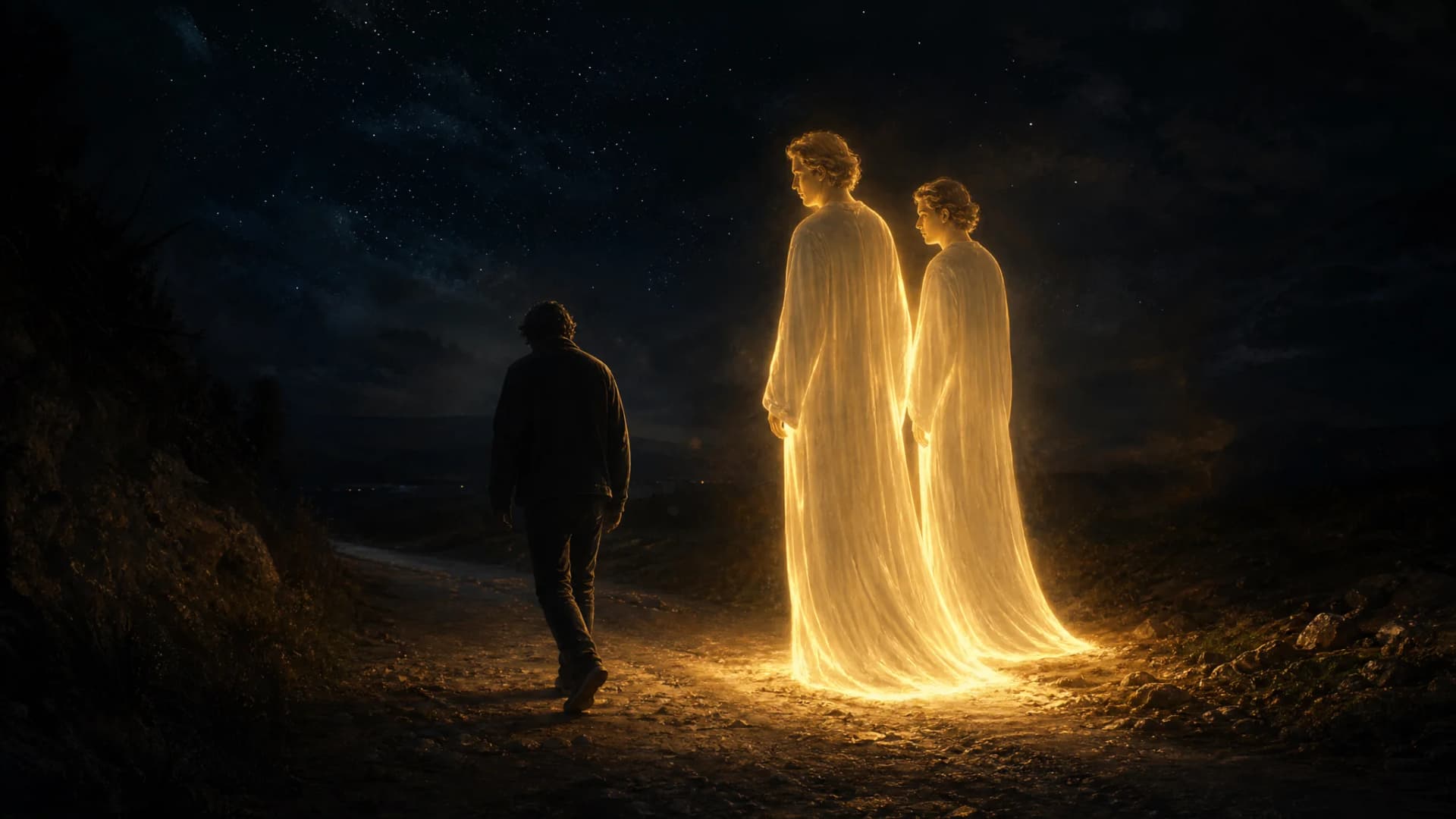
The Question Under the Question
Ask whether guardian angels exist and you are really asking three questions at once. Are there beings watching over us at all? If so, do I have one of my own? And what, exactly, do they do, since the world does not look especially guarded?
Most traditions answer the first question with folklore and go quiet on the other two. The Urantia Book does something almost unsettling instead. It treats angelic ministry as an ordinary fact of the universe, then answers all three questions with the specificity of an administrative manual: who is assigned, on what basis, in what numbers, and with what limits.
It opens the subject by settling the first question directly.
"The teaching about guardian angels is not a myth; certain groups of human beings do actually have personal angels. It was in recognition of this that Jesus, in speaking of the children of the heavenly kingdom, said: “Take heed that you despise not one of these little ones, for I say to you, their angels do always behold the presence of the spirit of my Father.”" (113:1.1)
Not a myth. But notice the careful phrasing that follows it: certain groups. The book's answer to "do I have a guardian angel" is more interesting than a simple yes, and more honest than the greeting-card version.
What an Angel Actually Is
Before asking who gets one, it helps to know what a seraphim is. The Urantia Book describes angels as a distinct order of beings, neither glorified humans nor vague forces.
"Angels do not have material bodies, but they are definite and discrete beings; they are of spirit nature and origin. Though invisible to mortals, they perceive you as you are in the flesh without the aid of transformers or translators; they intellectually understand the mode of mortal life, and they share all of man’s nonsensuous emotions and sentiments. They appreciate and greatly enjoy your efforts in music, art, and real humor. They are fully cognizant of your moral struggles and spiritual difficulties. They love human beings, and only good can result from your efforts to understand and love them." (38:2.1)
Jesus himself, in a conversation with the apostle Nathaniel recorded in Paper 167, drew the same line between angels and everything humans have confused them with.
"The angelic hosts are a separate order of created beings; they are entirely different from the material order of mortal creatures, and they function as a distinct group of universe intelligences. Angels are not of that group of creatures called ‘the Sons of God’ in the Scriptures; neither are they the glorified spirits of mortal men who have gone on to progress through the mansions on high. Angels are a direct creation, and they do not reproduce themselves. The angelic hosts have only a spiritual kinship with the human race. As man progresses in the journey to the Father in Paradise, he does traverse a state of being at one time analogous to the state of the angels, but mortal man never becomes an angel." (167:7.2)
So the beloved image of a departed grandmother earning her wings is, on this account, a category mistake. Angels are angels and humans are humans, on two different roads through the same universe. What the two orders share is kinship, affection, and, as we are about to see, an assignment.
Does Everyone Have One?
Here is where the Urantia Book departs from both the skeptics and the sentimentalists. Angelic care is universal. Personal guardians are earned.
The book describes seraphic ministry as organized by a person's spiritual progress through what it calls the psychic circles. The numbers are startlingly concrete: in the seventh and outermost circle, one guardian angel with one company of assisting cherubim watches over one thousand mortals; in the sixth circle, a seraphic pair with its company of cherubim guides groups of five hundred; in the fifth, companies of approximately one hundred; and in the fourth, groups of ten (113:1.7).
The threshold for a guardian of your own is the third circle.
"When a mortal mind breaks through the inertia of animal legacy and attains the third circle of human intellectuality and acquired spirituality, a personal angel (in reality two) will henceforth be wholly and exclusively devoted to this ascending mortal. And thus these human souls, in addition to the ever-present and increasingly efficient indwelling Thought Adjusters, receive the undivided assistance of these personal guardians of destiny in all their efforts to finish the third circle, traverse the second, and attain the first." (113:1.8)
The formal summary names three doorways, any one of which brings a personal pair.
"Seraphim are not known as guardians of destiny until such time as they are assigned to the association of a human soul who has realized one or more of three achievements: has made a supreme decision to become Godlike, has entered the third circle, or has been mustered into one of the reserve corps of destiny." (113:2.1)
And the assignment can be immediate. Speaking of those enrolled in the reserve corps and of the supreme decision itself, the book says:
"No matter in what circle a human happens to be, if such an individual becomes enrolled in any of the several reserve corps of destiny, right then and there, personal seraphim are assigned, and from that time until the earthly career is finished, that mortal will enjoy the continuous ministry and unceasing watchcare of a guardian angel. Also, when any human being makes the supreme decision, when there is a real betrothal with the Adjuster, a personal guardian is immediately assigned to that soul." (113:1.5)
The book even names the first human being ever to receive one.
"In the evolution of races a guardian of destiny is assigned to the very first being who attains the requisite circle of conquest. On Urantia the first mortal to secure a personal guardian was Rantowoc, a wise man of the red race of long ago." (113:2.2)
Two details in the fine print reward attention. First, your guardian is not a rookie. Assignments go only to volunteers, and only to the veterans among them: "Only seraphim of long service, the more experienced and tested types, are assigned as destiny guards" (113:2.3). Second, the personal angel is "in reality two" (113:1.8). Guardianship is a partnership, a pair working in alternation, which is why the book speaks of seraphic pairs throughout.
What Your Angel Will Not Do
If angels are real and assigned, why does life still hurt? Because of what a guardian is for. The Urantia Book is blunt about the limits, and the limits are principled, not budgetary.
"Angels do not invade the sanctity of the human mind; they do not manipulate the will of mortals; neither do they directly contact with the indwelling Adjusters. The guardian of destiny influences you in every possible manner consistent with the dignity of your personality; under no circumstances do these angels interfere with the free action of the human will. Neither angels nor any other order of universe personality have power or authority to curtail or abridge the prerogatives of human choosing." (113:5.1)
Your will is inviolate. The angel works with your choices, not instead of them.
"In the life of the flesh the intelligence of angels is not directly available to mortal men. They are not overlords or directors; they are simply guardians. The seraphim guard you; they do not seek directly to influence you; you must chart your own course, but these angels then act to make the best possible use of the course you have chosen. They do not (ordinarily) arbitrarily intervene in the routine affairs of human life. But when they receive instructions from their superiors to perform some unusual exploit, you may rest assured that these guardians will find some means of carrying out these mandates. They do not, therefore, intrude into the picture of human drama except in emergencies and then usually on the direct orders of their superiors. They are the beings who are going to follow you for many an age, and they are thus receiving an introduction to their future work and personality association." (113:5.4)
And a guardian's leading is not a comfort blanket.
"Seraphim function as teachers of men by guiding the footsteps of the human personality into paths of new and progressive experiences. To accept the guidance of a seraphim rarely means attaining a life of ease. In following this leading you are sure to encounter, and if you have the courage, to traverse, the rugged hills of moral choosing and spiritual progress." (113:4.3)
That is a very different promise from the one on the greeting cards. Not a smoother road. A better climb, with company that never quits.
The Guardian at the Hour of Death
The most consequential work of a guardian angel, on the Urantia Book's account, begins the moment your life ends. Jesus told Nathaniel:
"Also are these angels very much concerned with the means whereby man’s spirit is released from the tabernacles of the flesh and his soul escorted to the mansions in heaven. Angels are the sure and heavenly guides of the soul of man during that uncharted and indefinite period of time which intervenes between the death of the flesh and the new life in the spirit abodes." (167:7.6)
Paper 113 spells out what that escort actually carries.
"The guardian seraphim is the custodial trustee of the survival values of mortal man’s slumbering soul as the absent Adjuster is the identity of such an immortal universe being. When these two collaborate in the resurrection halls of mansonia in conjunction with the newly fabricated morontia form, there occurs the reassembly of the constituent factors of the personality of the mortal ascender." (113:6.5)
Your angel is the keeper of what makes you recognizably you, "the personal custodian of the mind patterns, memory formulas, and soul realities of the mortal survivor during that interval between physical death and morontia resurrection" (113:3.4). When you wake on the first mansion world, the being standing in the resurrection hall with your memories in trust is the same one who walked the last stretch of your life beside you.
Why the Angels Celebrate
One more scene belongs in this picture. When Jesus spoke of the joy in heaven over one sinner who repents, the Urantia Book says he was reporting fact, not sentiment.
"Many of these angels are engaged in the work of saving men, for have I not told you of the seraphic joy when one soul elects to forsake sin and begin the search for God? I did even tell you of the joy in the presence of the angels of heaven over one sinner who repents, thereby indicating the existence of other and higher orders of celestial beings who are likewise concerned in the spiritual welfare and with the divine progress of mortal man." (167:7.5)
So, do guardian angels exist? The Urantia Book's answer is yes, with a precision that turns comfort into invitation. The angels are real, the watchcare is universal, and the personal guardian is waiting on a decision that is entirely, untouchably yours.
Hear a study group take the next question, where the guardians escort you, in this conversation from the network:
Keep Asking
This article answers one question in a chain. Follow it onward:
- Do guardian angels exist? begins the chain
- Does everyone have a guardian angel?
- What happens when you die?
- Or walk the whole ladder of growth at the seven psychic circles
For the full journey your guardian is preparing you for, see the afterlife, step by step.
Connecting Articles



The Newsletter
Get the research behind each piece
Free. New Urantia Book explorations, the sources behind the videos, and early looks. No spam, unsubscribe anytime.
Prefer video? Follow on YouTube and Facebook.
Delivered through Substack. You can also read past issues.