
Heaven, Hell, and Devils: How Zoroastrianism Reshaped Jewish Theology
Pre-exilic Hebrew theology had minimal afterlife doctrine, no developed angelology, no cosmic adversary, and no final judgment. The post-exilic Jewish tradition acquired all of these. The Urantia Book identifies the specific source: Zoroastrian contact during the Babylonian captivity and the subsequent Persian period imported the full eschatological framework that would shape Jewish, Christian, and Islamic religious life for two millennia.
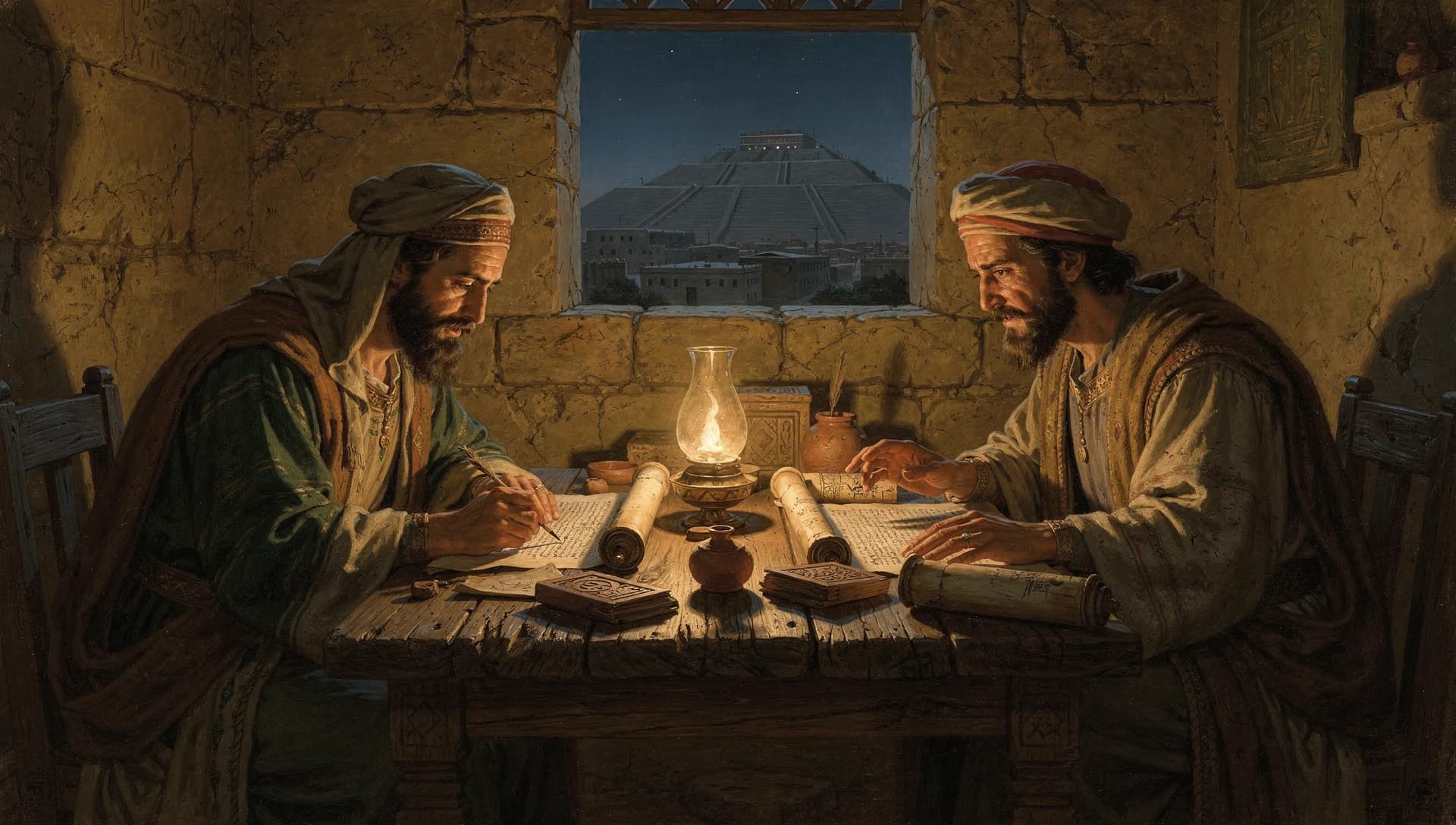
Zoroastrian influence on Jewish theology = Jewish heaven, hell, devils derived from Zoroastrianism
This article expands on the decoder mapping. For the side-by-side card and quick reference, see the mapping page.
The Theological Transformation Between Two Testaments
The theological distance between the Hebrew Bible and the New Testament is substantial. In pre-exilic Hebrew religion, the dead go to Sheol, a shadowy neutral realm where consciousness is diminished or absent. There is no developed heaven, no hell as place of torment, no final judgment, no cosmic adversary, no elaborate angelology, and no messianic eschatology in the form the New Testament assumes. By the first century CE, when the New Testament is composed, all of these theological features are central to Jewish (and emerging Christian) religious life.
The transformation occurred during and after the Babylonian captivity (586-539 BCE) and the subsequent Persian period (539 BCE through 332 BCE). The Hebrew exiles lived under Persian political and cultural dominance for two hundred years. During this period, Persian Zoroastrianism introduced theological concepts that did not exist in pre-exilic Hebrew religion and that became the defining features of post-exilic Judaism.
The Urantia Book identifies this transmission directly.
What the Urantia Book Says
The key passage is precise:
"The Jewish traditions of heaven and hell and the doctrine of devils as recorded in the Hebrew scriptures, while founded on the lingering traditions of Lucifer and Caligastia, were principally derived from the Zoroastrians during the times when the Jews were under the political and cultural dominance of the Persians. Zoroaster, like the Egyptians, taught the 'day of judgment,' but he connected this event with the end of the world." (UB 95:6.6)
Two claims are embedded in this passage. First, the underlying memory of heaven-hell-devils traces back to the actual Lucifer and Caligastia events (rebellion and planetary administrative failure). Second, the Jewish theological articulation of these concepts was inherited from Zoroastrianism during the Persian period rather than developed independently from the earlier Hebrew tradition.
The larger context places this inheritance within the Salem-transmission framework. Zoroaster's teaching (itself Salem-derived, per the companion Zoroaster article) passed into post-exilic Judaism, into Christianity, and into Islam, carrying theological content at each stage. The theological concepts that Christians and Muslims treat as fundamental to their traditions (heaven as eternal reward, hell as eternal punishment, angels and devils as distinct orders of beings, the final judgment, the messianic eschatology) are post-exilic in origin and Zoroastrian in derivation.
The Urantia Book's position is not that the inheritance was wholly distorting. The underlying reality (the rebellion, the planetary failure, the real cosmic-administrative situation) is real. The Zoroastrian articulation preserved real fragments of the reality (the day of judgment, the cosmic moral framework, the distinctions between good and evil beings). What the Zoroastrian framework added (symmetric dualism, eternal torment, elaborate demonology) is theological construction rather than revealed truth. The post-exilic Jewish and Christian inheritance preserved both the genuine content and the Zoroastrian constructions together.
What the Ancient Sources Say
The absence of developed afterlife doctrine in pre-exilic Hebrew religion is well-documented. James Barr's The Garden of Eden and the Hope of Immortality (Fortress, 1992) and Jon D. Levenson's Resurrection and the Restoration of Israel (Yale University Press, 2006) treat the question comprehensively. The pre-exilic Sheol is a shadowy neutral realm; the righteous and the wicked go to the same place; there is no doctrine of meaningful afterlife reward or punishment.
The transformation in the post-exilic period is documented across multiple textual strata:
First, the concept of bodily resurrection appears explicitly in Daniel 12:2 (second century BCE): "Many of those who sleep in the dust of the earth shall awake, some to everlasting life, and some to shame and everlasting contempt." This is unprecedented in earlier Hebrew material and closely parallels the Zoroastrian resurrection doctrine.
Second, the developed angelology appears in post-exilic literature. Pre-exilic Hebrew religion has messengers (malakim) who are functional deputies rather than a distinct celestial hierarchy. Post-exilic literature introduces named angels (Gabriel, Michael, Raphael, and others) with defined functions and hierarchical relationships. The angelological framework closely parallels Zoroastrian Amesha Spentas and Yazata hierarchies.
Third, the figure of Satan as cosmic adversary. Pre-exilic Hebrew ha-satan is a prosecutorial functional role in the heavenly court (Job 1-2, Zechariah 3). Post-exilic and intertestamental literature progressively develops Satan into a cosmic adversary figure paralleling Zoroastrian Angra Mainyu. Elaine Pagels's The Origin of Satan (Random House, 1995) traces this development.
Fourth, the final judgment and messianic eschatology. The detailed apocalyptic structure of 1 Enoch, 4 Ezra, 2 Baruch, and the related intertestamental literature has specific Zoroastrian parallels. John J. Collins's The Apocalyptic Imagination (Eerdmans, 2016) documents the Zoroastrian-Jewish apocalyptic parallels extensively.
The scholarly consensus on Zoroastrian influence on post-exilic Judaism has evolved across the twentieth century. Early Zoroastrian-influence hypotheses (particularly in the work of R. C. Zaehner, The Dawn and Twilight of Zoroastrianism, 1961) were challenged in the 1980s by skeptics (Norman Cohn, Cosmos, Chaos and the World to Come, Yale University Press, 1993) who argued for internal Jewish development. The current consensus accepts substantial Zoroastrian influence while recognizing that the Jewish tradition actively reshaped the inherited material rather than passively absorbing it.
The Urantia Book's claim is that the Jewish post-exilic theological development is principally derived from Zoroastrianism, consistent with the Zaehner-school analysis rather than the maximalist internal-development position. The underlying UB framework (Lucifer rebellion as real event, Zoroaster as Salem transmitter, Jewish post-exilic inheritance as downstream of this chain) integrates the academic observations within a causal framework.
Why This Mapping Matters
The Christian and Islamic traditions that shaped Western and Near Eastern religious history inherited their eschatological framework from post-exilic Judaism. The specific concepts of heaven, hell, final judgment, resurrection, angels, devils, and messianic expectation are not Christian innovations; they are the Christian inheritance from post-exilic Jewish theology, which was itself the Jewish inheritance from Zoroastrian contact during the Persian period.
This has significant interpretive consequences for how Christians and Muslims read their own traditions. The theological framework that structures Christian and Islamic religious imagination is post-exilic in origin. It did not exist in pre-exilic Hebrew religion, in the religious environment of the patriarchs, or in the earliest strata of Israelite tradition. The framework that appears to Christians and Muslims as simply "how things are" is actually a historical development traceable to Zoroastrian contact in the sixth through fourth centuries BCE.
The mapping's significance is that it identifies this specific historical origin. The Christian doctrine of hell is not Jesus's teaching unchanged; it is a theological development that Jesus inherited, reformed in some respects, but did not invent. The Islamic doctrine of the Day of Judgment is not Muhammad's revelation sui generis; it is the Islamic preservation of a theological framework that had been shaped in the Jewish tradition through Zoroastrian inheritance.
The Urantia Book's framework allows reading this complex inheritance with appropriate discernment. The underlying cosmic reality (the rebellion, the planetary situation, the pending adjudication) is real. The theological articulation of this reality in the Zoroastrian-Jewish-Christian-Islamic tradition preserves genuine fragments while adding constructions in the Zoroastrian style. Recognizing which features of the inherited framework are genuinely revealed content and which are Zoroastrian theological constructions is a significant interpretive task.
The practical consequence is that Christian and Muslim readers should hold their inherited eschatological framework with awareness of its historical origin. The framework is valuable and largely reliable as a theological structure, but some features (the symmetric cosmic dualism, the eternal torment framing, the elaborate demonology) are Zoroastrian additions that the Urantia revelation substantially corrects. Reading the inherited tradition alongside the Urantia framework allows distinguishing the preserved core from the Zoroastrian constructions.
Sources
- The Urantia Book, Paper 95 (The Melchizedek Teachings in the Levant). Urantia Foundation, first printing 1955. Cited passage: 95:6.6.
- Barr, James. The Garden of Eden and the Hope of Immortality. Fortress Press, 1992.
- Levenson, Jon D. Resurrection and the Restoration of Israel: The Ultimate Victory of the God of Life. Yale University Press, 2006.
- Collins, John J. The Apocalyptic Imagination: An Introduction to Jewish Apocalyptic Literature. Third edition, Eerdmans, 2016.
- Pagels, Elaine. The Origin of Satan. Random House, 1995.
- Zaehner, R. C. The Dawn and Twilight of Zoroastrianism. Weidenfeld & Nicolson, 1961.
- Cohn, Norman. Cosmos, Chaos and the World to Come: The Ancient Roots of Apocalyptic Faith. Yale University Press, 1993; revised 2001.
- Boyce, Mary. Zoroastrians: Their Religious Beliefs and Practices. Second edition, Routledge, 2001.
- Hultgård, Anders. "Persian Apocalypticism," in The Encyclopedia of Apocalypticism, Volume 1, Continuum, 1998.
Confidence and Evidence
- Confidence: UB CONFIRMED
- Evidence rating: STRONG
- Basis: The Urantia Book directly attributes Jewish post-exilic theology of heaven-hell-devils to Zoroastrian transmission in Paper 95:6.6. The academic documentation of the pre-exilic absence of these features and their post-exilic appearance is extensive. The Zoroastrian-Jewish parallels are specifically documented in bodily resurrection, angelology, Satan figure, and apocalyptic eschatology. The scholarly Zaehner-school analysis of substantial Zoroastrian influence is compatible with the Urantia account.
Related Decoder Articles
- Lucifer Rebellion = Zoroastrian Dualism
- Hebrew Scribal Revision During Babylonian Captivity
- Not One Devil, Six Rebels: The Theological Confusion
By Derek Samaras
Connecting Articles
The Final Adjudication: Ragnarok and the Pending Verdict
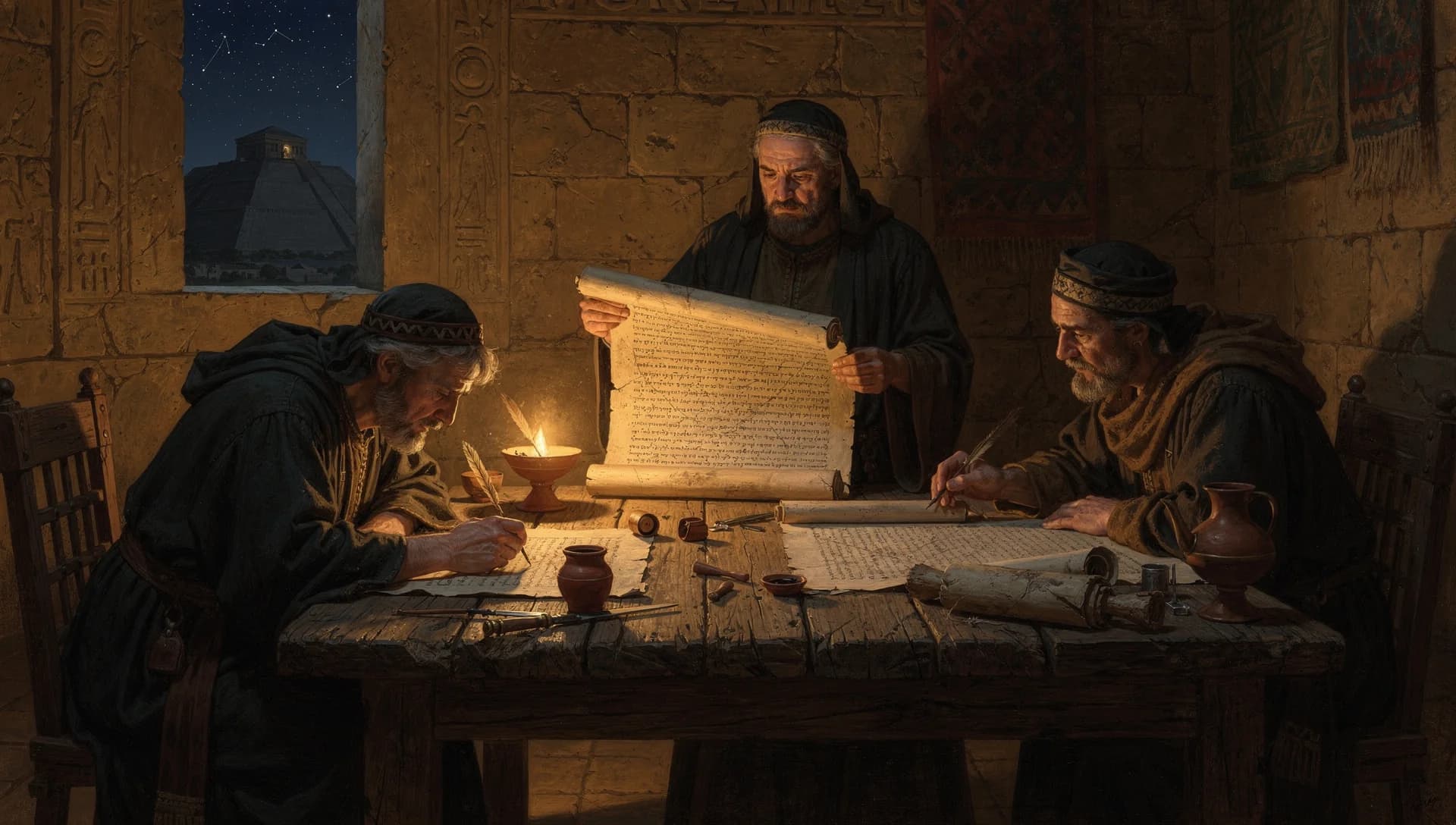
The Captivity Rewrite: Hebrew Scribal Revision in Babylon
The Priest Who Had No Father: Machiventa Melchizedek and the Genesis Fragment

Three Noahs, One Story: The Composite Noah of Genesis
The Newsletter
Get the research behind each piece
Free. New Urantia Book explorations, the sources behind the videos, and early looks. No spam, unsubscribe anytime.
Prefer video? Follow on YouTube and Facebook.
Delivered through Substack. You can also read past issues.