
The One Truth Tradition: Singlangton and the Roots of the Tao
Before Lao-tse, before Confucius, a hundred thousand years before either, the yellow race of East Asia was taught by a spiritual leader the Urantia Book names Singlangton. His doctrine of the One Truth became the substrate from which the entire later Chinese religious tradition grew, and its residue is traceable in the Tao of classical Chinese philosophy.
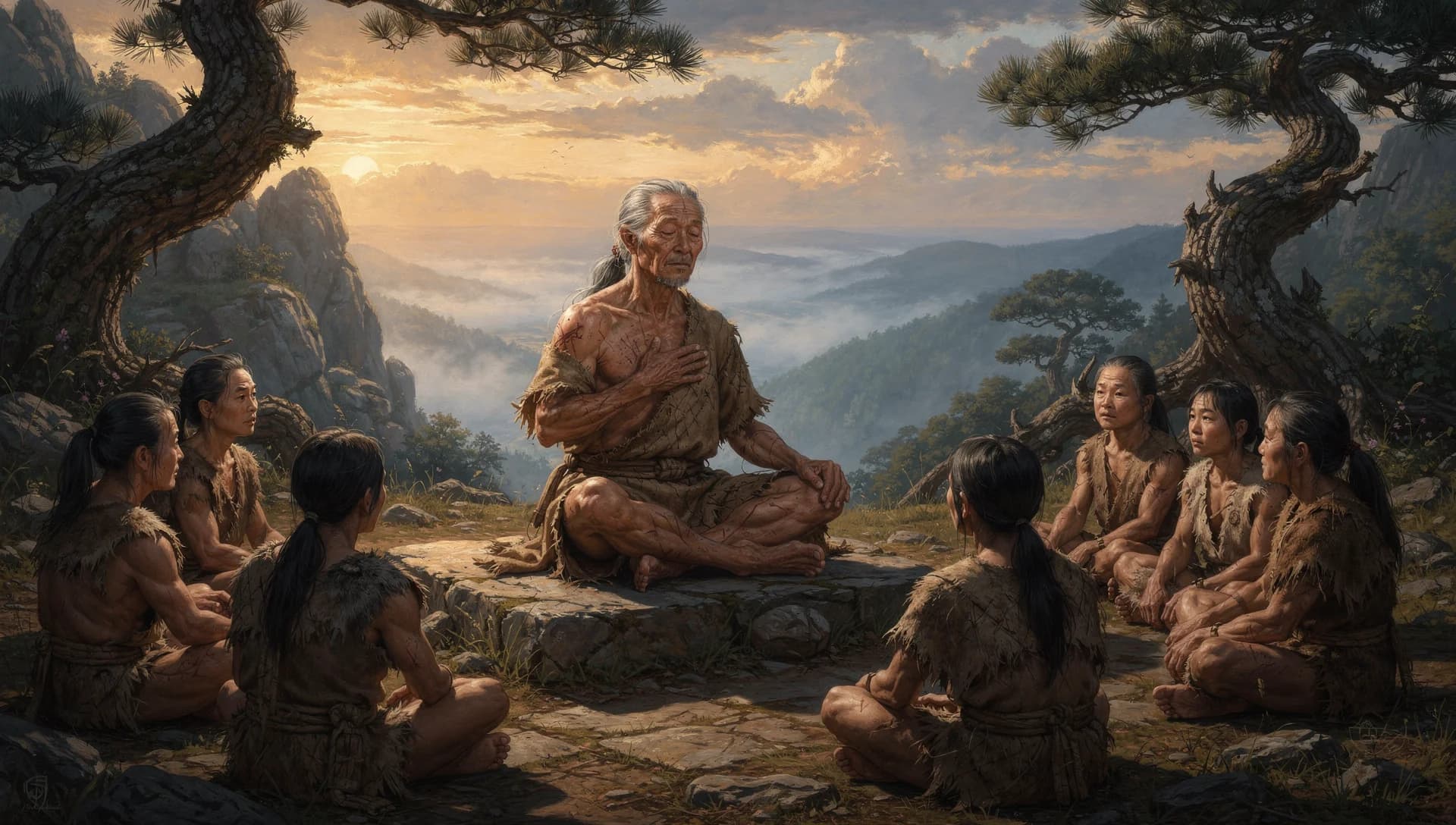
Singlangton, yellow race spiritual leader (~100,000 BC) = "One Truth" tradition → Tao / the Way
This article expands on the decoder mapping. For the side-by-side card and quick reference, see the mapping page.
The Teacher a Hundred Thousand Years Ahead of His Time
Before Moses, before Melchizedek, before the Sumerian kings of the first dynasty of Kish, before writing itself, the yellow race of East Asia was taught by a spiritual leader whose name the Urantia Book preserves as Singlangton. He lived approximately a hundred thousand years before the twentieth century. What he taught, and what his teaching produced as it propagated through the subsequent millennia, is the underlying substrate of classical Chinese religious civilization.
The claim is specific and chronologically ambitious. Most comparative religious scholarship places the distinctive development of Chinese religious consciousness in the Shang-Zhou period of the second and first millennia BCE. The Urantia Book places the originating event a hundred thousand years earlier and names a specific individual as its author (UB 64:6.15). The claim is testable, in the limited way that such claims can be tested, against the observable features of Chinese religious consciousness as it emerged into literate history.
What the Urantia Book Says
The Urantia Book credits the early Chinese with an unusually advanced religious orientation that it attributes directly to Singlangton's influence:
"The lingering teachings of Singlangton, which persisted in the concept of Shang-ti, the God of Heaven. In the times of Singlangton the Chinese people became virtually monotheistic; they concentrated their worship on the One Truth, later known as the Spirit of Heaven, the universe ruler. And the yellow race never fully lost this early concept of Deity, although in subsequent centuries many subordinate gods and spirits insidiously crept into their religion." (UB 94:5.3)
The structural claim is precise. First, Singlangton produced a virtual monotheism in his time. Second, the monotheism was organized around the concept of "One Truth." Third, the concept became known as the Spirit of Heaven and as Shang-ti. Fourth, the yellow race never lost the concept, even through subsequent absorptions of secondary deities and spirits.
The long persistence of the tradition is treated as a distinctive feature of Chinese civilization:
"During the age of Andite migrations the Chinese were among the more spiritual peoples of earth. Long adherence to the worship of the One Truth proclaimed by Singlangton kept them ahead of most of the other races. The stimulus of a progressive and advanced religion is often a decisive factor in cultural development; as India languished, so China forged ahead under the invigorating stimulus of a religion in which truth was enshrined as the supreme Deity." (UB 79:6.10)
"This worship of truth was provocative of research and fearless exploration of the laws of nature and the potentials of mankind. The Chinese of even six thousand years ago were still keen students and aggressive in their pursuit of truth." (UB 79:6.11)
The Tao concept, as it later emerges in the Lao-tse school, is placed by the Urantia Book in direct lineal descent from the Singlangton tradition. The path runs from the original Singlangton teaching of the One Truth, through the persistent Chinese veneration of Shang-ti as the Spirit of Heaven, through the Salem missionary reinforcement of the sixth century BCE, into the classical Taoist formulation:
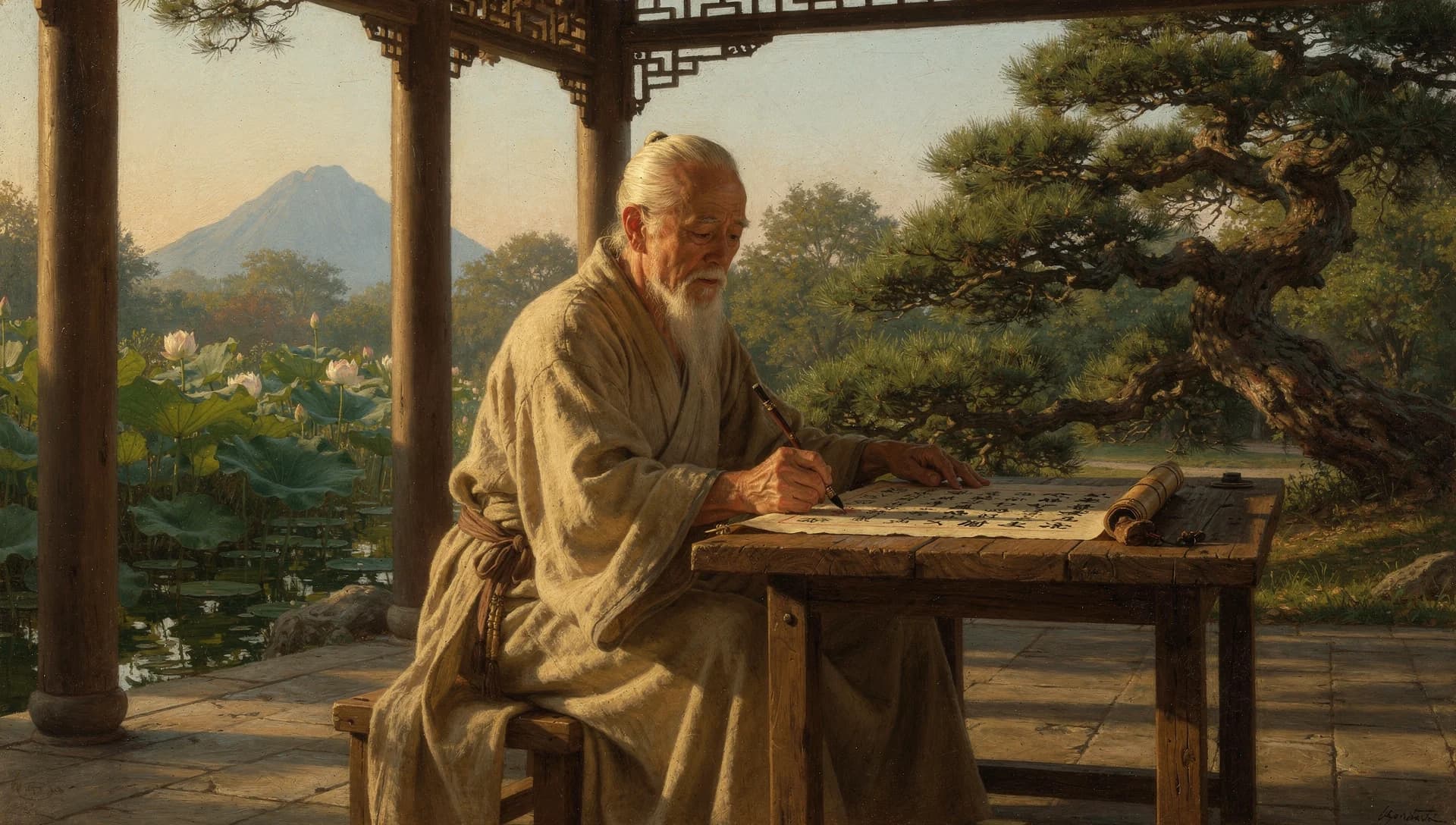
"Lao-tse built directly upon the concepts of the Salem traditions when he declared Tao to be the One First Cause of all creation. Lao was a man of great spiritual vision. He taught that man's eternal destiny was 'everlasting union with Tao, Supreme God and Universal King.' His comprehension of ultimate causation was most discerning, for he wrote: 'Unity arises out of the Absolute Tao, and from Unity there appears cosmic Duality, and from such Duality, Trinity springs forth into existence, and Trinity is the primal source of all reality.'" (UB 94:6.3)
The genealogy the Urantia Book establishes is explicit. The Tao is not a spontaneous philosophical invention of Lao-tse. It is the Chinese-language reformulation of Salem monotheism, laid over a substrate of Singlangton-derived One Truth tradition that had already been in place for nearly a hundred thousand years when Lao-tse wrote.
What the Ancient Source Says
The Chinese religious tradition's earliest documentary stratum is the oracle bone inscriptions of the late Shang dynasty (c. 1200 BCE). David N. Keightley's Sources of Shang History: The Oracle-Bone Inscriptions of Bronze Age China (University of California Press, 1978) remains the principal modern treatment. The oracle bones record divinatory consultations addressed to Shang-ti (the Shang high god), to the ancestors, and to various nature deities. The Shang-ti concept the Urantia Book identifies as Singlangton-derived is present from the earliest literate stratum of Chinese religion.
Robert Eno's The Confucian Creation of Heaven: Philosophy and the Defense of Ritual Mastery (SUNY Press, 1990) traces the evolution of the Shang-ti concept into the Zhou-dynasty Tian (Heaven) concept. Sarah Allan's The Shape of the Turtle: Myth, Art, and Cosmos in Early China (SUNY Press, 1991) treats the cosmological structure. Both scholars note the distinctiveness of the Chinese high-god tradition: where most early Near Eastern religions developed toward articulated pantheons, Chinese religion preserved an orientation toward a single supreme deity even as it elaborated a rich array of secondary spirits.
The Tao concept's philosophical elaboration is the work of the Daode jing (c. fourth or third century BCE), attributed to Lao-tse, and the Zhuangzi, attributed to Zhuangzi (c. fourth century BCE). The standard modern editions include D. C. Lau's translation of the Daode jing (Penguin, 1963), Roger Ames and David Hall's Dao De Jing: A Philosophical Translation (Ballantine, 2003), and Burton Watson's The Complete Works of Zhuangzi (Columbia University Press, 2013). The Tao is consistently treated as the ultimate principle from which the cosmos derives, the source of all things, the pattern of right action, and the path of authentic existence. A. C. Graham's Disputers of the Tao: Philosophical Argument in Ancient China (Open Court, 1989) treats the philosophical development across multiple schools.
The etymology of Tao (道) is unusually close to the semantic field the Urantia Book's "One Truth" describes. The character's basic meaning is "way" or "path," but by the time of the classical Chinese philosophical texts it has expanded to mean "doctrine," "true principle," "ultimate reality." Whalen Lai's Handbook of Buddhism in China (University of Hawaii Press, 2001) documents how Chinese Buddhist translators used the Tao concept to render the Sanskrit dharma, further confirming its role as the generic Chinese concept for the way things really are.
The distinctive Chinese preservation of a high-god orientation across the full documentary span from Shang oracle bones through modern religious practice is one of the well-observed features of comparative Chinese religion. Julia Ching's Chinese Religions (Orbis, 1993) and Daniel L. Overmyer's Religions of China (HarperSanFrancisco, 1986) treat the phenomenon. The Chinese never developed a fully articulated polytheistic pantheon on the Mesopotamian or Greek model. The high-god concept, in forms ranging from Shang-ti through Tian through the Tao, persisted as the structural apex of the religious cosmology even when popular practice multiplied secondary deities below it.
Why This Mapping Matters
The question of why Chinese religious consciousness took the form it did has occupied sinologists since the nineteenth century. Several features distinguish it from parallel ancient traditions. First, the early and persistent high-god orientation without a fully elaborated polytheism. Second, the unusually stable continuity of core concepts (Shang-ti, Tian, Tao) across four thousand years of documentary history. Third, the absence of the mystery-cult corruption that affected Egyptian, Mesopotamian, and Mediterranean religions in the late antique period. Fourth, the Chinese philosophical tradition's distinctive orientation toward the true way of things (Tao) rather than toward specific divine personalities.
The Urantia Book's Singlangton attribution explains these features as consequences of an unusually early and successful religious reform. A proto-monotheistic teaching delivered to a demographically coherent population a hundred thousand years ago, propagated through a long period of relative cultural isolation protected by geographic barriers, and reinforced by successive waves of Salem missionary activity, would produce exactly the profile of Chinese religious consciousness that the documentary record preserves.
The Tao concept, on this account, is not a distinctively Chinese philosophical innovation. It is the Chinese-language name for a reality that Singlangton first named the One Truth, that the Shang dynasty named Shang-ti, that the Zhou dynasty named Tian, that Lao-tse named the Tao, and that the Urantia revelation names the Universal Father. The name changes; the referent does not.
The mapping's significance is that it places Chinese philosophical religion in the same revealed-substrate tradition that produced Hebrew monotheism, Salem missionary monotheism, and the broader Melchizedek-derived religious trajectory. The Chinese tradition is not an independent world-religious stream parallel to the Near Eastern one. It is the eastern branch of the same stream, fed by an earlier and initially more successful teaching (Singlangton's), sustained across a longer preservation period, and reinforced by the same Salem missionary activity that shaped the western traditions. The Tao and El Elyon are, on the Urantia account, names for the same reality.
Sources
- The Urantia Book, Paper 45 (The Seven Adjutant Mind-Spirits), Paper 64 (The Evolutionary Races of Color), Paper 79 (Andite Expansion in the Orient), Paper 94 (The Melchizedek Teachings in the Orient). Urantia Foundation, first printing 1955. Cited passages: 79:6.10, 79:6.11, 94:5.3, 94:6.3.
- Keightley, David N. Sources of Shang History: The Oracle-Bone Inscriptions of Bronze Age China. University of California Press, 1978.
- Allan, Sarah. The Shape of the Turtle: Myth, Art, and Cosmos in Early China. State University of New York Press, 1991.
- Eno, Robert. The Confucian Creation of Heaven: Philosophy and the Defense of Ritual Mastery. State University of New York Press, 1990.
- Graham, A. C. Disputers of the Tao: Philosophical Argument in Ancient China. Open Court, 1989.
- Lau, D. C., translator. Tao Te Ching. Penguin Classics, 1963.
- Ames, Roger T. and David L. Hall, translators. Dao De Jing: A Philosophical Translation. Ballantine, 2003.
- Ching, Julia. Chinese Religions. Orbis Books, 1993.
- Overmyer, Daniel L. Religions of China: The World as a Living System. HarperSanFrancisco, 1986.
Confidence and Evidence
- Confidence: UB CONFIRMED
- Evidence rating: MODERATE to STRONG
- Basis: The Urantia Book attributes Chinese high-god religious consciousness to Singlangton directly and traces the lineage Shang-ti → Tian → Tao → Salem reinforcement. The distinctive features of Chinese religious history (early high-god orientation, absence of elaborated polytheism, long documentary continuity of core concepts) are exactly what the Singlangton-substrate hypothesis predicts.
Related Decoder Articles
- Salem Monotheism in Chinese Form = Lao-tse's Tao
- Returning Good for Evil = Lao-tse Anticipates Jesus
- Salem Missionaries' Purest European Teaching = Cynics
By Derek Samaras
Connecting Articles
The One First Cause: Salem Monotheism in Lao-tse's Tao
The Longest Memory: Australian Aboriginal Dreamtime and the Primordial Teaching-Ancestors
The Final Adjudication: Ragnarok and the Pending Verdict
We Come From One: African First-Family Traditions and the Sangik Origin
The Newsletter
Get the research behind each piece
Free. New Urantia Book explorations, the sources behind the videos, and early looks. No spam, unsubscribe anytime.
Prefer video? Follow on YouTube and Facebook.
Delivered through Substack. You can also read past issues.