
The Cult That Almost Became Christianity: Mithras and Corrupted Zoroastrianism
In the Roman Empire of the first three centuries CE, the dominant non-Jewish religious movement was not Christianity. It was Mithraism, a mystery cult with a December 25 festival, a sacramental meal, seven initiation orders, and a hero-savior god. The Urantia Book identifies the specific corruption path: original Zoroastrianism, reformed by priestly opposition, reworked into a mystery cult that carried Zoroastrian content into the pre-Christian Mediterranean.
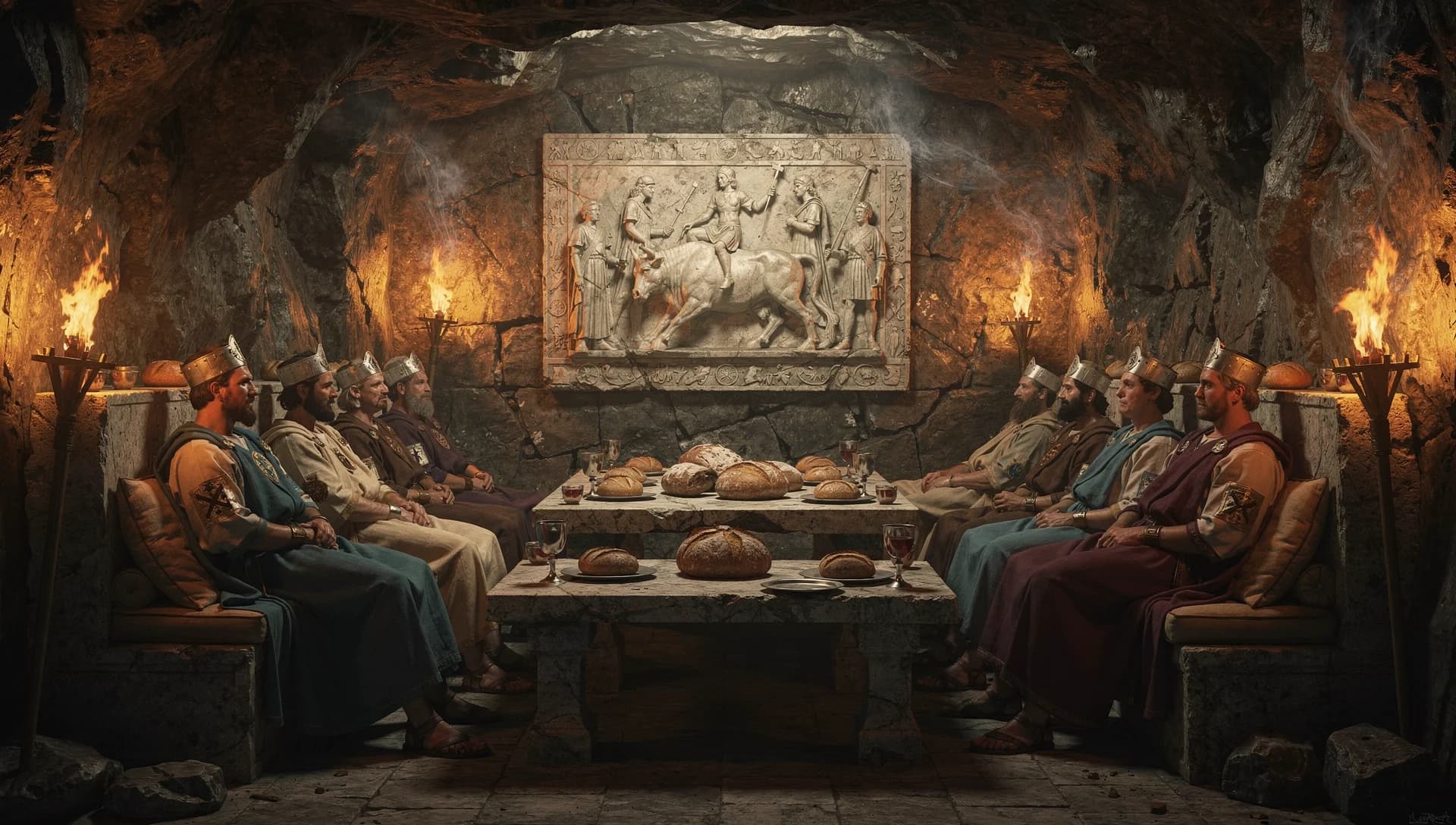
Corrupted Zoroastrianism in Rome = Mithras, mystery cult with December 25th festival
This article expands on the decoder mapping. For the side-by-side card and quick reference, see the mapping page.
The Cult That Shaped Christianity Without Becoming It
Mithraism was one of the most widely practiced religions in the first- through fourth-century Roman Empire. Temples to Mithras have been excavated from Hadrian's Wall in northern Britain to Syria in the east, with particularly dense concentrations in the Roman military bases along the Rhine and Danube frontiers. The cult was practiced by Roman soldiers, imperial administrators, merchants, and eventually by emperors (Diocletian and his co-emperors consecrated a Mithraic temple in 307 CE). At its peak in the late second and third centuries, Mithraism was a serious competitor to Christianity for the religious allegiance of the Roman world.
The question of Mithraism's relationship to Christianity has generated substantial scholarly literature. The formal parallels (December 25 festival, sacramental meal, seven initiation orders, hero-savior god, communion with the divine through ritual) have been noted since Franz Cumont's nineteenth-century work and remain a topic of active research. The Urantia Book identifies the path of theological transmission.
What the Urantia Book Says
The Urantia Book names Mithraism's origin in reformed Zoroastrianism:
"Even the religion which succeeded Zoroastrianism in Persia was markedly influenced by it. When the Iranian priests sought to overthrow the teachings of Zoroaster, they resurrected the ancient worship of Mithra. And Mithraism spread throughout the Levant and Mediterranean regions, being for some time a contemporary of both Judaism and Christianity. The teachings of Zoroaster thus came successively to impress three great religions: Judaism and Christianity and, through them, Mohammedanism." (UB 95:6.7)
The mechanism of Mithraic transmission is described:
"The Phrygian and Egyptian mysteries eventually gave way before the greatest of all the mystery cults, the worship of Mithras. The Mithraic cult made its appeal to a wide range of human nature and gradually supplanted both of its predecessors. Mithraism spread over the Roman Empire through the propagandizing of Roman legions recruited in the Levant, where this religion was the vogue, for they carried this belief wherever they went." (UB 98:5.1)
"The cult of Mithras arose in Iran and long persisted in its homeland despite the militant opposition of the followers of Zoroaster. But by the time Mithraism reached Rome, it had become greatly improved by the absorption of many of Zoroaster's teachings. It was chiefly through the Mithraic cult that Zoroaster's religion exerted an influence upon later appearing Christianity." (UB 98:5.2)
The theological content of Roman Mithraism is described:
"The Mithraic cult portrayed a militant god taking origin in a great rock, engaging in valiant exploits, and causing water to gush forth from a rock struck with his arrows. There was a flood from which one man escaped in a specially built boat and a last supper which Mithras celebrated with the sun-god before he ascended into the heavens. This sun-god, or Sol Invictus, was a degeneration of the Ahura-Mazda deity concept of Zoroastrianism." (UB 98:5.3)
The cult's ritual structure is well-defined:
"The adherents of this cult worshiped in caves and other secret places, chanting hymns, mumbling magic, eating the flesh of the sacrificial animals, and drinking the blood. Three times a day they worshiped, with special weekly ceremonials on the day of the sun-god and with the most elaborate observance of all on the annual festival of Mithras, December twenty-fifth. It was believed that the partaking of the sacrament ensured eternal life, the immediate passing, after death, to the bosom of Mithras, there to tarry in bliss until the judgment day." (UB 98:5.4)
The Urantia Book's specific tracing therefore establishes: Zoroaster's reform → priestly opposition in Iran → revival of ancient Mithra worship as anti-Zoroastrian movement → incorporation of Zoroaster's teachings into the revived Mithraic tradition → spread through Roman military recruitment from the Levant → establishment as a major Mediterranean mystery religion → eventual influence on Christian theological development.
What the Ancient Sources Say
Mithraism is one of the best documented ancient religions in the archaeological record. Franz Cumont's Textes et Monuments Figurés Relatifs aux Mystères de Mithra (1896-1899) remains the foundational scholarly compendium. Manfred Clauss's The Roman Cult of Mithras (Routledge, 2000) provides the definitive modern treatment. Roger Beck's The Religion of the Mithras Cult in the Roman Empire (Oxford University Press, 2006) treats the theological structure in depth.
The principal features of Roman Mithraism include:
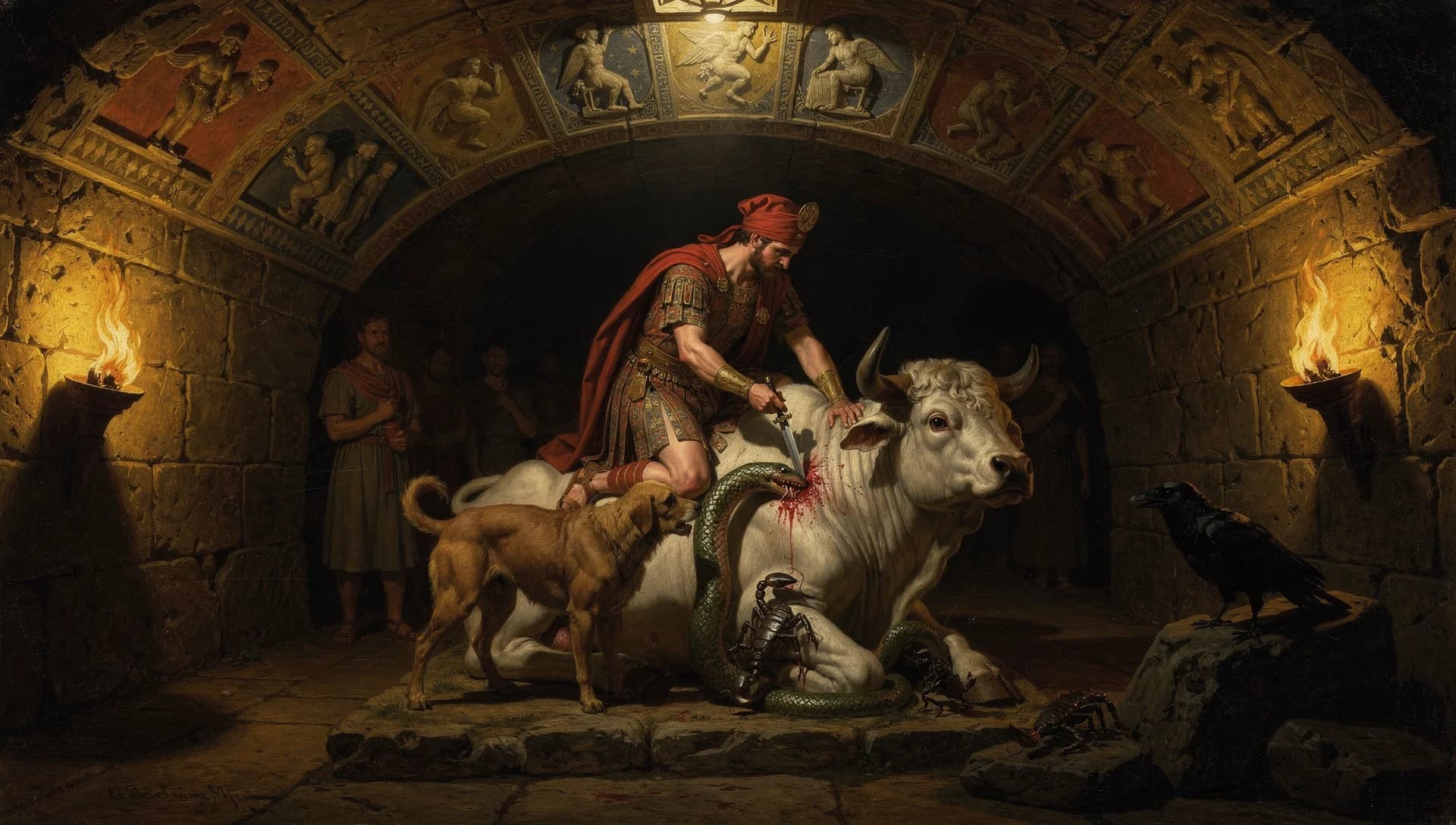
First, the tauroctony. The central iconographic image of Mithraism is Mithras killing the cosmic bull. The scene appears in essentially every Mithraic temple, with remarkable consistency of detail (Mithras in Phrygian cap, looking away as he kills the bull, a dog and a snake licking the wound, a scorpion at the bull's testicles, a raven, stellar and zodiacal iconography). The tauroctony's meaning remains contested; Roger Beck's astronomical interpretation (tauroctony as a star-map depicting the shift of the spring equinox from Taurus to Aries) is the current leading hypothesis.
Second, seven initiation orders. Mithraism's initiatory structure organized adherents into seven successive grades: Corax (raven), Nymphus (bride), Miles (soldier), Leo (lion), Perses (Persian), Heliodromus (sun-runner), Pater (father). Each grade had ritual associations with one of the seven classical planets. The seven-fold structure parallels the Zoroastrian Amesha Spentas framework (treated in the companion decoder article).
Third, the sacramental meal. Mithraic ritual centered on a communal meal of bread and wine (or bread and water) celebrated in the mithraeum (cave-temple). The meal was understood to unite the participants with Mithras and with each other. The parallel to Christian eucharistic practice has been extensively noted and is a principal point of contention in the history-of-religions-school comparative analysis.
Fourth, the December 25 festival. The Natalis Solis Invicti (Birthday of the Unconquered Sun) on December 25 was celebrated in the late Roman Empire in association with Mithras. Christian observance of Christmas on December 25 was established in the fourth century CE, after Mithraism had been a major competitor for over a century. The relationship between the two December 25 observances is debated; some scholars (following Hermann Usener's Das Weihnachtsfest, 1889) argue Christian appropriation, while others (following Susan Roll's Toward the Origins of Christmas, Kok Pharos, 1995) defend independent Christian reasoning.
Fifth, the all-male membership and military association. Mithraism was practiced exclusively by men (with separate women's cults of Cybele often located adjacent to Mithraic temples). Roman soldiers were the principal carriers. The cult's diffusion pattern across the Roman Empire follows the deployment patterns of Roman legions.
The parallel to Christianity on several structural points (sacramental meal, seven sacraments, winter festival, monotheistic-leaning theology, personal ethical framework) has been the subject of sustained scholarly investigation. Franz Cumont's initial judgment that Christianity borrowed from Mithraism has been progressively qualified in subsequent scholarship. The current consensus treats the two religions as parallel responses to the late-antique religious environment, each drawing on shared Hellenistic-Jewish and Iranian theological materials, with significant mutual interaction but not simple unidirectional borrowing.
The Urantia Book's account is consistent with this complex picture. Mithraism carried Zoroaster's teachings into the Roman Mediterranean. Christianity arose in the same environment and drew on some of the same Zoroastrian-derived theological materials. Both traditions share a common upstream source (the Salem-Zoroaster transmission chain), which produces the observed structural parallels without requiring direct Christian borrowing from Mithraism.
Why This Mapping Matters
The relationship between Mithraism and early Christianity has been one of the central scholarly questions in comparative religious history since the nineteenth century. The parallels are real and substantial. The direction of theological influence is contested. The historical outcome (Christianity's eventual dominance and Mithraism's disappearance) is decisive but the theological inheritance is complex.
The Urantia Book's contribution is the identification of the common upstream source. Mithraism and early Christianity are not parallel independent developments. They are two branches of a single theological transmission chain whose root is the Salem Melchizedek tradition. Zoroaster's sixth century BCE reform preserved and reorganized the Salem material for the Iranian environment. Priestly opposition in Iran produced the revived Mithraic tradition that absorbed much of Zoroaster's reformed teaching. Roman military recruitment from the Levant spread this tradition across the empire. Christianity arose in the same general theological environment, drawing on the same upstream Salem source through the separate channels of Jewish tradition (shaped by Babylonian-captivity contact with Zoroastrianism) and through direct Mediterranean religious contact.
The mapping therefore places Mithraism within the same Salem-derived tradition that includes Zoroastrianism, post-exilic Judaism, and Christianity itself. The Urantia framework identifies all four as downstream preservations of the original Salem mission, each carrying features of the original teaching and each introducing characteristic distortions.
The theological consequence is that the Mithraism-Christianity parallel is not a problem to be resolved. It is a confirmation that both traditions preserved fragments of a common source. The Christian tradition's eventual dominance is not a vindication of originality over borrowing; it is the historical outcome of theological and political factors in the fourth-century Roman Empire. The Mithraic tradition's disappearance is not a refutation of its theological content; it is the historical outcome of not having a Michael-bestowal equivalent to anchor the religious life of its adherents.
Sources
- The Urantia Book, Paper 95 (The Melchizedek Teachings in the Levant), Paper 98 (The Melchizedek Teachings in the Occident). Urantia Foundation, first printing 1955. Cited passages: 95:6.7, 98:5.1, 98:5.2, 98:5.3, 98:5.4.
- Cumont, Franz. Textes et Monuments Figurés Relatifs aux Mystères de Mithra. 2 volumes, H. Lamertin, 1896-1899.
- Cumont, Franz. The Mysteries of Mithra. Translated by Thomas J. McCormack. Open Court, 1903; reprinted Dover, 1956.
- Clauss, Manfred. The Roman Cult of Mithras: The God and His Mysteries. Translated by Richard Gordon. Routledge, 2000.
- Beck, Roger. The Religion of the Mithras Cult in the Roman Empire: Mysteries of the Unconquered Sun. Oxford University Press, 2006.
- Ulansey, David. The Origins of the Mithraic Mysteries: Cosmology and Salvation in the Ancient World. Oxford University Press, 1989.
- Roll, Susan K. Toward the Origins of Christmas. Kok Pharos, 1995.
- Hijmans, Steven E. "Sol Invictus, the Winter Solstice, and the Origins of Christmas," Mouseion 3 (2003), pp. 377-398.
Confidence and Evidence
- Confidence: UB CONFIRMED
- Evidence rating: STRONG
- Basis: The Urantia Book directly traces Mithraism to reformed-Zoroastrian Iranian priestly movement in Paper 95:6.7. The academic reconstruction of Mithraism's Iranian origins and Roman dissemination is well-established. The formal parallels between Mithraism and early Christianity are extensively documented. The Urantia account's explanation of a common upstream source (Salem-Zoroaster-Mithraism-Christianity) is internally consistent and accounts for the observed parallels without requiring direct Christian borrowing from Mithraism.
Related Decoder Articles
- Zoroaster, Salem Missionary Descendant = Zarathustra
- Seven Master Spirits = Amesha Spentas
- Mithraic Birth Legend = Christian Nativity Sources
By Derek Samaras
Connecting Articles
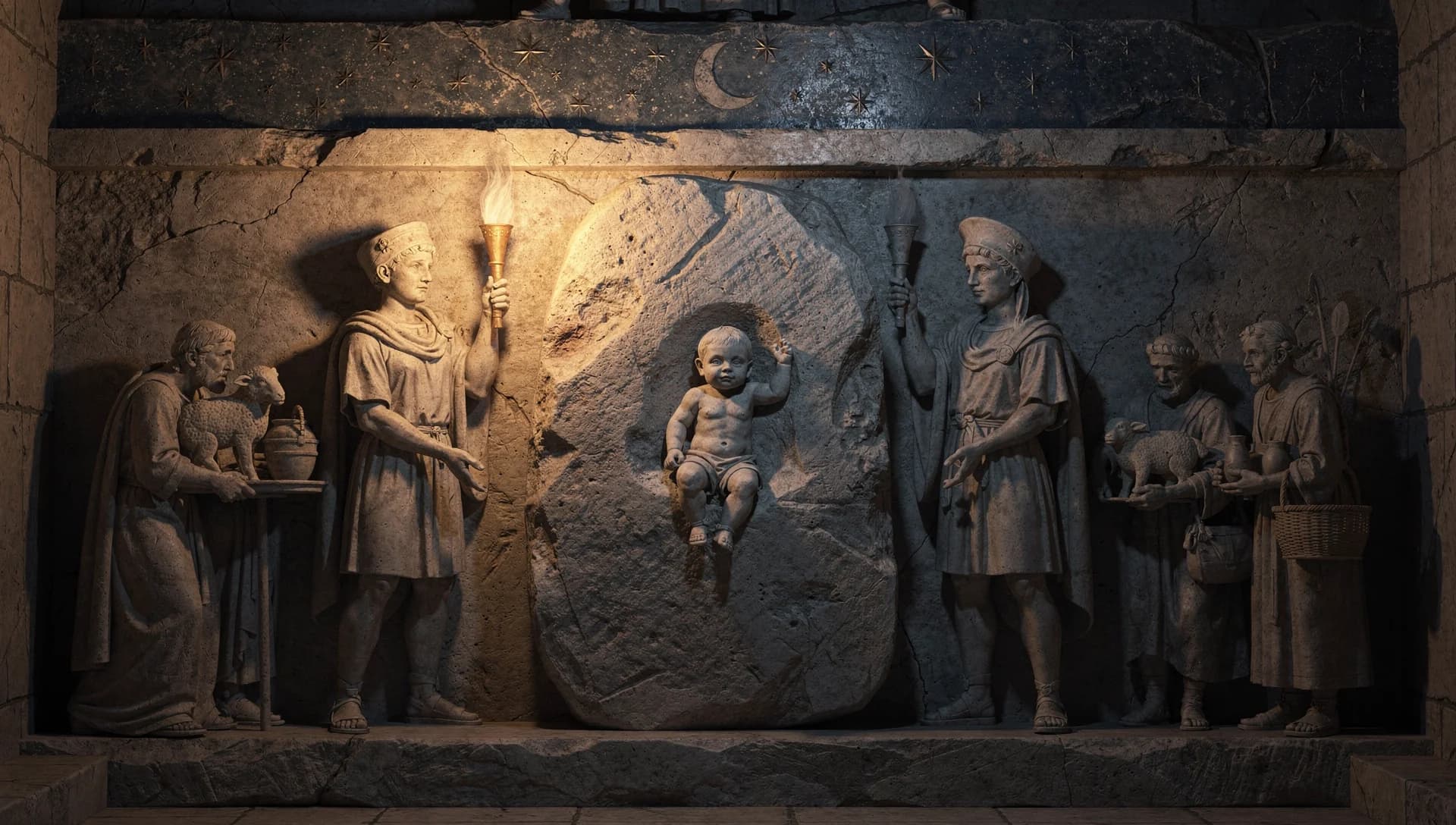
Shepherds at the Birth: Mithraic Sources and the Christian Nativity
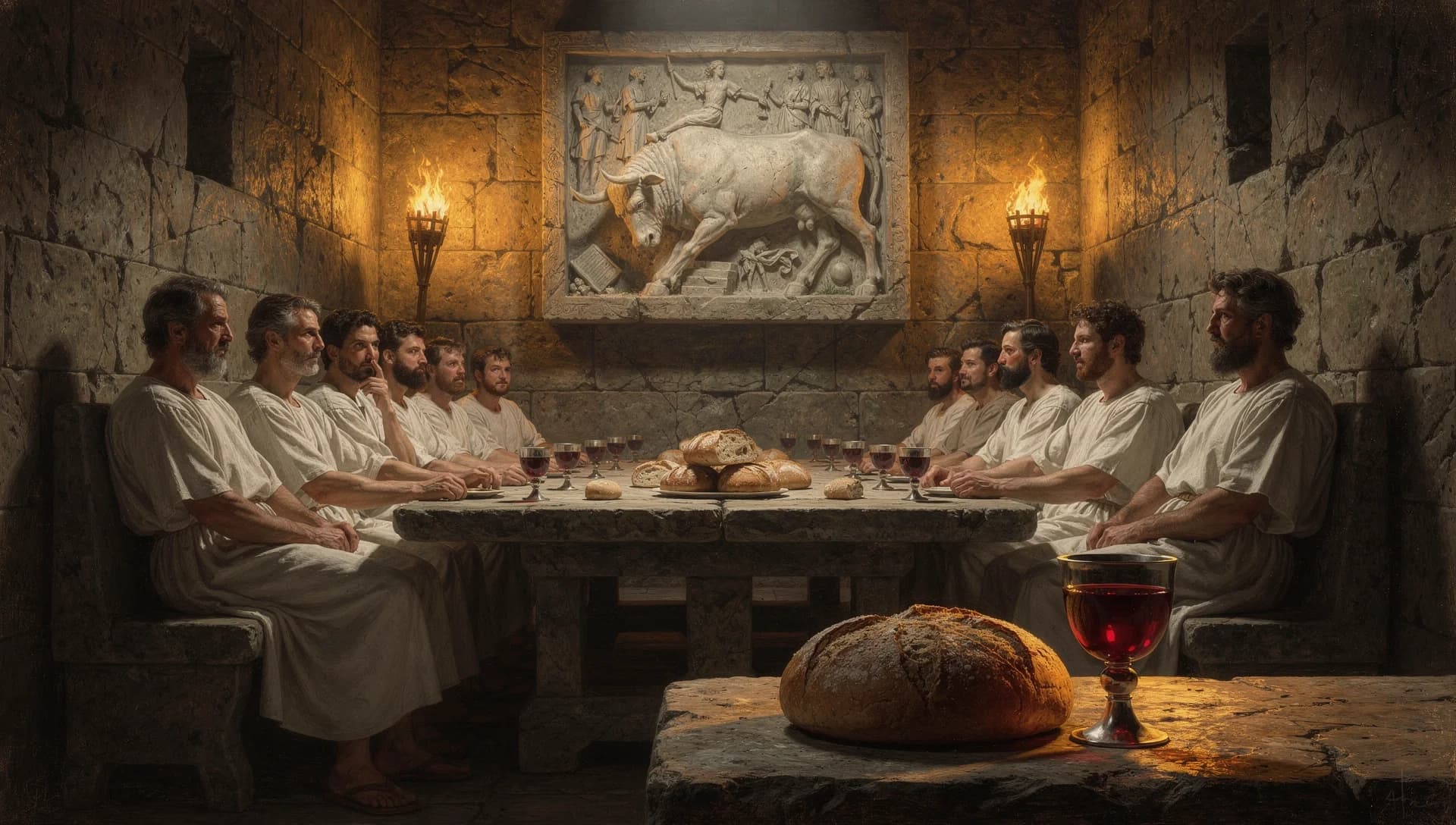
Bread, Wine, and Sunday: Mithraic Sacraments and Christian Ritual
The Bull-Slayer and the Cosmic Ages: Mithraic Tauroctony and the Rebellion Memory
The All-Night Talk: Jesus and Angamon, Leader of the Stoics
The Newsletter
Get the research behind each piece
Free. New Urantia Book explorations, the sources behind the videos, and early looks. No spam, unsubscribe anytime.
Prefer video? Follow on YouTube and Facebook.
Delivered through Substack. You can also read past issues.