
Bread, Wine, and Sunday: Mithraic Sacraments and Christian Ritual
The Christian Eucharist, Sunday worship, and seven-sacrament structure each have Mithraic precedents. The Urantia Book identifies these not as Christian borrowings from Mithraism but as parallel inheritances from the shared Salem-Zoroastrian upstream source that flowed into both traditions.
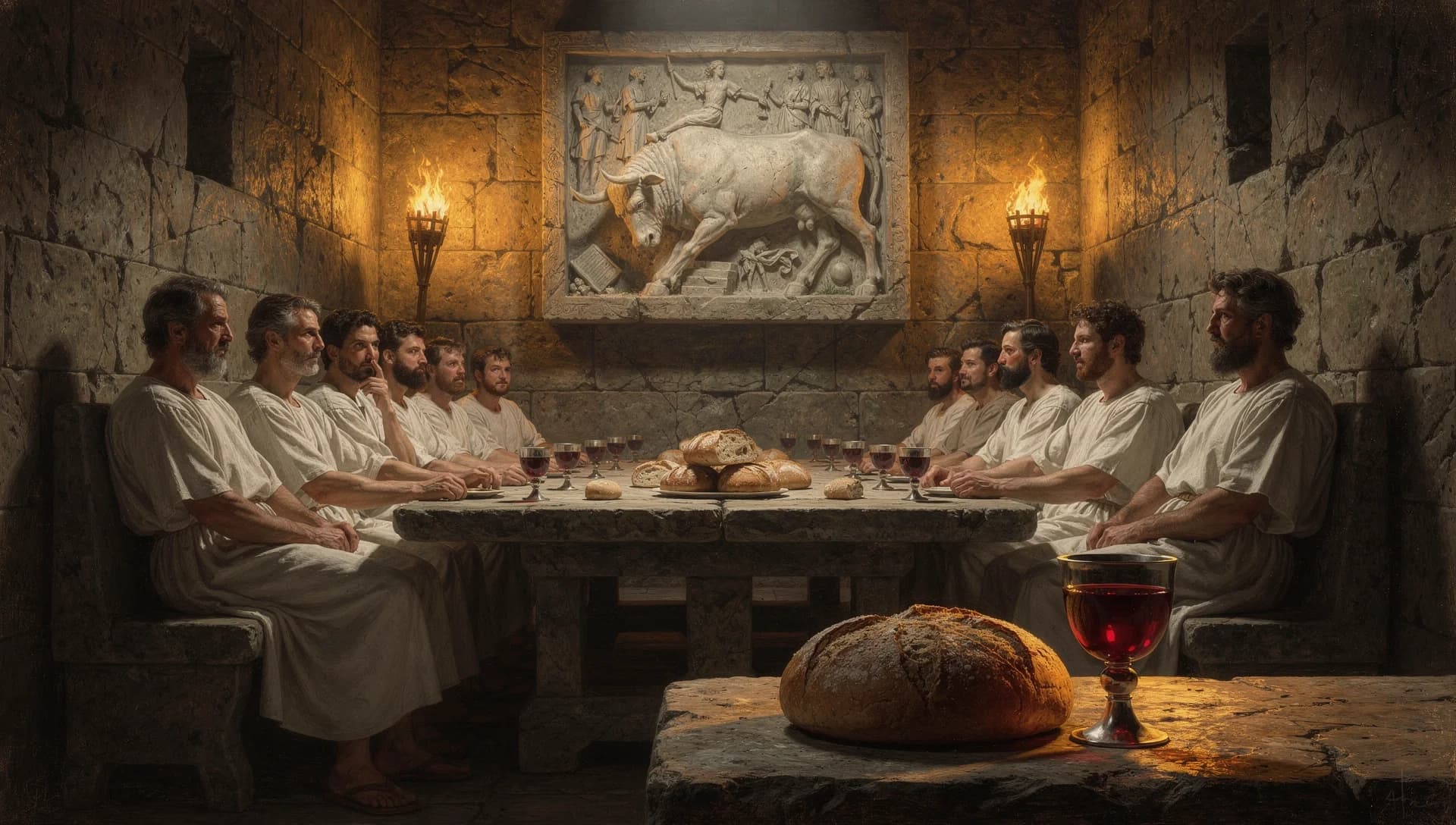
Mithraic ritual as proto-Christian practice = Mithraic sacraments: communion and Sunday worship
This article expands on the decoder mapping. For the side-by-side card and quick reference, see the mapping page.
The Ritual Parallels That Have Troubled Christian Historians
The formal parallels between Mithraic and Christian ritual practice are extensive and detailed. A sacramental meal of bread and wine. Sunday as the principal day of weekly worship. A seven-fold initiation structure. A winter festival at December 25. Communal worship in consecrated spaces. A hero-savior god celebrated through ritual identification. Baptismal cleansing ceremonies. Honorific titles for clergy (pater, leo) that parallel Christian liturgical offices.
These parallels have troubled Christian historians since the nineteenth century. Franz Cumont's initial thesis that Christianity borrowed extensively from Mithraism produced a generation of scholarly controversy. The subsequent reaction (particularly in the early-twentieth-century Christian apologetic literature) sought to minimize the parallels or treat them as coincidental. The current scholarly consensus occupies a middle position: the parallels are real and substantial, but the direction of influence is complex and rarely straightforwardly unidirectional.
The Urantia Book identifies the resolution: both traditions inherited ritual structures from a common upstream source.
What the Urantia Book Says
Paper 98 describes the Mithraic sacramental structure:
"The adherents of this cult worshiped in caves and other secret places, chanting hymns, mumbling magic, eating the flesh of the sacrificial animals, and drinking the blood. Three times a day they worshiped, with special weekly ceremonials on the day of the sun-god and with the most elaborate observance of all on the annual festival of Mithras, December twenty-fifth. It was believed that the partaking of the sacrament ensured eternal life, the immediate passing, after death, to the bosom of Mithras, there to tarry in bliss until the judgment day." (UB 98:5.4)
The seven-fold initiation structure is named:
"At first it was a religion only for men, and there were seven different orders into which believers could be successively initiated. Later on, the wives and daughters of believers were admitted to the temples of the Great Mother, which adjoined the Mithraic temples." (UB 98:5.5)
The Christian inheritance pattern is addressed through the broader framework of late-antique religious development:
"The cult of Mithras arose in Iran and long persisted in its homeland despite the militant opposition of the followers of Zoroaster. But by the time Mithraism reached Rome, it had become greatly improved by the absorption of many of Zoroaster's teachings. It was chiefly through the Mithraic cult that Zoroaster's religion exerted an influence upon later appearing Christianity." (UB 98:5.2)
The Urantia Book's position is that Mithraism and Christianity share a common upstream source: the Salem Melchizedek tradition, carried forward through Zoroaster's Iranian reform, which then entered both the Mithraic tradition (through the priestly Iranian revival) and the Christian tradition (through the broader Zoroastrian influence on post-exilic Judaism). Both traditions therefore inherited ritual structures from the shared Salem source, with Zoroaster as the proximate transmitter and with their subsequent developments occurring in parallel rather than as direct mutual borrowing.
The sacramental features common to both traditions are, on this account, neither Christian borrowings from Mithraism nor Mithraic inventions that Christianity then appropriated. They are the preserved ritual residues of the Salem sacramental tradition (particularly the bread-and-wine substitute for animal sacrifice that Machiventa introduced at Salem, per UB 93:4.14), carried forward through the centuries in multiple parallel streams.
What the Ancient Sources Say
The Bread-and-Wine Sacrament
Machiventa's Salem innovation of bread and wine as substitute for animal sacrifice is recorded in UB 93:4.14:
"While no sacrifices were permitted within the colony, Melchizedek well knew how difficult it is to suddenly uproot long-established customs and accordingly had wisely offered these people the substitute of a sacrament of bread and wine for the older sacrifice of flesh and blood. It is of record, 'Melchizedek, king of Salem, brought forth bread and wine.'"
The Genesis 14:18 fragment preserves this innovation: "Melchizedek king of Salem brought out bread and wine." The bread-and-wine substitute for animal sacrifice is therefore specifically Salem-originated in the Urantia account.
The Mithraic sacramental meal of bread and wine (or bread and water in some variants) is documented across the Roman Empire. Manfred Clauss's The Roman Cult of Mithras (Routledge, 2000) treats the ritual in detail. The Mithraic dining couches (klinai) found in virtually every mithraeum establish that communal meals were a central ritual feature.
The Christian Eucharist, instituted at the Last Supper per Gospel tradition, uses bread and wine as the core sacramental elements. The direct attribution to Jesus's institution is theologically central but the bread-and-wine form has the Salem precedent that both Jewish and Christian tradition partly preserves.
Sunday as Worship Day
The Mithraic observance of Sunday (dies Solis) as the principal worship day is documented in Roman-era evidence. The name "Sunday" itself derives from the sun-god association that Mithraism carried forward. Steven Hijmans's "Sol Invictus, the Winter Solstice, and the Origins of Christmas" (Mouseion 3, 2003) treats the broader solar-religious context.
The Christian adoption of Sunday worship is historically complex. The earliest Christian tradition (first and second centuries CE) observed Sunday ("the Lord's day," Revelation 1:10) as the resurrection commemoration while maintaining Sabbath observance. The full replacement of Sabbath with Sunday as the principal worship day was gradual, completed during the fourth-century Constantinian period when Christianity became the imperial religion. The timing corresponds to the period when Mithraism was being actively suppressed but its ritual infrastructure was being absorbed into the Christian establishment.
Seven-Fold Initiation
Mithraism's seven-grade initiation structure (Corax, Nymphus, Miles, Leo, Perses, Heliodromus, Pater) parallels the Zoroastrian Amesha Spentas framework (treated in the companion decoder article). The Christian sacramental tradition eventually developed its own seven-fold sacramental structure (Baptism, Confirmation, Eucharist, Reconciliation, Anointing, Orders, Matrimony), though this was formalized only in the twelfth century by Peter Lombard's Four Books of Sentences. The Christian seven-sacrament structure is not directly Mithraic in origin but reflects the same seven-fold theological framework that the Zoroastrian-Mithraic tradition preserved and that the Urantia Book identifies as the Seven Master Spirits substrate.
The scholarly question of whether Christian ritual structure was directly influenced by Mithraism or whether both developed in parallel from shared sources has been treated extensively. Franz Cumont's early-twentieth-century work argued for direct influence. The subsequent Christian apologetic reaction (Ramsay MacMullen, Paganism in the Roman Empire, Yale University Press, 1981; Larry W. Hurtado, Lord Jesus Christ, Eerdmans, 2003) argued for minimal influence. The current middle position recognizes substantial structural parallels while treating the causal relationship as complex.
The Urantia Book's framework resolves the complexity by identifying the common upstream source. Both Mithraism and Christianity inherited ritual structures from the shared Salem-Zoroastrian substrate. The parallels are not Christian borrowings from Mithraism; they are shared downstream features of a common inheritance. The apparent "Mithraic influence" on Christianity is, on this account, the influence of the common source on both traditions, with the Mithraic tradition simply being the more chronologically prior preservation of the shared material in the Roman Mediterranean.
Why This Mapping Matters
The Christian tradition's theological self-understanding has traditionally treated its ritual forms as specifically Christian innovations grounded in Jesus's institution and the apostolic teaching. The Eucharist is the Lord's Supper as Jesus instituted it. Sunday worship is the apostolic observance of the resurrection. The sacramental structure is the Church's development of Christian grace-conveying rituals.
The Mithraic parallels have always complicated this self-understanding. If bread-and-wine communion, Sunday worship, December 25 festival, and seven-fold initiation are also Mithraic, the claim that these are specifically Christian innovations becomes difficult to maintain. The alternatives have been either to deny the Mithraic parallels (scholarly untenable) or to treat them as pagan corruption that Christianity unfortunately absorbed (theologically troubling).
The Urantia Book's framework offers a third option. The ritual forms are not specifically Christian innovations; they are specifically Salem innovations (particularly the bread-and-wine substitute) that the Salem Melchizedek tradition introduced nearly two thousand years before Christ (UB 93:2.1). Both Mithraism and Christianity inherited these forms through the Salem-Zoroastrian transmission chain. The Christian practice of the Eucharist, on this reading, is not Christian borrowing from Mithraism; it is Christian preservation of the same Salem ritual that Mithraism also preserved. Neither tradition is secondary to the other; both are downstream of the common source.
The theological significance is substantial. The Eucharist's legitimacy does not depend on being specifically Christian in its ritual form. Its legitimacy depends on being a faithful carrier of the Salem teaching (and, through that, of the underlying cosmic reality of Michael's Bestowal). The form is not the content; the Salem tradition preserved both the form (bread and wine) and the content (personal faith in God, ethical life, hope of survival) across four millennia of transmission. The Christian inheritance preserves the same form with Christological content (the bread and wine as symbols of Jesus's body and blood).
The practical consequence for contemporary Christian practice is that the Eucharist can be celebrated without anxiety about its Mithraic parallels. The parallels are real, but they do not compromise the Eucharist; they confirm that the bread-and-wine sacrament is a genuinely ancient Salem-preserved ritual whose theological significance transcends any one of its downstream preservations. Both Mithraic and Christian observance drew on the same source, and the deeper question is not which tradition borrowed from which but what the common source actually was. The Urantia Book supplies the answer: the Salem Melchizedek tradition, anchored in a specific historical incarnation, preserved ritual forms whose echoes persist in multiple world religious traditions.
Sources
- The Urantia Book, Paper 93 (Machiventa Melchizedek), Paper 98 (The Melchizedek Teachings in the Occident). Urantia Foundation, first printing 1955. Cited passages: 93:4.14, 98:5.2, 98:5.4, 98:5.5.
- Clauss, Manfred. The Roman Cult of Mithras: The God and His Mysteries. Translated by Richard Gordon. Routledge, 2000.
- Cumont, Franz. The Mysteries of Mithra. Translated by Thomas J. McCormack. Open Court, 1903; reprinted Dover, 1956.
- Beck, Roger. The Religion of the Mithras Cult in the Roman Empire. Oxford University Press, 2006.
- MacMullen, Ramsay. Paganism in the Roman Empire. Yale University Press, 1981.
- Hurtado, Larry W. Lord Jesus Christ: Devotion to Jesus in Earliest Christianity. Eerdmans, 2003.
- Hijmans, Steven E. "Sol Invictus, the Winter Solstice, and the Origins of Christmas," Mouseion 3 (2003), pp. 377-398.
- Bradshaw, Paul F. The Search for the Origins of Christian Worship. Second edition, Oxford University Press, 2002.
Confidence and Evidence
- Confidence: UB CONFIRMED
- Evidence rating: STRONG
- Basis: The Urantia Book describes Mithraic sacramental practice in detail in Paper 98:5.4-5 and locates it within the Salem-Zoroastrian-Mithraic-Christian transmission chain. The bread-and-wine Salem innovation is explicitly attributed to Machiventa in Paper 93:4.14. The academic documentation of Mithraic ritual practice and its structural parallels with Christian ritual is well-established. The Urantia account's framework of a common upstream source resolves the complex question of causal direction.
Related Decoder Articles
- Corrupted Zoroastrianism in Rome = Mithras Mystery Cult
- Machiventa Melchizedek = Deleted Priest-King of Genesis
- Seven Master Spirits = Amesha Spentas
By Derek Samaras
Connecting Articles
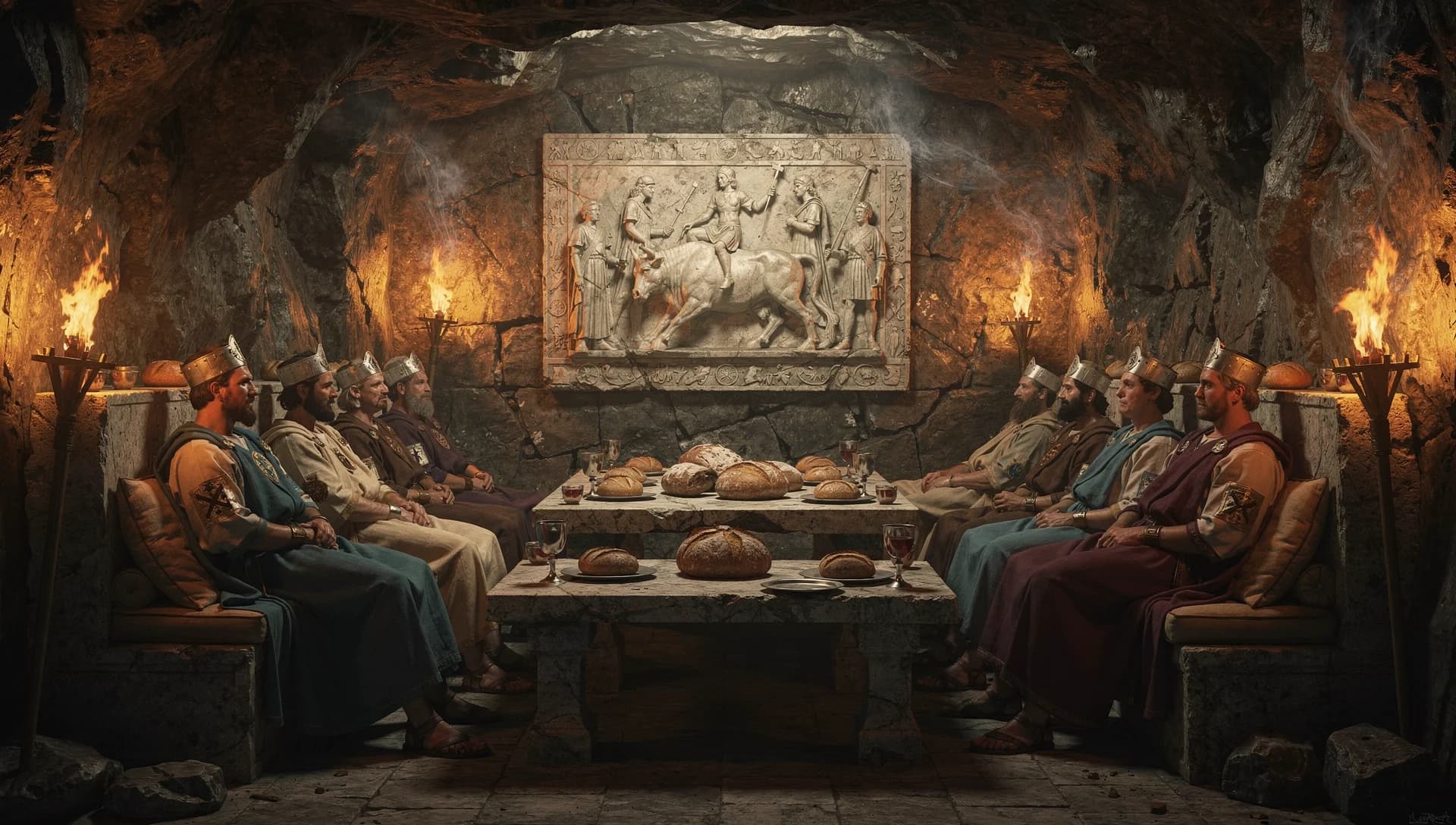
The Cult That Almost Became Christianity: Mithras and Corrupted Zoroastrianism
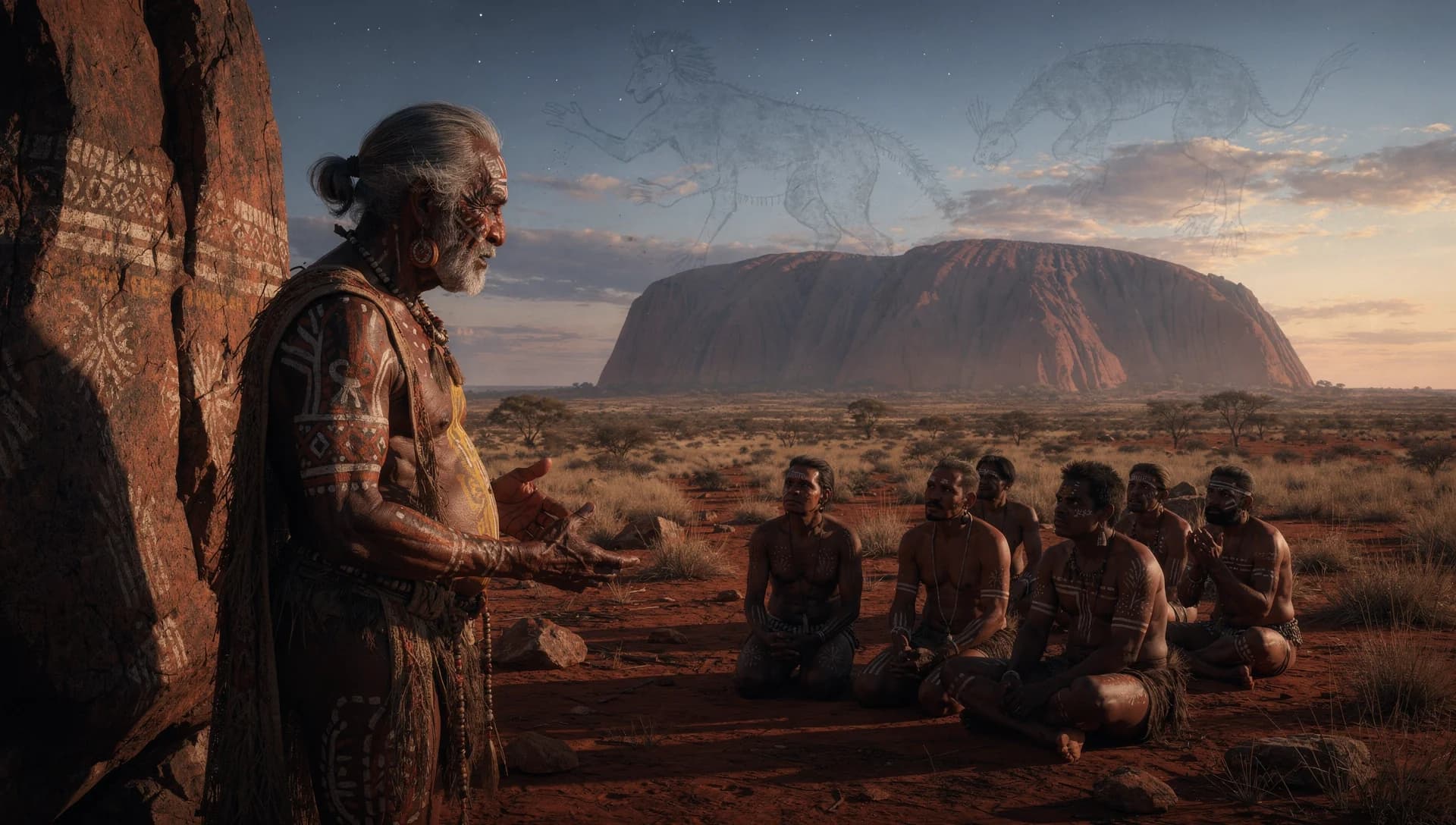
The Longest Memory: Australian Aboriginal Dreamtime and the Primordial Teaching-Ancestors
The Final Adjudication: Ragnarok and the Pending Verdict

We Come From One: African First-Family Traditions and the Sangik Origin
The Newsletter
Get the research behind each piece
Free. New Urantia Book explorations, the sources behind the videos, and early looks. No spam, unsubscribe anytime.
Prefer video? Follow on YouTube and Facebook.
Delivered through Substack. You can also read past issues.