
The Bull-Slayer and the Cosmic Ages: Mithraic Tauroctony and the Rebellion Memory
Mithraic iconography centers on the tauroctony, Mithras slaying a bull while serpent, scorpion, dog, and raven attend the scene. Modern scholarship has shown the astronomical encoding: Mithras represents the power that moves the equinoxes, overturning the old cosmic order and inaugurating a new one. The Urantia Book traces Mithraism back to Zoroastrian roots, and Zoroastrian dualism itself back to distorted memory of the Lucifer rebellion. The tauroctony preserves, in Roman mystery-cult form, the memory of an actual cosmic conflict the Urantia record documents.
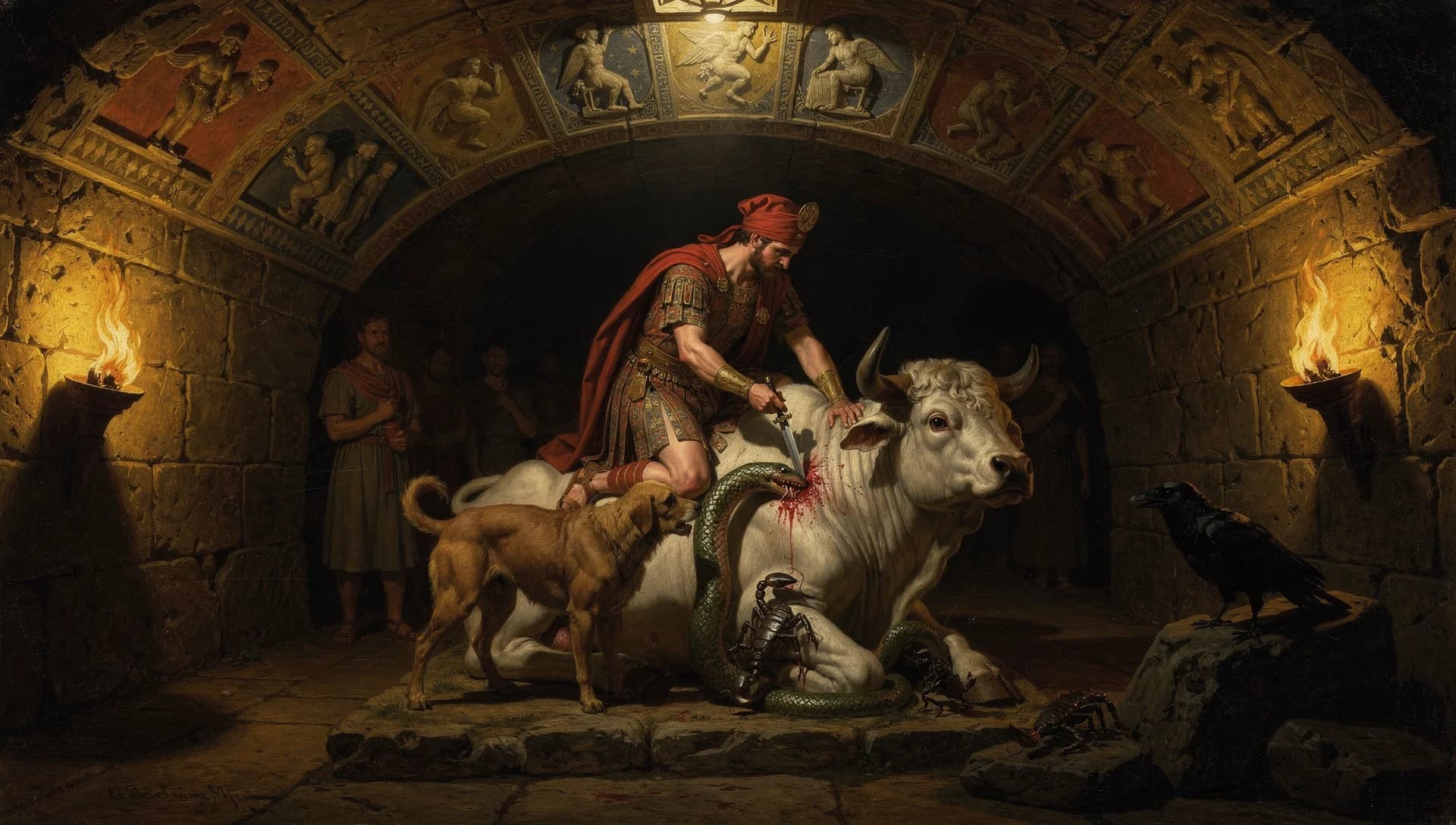
Cosmic conflict memory preserved in astronomical-ritual form = Mithraic tauroctony, the bull-slaying as cosmic-order symbol
This article expands on the decoder mapping. For the side-by-side card and quick reference, see the mapping page.
The Bull-Slaying Scene
Every Mithraic sanctuary, or Mithraeum, across the Roman Empire kept the same image at its heart: the tauroctony, a sculpted or painted scene of the god Mithras killing a bull. The composition is consistent. Mithras wears the Phrygian cap, his cloak streams behind him, and he looks away from the bull as he drives the sword into its neck. The bull collapses to its knees. A serpent and a dog leap up to drink the blood. A scorpion attacks the bull's genitals. A raven perches above. On either side stand two torch-bearers, Cautes and Cautopates, representing the rising and setting sun.
Scholars have read this scene through several frames. Franz Cumont, writing in the late nineteenth century, treated the tauroctony as Roman iconography adapted from Zoroastrian dualism. David Ulansey's 1989 study reinterpreted it as a coded star map: the precession of the equinoxes, with Mithras as the cosmic power that moves the ages. Roger Beck has carried the astronomical reading further, threading it through the cult's seven-grade hierarchy.
The Urantia Book supplies the underlying historical substrate.
What the Urantia Book Says
The Urantia Book traces Mithraism to Zoroastrian roots:
"The Mithraic cult made its appeal to a wide range of human nature and gradually supplanted both of its predecessors. Mithraism spread over the Roman Empire through the propagandizing of Roman legions recruited in the Levant, where this religion was the vogue, for they carried this belief wherever they went." (98:5.1)
"The cult of Mithras arose in Iran and long persisted in its homeland despite the militant opposition of the followers of Zoroaster. But by the time Mithraism reached Rome, it had become greatly improved by the absorption of many of Zoroaster's teachings. It was chiefly through the Mithraic cult that Zoroaster's religion exerted an influence upon later appearing Christianity." (98:5.2)
The Zoroastrian dualism that fed into Mithraism is itself traced to distorted memory of the Lucifer rebellion. The Urantia Book records that Zoroaster, on his first pilgrimage to Ur in Mesopotamia, learned of the traditions of the Caligastia and the Lucifer rebellion along with many other traditions, all of which made a strong impression on his mind (95:6.2). Zoroastrianism is identified as the only Urantian creed that perpetuates the Dalamatian and Edenic teachings about the Seven Master Spirits, and while original Zoroastrianism was not a pure dualism, only in later times did the belief gain credence that good and evil contended on equal terms (95:6.5).
The Lucifer rebellion itself is documented in Paper 53 (The Lucifer Rebellion), with its consequences for our world treated in Paper 54 (Problems of the Lucifer Rebellion) and Paper 67 (The Planetary Rebellion). The rebel faction (Lucifer, Satan, Caligastia, Daligastia, and their followers) clashed with the loyal administrative order in a real cosmic conflict. That conflict left a trace in human cultural memory, and the trace traveled through Zoroastrian dualism into the Roman Mithraic mysteries.
Read through that lens, the tauroctony preserves a memory: the old order overcome, a new order established by the action of a cosmic hero. The astronomical encoding Ulansey and Beck identify is the precessional layer of the symbolism. Underneath sits the older substrate, carried forward through the Zoroastrian and then the Mithraic stream.
What the Ancient Sources Say
The Mithraic tradition left abundant archaeology (Mithraea reach from Britain to Syria) but very little text. Franz Cumont's Les mystères de Mithra (Bruxelles, 1903) and his two-volume Textes et monuments figurés relatifs aux mystères de Mithra (Bruxelles, 1899) laid the foundation for modern study. Cumont's Iranian-derivation reading dominated the field until the late twentieth century, when it was substantially revised.
David Ulansey's The Origins of the Mithraic Mysteries: Cosmology and Salvation in the Ancient World (Oxford University Press, 1989) put forward the astronomical reading. Ulansey showed that the figures around the bull match the constellations on the celestial equator during the Age of Taurus, roughly 4000 to 2000 BCE, and that the move into the Age of Aries (from about 2000 BCE) is what Mithras dramatizes when he kills the bull. The precession of the equinoxes, discovered by Hipparchus of Rhodes in the second century BCE, gives the iconography its astronomical key.
Roger Beck's The Religion of the Mithras Cult in the Roman Empire: Mysteries of the Unconquered Sun (Oxford University Press, 2006) extended the reading through the seven initiation grades (Corax, Nymphus, Miles, Leo, Perses, Heliodromus, Pater) and the astronomical correspondences attached to each. Beck treats the cult as an elaborate "star-talk" system.
Manfred Clauss's The Roman Cult of Mithras: The God and His Mysteries (Routledge, 2000) is the standard modern synthesis of the archaeology and texts. Clauss documents how Roman legions carried the cult across the empire from the Levant, the all-male initiate community, and the seven-grade structure of advancement.
For the Zoroastrian background, Mary Boyce's three-volume A History of Zoroastrianism (Brill, 1975 to 1991) traces the Avestan Mithra (the yazata of covenant and light) from his Indo-Iranian roots through Zoroaster's reform and on into the Hellenistic adaptations that produced Roman Mithraism. The chain runs deep.
The composition itself has Hellenistic precedent. The Greek Nike-slaying-the-bull scene on the Athenian acropolis (fifth century BCE) gives the iconographic prototype. The Roman tauroctony swaps Mithras for Nike and adds the Zoroastrian-flavored attendant creatures.
The convergence between Mithraism and early Christianity is treated at UB 98:6.3-5 and in a wide scholarly literature. Shared ritual features include underground worship spaces, sacramental bread and wine, baptismal holy water, and a sacrificial savior theology. The Christian December 25 Christmas date matches the Mithraic Dies Natalis Solis Invicti, the Birthday of the Unconquered Sun, with which Mithras was associated.
Why This Mapping Matters
The Mithraic tauroctony is the most elaborate piece of iconography any Roman mystery cult produced. The astronomical encoding Ulansey and Beck identify is sophisticated, and the cult's intellectual reach was real. The Urantia Book supplies the deeper layer: an actual Lucifer rebellion, preserved through distorted Zoroastrian dualism, and carried into the Roman Mithraic form.
The two readings (astronomical precession and rebellion memory) are not in competition. The cult drew educated Roman officers and administrators who appreciated the star-knowledge. It also drew a popular audience that responded to the cosmic-conflict story: the bull-slayer overcoming the old order, the saving action of the cosmic hero. Both layers were operating at once, across the cult's wide imperial spread.
The Christian convergence the Urantia Book documents at 98:6.3-5 has theological consequences. Shared ritual ground produced inherited forms (baptism, eucharist, underground worship, sacrificial savior theology) that carried into later Christianity. The Christmas date borrowed from the Mithraic Dies Natalis Solis Invicti is one piece of a larger pattern.
The Urantia Book framework draws a clean line between the historical Christ event and the inherited ritual structure. The Michael bestowal as Jesus of Nazareth is a real historical event, distinct from the mythological Mithras figure. The calendrical and ritual forms early Christianity absorbed from its Mithraic environment are cultural inheritance; they did not compromise the substance of the bestowal.
The mapping's payoff is that the tauroctony reads as multi-layered preservation. At the iconographic level, astronomical encoding. At the religious level, Zoroastrian dualism. Underneath both, the cosmic memory of the Lucifer rebellion. The Urantia Book at 95:6.5 and 98:5 names the chain of transmission, running from the original cosmic conflict through Zoroastrianism and Mithraism into the Christian inheritance.
Sources
- The Urantia Book, Paper 53 (The Lucifer Rebellion), Paper 67 (The Planetary Rebellion), Paper 95 (The Melchizedek Teachings in the Levant), Paper 98 (The Melchizedek Teachings in the Occident). Urantia Foundation, first printing 1955. Cited passages: 95:6.5, 98:5.1-5, 98:6.3-5.
- Ulansey, David. The Origins of the Mithraic Mysteries: Cosmology and Salvation in the Ancient World. Oxford University Press, 1989.
- Beck, Roger. The Religion of the Mithras Cult in the Roman Empire: Mysteries of the Unconquered Sun. Oxford University Press, 2006.
- Clauss, Manfred. The Roman Cult of Mithras: The God and His Mysteries. Routledge, 2000.
- Cumont, Franz. Les mystères de Mithra. Bruxelles, 1903.
- Cumont, Franz. Textes et monuments figurés relatifs aux mystères de Mithra. Bruxelles, 1899 (two volumes).
- Boyce, Mary. A History of Zoroastrianism. Brill, 1975-1991 (three volumes).
- Vermaseren, Maarten J. Corpus Inscriptionum et Monumentorum Religionis Mithriacae. Martinus Nijhoff, 1956-1960 (two volumes).
Confidence and Evidence
- Confidence: INFORMED SPECULATION
- Evidence rating: MODERATE
- Basis: The Urantia Book traces Mithraism to Zoroastrian roots at 98:5.2, and Zoroastrian dualism to distorted rebellion memory at 95:6.5. The astronomical reading of the tauroctony is well established in modern scholarship (Ulansey, Beck). Holding both layers together (astronomical encoding plus rebellion memory) accounts for the rich theological and iconographic content of the cult.
Related Decoder Articles
- Zoroaster = Persian Salem Teaching Reform
- Paul's Composite Christianity
- Dying-and-Rising Gods = Corrupted Salem Teaching
Byline: Derek Samaras | Urantia Book Network | April 2026
Connecting Articles
Not Equal Principles, Real Rebellion: Zoroastrian Dualism and the Lucifer Event
The Insider Who Betrayed: Caligastia and the Norse Loki
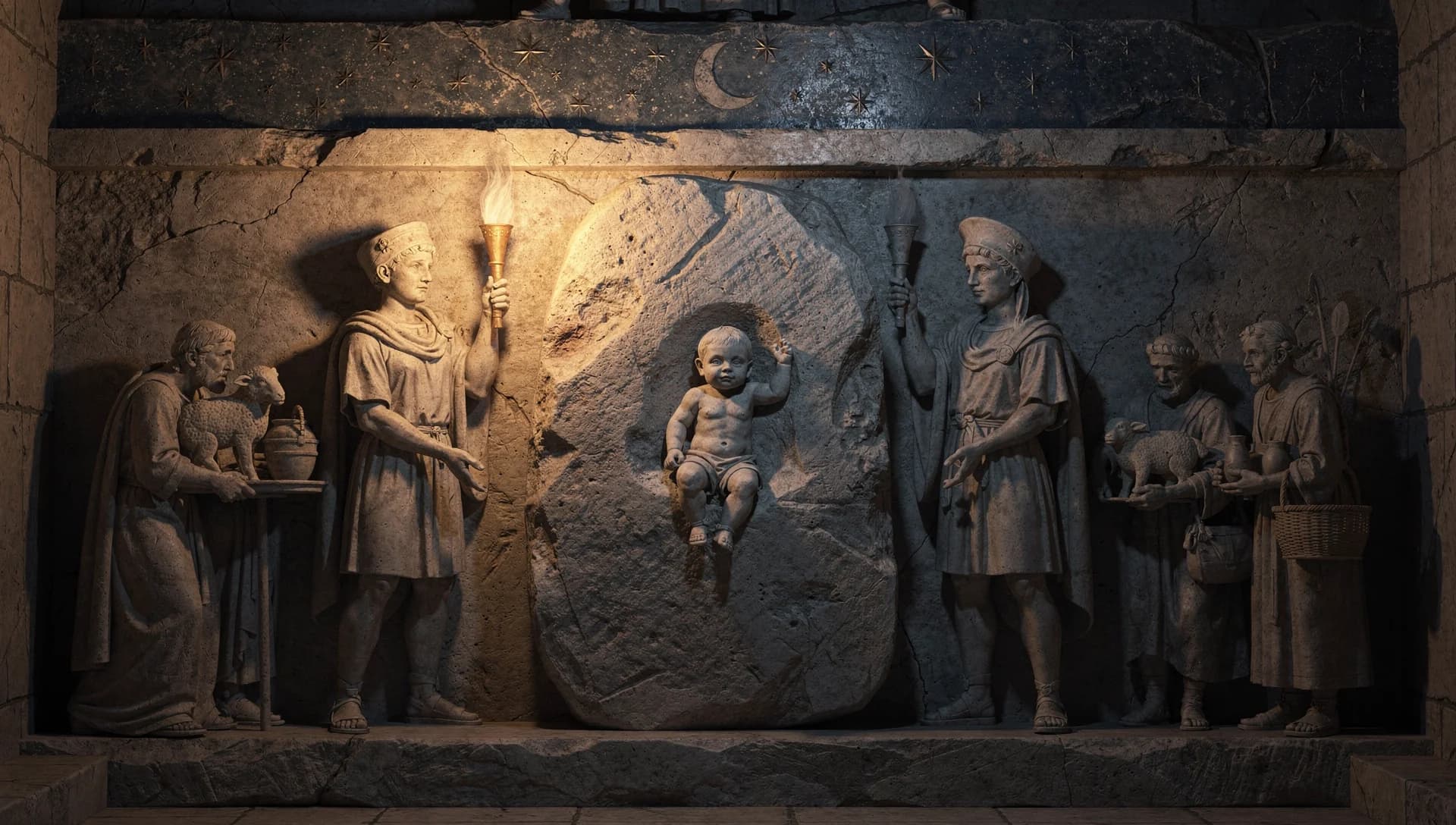
Shepherds at the Birth: Mithraic Sources and the Christian Nativity
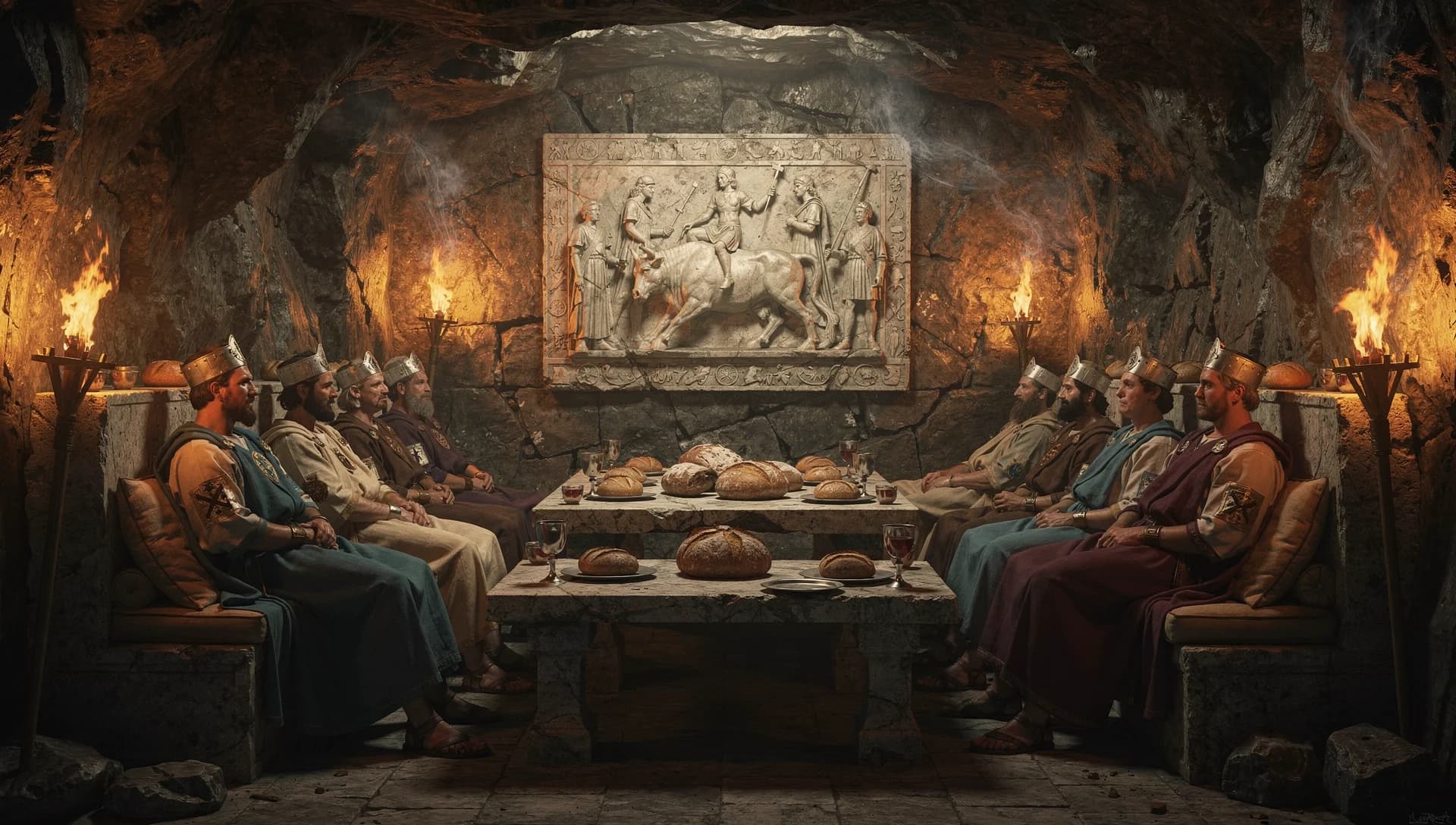
The Cult That Almost Became Christianity: Mithras and Corrupted Zoroastrianism
The Newsletter
Get the research behind each piece
Free. New Urantia Book explorations, the sources behind the videos, and early looks. No spam, unsubscribe anytime.
Prefer video? Follow on YouTube and Facebook.
Delivered through Substack. You can also read past issues.