
Shepherds at the Birth: Mithraic Sources and the Christian Nativity
The Gospel of Luke's nativity narrative includes details that do not appear in Matthew's account: shepherds visited by angelic announcement, a birth proclaimed by celestial witnesses. The Urantia Book identifies the source: the Roman-Mithraic legend of the savior-hero Mithras, whose birth was announced to gift-bearing shepherds centuries before the gospel of Luke was composed.
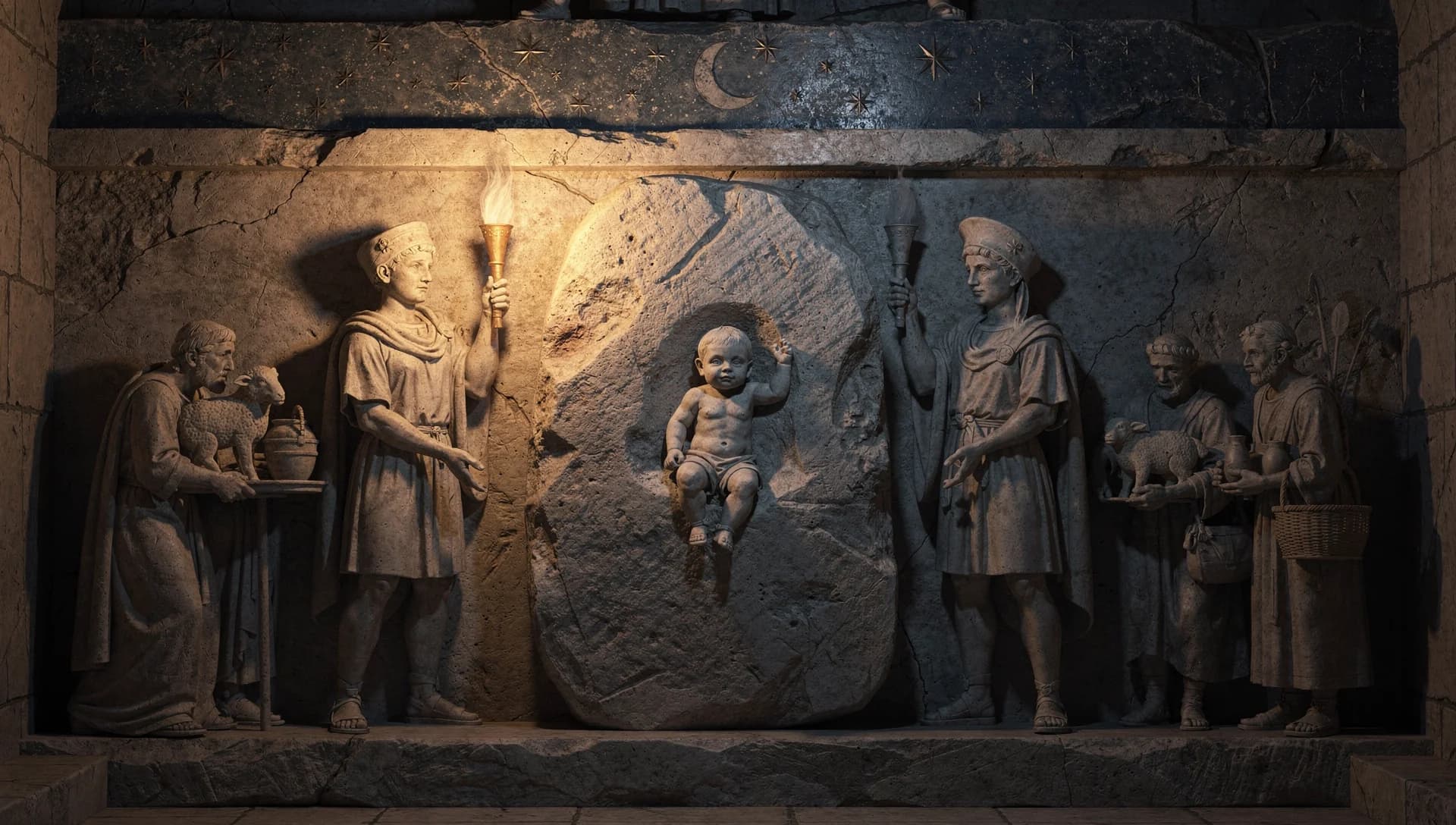
Mithraic birth legend as nativity source = Shepherds and angels at Mithras' birth
This article expands on the decoder mapping. For the side-by-side card and quick reference, see the mapping page.
Two Nativity Traditions in the New Testament
The New Testament preserves two distinct nativity narratives. Matthew 2 tells the story of the magi from the East following a star, visiting Herod, and presenting gifts to the infant Jesus. Luke 2 tells a different story: shepherds watching their flocks by night, an angelic announcement, a multitude of the heavenly host praising God, and the shepherds' journey to the manger to find the baby. The two narratives are composed from different source materials, cover different details, and have remained distinct across two millennia of Christian interpretation despite the devotional tradition's tendency to conflate them into a single Christmas tableau.
The scholarly question of what sources each Gospel drew on has been extensively investigated. The Urantia Book identifies the source of the Lukan shepherd tradition: the Roman-Mithraic legend of the birth of Mithras, which circulated in the Mediterranean world for over a century before the Gospel of Luke was composed.
What the Urantia Book Says
The key passage identifies the Mithraic source:
"Even the legends of the birth of Jesus on Urantia became tainted with the Roman version of the miraculous birth of the Iranian savior-hero, Mithras, whose advent on earth was supposed to have been witnessed by only a handful of gift-bearing shepherds who had been informed of this impending event by angels." (UB 98:7.7)
The broader passage locates the Mithraic influence within a list of theological-mythological borrowings that affected Christian development:
"4. The mystery cults, especially Mithraism but also the worship of the Great Mother in the Phrygian cult. Even the legends of the birth of Jesus on Urantia became tainted with the Roman version of the miraculous birth of the Iranian savior-hero, Mithras, whose advent on earth was supposed to have been witnessed by only a handful of gift-bearing shepherds who had been informed of this impending event by angels." (UB 98:7.7)
The broader context of the Mithraic influence on Christianity is developed in the companion decoder article on corrupted Zoroastrianism. The nativity claim is that the Lukan narrative of shepherds and angels reflects Mithraic source material rather than direct historical recollection of the actual nativity.
The Urantia Book's treatment of the actual Jesus nativity (Paper 122) is extensive and provides a distinct narrative. The actual historical birth (dated by the Urantia Book to August 21, 7 BCE, per UB 122:8.2) does not involve shepherd witnesses or angelic announcements. The actual event is described as a simple birth in a Bethlehem stable, witnessed by Mary, Joseph, and the stable-keeper. The Lukan narrative that supplements this with Mithraic motifs (shepherds informed by angels, the heavenly host, the December 25 festival date) is, in the Urantia account, a later theological accretion rather than a historical record.
The Matthean magi narrative is treated differently. Paper 122 indicates that specific Chaldean astronomer-priests did observe a conjunction of Jupiter and Saturn in 7 BCE that they interpreted as signifying an important event, did travel to Palestine in response, and did eventually encounter the child. The historicity of the magi visit is affirmed with specifics; the historicity of the Lukan tableau of shepherds and angels is treated as Mithraic borrowing rather than historical record.
What the Ancient Sources Say
The Mithraic birth legend as reconstructed from Roman-period iconographic and textual evidence includes several features. Mithras is born from a rock (petra genetrix, "the birth-giving rock"), emerging already armed. The birth is witnessed by specific attendants, often depicted in Mithraic iconography as shepherds (pastores) bearing gifts, with torch-bearers (Cautes and Cautopates) on either side of the rock. The scene is widely attested in Mithraic temple iconography across the Roman Empire.
Manfred Clauss's The Roman Cult of Mithras (Routledge, 2000) documents the birth-scene iconography in detail. The petra genetrix image, the shepherd witnesses, and the torch-bearer attendants are standard features of Mithraic temple reliefs from the first through fourth centuries CE. The iconographic tradition is stable across the cult's geographic distribution, suggesting a coherent narrative rather than local variation.
The date of Mithras's birth was celebrated on December 25 as part of the Natalis Solis Invicti festival. The association of December 25 with Mithras's birth predates the Christian adoption of December 25 as Christmas by at least a century. Steven Hijmans's article "Sol Invictus, the Winter Solstice, and the Origins of Christmas" (Mouseion 3, 2003) treats the question in detail. The scholarly consensus treats the December 25 Christian observance as at least partially adopted from the pre-existing Sol Invictus / Mithras tradition, though the full causal picture is debated.
The Lukan narrative in Luke 2:8-20 introduces features that correspond to the Mithraic birth iconography:
- Shepherds "living out in the fields, keeping watch over their flock by night" (parallel to Mithraic shepherd-attendants at the birth rock)
- An angel of the Lord appearing to the shepherds (parallel to Mithraic celestial announcement)
- "A multitude of the heavenly host" praising God (parallel to Mithraic celestial witness motif)
- The shepherds as the first witnesses to the birth (parallel to Mithraic pastores)
The parallels are close enough to note. They are not universal mythological motifs; they are specifically Mithraic iconographic features that appear in Luke's nativity. The chronological relationship is clear: Mithraic iconography predates Luke's composition by at least a century, and the Mithraic cult was a major presence in the first-century Mediterranean religious environment.
Raymond E. Brown's The Birth of the Messiah (Anchor Yale Bible, Doubleday, updated 1993) provides the exhaustive scholarly analysis of the canonical nativity narratives. Brown treats the Lukan shepherd narrative as Luke's literary composition drawing on various Jewish and Greco-Roman sources. The Mithraic source attribution is not part of Brown's principal argument, but the general recognition that Luke drew on non-historical theological-mythological sources for the nativity is mainstream biblical scholarship.
Martin Hengel's The Son of God: The Origin of Christology and the History of Jewish-Hellenistic Religion (Fortress, 1976) documents the broader question of Hellenistic-mystery-cult influence on early Christology. Hengel's treatment is measured: direct borrowing is not easy to establish, but the shared theological environment produced substantial mutual influence between emerging Christianity and the surrounding mystery religions including Mithraism.
Why This Mapping Matters
The historicity of the canonical nativity narratives has been contested throughout the modern scholarly treatment of the New Testament. The narratives differ from each other in ways that resist easy harmonization. Matthew has magi; Luke has shepherds. Matthew's chronology requires Herod the Great's reign (died 4 BCE); Luke's Quirinius census reference points to 6 CE. Matthew has a flight to Egypt; Luke has a presentation at the Temple. The two narratives cannot both be straightforwardly historical; at least one of them involves substantial theological construction.
The Urantia Book's claim is that Luke's narrative of shepherds and angels is the theologically constructed narrative, drawing on Mithraic birth iconography that was widely known in the Mediterranean religious environment at the time of Luke's composition. The Matthew magi narrative, by contrast, is treated as substantially historical (the Chaldean astronomer-priests did observe the 7 BCE Jupiter-Saturn conjunction and did travel to Palestine).
This reading has practical consequences for how Christmas should be celebrated and understood. The traditional Christmas tableau (shepherds, angels, December 25 observance) is, on the Urantia account, Mithraic in substantial part. This does not invalidate the devotional tradition; religious practices often draw on theological inheritance without strict historical accuracy. But it does mean that the Christmas celebration is not simply a record of what happened at Bethlehem; it is a composite constructed from the actual historical nativity, later theological reflection, and Mithraic source material.
The mapping's broader significance is that it places early Christian theological development within the Mediterranean religious environment of the first three centuries CE. Christianity did not arise in a vacuum. It drew on the available religious vocabulary, including Mithraic vocabulary. Some of what we now call Christian is the preserved residue of what was Mithraic before Christianity absorbed it. The Urantia framework identifies these inheritances, which allows a more precise reading of what is historically original to the Jesus movement versus what was absorbed from the surrounding religious environment.
The December 25 date, the shepherds, the angelic announcement, the manger, the celestial witness chorus: all of these are Mithraic features that entered the Christian tradition through the theological-cultural environment of late-antique Rome. The actual historical birth of Jesus on August 21, 7 BCE (per UB 122:8.2) was not witnessed by shepherds with angels, was not announced by a heavenly host, and did not occur on December 25. The Christmas tradition is theologically valuable as a devotional practice but should be read with awareness of its Mithraic source layer.
Sources
- The Urantia Book, Paper 98 (The Melchizedek Teachings in the Occident), Paper 122 (Birth and Infancy of Jesus). Urantia Foundation, first printing 1955. Cited passages: 98:7.2, 98:7.6, 98:7.7, 98:7.9, 122:8.2.
- Clauss, Manfred. The Roman Cult of Mithras: The God and His Mysteries. Translated by Richard Gordon. Routledge, 2000.
- Brown, Raymond E. The Birth of the Messiah. Updated edition, Anchor Yale Bible, Doubleday, 1993.
- Hengel, Martin. The Son of God: The Origin of Christology and the History of Jewish-Hellenistic Religion. Translated by John Bowden. Fortress, 1976.
- Cumont, Franz. The Mysteries of Mithra. Translated by Thomas J. McCormack. Open Court, 1903; reprinted Dover, 1956.
- Beck, Roger. The Religion of the Mithras Cult in the Roman Empire. Oxford University Press, 2006.
- Hijmans, Steven E. "Sol Invictus, the Winter Solstice, and the Origins of Christmas," Mouseion 3 (2003), pp. 377-398.
- Roll, Susan K. Toward the Origins of Christmas. Kok Pharos, 1995.
Confidence and Evidence
- Confidence: UB CONFIRMED
- Evidence rating: STRONG
- Basis: The Urantia Book names the Mithraic birth legend as the source of the nativity motifs of shepherds and angels. The Mithraic iconographic tradition of petra-genetrix birth with pastores witnesses is well-documented in Roman archaeological evidence. The chronological relationship (Mithraic iconography predating Lukan composition) supports the borrowing direction. The mainstream biblical-studies recognition of Luke's nativity as theologically constructed rather than strictly historical supports the general framework.
Related Decoder Articles
- Corrupted Zoroastrianism in Rome = Mithras Mystery Cult
- Zoroaster, Salem Missionary Descendant = Zarathustra
- Seven Master Spirits = Amesha Spentas
By Derek Samaras
Connecting Articles
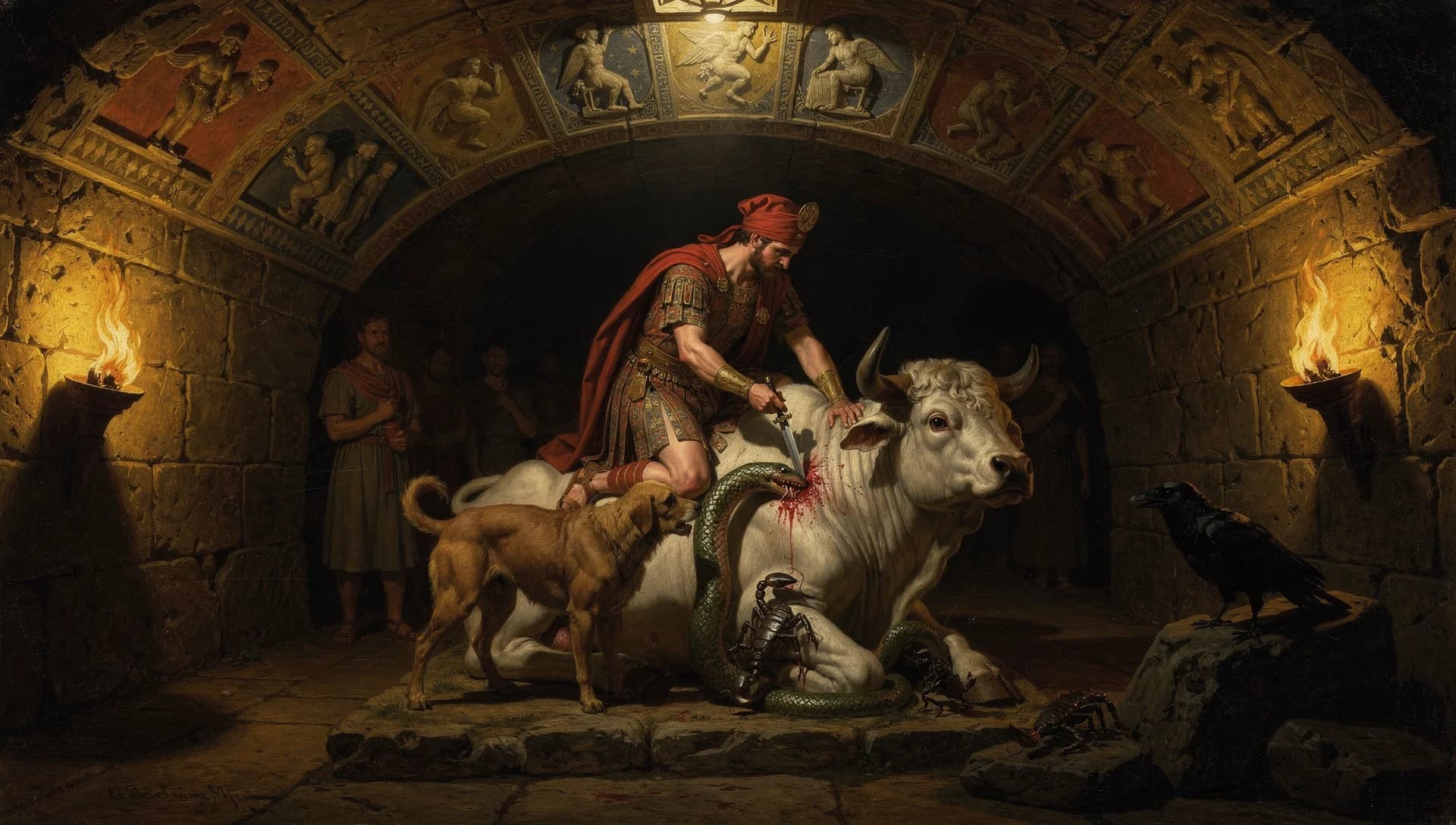
The Bull-Slayer and the Cosmic Ages: Mithraic Tauroctony and the Rebellion Memory
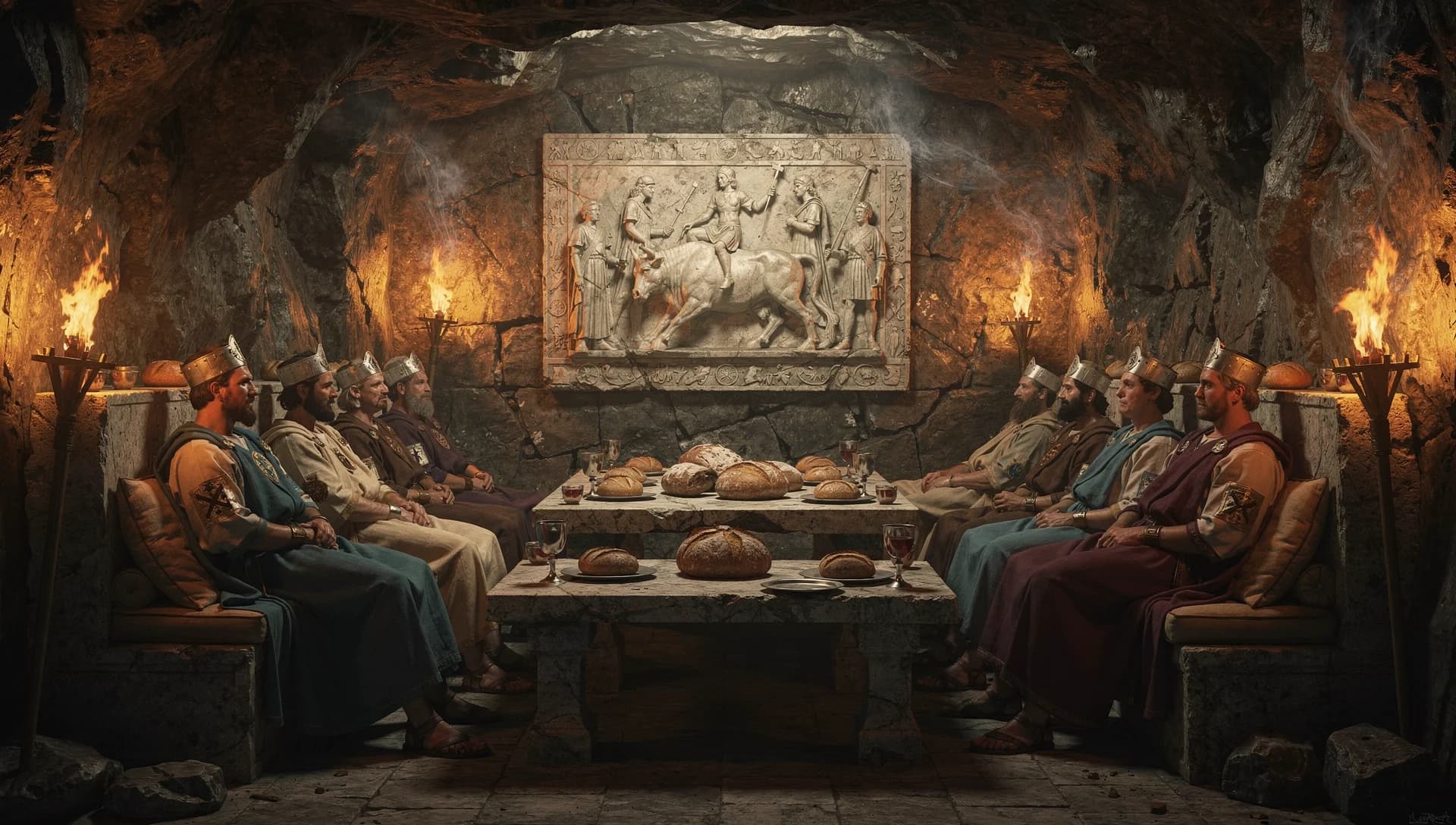
The Cult That Almost Became Christianity: Mithras and Corrupted Zoroastrianism
The Longest Memory: Australian Aboriginal Dreamtime and the Primordial Teaching-Ancestors
The Final Adjudication: Ragnarok and the Pending Verdict
The Newsletter
Get the research behind each piece
Free. New Urantia Book explorations, the sources behind the videos, and early looks. No spam, unsubscribe anytime.
Prefer video? Follow on YouTube and Facebook.
Delivered through Substack. You can also read past issues.