
The Sacrificed Son Who Rises: Osiris, Tammuz, Attis, and the Corrupted Salem Teaching
The dying-and-rising god motif appears with remarkable persistence across the ancient Near East and Mediterranean: Osiris in Egypt, Tammuz in Mesopotamia, Attis in Phrygia, Adonis in Syria. The Urantia Book identifies these mystery cults as degraded descendants of Salem missionary teaching. The original doctrine of salvation by faith in one God was slowly transformed into ritual reenactments of a sacrificed god whose resurrection was celebrated each year. The pattern is not pre-Christian prophecy. It is downstream corruption of the same Salem seed.
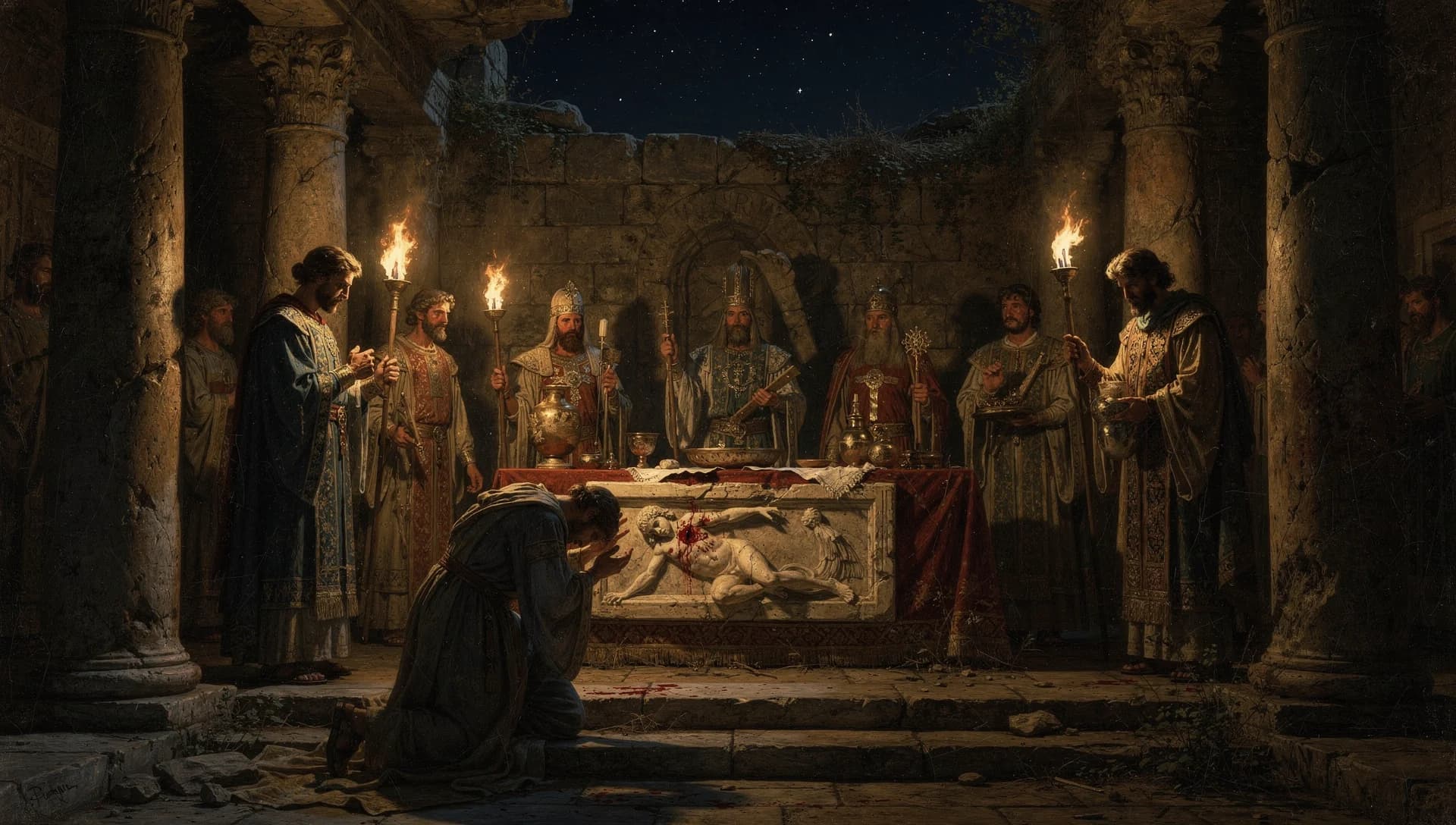
Corrupted Salem teaching ritualized into dying-god cults = Osiris, Tammuz, Attis, Adonis, Dionysus
This article expands on the decoder mapping. For the side-by-side card and quick reference, see the mapping page.
The Dying-and-Rising God Pattern
A single religious shape recurs across the ancient Mediterranean and Near East. A divine or half-divine son dies, and then he comes back. His death and his return are celebrated each year in ritual, and that annual cycle sits at the heart of the cult.
The chief examples are well known. In Egypt, Osiris is dismembered by his brother Set, scattered, reassembled by Isis, and resurrected as ruler of the underworld. The Nile's annual flood was tied ritually to his death and return. In Mesopotamia, the shepherd-god Tammuz (Sumerian Dumuzi) descends into the underworld and is partially restored through the intervention of his consort Inanna or Ishtar. In Phrygia, Attis is the consort of the goddess Cybele. He castrates himself, dies, and is mourned and celebrated every year in the bloody rites of the Cybele cult. In Syria, the beautiful youth Adonis is loved by Aphrodite, killed by a boar, and his blood produces the annual blooming of the anemone, marked across the Hellenistic world in the Adonis festivals. In certain Orphic strands, Dionysus is the twice-born god torn apart by the Titans and put back together.
The Urantia Book names these cults as corruptions of the original Salem monotheistic teaching.
What the Urantia Book Says
The mystery cults are documented at UB 98:4:
"The majority of people in the Greco-Roman world, having lost their primitive family and state religions and being unable or unwilling to grasp the meaning of Greek philosophy, turned their attention to the spectacular and emotional mystery cults from Egypt and the Levant." (98:4.1)
The three most popular cults are named directly:
"The three mystery cults which became most popular were:" (98:4.2)
"The Phrygian cult of Cybele and her son Attis." (98:4.3)
"The Egyptian cult of Osiris and his mother Isis." (98:4.4)
"The Iranian cult of the worship of Mithras as the savior and redeemer of sinful mankind." (98:4.5)
The dying-and-rising theology is laid out plainly:
"The Phrygian and Egyptian mysteries taught that the divine son (respectively Attis and Osiris) had experienced death and had been resurrected by divine power, and further that all who were properly initiated into the mystery, and who reverently celebrated the anniversary of the god's death and resurrection, would thereby become partakers of his divine nature and his immortality." (98:4.6)
The degraded character of the Phrygian rites is noted:
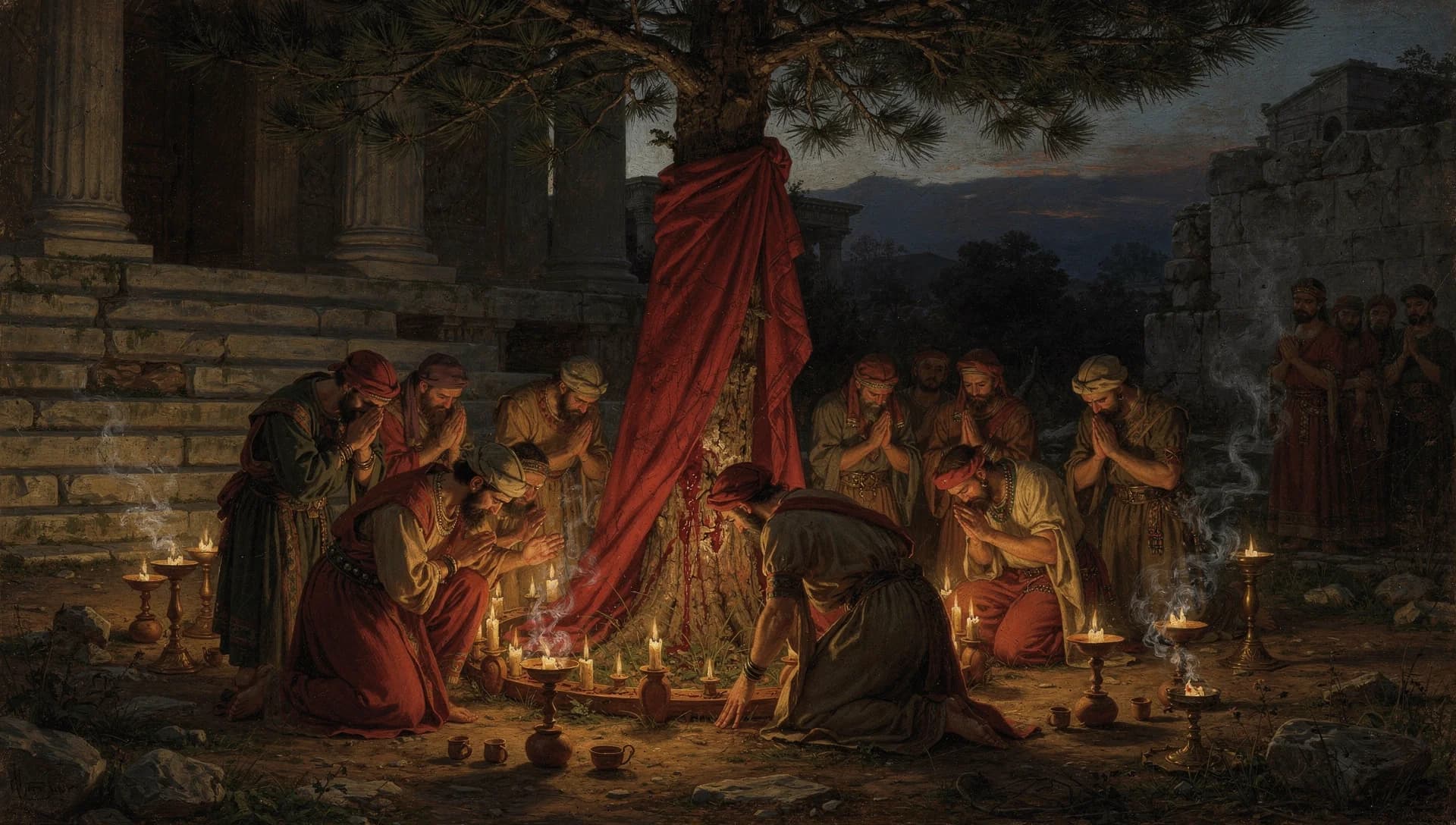
"The Phrygian ceremonies were imposing but degrading; their bloody festivals indicate how degraded and primitive these Levantine mysteries became. The most holy day was Black Friday, the 'day of blood,' commemorating the self-inflicted death of Attis." (98:4.7)
The Egyptian rites were a step up:
"The rituals of the worship of Isis and Osiris were more refined and impressive than were those of the Phrygian cult. This Egyptian ritual was built around the legend of the Nile god of old, a god who died and was resurrected, which concept was derived from the observation of the annually recurring stoppage of vegetation growth followed by the springtime restoration of all living plants." (98:4.8)
The Urantia Book traces how Salem monotheism turned into mystery religion across Papers 93 and 98. Salem missionaries planted their teaching across the Mediterranean and the Near East. The difficult conditions of preservation that the book describes at UB 93:7.3-4 produced partial survival, and the Salem content was absorbed and reshaped through generations of local elaboration.
The substrate it landed on matters. The ancient Mediterranean and Near East already had agricultural rituals tied to the yearly death and rebirth of vegetation. That existing ritual infrastructure absorbed the Salem promise of a future bestowal Son, and over generations the two fused. The dying-and-rising god cults preserved by the mystery religions are what came out of that fusion: Salem teaching corrupted, and then woven into older vegetation rites.
Mithraism is treated separately. The Mithraic transmission carried Persian content, derived from the Zoroastrian branch of the Salem teaching at UB 95:6, westward through the Roman military and administrative networks. That produced the soldier-oriented Mithraic cult of the late Empire. The Iranian Salem content preserved in Mithraism was distinct from the Egyptian and Phrygian streams, but it shared the same savior-figure shape.
What the Ancient Sources Say
The dying-and-rising god pattern was first treated systematically in Sir James Frazer's The Golden Bough (Macmillan, 1890; expanded twelve-volume third edition, 1906-1915). Frazer's pioneering comparative work documented the recurrence of the motif across the ancient Mediterranean, the Near East, and the broader religious world. His framework identified the death-and-resurrection cycle as one of the most widely attested patterns in ancient religion.
Frazer's sweeping synthesis later drew heavy criticism. Jonathan Z. Smith's "Dying and Rising Gods" in The Encyclopedia of Religion (Macmillan, 1987), and his later Drudgery Divine: On the Comparison of Early Christianities and the Religions of Late Antiquity (University of Chicago Press, 1990), pushed back hard on Frazer's generalizations. Smith argued that careful examination of each cult on its own terms revealed far less consistency than Frazer's grand synthesis suggested.
Tryggve Mettinger's The Riddle of Resurrection: "Dying and Rising Gods" in the Ancient Near East (Almqvist and Wiksell, 2001) re-examined the evidence in light of Smith's critique. Mettinger concluded that the dying-and-rising pattern is genuinely attested for Osiris, Dumuzi, Baal, and Melqart, contrary to Smith's broader skepticism. His philologically careful reading restored the cross-cultural pattern while taking Smith's methodological concerns seriously.
The individual cults are documented across a substantial literature. For Osiris, the Pyramid Texts (twenty-fourth century BCE), the Coffin Texts (Middle Kingdom), the Book of the Dead (New Kingdom), and the later Graeco-Egyptian elaborations, with Henri Frankfort's Kingship and the Gods (University of Chicago Press, 1948) as the principal scholarly synthesis. For Tammuz and Dumuzi, the Sumerian Descent of Inanna, the Akkadian Descent of Ishtar, and the broader Mesopotamian liturgical corpus, with Thorkild Jacobsen's The Treasures of Darkness (Yale University Press, 1976) as the principal treatment. For Attis, the Roman sources (Catullus 63, Ovid's Fasti 4, Lucretius's De Rerum Natura 2), the Greek sources (Pausanias, Herodotus), and the archaeological record from the Phrygian sanctuaries, with Maarten Vermaseren's Cybele and Attis (Thames and Hudson, 1977) as the standard synthesis.
Mithras is a different case. The cult left a great deal of archaeological evidence, with Mithraea scattered across the Empire from Britain to Syria, but very little text. That has made the theological reconstruction of the cult a contested business. Franz Cumont's Les mystères de Mithra (Bruxelles, 1903) established the foundational scholarly treatment. David Ulansey's The Origins of the Mithraic Mysteries (Oxford University Press, 1989) proposed the astronomical reading that has shaped much of the recent debate.
The relationship between the mystery cults and early Christianity has been argued over for more than a century. The religionsgeschichtliche Schule, the history-of-religions school active roughly from 1890 to 1930, proposed that early Christianity borrowed substantially from the mystery cults. Later scholarship has qualified this thesis heavily, recognizing a shared cultural and religious context while rejecting most direct borrowing claims. Bruce Metzger's "Methodology in the Study of the Mystery Religions and Early Christianity" (in Historical and Literary Studies, E. J. Brill, 1968) is a careful, methodologically restrained treatment of the question.
Why This Mapping Matters
The pre-Christian dying-and-rising god pattern has been read in very different ways. Christian apologists have sometimes treated it as demonic counterfeit, sometimes as providential preparation for the gospel. Comparative-religion scholarship has at times read early Christianity as dependent on the mystery cults. Skeptics have at times read Christianity as indistinguishable from them.
The Urantia Book offers a distinct alternative. The dying-and-rising god pattern is corrupted Salem teaching. The original Salem content, salvation by faith in one God and the expectation of a future bestowal Son, was absorbed and reshaped by local ritual cultures across generations of partial preservation.
This account resolves several long-running difficulties.
First, it explains why the pattern shows up across widely separated regions without requiring direct borrowing between the individual cults. The shared substrate is the Salem missionary enterprise, which planted monotheistic and bestowal-Son content across the Mediterranean and the Near East between roughly the twentieth and the first century BCE.
Second, it explains why the cults preserve both shared features and distinct ones. The shared features are the dying-and-rising structure, the annual ritual cycle, and the initiation into the god's immortality. The distinct features are local: Osiris is bound up with the Nile and the agricultural year, Attis with the bloody rites of Phrygia, Dumuzi with the shepherd-king of Mesopotamia. The shared shape comes from the common Salem source. The local color comes from the soil each cult grew in.
Third, it explains why the Christian event, though it shares some structural features with the mystery cults, differs from them in ways that go well beyond what borrowing could account for. The Christian event is the actual fulfillment of the original Salem expectation of a bestowal Son. The mystery cults are corrupted anticipations of that same expectation. The Christ is distinct from the mystery cult gods in historical reality, not merely in mythic structure.
Fourth, it explains the persistent worldwide expectation of a coming or returning divine Son that the mystery cults ritually embodied. The Salem teaching specifically promised that a bestowal Son would one day come to Urantia (93:9.10). The widespread dying-and-rising god cults are local performative preservations of that promise.
The degraded character of the cults, the bloody Phrygian rites, the spectacular and emotional rather than ethical and philosophical orientation, is what you would expect when elevated monotheistic content is absorbed into older vegetation and fertility religion. The Salem seed kept germinating, but in soil that had its own ideas about how a god should die.
The mapping's significance is this. The dying-and-rising god pattern is not pagan myth running in parallel to the Christian tradition, and it is not pre-Christian prophecy anticipating it. It is corrupted Salem-era preservation of a genuine expectation, planted by Salem missionaries across the pre-Christian Mediterranean and Near East. The shared structural features between the mystery cults and early Christianity trace back to that shared Salem substrate, not to direct borrowing. The distinct features of the Christian event trace back to the actual historical reality of the Christ bestowal as the fulfillment of what Salem had been promising all along.
Sources
- The Urantia Book, Paper 98 (The Melchizedek Teachings in the Occident). Urantia Foundation, first printing 1955. Cited passages: 98:4.1-8, 98:5.3-4.
- Frazer, James George. The Golden Bough: A Study in Magic and Religion. Macmillan, 1890; third edition in twelve volumes, 1906-1915.
- Smith, Jonathan Z. "Dying and Rising Gods." In The Encyclopedia of Religion, edited by Mircea Eliade, Macmillan, 1987.
- Smith, Jonathan Z. Drudgery Divine: On the Comparison of Early Christianities and the Religions of Late Antiquity. University of Chicago Press, 1990.
- Mettinger, Tryggve N. D. The Riddle of Resurrection: "Dying and Rising Gods" in the Ancient Near East. Almqvist and Wiksell, 2001.
- Frankfort, Henri. Kingship and the Gods: A Study of Ancient Near Eastern Religion as the Integration of Society and Nature. University of Chicago Press, 1948.
- Jacobsen, Thorkild. The Treasures of Darkness: A History of Mesopotamian Religion. Yale University Press, 1976.
- Vermaseren, Maarten J. Cybele and Attis: The Myth and the Cult. Thames and Hudson, 1977.
- Cumont, Franz. Les mystères de Mithra. Bruxelles, 1903.
- Metzger, Bruce M. "Methodology in the Study of the Mystery Religions and Early Christianity." In Historical and Literary Studies, E. J. Brill, 1968.
Confidence and Evidence
- Confidence: UB CONFIRMED
- Evidence rating: STRONG
- Basis: The Urantia Book names the mystery cults (Cybele-Attis, Osiris-Isis, Mithraism) at UB 98:4.1-8 and frames them as corrupted Salem teaching. The dying-and-rising god pattern is documented across substantial comparative-religion scholarship (Frazer, Mettinger). The mechanism of partial preservation followed by local degradation, which the Urantia Book documents at 93:7.3-4 and 98:4.7, accounts for both the shared underlying shape and the distinct local elaborations.
Related Decoder Articles
- Axial Age = Salem Continuity and Seven Teachers
- Osiris = Van Pattern and the Dalamatian Substrate
- Melchizedek = Machiventa and the Salem Enterprise
Byline: Derek Samaras | Urantia Book Network | April 2026
Connecting Articles
The Sky God Who Withdrew: African High-God Traditions and the Salem Teaching Layer
The Day of Blood: Black Friday, Attis, and the Pre-Christian Sacred Calendar
Seven Teachers, One Preparation: The Axial Age and the Salem Continuity
The Vow to Stay: Bodhisattva Ideal and the Salem Missionary Commission
The Newsletter
Get the research behind each piece
Free. New Urantia Book explorations, the sources behind the videos, and early looks. No spam, unsubscribe anytime.
Prefer video? Follow on YouTube and Facebook.
Delivered through Substack. You can also read past issues.