
The Grain Revealed: Eleusinian Mysteries and the Adamic Agricultural Inheritance
The Eleusinian Mysteries, centered on Demeter the grain mother and her daughter Persephone, were the oldest and most prestigious of the Greek mysteries. The climax of initiation was the silent disclosure of a single sheaf of grain. The Urantia Book names them as a Greek version of fertility worship that grew up after Salem missionary teaching had been diluted, preserving in sacramental form the memory of agriculture as a gift rather than an invention.
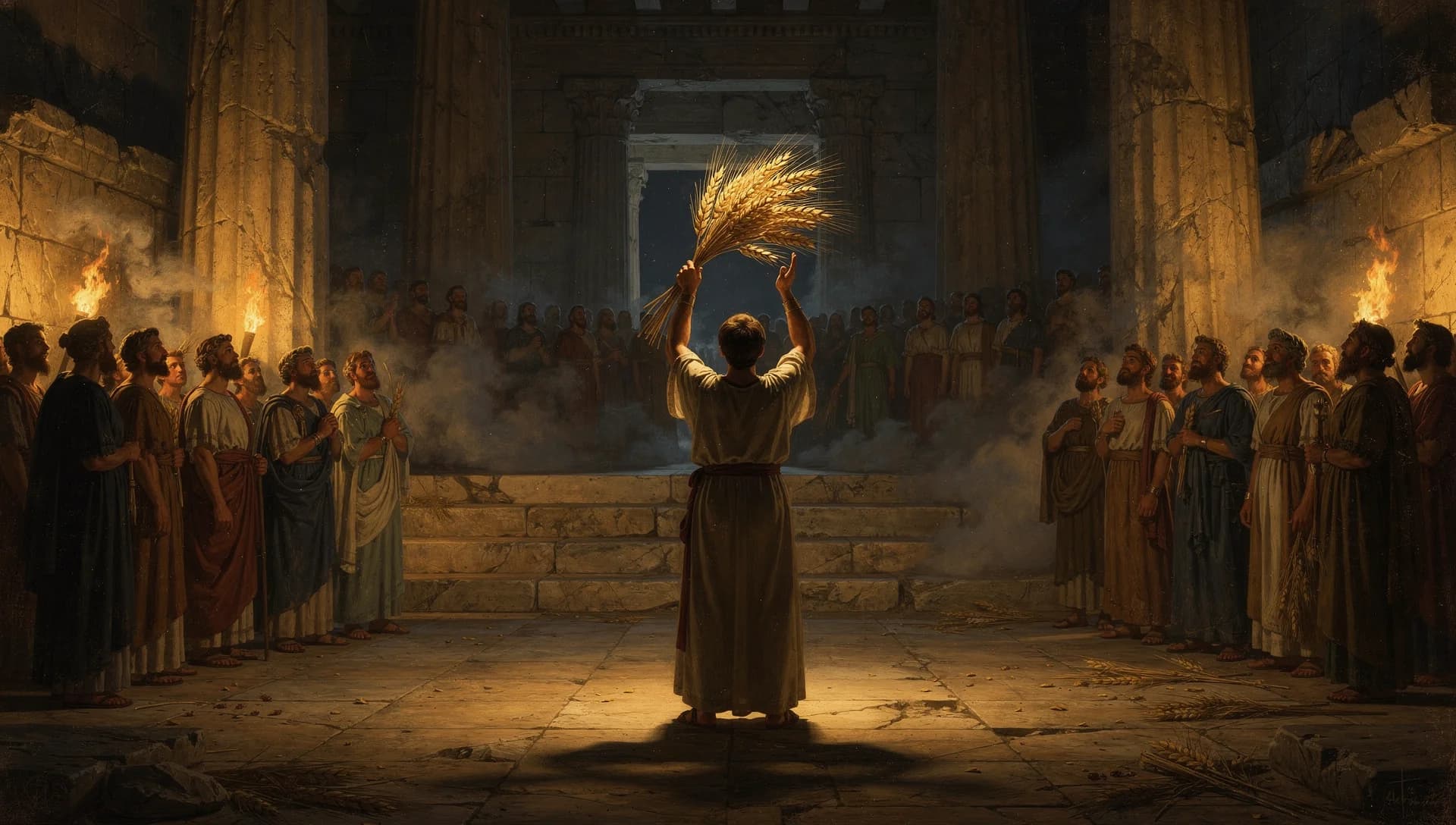
Adamic agricultural inheritance preserved in sacramental form = Eleusinian Mysteries, the grain-goddess and cultivated life
This article expands on the decoder mapping. For the side-by-side card and quick reference, see the mapping page.
The Greatest of the Greek Mysteries
The Eleusinian Mysteries were celebrated every year at Eleusis, an Attic sanctuary about fourteen miles west of Athens, from roughly the fifteenth century BCE until 392 CE. They were the oldest and most prestigious of the Greek mystery cults. The story at their heart is the story of Demeter, the grain goddess, and her daughter Persephone, who is carried into the underworld by Hades and whose annual return brings the spring back to life. The climax of the initiation rite, the Telete, was a single moment of pure stagecraft: a reaped sheaf of wheat, lifted in silence before the eyes of the initiates.
The Urantia Book identifies the Eleusinian Mysteries as Salem teaching that took on the form of a Greek fertility cult.
What the Urantia Book Says
The Urantia Book describes the Eleusinian and Orphic mysteries at UB 98:2.10:
"The Eleusinian mysteries grew up within the Olympian pantheon, a Greek version of the worship of fertility; Dionysus nature worship flourished; the best of the cults was the Orphic brotherhood, whose moral preachments and promises of salvation made a great appeal to many." (98:2.10)
The Adamic origin of advanced agriculture is documented in Paper 76, which describes the cultural advantage of the second Eden:
"Adam's caravan had carried the seeds and bulbs of hundreds of plants and cereals of the first garden with them to the land between the rivers; they also had brought along extensive herds and some of all the domesticated animals. Because of this they possessed great advantages over the surrounding tribes. They enjoyed many of the benefits of the previous culture of the original Garden." (76:3.6)
The Greek reception of Salem teaching is laid out at UB 98:2.1-12. The philosophers, Thales, Pythagoras, Xenophanes, and later Socrates, Plato, and Aristotle, took up the elevated content. The popular religion, unable or unwilling to embrace abstract monotheism, absorbed the same Salem material into the older Greek fertility traditions and produced the Eleusinian mystery form.
What the Ancient Sources Say
The Eleusinian Mysteries are documented through both texts and stones. The Homeric Hymn to Demeter (about the seventh century BCE) preserves the foundational narrative of Demeter and Persephone and records the founding of the cult at Eleusis. The archaeological site itself preserves substantial remains of the Telesterion, the initiation hall, across construction phases that run from Mycenaean times through the late Roman period.
Walter Burkert's Ancient Mystery Cults (Harvard University Press, 1987) is the principal modern synthesis. Burkert documents the grain revelation as the climax of initiation and traces the pre-Olympian roots of the Demeter cult to the older agricultural religion of pre-Hellenic Greece.
Carl Kerenyi's Eleusis: Archetypal Image of Mother and Daughter (Princeton University Press, 1967) offers the Jungian reading of the Demeter and Persephone story, with close attention to its agricultural roots. Kerenyi traces the Demeter cult back to Neolithic farming religion.
George Mylonas's Eleusis and the Eleusinian Mysteries (Princeton University Press, 1961) is the principal archaeological treatment. Mylonas's detailed excavation reports document the architecture and the physical evidence for the cult's operation across nearly eighteen centuries of unbroken observance.
The initiation sequence is partly known despite the strict secrecy of the cult. The public phases (the procession from Athens to Eleusis, the ritual bathing, the nine days of preliminary observance) are well documented. The secret climax (the Epopteia, the direct vision inside the Telesterion) survives only through hostile Christian sources. Hippolytus and Clement of Alexandria report that the culminating moment was the silent revelation of the grain.
The promise the cult made to its initiates was a blessed afterlife. A fragment of Sophocles's Triptolemus preserves the Eleusinian promise: "Thrice happy are those of mortals who, having seen those rites, depart for Hades; for to them alone is it granted to have true life there. To the rest, all there is evil." That soteriology, salvation through initiation knowledge, is Salem-derived content folded into a Greek agricultural cult.
The agricultural inheritance the Urantia Book describes lines up with the archaeologically documented shift from hunting and gathering to farming across the Neolithic Revolution in the Near East, roughly 10,000 to 8,000 BCE. Jared Diamond's Guns, Germs, and Steel (Norton, 1997) is the standard accessible treatment. On the Urantia Book reading, the Adamic enhancement of agricultural technique is the elevated cultural substrate that spread out from the second Eden across the Mediterranean and the wider Eurasian world.
Why This Mapping Matters
The Eleusinian emphasis on agriculture as a divine gift, rather than a thing humans figured out on their own, preserves a real memory of the Adamic agricultural inheritance the Urantia Book describes. The sacramental disclosure of the grain at the climax of the rite says, in ritual form, that agriculture is revealed knowledge.
The Demeter and Persephone story also encodes the agricultural year. Persephone's descent into the underworld, during which Demeter's grief stops the grain from growing, and her return to the surface, which triggers spring germination, set the annual cycle into mythic form. Encoding the farming year in ritual is one of the most effective ways a culture has of carrying farming knowledge across generations.
The salvation elements of the Eleusinian initiation, the promise of a blessed afterlife, the purification, the direct vision at the climax, carry Salem-derived content. The Adamic era preceded Machiventa Melchizedek's Salem mission by many millennia, but the Salem missionary effort reinforced and elaborated the older substrate, and the two layers eventually fused in Mediterranean religious development.
The cult lasted nearly eighteen centuries, from its Mycenaean beginnings to the Theodosian suppression in 392 CE. That is an extraordinary record of institutional preservation. The Christian suppression closed the formal tradition, but the Demeter and Persephone story kept moving through Western culture under other names.
The point of the mapping is this: the Eleusinian Mysteries should be read as genuine preservation of the Adamic agricultural revelation, with Salem-era soteriology layered on top, all of it synthesized into the Greek fertility cult that dominated popular Greek religion across the Classical and Hellenistic periods. The Urantia Book's note at 98:2.10 names the Salem-derived character of the content directly.
Sources
- The Urantia Book, Paper 76 (The Second Garden), Paper 98 (The Melchizedek Teachings in the Occident). Urantia Foundation, first printing 1955. Cited passages: 76:4 (Adamic agriculture), 98:2.10.
- Burkert, Walter. Ancient Mystery Cults. Harvard University Press, 1987.
- Kerenyi, Carl. Eleusis: Archetypal Image of Mother and Daughter. Princeton University Press, 1967.
- Mylonas, George E. Eleusis and the Eleusinian Mysteries. Princeton University Press, 1961.
- Parker, Robert. Polytheism and Society at Athens. Oxford University Press, 2005.
- Homeric Hymn to Demeter. In The Homeric Hymns, translated by Jules Cashford, Penguin Classics, 2003.
- Diamond, Jared. Guns, Germs, and Steel: The Fates of Human Societies. Norton, 1997.
Confidence and Evidence
- Confidence: UB CONFIRMED
- Evidence rating: STRONG
- Basis: The Urantia Book directly names the Eleusinian mysteries as a Greek version of fertility worship that grew up after Salem missionary influence had been diluted (UB 98:2.10). The grain revelation at the climax of initiation matches the Adamic agricultural substrate. The salvation promise of the cult matches the Salem-derived soteriology. The nearly eighteen centuries of continuous observance represent a remarkable preservation of cultural memory.
Related Decoder Articles
- Orphic Brotherhood = Thought Adjuster Teaching
- Dying-and-Rising Gods = Corrupted Salem Teaching
- Adam and the Violet Race
Byline: Derek Samaras | Urantia Book Network | April 2026
Connecting Articles
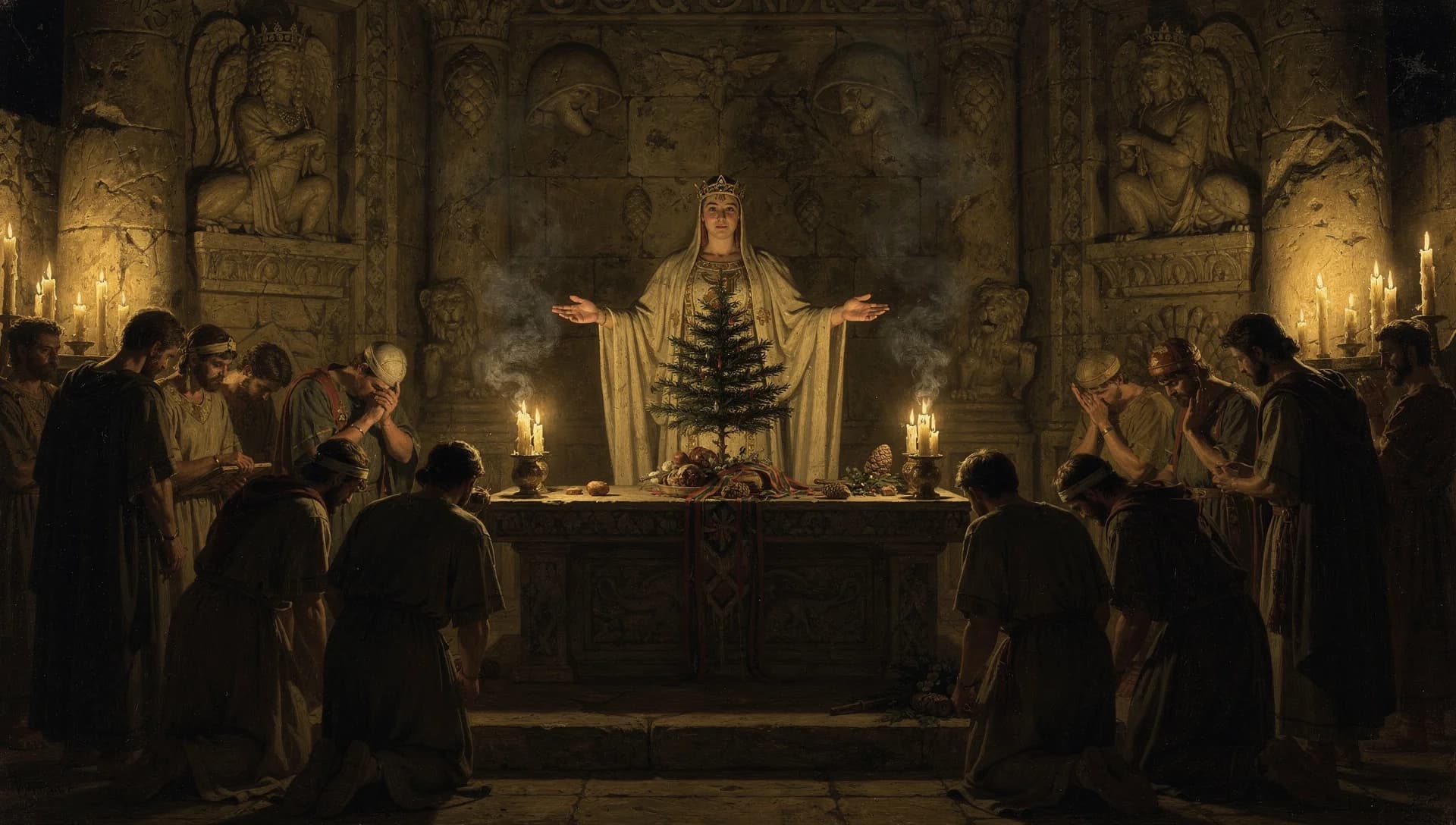
The Mother and Her Dying Son: Cybele, Attis, and the Corrupted Salem Teaching
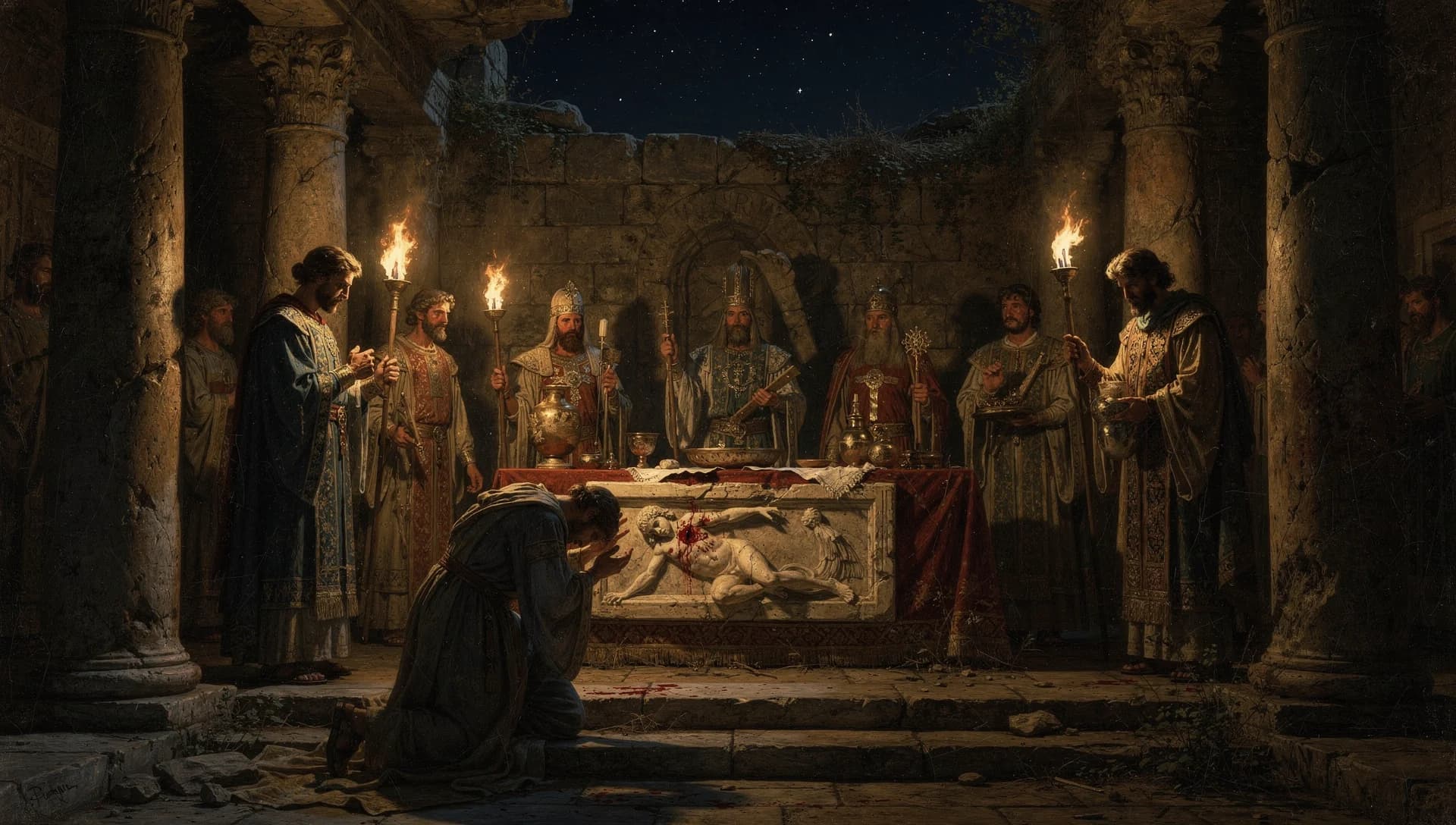
The Sacrificed Son Who Rises: Osiris, Tammuz, Attis, and the Corrupted Salem Teaching
The Three-Source Christianity: Paul, Mystery Cults, and the Composite Religion

The Longest Memory: Australian Aboriginal Dreamtime and the Primordial Teaching-Ancestors
The Newsletter
Get the research behind each piece
Free. New Urantia Book explorations, the sources behind the videos, and early looks. No spam, unsubscribe anytime.
Prefer video? Follow on YouTube and Facebook.
Delivered through Substack. You can also read past issues.