
 Mythic
Jewish heaven, hell, devils derived from Zoroastrianism
 UB
UBZoroastrian influence on Jewish theology
Full Article
Read the deep-dive article on this connection
Zoroastrian influence on Jewish theology = Jewish heaven, hell, devils derived from Zoroastrianism
The Connection
The UB states that Jewish concepts of heaven, hell, and devil figures were largely derived from Zoroastrian contact during and after the Babylonian exile. Before Persian influence, Hebrew theology had minimal afterlife doctrine. The elaborate angelology, demonology, and eschatology of Second Temple Judaism trace directly to Zoroastrian transmission.
UB Citation
Academic Source
Hinnells, Persian Mythology (1973); Barr, The Question of Religious Influence (1985)
Historical Evidence(Strong evidence)
The UB directly attributes Jewish afterlife concepts to Zoroastrian influence. John Hinnells documents the extensive parallels between Zoroastrian and Jewish eschatology: bodily resurrection, final judgment, heaven and hell, angelic hierarchies, and a cosmic adversary. James Barr notes that pre-exilic Hebrew religion had "virtually no concept of meaningful afterlife," with Sheol being a shadowy, neutral realm. The transformation occurred during and after Persian contact (539 BCE onward), consistent with the UB timeline.
Deep Dive
Read the Hebrew Bible from beginning to end and pay attention to the development of certain ideas. In the books of the Pentateuch, the historical books of Joshua through Kings, and the pre-exilic prophets, you find a particular theological vocabulary. Sheol is the abode of the dead, a shadowy underground place where all souls go regardless of moral behavior, with no clear distinction between the righteous and the wicked in their post-mortem state. The afterlife is barely articulated. There is no developed doctrine of resurrection, no heaven, no hell, no fully personal devil, no elaborate angelic hierarchy with named individual angels. The opposition between good and evil is real but is not yet cosmic-metaphysical; the Hebrew tradition is monotheistic and the Lord deals with both good and evil within the unity of his sovereignty.
Now read the post-exilic and Second Temple Jewish literature: Daniel, Tobit, the Enoch literature, the Qumran scrolls, the apocalyptic apocrypha, the Mishnah and the early Talmud. The vocabulary has changed dramatically. There is now a developed doctrine of resurrection. There is a heaven and a hell with clear moral discrimination. There are named angels (Michael, Gabriel, Raphael, Uriel) with defined functions. There is a cosmic adversary, Satan, who has become a personal cosmic figure rather than a member of the divine council. There is an elaborate eschatology with a coming day of judgment, a messianic figure, and a final restoration. The transformation is so substantial that it constitutes effectively a new theological system grafted onto the older Hebrew base.
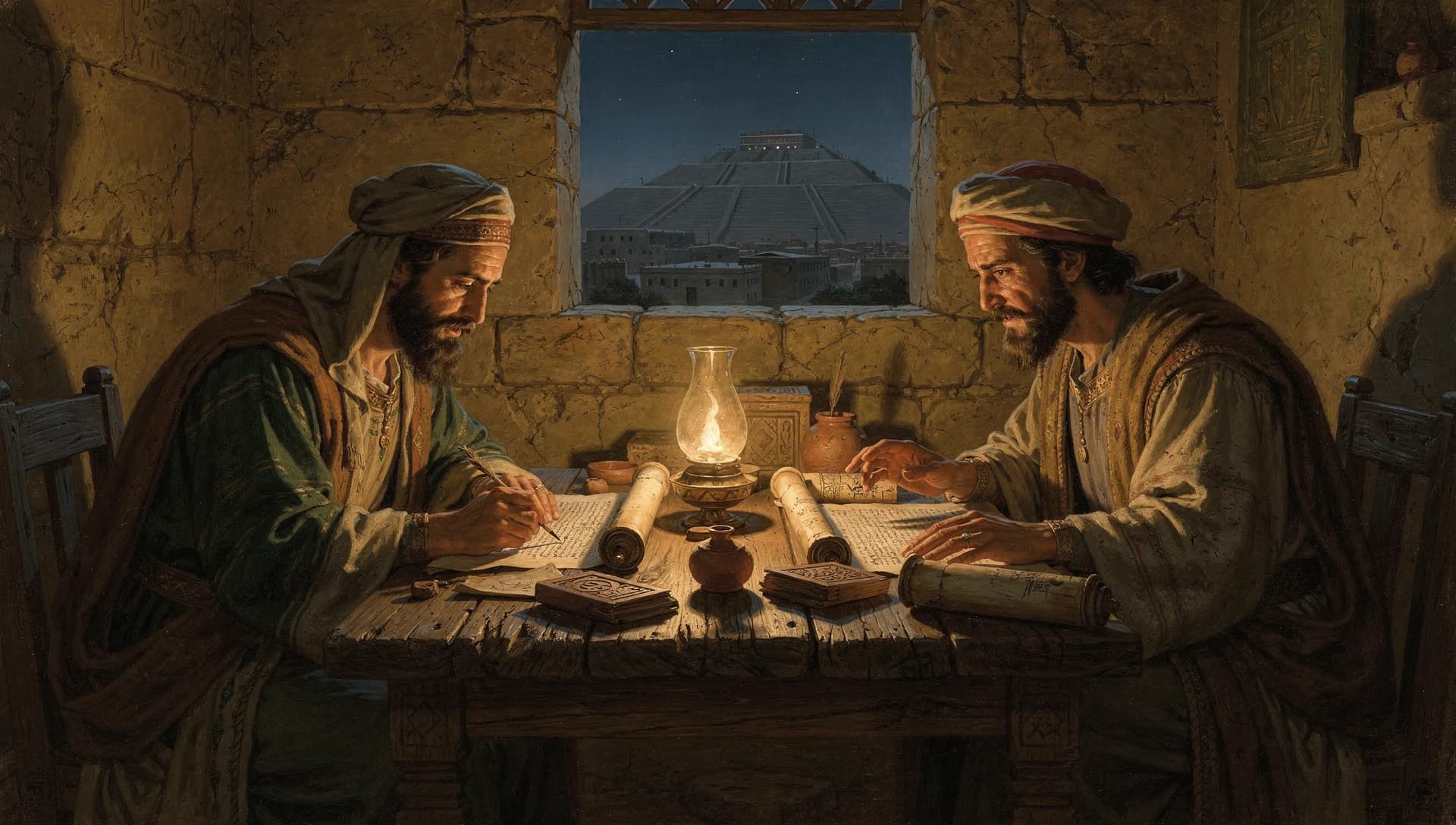
What changed between the pre-exilic and post-exilic theological vocabularies? The Babylonian exile (586-539 BCE) and the subsequent Persian period (539-332 BCE). For roughly two centuries the Jewish community lived under Achaemenid Persian rule, with extensive contact with the Zoroastrian religious establishment. The transformation of Jewish theology during this period is documented through the surviving sources and is the subject of an extensive academic literature.
The Urantia Book at 95:6.6 records this transmission directly: the Jewish traditions of heaven and hell and the doctrine of devils as recorded in the Hebrew scriptures, while founded on the lingering traditions of Lucifer and Caligastia, were principally derived from the Zoroastrians during the times when the Jews were under the political and cultural dominance of the Persians. Zoroaster, like the Egyptians, taught the day of judgment, but he connected this event with the end of the world. Paper 95:6.7 adds that the teachings of Zoroaster thus came successively to impress three great religions: Judaism and Christianity and, through them, Mohammedanism.
This is one of the most consequential UB historical claims. The eschatological architecture of Western monotheism, the heaven-and-hell, the personal devil, the angelic hierarchy, the bodily resurrection, the cosmic judgment day, is Zoroastrian in immediate origin. It entered Jewish theology through the Persian period of Jewish history, was inherited by Christianity from Second Temple Jewish theology, and was inherited by Islam from the broader Near Eastern monotheistic synthesis. Approximately half of the distinctive theological content of contemporary Christianity and Islam, on the UB account, traces back through Zoroaster to the original Salem-derived teaching at Ur.
John Hinnells' 1973 monograph Persian Mythology and his subsequent academic work documented the extensive parallels between Zoroastrian and Jewish eschatology. James Barr's 1985 article The Question of Religious Influence acknowledged that pre-exilic Hebrew religion had virtually no concept of meaningful afterlife, with Sheol being a shadowy, neutral realm, and that the transformation occurred during and after Persian contact. The academic consensus, while cautious about the specific mechanisms, broadly accepts that Zoroastrian influence was a major factor in the transformation of Jewish theology during the Persian and Hellenistic periods.
The structural fit with the UB account is precise. The Hebrew theological development followed exactly the trajectory the UB describes: pre-exilic Hebrew religion preserved the Salem-derived Abrahamic covenant in attenuated form, the Babylonian exile and Persian period exposed the Jewish community to the more developed Zoroastrian formulation of essentially the same Salem-derived material, and the post-exilic Jewish synthesis combined the two streams into the elaborate theological system that became the matrix from which Christianity and Islam both emerged.
The strongest counterargument is that the developments in post-exilic Jewish theology can be explained as internal Jewish reflection on the experiences of exile and restoration without requiring Zoroastrian influence as a primary source. This is the position taken by some academic scholars (notably Jon Levenson) who emphasize internal Jewish development. The reply is that the cluster of features that emerges in post-exilic Jewish theology (developed afterlife, personal devil, angelic hierarchy, eschatological judgment) matches the cluster present in Zoroastrianism with such precision that internal-development-alone is implausible. The UB account combines internal Jewish reflection with external Zoroastrian transmission to produce a more complete explanation.
What the parallel implies is profound for the contemporary monotheistic believer. The doctrines of heaven and hell, of angels and devils, of resurrection and judgment, that pervade Christian and Islamic theology, are not directly biblical in origin. They are Salem-derived, transmitted through Zoroaster, absorbed into post-exilic Judaism, and inherited by the later monotheisms. This is not a debunking. The doctrines are not wrong because of their transmission lineage. They are partial preservations of the same underlying Salem-derived teaching that the UB makes available in fuller form. For contemporary readers wrestling with the relationship between biblical and post-biblical theological developments, the UB framework offers a way to take both seriously as legitimate inheritances of the underlying revelation.
Key Quotes
“The Jewish traditions of heaven and hell and the doctrine of devils as recorded in the Hebrew scriptures, while founded on the lingering traditions of Lucifer and Caligastia, were principally derived from the Zoroastrians during the times when the Jews were under the political and cultural dominance of the Persians. Zoroaster, like the Egyptians, taught the “day of judgment,” but he connected this event with the end of the world.”
“Even the religion which succeeded Zoroastrianism in Persia was markedly influenced by it. When the Iranian priests sought to overthrow the teachings of Zoroaster, they resurrected the ancient worship of Mithra. And Mithraism spread throughout the Levant and Mediterranean regions, being for some time a contemporary of both Judaism and Christianity. The teachings of Zoroaster thus came successively to impress three great religions: Judaism and Christianity and, through them, Mohammedanism.”
“Hinnells documents the extensive parallels between Zoroastrian and post-exilic Jewish eschatology, with the doctrines of bodily resurrection, final judgment, heaven and hell, and angelic hierarchies appearing in Jewish theology after the Persian period in forms that closely match the Zoroastrian formulations.”
“Barr acknowledges that pre-exilic Hebrew religion had virtually no concept of meaningful afterlife, with the transformation toward developed eschatology occurring during and after the Persian period of Jewish history.”
Cultural Impact
The Zoroastrian theological inheritance shapes the entire eschatological imagination of contemporary Western monotheism. The Christian doctrine of heaven and hell, the Islamic Jannah and Jahannam, the Jewish Olam Ha-Ba, are all developments of the Zoroastrian framework grafted onto the older Hebrew base during the Persian and Hellenistic periods. The personal figure of Satan in Christianity, the Iblis of Islam, and the developed angelology and demonology of all three traditions trace through this lineage. The figure of the Messiah in Christianity (and the Mahdi in Islam) carries Zoroastrian Saoshyant inheritance. The apocalyptic literature that pervades the New Testament, particularly the book of Revelation, is structurally Zoroastrian in its cosmic-conflict framing and eschatological architecture. Beyond the high theological tradition, the Zoroastrian inheritance shapes Western popular religious imagination through Christmas (the Magi being Zoroastrian priests), through medieval and modern devil-iconography, through the cosmic-battle framing of Christian apocalyptic, and through the heaven-and-hell architecture of Western afterlife imagination. Approximately half of the distinctive theological vocabulary of Western monotheism is, in immediate genealogical terms, a Zoroastrian inheritance. This is one of the most underappreciated facts of comparative religion.
Modern Resonance
Many contemporary Christians and Muslims are unaware that core elements of their inherited theology came through Zoroaster rather than directly from the Hebrew scriptures or the New Testament. The UB framework makes this transmission lineage explicit and offers a way to integrate the Zoroastrian inheritance into a coherent account of revealed religion. The inheritance is not corrupting; it is part of the underlying Salem-derived teaching being transmitted through multiple channels. For Christians who have been disturbed by the discovery that hell, the devil, and the angels are not directly biblical in their developed forms, the UB framework offers a way to take the doctrines seriously without requiring them to be biblical inventions. For Jewish readers, the framework offers an explanation of why post-exilic Jewish theology differs so substantially from pre-exilic theology. For Muslim readers, the framework places the Quranic eschatology in its proper Near Eastern monotheistic lineage. For interfaith dialogue, the framework provides shared genealogical context that can ground productive conversation across the three Abrahamic traditions and Zoroastrianism. The Salem teaching is the common root. The various traditions are differential preservations. The UB undertakes to restore the underlying source.
Related Mappings
Zoroaster, Salem missionary descendant
= Zarathustra, founder of Zoroastrianism
Seven Master Spirits, supreme universe administrators
= Ahura Mazda + seven supreme gods (Amesha Spentas)
Lucifer rebellion, distorted memory of cosmic war
= Zoroastrian dualism (Ahura Mazda vs. Angra Mainyu)
Corrupted Zoroastrianism in Rome
= Mithras, mystery cult with December 25th festival
Related Articles
Where to next
The free newsletter. The research behind each piece, no spam.