
 Mythic
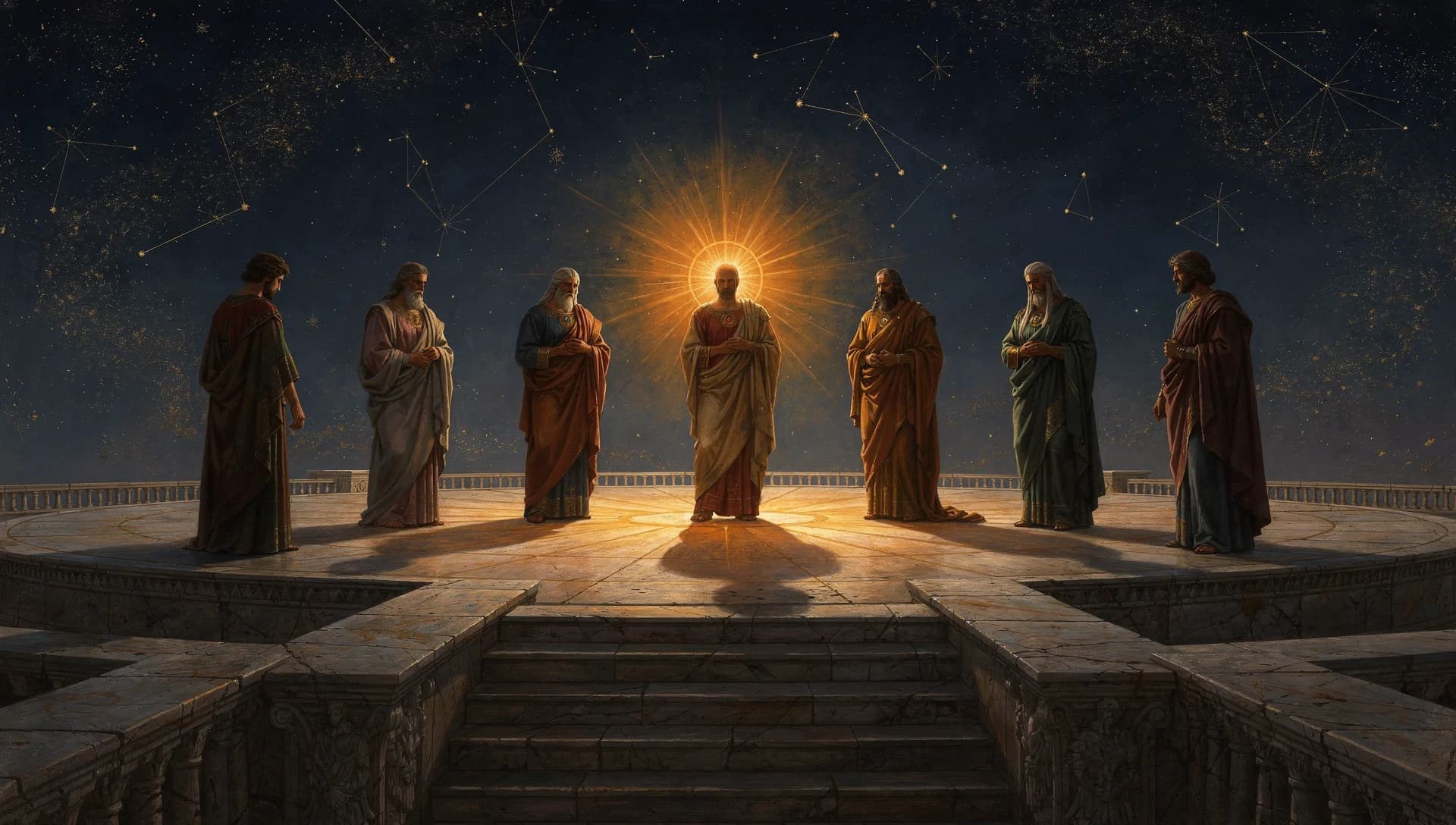
Ahura Mazda + seven supreme gods (Amesha Spentas)
 UB
UBSeven Master Spirits, supreme universe administrators
Full Article
Read the deep-dive article on this connection
Seven Master Spirits, supreme universe administrators = Ahura Mazda + seven supreme gods (Amesha Spentas)
The Connection
The UB draws a connection between Zoroaster's concept of Ahura Mazda surrounded by seven supreme spiritual beings (Amesha Spentas) and the actual universe structure of seven Master Spirits. The Amesha Spentas govern aspects of creation (righteousness, good mind, devotion, dominion, health, immortality) much as the Master Spirits govern the seven superuniverses.
UB Citation
Academic Source
Boyce, A History of Zoroastrianism Vol. I (1975); Rose, Zoroastrianism: An Introduction (2011)
Historical Evidence(Moderate evidence)
The UB states that Zoroaster's formulation of Ahura Mazda and seven supreme beings reflects a garbled memory of the Seven Master Spirits. Jenny Rose documents the Amesha Spentas as seven divine beings emanating from Ahura Mazda, each governing a domain of creation. The sevenfold divine structure is one of the most distinctive features of Zoroastrianism, and the UB provides a cosmological explanation for its origin.
Deep Dive
In the Yashts, the hymnic compositions of the Younger Avesta, the Iranian theological imagination crystallizes a distinctive structure. At the center stands Ahura Mazda, the Wise Lord, the supreme creator. Around him stand six (or seven, with Ahura Mazda himself counted as one of the seven) supreme spiritual beings, the Amesha Spentas, the Holy Immortals. Each governs a specific domain of moral and cosmic reality. Vohu Manah is Good Mind. Asha Vahishta is Best Righteousness. Khshathra Vairya is Desirable Dominion. Spenta Armaiti is Holy Devotion. Haurvatat is Wholeness. Ameretat is Immortality. Together they constitute the inner spiritual cabinet of Ahura Mazda, the seven through whom the supreme creative will is mediated into the cosmos. This sevenfold spiritual structure is one of the most distinctive features of Zoroastrianism and is unparalleled in the surrounding Iranian and Indo-European traditions.
The Urantia Book's account of universe administration places at its center the Seven Master Spirits, the seven primary personalities of the Conjoint Actor (the Infinite Spirit), each governing one of the seven superuniverses of the grand universe and each representing a specific combination of the Trinity persons in their cosmic activity. Paper 16 of the UB describes the Seven Master Spirits in detail: each has a distinctive nature and function, each governs a specific superuniverse domain, each contributes a specific quality to the unfolding of the cosmic plan. The Master Spirits are not separate deities but functional differentiations within the Conjoint Actor, the way the Infinite Spirit's activity is structured to govern the seven superuniverses.
Paper 95:6.2 records that Zoroaster, after learning of the story of the Seven Master Spirits as the tradition lingered in Ur, accordingly created a galaxy of seven supreme gods with Ahura-Mazda at its head, associating these subordinate gods with the idealization of Right Law, Good Thought, Noble Government, Holy Character, Health, and Immortality. The UB at 95:6.5 further records that Zoroastrianism is the only Urantian creed that perpetuates the Dalamatian and Edenic teachings about the Seven Master Spirits. While failing to evolve the Trinity concept, it did in a certain way approach that of God the Sevenfold.
This is a striking and specific UB claim. Of all the world religions, Zoroastrianism alone has preserved a recognizable structural memory of the Seven Master Spirits. The Amesha Spentas, with their sevenfold structure governing distinct domains under a supreme creator, are the cultural-historical residue of the original Salem-derived teaching about the Seven Master Spirits, transmitted to Zoroaster at Ur and reformulated in Iranian theological vocabulary. The mapping is not perfect: the Amesha Spentas are individually personified in the Iranian tradition in a way the Master Spirits are not in the UB tradition; the Amesha Spentas are six-plus-Mazda rather than seven; the specific domains differ. But the structural core, a sevenfold differentiation of supreme spiritual administration under a single supreme creator, is preserved in Zoroastrianism in a way it is not preserved in any other surviving world religion.
Mary Boyce's first volume of A History of Zoroastrianism (1975) documents the Amesha Spentas in detail, with each holy immortal having a specific cosmic and moral function and specific physical-world correspondences (sky, fire, earth, water, plants, animals, humans). Jenny Rose's 2011 Zoroastrianism: An Introduction provides a contemporary survey of the Amesha Spentas as the central theological structure of the tradition. The sevenfold structure pervades Zoroastrian liturgical practice, with the seven primary creations corresponding to the seven Holy Immortals and the seven great festivals of the Zoroastrian calendar.
The structural fit with the UB account is striking enough that it requires explanation. The Amesha Spentas are not a vague abstract sevenfold structure; they are a specific theological doctrine of a sevenfold supreme spiritual administration governing specific domains of cosmic reality under a single creator. The UB's identification of this as the residue of Salem-derived teaching about the Seven Master Spirits is parsimonious: it explains why this particular theological structure appears in Zoroastrianism (transmission from the Salem-derived material at Ur) and why it does not appear in surrounding traditions (which did not receive the Salem material in this form). The alternative explanation, independent Iranian invention of an unprecedented theological structure, has no obvious internal Iranian precedent to point to.
The strongest counterargument is that the Amesha Spentas can be explained as a development from the older Indo-Iranian asuras (the Vedic ahuras), with each Holy Immortal corresponding to a specific moral-cosmic domain that emerged within Iranian theological thought without external influence. This is a fair point. The reply is that the specific sevenfold-supreme-administration-under-one-creator structure is not present in the Indo-Iranian tradition before Zoroaster and is unique to his reform, and the UB account explains this by identifying the source.
What the parallel implies is that the cosmological structure of the universe, the sevenfold superuniverse organization with Master Spirits, has been preserved in fragmentary form in Zoroastrian theology and is available to the contemporary reader through that lineage. The Zoroastrian Amesha Spentas are not an exotic Iranian invention but a real cosmic structure remembered, with theological embellishment, in a particular historical religious tradition. The UB completes the partial preservation by giving the cosmological reality in fuller form. For contemporary readers, the Amesha Spentas become intelligible as the Iranian preservation of a real cosmological structure rather than as an arbitrary mythological elaboration.
Key Quotes
“This founder of a new religion was a virile and adventurous youth, who, on his first pilgrimage to Ur in Mesopotamia, had learned of the traditions of the Caligastia and the Lucifer rebellion, along with many other traditions, all of which had made a strong appeal to his religious nature. ... He had learned of the story of the Seven Master Spirits as the tradition lingered in Ur, and, accordingly, he created a galaxy of seven supreme gods with Ahura-Mazda at its head. These subordinate gods he associated with the idealization of Right Law, Good Thought, Noble Government, Holy Character, Health, and Immortality.”
“Zoroastrianism is the only Urantian creed that perpetuates the Dalamatian and Edenic teachings about the Seven Master Spirits. While failing to evolve the Trinity concept, it did in a certain way approach that of God the Sevenfold.”
“Boyce documents the Amesha Spentas as a sevenfold differentiation of supreme spiritual administration under Ahura Mazda, with each Holy Immortal governing a specific cosmic domain and physical creation.”
“Rose presents the Amesha Spentas as the central theological structure of the Zoroastrian tradition, with the sevenfold organization pervading liturgical practice and cosmological imagination.”
Cultural Impact
The sevenfold supreme-spiritual-administration structure of Zoroastrianism has shaped the theological imagination of all the major Western monotheisms in subtle but real ways. The seven archangels of late Second Temple Jewish tradition (Michael, Gabriel, Raphael, Uriel, and three others varying by source) are a Zoroastrian-influenced development, with the angelic hierarchy emerging in Jewish theology only after the Persian period. The seven spirits of God in the Book of Revelation echo the same structural pattern. The seven sacraments of medieval Catholic theology, the seven heavens of Islamic eschatology, the seven gifts of the Spirit in Christian theology, all are downstream developments of the underlying sevenfold structure that Zoroastrianism preserved most clearly. In Western occult and esoteric tradition, the seven planetary rulers, the seven chakras (a separate but parallel Indian development), the seven days of the week, and the seven liberal arts all participate in the broader sevenfold-organization motif. Carl Jung treated the seven as a primary archetype of completeness. Beyond the high tradition, the sevenfold structure pervades Western folk-numerology in ways most contemporary Westerners do not consciously recognize: the seven dwarfs, the seven samurai, the seven seas, the seven wonders, are all participating in the deep cultural inheritance of the seven-as-complete-administration motif.
Modern Resonance
The contemporary fascination with the number seven, manifest in everything from popular culture to esoteric tradition, is the deep cultural memory of a real cosmological structure. The UB framework makes this memory intelligible by tracing it to its source: the universe is structured into seven superuniverses, administered by seven Master Spirits, and this real structure has been remembered, with various degrees of fidelity, across many cultures and millennia. For the contemporary reader drawn to numerological or esoteric traditions of the seven, the UB framework offers a way to take the underlying intuition seriously without uncritically accepting any particular esoteric system. The seven is real because it reflects a real cosmological structure. The Zoroastrian preservation is the clearest of the historical preservations. The Christian, Jewish, and Islamic developments are partial inheritances. The UB completes the picture. For contemporary spiritual practice, this offers a corrective to the modern assumption that numerological structures are mere cultural conventions: some of them are real cosmological structures preserved in cultural memory.
Related Mappings
Zoroaster, Salem missionary descendant
= Zarathustra, founder of Zoroastrianism
Lucifer rebellion, distorted memory of cosmic war
= Zoroastrian dualism (Ahura Mazda vs. Angra Mainyu)
Zoroastrian influence on Jewish theology
= Jewish heaven, hell, devils derived from Zoroastrianism
Corrupted Zoroastrianism in Rome
= Mithras, mystery cult with December 25th festival
Related Articles
Where to next
The free newsletter. The research behind each piece, no spam.