
 Mythic
Mithras, mystery cult with December 25th festival
 UB
UBCorrupted Zoroastrianism in Rome
Full Article
Read the deep-dive article on this connection
Corrupted Zoroastrianism in Rome = Mithras, mystery cult with December 25th festival
The Connection
The UB identifies Mithraism as a corruption of Zoroastrianism that became the dominant mystery religion of the Roman Empire. The Mithraic December 25th festival (Dies Natalis Solis Invicti, birthday of the Unconquered Sun) was later adopted as the date for Christmas. Mithraism was Christianity's primary competitor in the Roman world.
UB Citation
Academic Source
Clauss, The Roman Cult of Mithras (2000); Beck, The Religion of the Mithras Cult (2006)
Historical Evidence(Strong evidence)
The UB traces Mithraism from Zoroastrian roots through its Roman transformation. Manfred Clauss documents Mithraism as the most widespread mystery religion in the Roman Empire, with temples (mithraea) found from Britain to Syria. Roger Beck confirms the December 25th solar festival and its later Christian adoption. The Chronograph of 354 CE first records December 25 as Jesus' nativity date, centuries after Mithraic practice had established the date as the birthday of the sun god.
Deep Dive
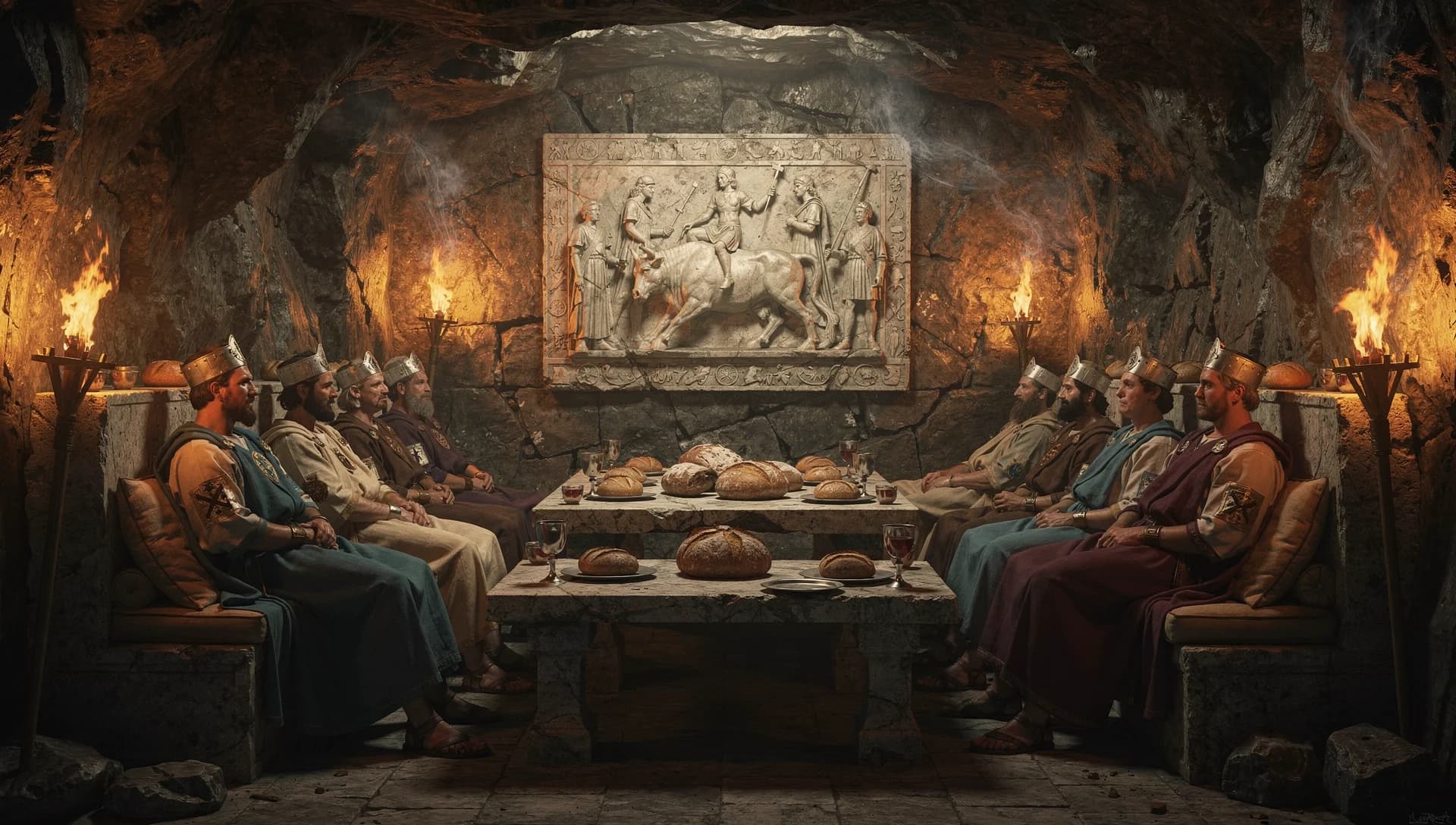
By the second century CE, walking through any major city of the Roman Empire, you would have found a particular kind of underground cult chamber. Long, rectangular, vaulted, with stone benches running along both walls and at the head of the room a relief or fresco of a young man slaying a bull. This was a Mithraeum, and there were probably four hundred to seven hundred of them across the empire, from Hadrian's Wall to the Euphrates frontier. The cult was nearly exclusively male, popular with soldiers, civil servants, freedmen, and slaves. Initiation was through seven progressive grades, each with its own iconography, secrets, and ritual obligations. The annual high festival was December 25, the day of Sol Invictus, the Unconquered Sun. The cult worshipped Mithras, a god whose name was Iranian but whose Roman cult had been substantially reshaped from its older Iranian roots.
The Urantia Book at 98:5.3-4 gives a remarkably full account of Mithraism. The cult portrayed a militant god taking origin in a great rock, engaging in valiant exploits, and causing water to gush forth from a rock struck with his arrows. There was a flood from which one man escaped in a specially built boat and a last supper which Mithras celebrated with the sun-god before he ascended into the heavens. This sun-god, or Sol Invictus, was a degeneration of the Ahura-Mazda deity concept of Zoroastrianism. Paper 95:6.7 traces the Iranian Mithraic origins: when the Iranian priests sought to overthrow the teachings of Zoroaster, they resurrected the ancient worship of Mithra. Mithraism then spread throughout the Levant and Mediterranean regions, being for some time a contemporary of both Judaism and Christianity.
The historical lineage the UB names is precise. The original Iranian Mithra was an older Indo-Iranian deity (also Mitra in the Vedic tradition), associated with covenants, friendship, and the morning sun. Zoroaster's reform demoted Mithra from supreme deity to a subordinate position under Ahura Mazda. After Zoroaster's death, when the Iranian priesthood resisted the full Zoroastrian monotheistic reform, the older Mithra worship was revived and partially fused with elements of the Zoroastrian theological vocabulary. This Mithra-Zoroastrian synthesis spread westward, eventually reaching the Roman Empire through several transmission routes (probably including Cilician pirates captured by Pompey in 67 BCE, who Plutarch credits with introducing Mithraism to Rome).
By the time Mithraism was a fully established Roman cult in the second century CE, it had absorbed substantial Hellenistic and Roman elements. The astronomical encoding of the tauroctony (analyzed by Ulansey and Beck), the seven-grade hierarchy of initiation corresponding to the seven planets, the Persian-styled iconography combined with Roman cultic practice, all reflect the Roman-period synthesis. The Iranian roots remained visible in the name, the cosmic-dualism framework, and the soteriological orientation, but the cult had been substantially Romanized.
Manfred Clauss's 2000 monograph The Roman Cult of Mithras documents the cult's spread from the eastern Mediterranean across the empire, with the highest concentrations of mithraea in soldier-heavy provinces (Roman Britain, the Rhine and Danube frontier, Roman Pannonia and Dacia) and in port cities (Ostia, Aquileia). Roger Beck's 2006 The Religion of the Mithras Cult in the Roman Empire provides the most sophisticated contemporary academic treatment, integrating archaeological, epigraphic, and iconographic evidence into a coherent account of the cult's theological structure and ritual practice. The December 25 festival as the birthday of the Unconquered Sun is well-attested in the Roman calendar, and the Chronograph of 354 CE first records December 25 as the nativity date of Christ, centuries after Mithraic practice had established the date.
The structural fit with the UB account is precise. Mithraism is a corruption of Zoroastrianism, retaining the basic cosmic-dualism framework and the broad outlines of the Iranian theological vocabulary, but adding mythological elaborations (the rock-birth, the bull-slaying, the cosmic-conflict iconography) and absorbing local Mediterranean cultic practices. The transmission of cosmic-rebellion memory continues through Mithraism into the Roman religious environment, where it eventually intersects with the Christian apocalyptic literature and contributes to the theological synthesis of late antique Christianity.
The strongest counterargument is that scholarly opinion is divided about how much actual Iranian content survived in Roman Mithraism, with some scholars (Gordon, Beck in part) arguing that Roman Mithraism was essentially a Roman invention with only superficial Iranian features. The reply is that even the strong-Roman-invention reading agrees that the cult drew on Iranian theological vocabulary and that some structural elements (the cosmic-dualism frame, the soteriological orientation, the name itself) are non-Roman in origin. The UB account does not require a strong continuity from Zoroaster's Mithra to Roman Mithras; it requires only that the Iranian inheritance is real even if heavily transformed in the Roman context.
What the parallel implies is significant for understanding the religious environment of early Christianity. Mithraism was Christianity's primary competitor in the second through fourth centuries CE. The two religions ran in parallel for nearly three centuries, with similar social bases (initially urban, with significant military and civil-service participation), similar ritual structures (sacred meals, baptismal initiations, graded membership), and overlapping calendrical observances (Sunday worship, the December 25 festival). The eventual Christian victory over Mithraism was not simply a matter of theological superiority; it was also a matter of imperial patronage, organizational sophistication, and openness to women and other groups Mithraism excluded. The UB account places this competition in its proper historical lineage: both Christianity and Mithraism were partial preservations of the underlying Salem-derived teaching, with Christianity ultimately preserving more of the underlying truth and proving more durable.
Key Quotes
“The Mithraic cult portrayed a militant god taking origin in a great rock, engaging in valiant exploits, and causing water to gush forth from a rock struck with his arrows. There was a flood from which one man escaped in a specially built boat and a last supper which Mithras celebrated with the sun-god before he ascended into the heavens. This sun-god, or Sol Invictus, was a degeneration of the Ahura-Mazda deity concept of Zoroastrianism.”
“Even the religion which succeeded Zoroastrianism in Persia was markedly influenced by it. When the Iranian priests sought to overthrow the teachings of Zoroaster, they resurrected the ancient worship of Mithra. And Mithraism spread throughout the Levant and Mediterranean regions, being for some time a contemporary of both Judaism and Christianity.”
“Clauss documents Mithraism as the most widespread mystery religion in the Roman Empire, with mithraea found from Britain to Syria and a fully developed seven-grade initiation system organized around the central tauroctony iconography.”
“Beck integrates archaeological, epigraphic, and iconographic evidence to produce a comprehensive account of the cult's theological structure, with the December 25 festival of the Unconquered Sun as the central annual observance.”
Cultural Impact
Mithraism's most direct cultural inheritance is the December 25 Christmas date. The Chronograph of 354 CE is the first surviving Christian source to record December 25 as the nativity of Christ, and the date was almost certainly adopted by the church in conscious or unconscious continuity with the existing Mithraic and Sol Invictus festival. The Sunday observance as the Christian holy day also reflects Mithraic precedent (the day of the Sun, dies Solis), as does the seven-grade structure that the early Christian minor and major orders loosely paralleled. The cosmic-warrior iconography of Christ in late antique Christian art, the militant Christ of imperial-era theology, and the Christus Victor atonement model all carry Mithraic resonance. Beyond the Christian channel, Mithraic inheritance has surfaced in Western esoteric tradition: seventeenth-century Rosicrucianism, eighteenth-century Freemasonry (whose grade structure resembles the Mithraic), nineteenth-century Theosophy, and twentieth-century neopagan reconstructionism have all claimed some form of Mithraic lineage. The visual vocabulary of the bull-slaying scene has had a long afterlife in Western art, from medieval bestiaries through Renaissance allegorical painting to contemporary fantasy illustration. The seven liberal arts of the medieval university curriculum, while not directly Mithraic, participate in the same broader sevenfold-progression imaginative pattern.
Modern Resonance
The discovery that Christmas is on December 25 because of pre-Christian Mithraic practice has been weaponized by skeptics for over a century as evidence that Christianity is a fraud. The UB framework cuts the knot: yes, the date is pre-Christian; no, this does not invalidate Christianity. The Mithraic and Christian observances are both partial preservations of the same Salem-derived teaching, with Christianity ultimately preserving more of the underlying truth. The calendrical absorption was reuse of an existing public observance for a real historical commemoration. For contemporary believers troubled by the discovery of Christianity's pagan inheritance, the UB framework offers a way to take the historical facts seriously without abandoning the faith. For skeptics inclined to reduce Christianity to mythology-recycling, the framework offers a more accurate diagnosis: Christianity is not unique, but it is also not arbitrary; it is one preservation among several of an underlying revelation that the framework makes available in fuller form. Mithraism becomes intelligible as a serious religious tradition that ran out of organizational capacity, rather than as a primitive cult that Christianity properly displaced.
Related Mappings
Zoroaster, Salem missionary descendant
= Zarathustra, founder of Zoroastrianism
Seven Master Spirits, supreme universe administrators
= Ahura Mazda + seven supreme gods (Amesha Spentas)
Lucifer rebellion, distorted memory of cosmic war
= Zoroastrian dualism (Ahura Mazda vs. Angra Mainyu)
Zoroastrian influence on Jewish theology
= Jewish heaven, hell, devils derived from Zoroastrianism
Related Articles
Where to next
The free newsletter. The research behind each piece, no spam.