
 Mythic
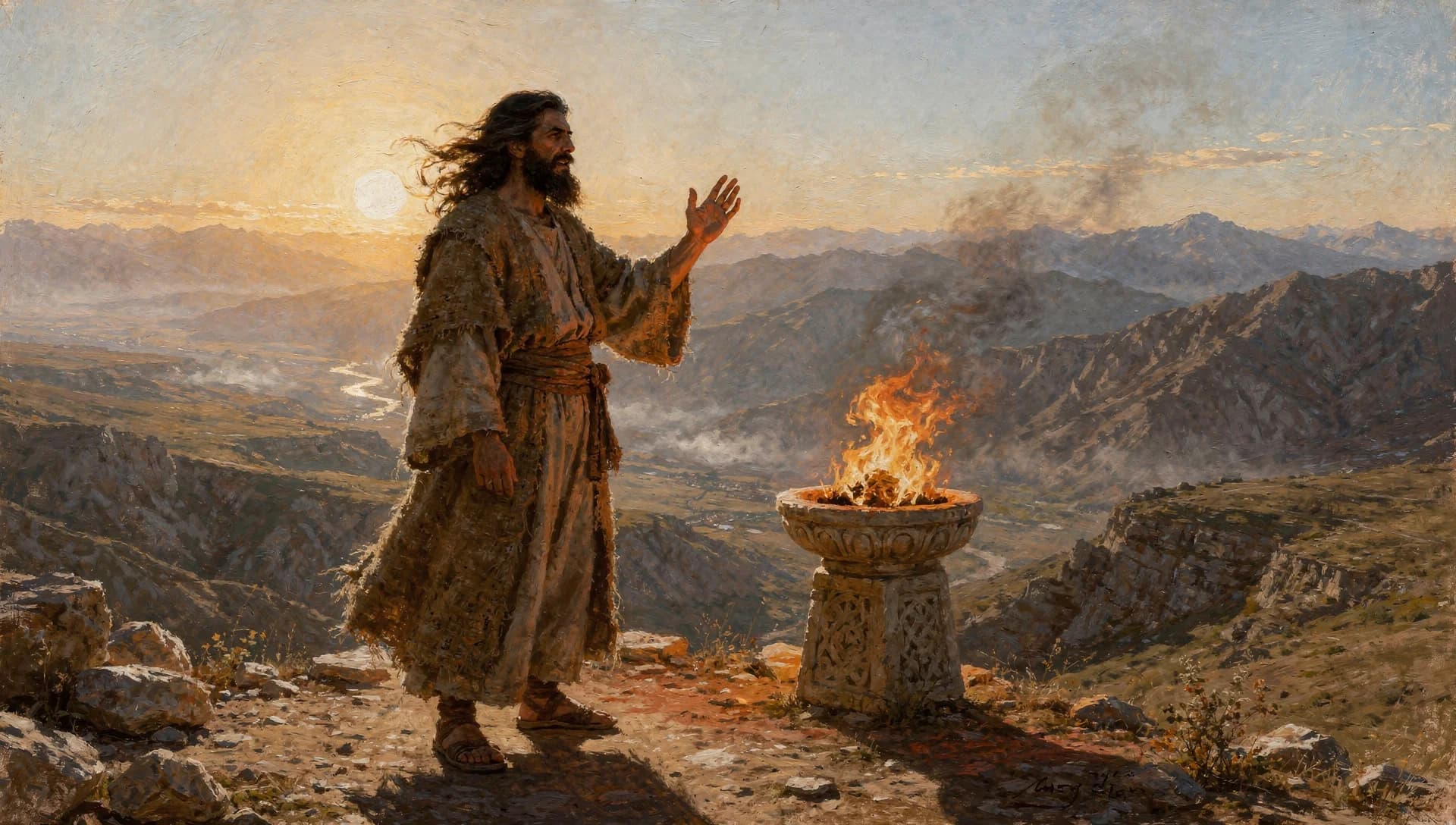
Zarathustra, founder of Zoroastrianism
 UB
UBZoroaster, Salem missionary descendant
Full Article
Read the deep-dive article on this connection
Zoroaster, Salem missionary descendant = Zarathustra, founder of Zoroastrianism
The Connection
The UB identifies Zoroaster as a direct descendant of the Salem missionaries. He encountered remnants of Melchizedek's original teaching and reformulated them into the Zoroastrian religion. His monotheistic impulse, moral dualism, and concept of a final judgment all trace back to Salem sources rather than being independent innovations.
UB Citation
Academic Source
Boyce, Zoroastrians: Their Religious Beliefs and Practices (1979); Clark, Zoroastrianism (1998)
Historical Evidence(Strong evidence)
The UB states: "Zoroaster was in direct contact with the descendants of the earlier Melchizedek missionaries." Mary Boyce documents Zoroaster's radical monotheistic reform of Iranian polytheism, dating his activity to approximately 1500-1200 BCE. His proclamation of Ahura Mazda as the one supreme God closely parallels the Salem teaching of one God. Peter Clark notes that Zoroastrianism's ethical monotheism was unprecedented in the Iranian context, consistent with an external teaching influence.
Deep Dive
Somewhere in northeastern Iran, probably between 1500 and 1200 BCE though some scholars argue for as late as 600 BCE, a young priest of the old Iranian religion had a series of visions in which a god named Ahura Mazda, the Wise Lord, appeared to him and commissioned him as a prophet. The young priest's name was Zarathushtra in his native Avestan, Zoroaster in the later Greek transcription. He composed a body of hymns, the Gathas, in archaic Avestan meter, that survive as the only firmly attested compositions of the founder of Zoroastrianism. The Gathas are dense, theologically sophisticated, and often obscure to modern translators, but they make several things clear. There is one supreme God, Ahura Mazda, who is the creator and the source of righteousness. There are spirits of good and spirits of evil whose choice is contested in the human heart. There is a coming day of judgment when the cosmic balance will be set right. The teaching is recognizably monotheistic, ethically dualistic, and eschatologically oriented.
The Urantia Book at 95:6.1 records that from Palestine some of the Melchizedek missionaries passed on through Mesopotamia and to the great Iranian plateau, where for more than five hundred years the Salem teachers made headway, and the whole nation was swinging to the Melchizedek religion when a change of rulers precipitated a bitter persecution which practically ended the monotheistic teachings of the Salem cult. The doctrine of the Abrahamic covenant was virtually extinct in Persia when, in that great century of moral renaissance, the sixth before Christ, Zoroaster appeared to revive the smouldering embers of the Salem gospel. Paper 95:6.2 adds the specific historical detail: Zoroaster was a virile and adventurous youth who, on his first pilgrimage to Ur in Mesopotamia, learned of the traditions of the Caligastia and Lucifer rebellion along with many other traditions, all of which made a strong appeal to his religious nature. As the result of a dream while in Ur, he settled upon a program of returning to his northern home to undertake the remodeling of the religion of his people.
This is one of the most specific historical claims the UB makes about a major world religion. Zoroaster's monotheistic reform was not an independent innovation. It was the deliberate revival, by a man who had directly encountered Salem-derived material at Ur in Mesopotamia, of a Salem teaching that had been present in Iran for five centuries before being suppressed. The UB further records that he had imbibed the Hebraic idea of a God of justice, the Mosaic concept of divinity, and that the idea of a supreme God was clear in his mind. He set down all other gods as devils and consigned them to the ranks of the demons of which he had heard in Mesopotamia. He had learned of the story of the Seven Master Spirits as the tradition lingered in Ur and accordingly created a galaxy of seven supreme gods with Ahura-Mazda at its head.
Mary Boyce's three-volume A History of Zoroastrianism (1975-1991) is the foundational modern academic treatment. Boyce documents Zoroaster's radical monotheistic reform of Iranian polytheism, dating his activity to approximately 1500-1200 BCE on linguistic grounds (the Gathas are in archaic Avestan close to the Vedic Sanskrit of the Rig Veda). She presents the Gathas as a coherent ethical-monotheistic teaching that is unprecedented in its Iranian context. Peter Clark's 1998 Zoroastrianism notes that Zoroastrianism's ethical monotheism was without parallel in the surrounding ancient Near Eastern context, with its sophisticated articulation of the moral struggle, the active human role in choosing good, and the eschatological framework of final judgment.
The structural fit with the UB account is precise. A reformer who had encountered Salem-derived monotheism at Ur, the Salem missionary outpost the UB names as the historical Ur of the Chaldees that Abraham came from, would produce exactly what the historical Zarathushtra produced: a monotheistic reform of Iranian polytheism, with a single supreme God at the center, ethical dualism in the choice between good and evil, eschatological judgment as the final sorting of the cosmic struggle, and seven supreme spiritual beings as the structural memory of the Seven Master Spirits. Each of these elements aligns precisely with a Salem-derived theological inheritance, transmitted through the actual mechanism the UB names: a personal pilgrimage to Ur, encounter with the lingering tradition, a vocational dream of religious reform, and return to Iran to enact the reform.
The strongest counterargument is that Zoroastrianism is universally treated by academic scholarship as an independent Iranian innovation, with no need for external Salem influence to explain it. The reply is that the academic explanation, that the reform emerged from within the Iranian religious tradition, does not actually explain why the monotheistic reform appeared in Iran specifically rather than elsewhere, and why it appeared with this particular cluster of features (monotheism, ethical dualism, eschatological judgment, sevenfold supreme beings). The UB account explains the cluster by tracing it to a specific historical encounter with Salem-derived material, and the explanation has the merit of accounting for both the Iranian particularity and the cluster of distinctive features.
What the parallel implies is significant for the comparative history of religion. Zoroastrianism is the missing link between Salem-derived monotheism and the major Western monotheisms. Through its influence on post-exilic Judaism (heaven, hell, devils, angels, eschatology), Zoroastrianism transmitted the Salem theological cluster into the Hebrew Bible and from there into Christianity and Islam. The UB account makes this transmission lineage intelligible by identifying its actual historical origin: a Salem-derived teaching, suppressed in Iran but revived by Zarathushtra after his Ur pilgrimage, then transmitted through the Achaemenid empire's contact with the exiled Jews into the post-exilic Jewish theological synthesis.
Key Quotes
“From Palestine some of the Melchizedek missionaries passed on through Mesopotamia and to the great Iranian plateau. For more than five hundred years the Salem teachers made headway in Iran, and the whole nation was swinging to the Melchizedek religion when a change of rulers precipitated a bitter persecution which practically ended the monotheistic teachings of the Salem cult. The doctrine of the Abrahamic covenant was virtually extinct in Persia when, in that great century of moral renaissance, the sixth before Christ, Zoroaster appeared to revive the smouldering embers of the Salem gospel.”
“This founder of a new religion was a virile and adventurous youth, who, on his first pilgrimage to Ur in Mesopotamia, had learned of the traditions of the Caligastia and the Lucifer rebellion, along with many other traditions, all of which had made a strong appeal to his religious nature. Accordingly, as the result of a dream while in Ur, he settled upon a program of returning to his northern home to undertake the remodeling of the religion of his people.”
“Boyce documents Zoroaster's monotheistic reform as a radical departure from the surrounding Iranian polytheism, with the Gathas presenting a coherent ethical-monotheistic teaching unprecedented in its ancient Near Eastern context.”
“Clark notes that Zoroastrianism's ethical monotheism was without parallel in the surrounding ancient Near Eastern religious context, suggesting an external teaching influence rather than purely internal Iranian development.”
Cultural Impact
Zoroastrianism is one of the most influential religions in human history, despite being currently practiced by fewer than two hundred thousand people. Its theological inheritance shapes nearly all the major Western monotheistic traditions. Through its influence on post-exilic Judaism (the period of Persian rule, 539-332 BCE), it transmitted the doctrines of bodily resurrection, final judgment, heaven and hell, an elaborate angelic hierarchy, and a cosmic adversary into the Hebrew Bible. From there, these doctrines passed into Christianity (the eschatological framework of the New Testament is heavily Zoroastrian-influenced) and into Islam (the cosmic-judgment framework of the Quran has clear Zoroastrian structural debts). The Iranian inheritance also shaped Manichaeism, the Bahai Faith, and various Gnostic traditions. The figure of the Magi in Matthew's nativity account is Zoroastrian, with the Greek term magos referring specifically to Zoroastrian priests. The cosmic-conflict framing of Western religious imagination, the cosmic struggle between good and evil with humanity as the contested ground, is a Zoroastrian inheritance reinforced through the apocalyptic literature. Beyond the religious channel, Zoroastrianism shaped Persian high culture for over a millennium and continues to be central to the Parsi community of India and to the Iranian diaspora's cultural identity.
Modern Resonance
The Zoroastrian inheritance is one of the most underappreciated facts of Western religious history. Most contemporary Christians, Jews, and Muslims have no idea how much of their theological architecture comes through Zoroaster. The UB framework makes this transmission lineage explicit and intelligible, presenting Zoroaster as a real historical reformer who deliberately drew on Salem-derived material from Ur and produced a theological synthesis that would shape the major Western monotheisms for the next twenty-five centuries. For contemporary readers, this offers a way to take Zoroaster seriously as a major figure in the lineage of revealed religion rather than as an exotic outsider. For the small modern Zoroastrian community (the Parsis of India and the Iranian Zoroastrians), the UB framework offers strong validation of the tradition's spiritual significance, placing it in the apostolic succession of Salem-derived monotheism alongside Judaism, Christianity, and Islam. For interfaith dialogue, the framework offers a way to identify shared theological inheritance across traditions that have often understood themselves as competitors. Most fundamentally, the framework explains why the cluster of features (monotheism, ethical dualism, eschatological judgment) appears together in the Western monotheistic tradition: they appeared together because they came from a single source, transmitted through a single reformer working at a specific historical moment.
Related Mappings
Seven Master Spirits, supreme universe administrators
= Ahura Mazda + seven supreme gods (Amesha Spentas)
Lucifer rebellion, distorted memory of cosmic war
= Zoroastrian dualism (Ahura Mazda vs. Angra Mainyu)
Zoroastrian influence on Jewish theology
= Jewish heaven, hell, devils derived from Zoroastrianism
Corrupted Zoroastrianism in Rome
= Mithras, mystery cult with December 25th festival
Related Articles
Where to next
The free newsletter. The research behind each piece, no spam.