
 Mythic
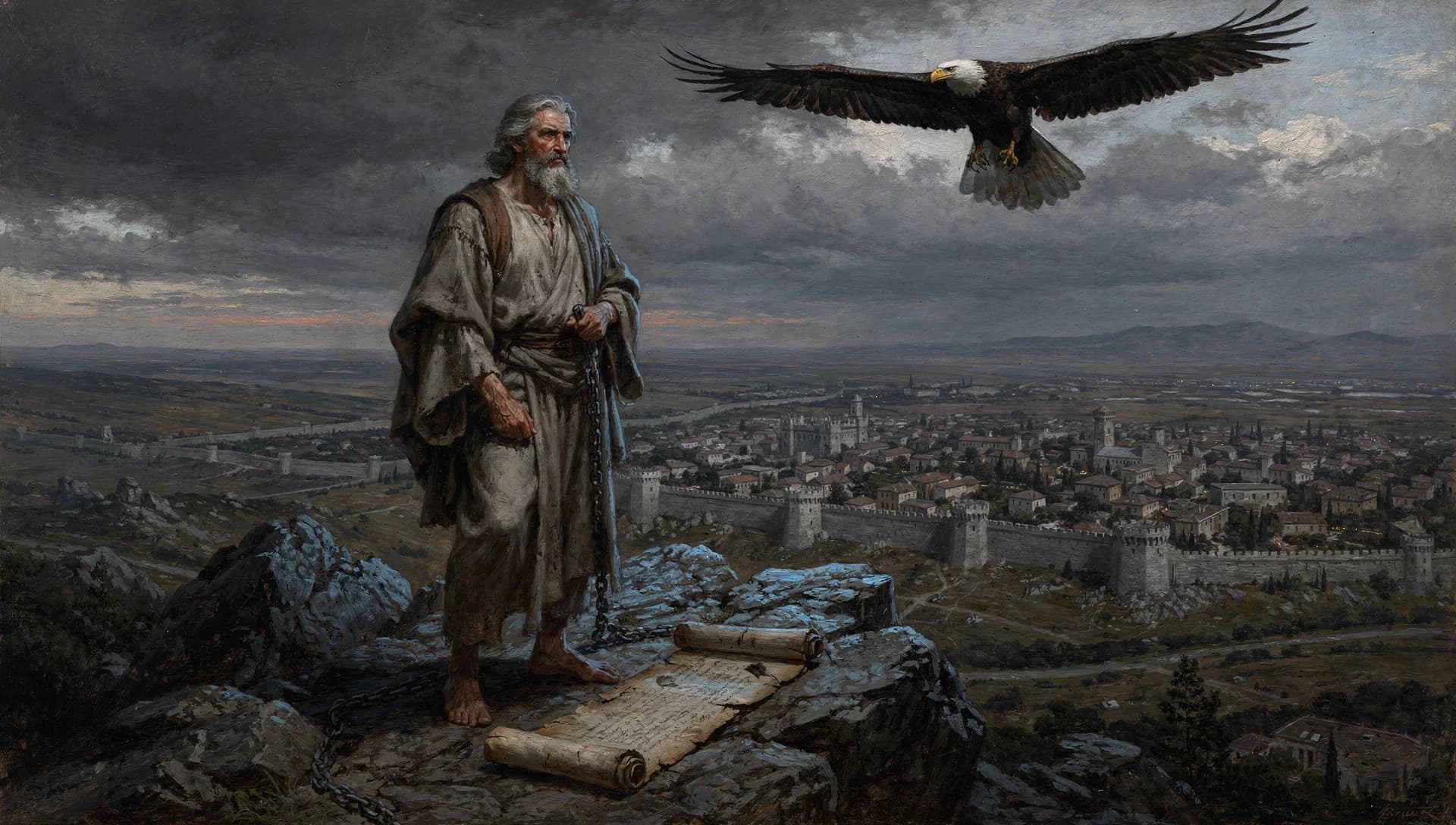
Prometheus, Titan who defied Zeus to bring civilization to humanity
 UB
UBVan, loyal corporeal staff member who defied Caligastia for 150,000 years
Full Article
Read the deep-dive article on this connection
Van, loyal corporeal staff member who defied Caligastia for 150,000 years = Prometheus, Titan who defied Zeus to bring civilization to humanity
The Connection
Van refused to follow Caligastia during the Lucifer rebellion and devoted 150,000 years to protecting humanity and preparing for Adam and Eve. Prometheus defied Zeus by stealing fire and delivering it to humanity. Both are civilization-bringers who defy the supreme local authority out of loyalty to a higher principle, suffer isolation as their consequence, and are remembered as the great benefactors who kept humanity alive during a cosmic crisis.
UB Citation
UB 67:3.5, 67:6.1, 73:1.1
Academic Source
Hesiod, Theogony and Works and Days (c. 700 BCE); Aeschylus, Prometheus Bound (c. 450 BCE); Griffith, Aeschylus: Prometheus Bound (Cambridge, 1983)
Historical Evidence(Strong evidence)
The structural parallel is precise on four points. First, both defy the supreme planetary authority (Caligastia / Zeus) not out of rebellion but out of loyalty to a higher order. Second, both deliver what sustains civilization: Prometheus brings fire, the arts, and knowledge; Van's ten councils teach agriculture, animal husbandry, metallurgy, and medicine. Third, both are punished by isolation rather than annihilation: Prometheus is chained; Van is cut off from normal universe circuits and left stranded. Fourth, both endure their isolation for extraordinary spans of time with no loss of conviction. Aeschylus's Prometheus explicitly describes himself as the one who "gave mortals all the arts of civilization" (Prometheus Bound, lines 442-506). Classical scholars note that the Prometheus myth cluster originated in the Caucasus region, near where the UB places Van's highland headquarters near Lake Van / Urartu after the fall of Dalamatia.
Deep Dive
Aeschylus brought his Prometheus Bound to the Athenian theater around 450 BCE. The play opens with the Titan being chained to a rock at the edge of the world, on the orders of Zeus, with Hephaestus the smith reluctantly driving in the spikes. Prometheus has committed two crimes against the new ruling order: he has given fire to humanity, and he has refused to disclose to Zeus the prophecy of Zeus's eventual fall. Throughout the play Prometheus catalogues, with mounting detail, what he has done for humans. He gave them fire. He taught them the rising and setting of the stars. He gave them number, the most exquisite of inventions, and the joining of letters into writing. He showed them how to harness the ox to the plow and the horse to the chariot. He revealed the healing arts and the practice of divination. He brought up from the earth the bronze, iron, silver, and gold. In Aeschylus's culminating phrase, paraphrased here rather than quoted, every art that mortals possess they possess from Prometheus.
The Urantia Book gives us, in the long story of Van across Papers 67 and 73, a figure whose biographical structure matches Prometheus's at every important point. Van was the chairman of the supreme council of co-ordination during the administration of the Planetary Prince Caligastia. When the Lucifer rebellion broke out, Van was the staff member who refused. Paper 67:2.2 records that Van, "this distinguished administrator and able jurist branded the proposed course of Caligastia as an act bordering on planetary rebellion and appealed to his conferees to abstain from all participation until an appeal could be taken to Lucifer, the System Sovereign of Satania." When Lucifer's confirmation arrived demanding unquestioning allegiance to Caligastia, Van delivered his memorable address of seven hours' length formally indicting Daligastia, Caligastia, and Lucifer as standing in contempt of the sovereignty of the universe of Nebadon. He appealed to the Most Highs of Edentia for support and was vindicated.
Paper 67:3.5 records the immediate consequence: "Upon the outbreak of rebellion, loyal cherubim and seraphim, with the aid of three faithful midwayers, assumed the custody of the tree of life and permitted only the forty loyalists of the staff and their associated modified mortals to partake of the fruit and leaves of this energy plant." Paper 67:6.1 records the geographic move: "The followers of Van early withdrew to the highlands west of India, where they were exempt from attacks by the confused races of the lowlands, and from which place of retirement they planned for the rehabilitation of the world." Paper 67:6.4 records the duration: "Van was left on Urantia until the time of Adam, remaining as titular head of all superhuman personalities functioning on the planet. He and Amadon were sustained by the technique of the tree of life in conjunction with the specialized life ministry of the Melchizedeks for over one hundred and fifty thousand years."
The structural fit with Prometheus is dense. First, the loyalty-by-defiance. Both Prometheus and Van defy the supreme local authority (Zeus, Caligastia) not out of rebellion against the cosmic order but out of loyalty to a higher principle. Prometheus's defiance is on behalf of humanity; Van's is on behalf of the sovereignty of the universe of Nebadon. Both are insiders refusing the corruption of the inner circle. Second, the civilization-bringing. Prometheus's catalog of gifts to humans, fire and number and writing and metals and the healing arts, maps almost item by item onto the work of the ten councils of the Prince's staff that Van's loyal remnant continued to maintain. Paper 66:5 lists those councils explicitly: food and material welfare, animal domestication, conquest of predatory animals, dissemination and conservation of knowledge, industry and trade, revealed religion, the family, the arts and sciences, tribal government, racial co-operation. The Prometheus catalog is the cultural memory of these councils.
Third, the isolation as punishment. Prometheus is chained to the rock at the edge of the world. Van is cut off from normal universe circuits and left stranded on a quarantined planet. The mode of punishment in both cases is enforced separation from the normal flow of cosmic life, neither annihilation nor pardon but a long stranding. Fourth, the duration. Prometheus's chaining is described in the Greek tradition as enduring for ages, sometimes glossed as thirty thousand years before Heracles releases him. Van's stranding lasts one hundred and fifty thousand years. The orders of magnitude are different but both traditions preserve the marker that the punishment was extreme in temporal extent. Fifth, the geographic detail. The Greek tradition consistently locates the chaining of Prometheus in the Caucasus, on Mount Kazbek or thereabouts. The UB locates Van's highland retreat in the same general arc, west of India, in the highland country that includes the Caucasus and the Lake Van / Urartu region. The geographic match is striking.
Sixth, the figure's transcendent status. Prometheus is a Titan, of the older generation of gods, distinct from the Olympians who currently rule. Van is a corporeal staff member of Caligastia, of the order of beings that preceded the human evolutionary stock and the Adamic dispensation. In both cases the figure stands above the human but below the supreme governing class, occupying the same intermediate niche in the cosmic hierarchy.
Hesiod, in Works and Days, gives an earlier version of the Prometheus tradition, focused on the Pandora story and the gift of fire. The mythographic elaboration in Aeschylus is later but draws on a tradition that can be traced back through Hesiod into the seventh and eighth centuries BCE. Mark Griffith, in his Cambridge edition of Prometheus Bound (1983), documents the tradition as composite, drawing on Indo-European trickster-figure material, on the Mesopotamian inheritance through the Hurrian and Hittite intermediaries, and on indigenous Aegean elements. Carolina Lopez Ruiz, in When the Gods Were Born, traces the Greek reception of Near Eastern mythological material through the eighth-century-BCE channels Burkert had earlier mapped. The Prometheus myth cluster sits exactly where the documented transmission corridor places its Mesopotamian and Caucasian roots.
The strongest counterargument is that Prometheus is a Titan god while Van is described in the UB as a corporeal staff member of an angelic order, and the two ontological categories are not interchangeable. The reply is that the UB's distinction between angelic and superhuman corporeal orders is a finer grain than any prehistoric cultural memory could have preserved. From the perspective of the Andonite and post-Adamic populations who knew Van and his loyal remnant only through their effects, Van was a being of the older superhuman generation, distinct from the gods who rule, occupying the niche the Greeks would later assign to the Titans. Cultural memory does not preserve ontological distinctions; it preserves functional and biographical ones. The functional and biographical match between Van and Prometheus is the kind of evidence that survives across millennia of priestly retelling.
What the parallel implies is that the figure of Prometheus, the loyal one who defies the supreme local authority on behalf of humanity, who suffers long isolation as the consequence, and who is the source of all the arts of civilization, is the cultural memory of a real being who really did all of those things on this planet about two hundred thousand years ago. The UB account adds the historical referent that classical scholarship has been working without. The decoder's job is to point at it.
Key Quotes
“The presentation of this astounding demand was followed by the masterly appeal of Van, chairman of the supreme council of co-ordination. This distinguished administrator and able jurist branded the proposed course of Caligastia as an act bordering on planetary rebellion and appealed to his conferees to abstain from all participation until an appeal could be taken to Lucifer, the System Sovereign of Satania; and he won the support of the entire staff.”
“Throughout the seven crucial years of the Caligastia rebellion, Van was wholly devoted to the work of ministry to his loyal army of men, midwayers, and angels. The spiritual insight and moral steadfastness which enabled Van to maintain such an unshakable attitude of loyalty to the universe government was the product of clear thinking, wise reasoning, logical judgment, sincere motivation, unselfish purpose, intelligent loyalty, experiential memory, disciplined character, and the unquestioning dedication of his personality to the doing of the will of the Father in Paradise.”
“Van was left on Urantia until the time of Adam, remaining as titular head of all superhuman personalities functioning on the planet. He and Amadon were sustained by the technique of the tree of life in conjunction with the specialized life ministry of the Melchizedeks for over one hundred and fifty thousand years.”
Cultural Impact
The Prometheus figure is one of the most enduring archetypes of Western imagination. Through Aeschylus's tragedy, through Plato's myths, through the Roman reception in Ovid and others, Prometheus entered Western literature as the great defier-on-behalf-of-humanity. The Renaissance recovered him as a figure of humanist creative power; Marsilio Ficino used Prometheus as an emblem of the human potential to share in divinity through learning. Goethe's Prometheus poem, the early Storm and Stress fragments, made Prometheus a Romantic icon of human autonomy against the gods. Mary Shelley subtitled Frankenstein "The Modern Prometheus," drawing the parallel between her scientist-hero and the fire-bringer who oversteps. Beethoven wrote a ballet on the Prometheus theme. Liszt and Scriabin composed major orchestral works under that title. Karl Marx praised Prometheus as the noblest saint and martyr in the philosophical calendar. Twentieth-century literature returned to Prometheus repeatedly: Andre Gide, Albert Camus, Tony Harrison's verse drama. Through this whole reception history, the figure has consistently carried the meaning the UB account locates in Van: the loyalist who suffers for choosing the higher principle over the local authority. The cultural inheritance is among the deepest substrates of how the West thinks about defiance, civilization, and moral courage.
Modern Resonance
The Prometheus archetype has had an explosive presence in twenty-first-century popular culture. The Ridley Scott film Prometheus (2012), the long Marvel and DC Comics traditions of defiant champions, the wider science-fiction tradition of the rogue scientist who steals knowledge from the gods, the climate-activist framing of human technological reach as Promethean overreach, all draw on the same mythic substrate. Whenever a contemporary writer reaches for the figure of the noble defier whose loyalty to a higher principle leads through long suffering, that writer is drawing from the Prometheus well. The UB account adds historical depth: the archetype is not just a psychological pattern but a real biography. Van of Urantia really did refuse the rebellion, really did keep the tree of life alive in the highland country for one hundred and fifty thousand years, really did hold the planet together for the Adamic mission. The cultural reverberation across three thousand years of literature, drama, and political imagination is the long tail of the actual event. For contemporary readers exhausted by the cynicism that treats noble defiance as naive, Van and Prometheus together offer the same encouragement: it has been done before, by a real person, and it can be done again.
Related Mappings
Adamson + Ratta, superhuman couple
= Cronus + Rhea, Titan parents of the Olympians
16 children of Adamson + Ratta
= Olympian Gods: Zeus, Hera, Poseidon, etc.
Caligastia, invisible sky ruler
= Ouranos, Greek sky father (via Hittite Anu transmission)
Salem missionaries' purest European teaching
= Cynics, philosophical school preserving Salem monotheism
Related Articles
Where to next
The free newsletter. The research behind each piece, no spam.