
 Mythic
Cronus + Rhea, Titan parents of the Olympians
 UB
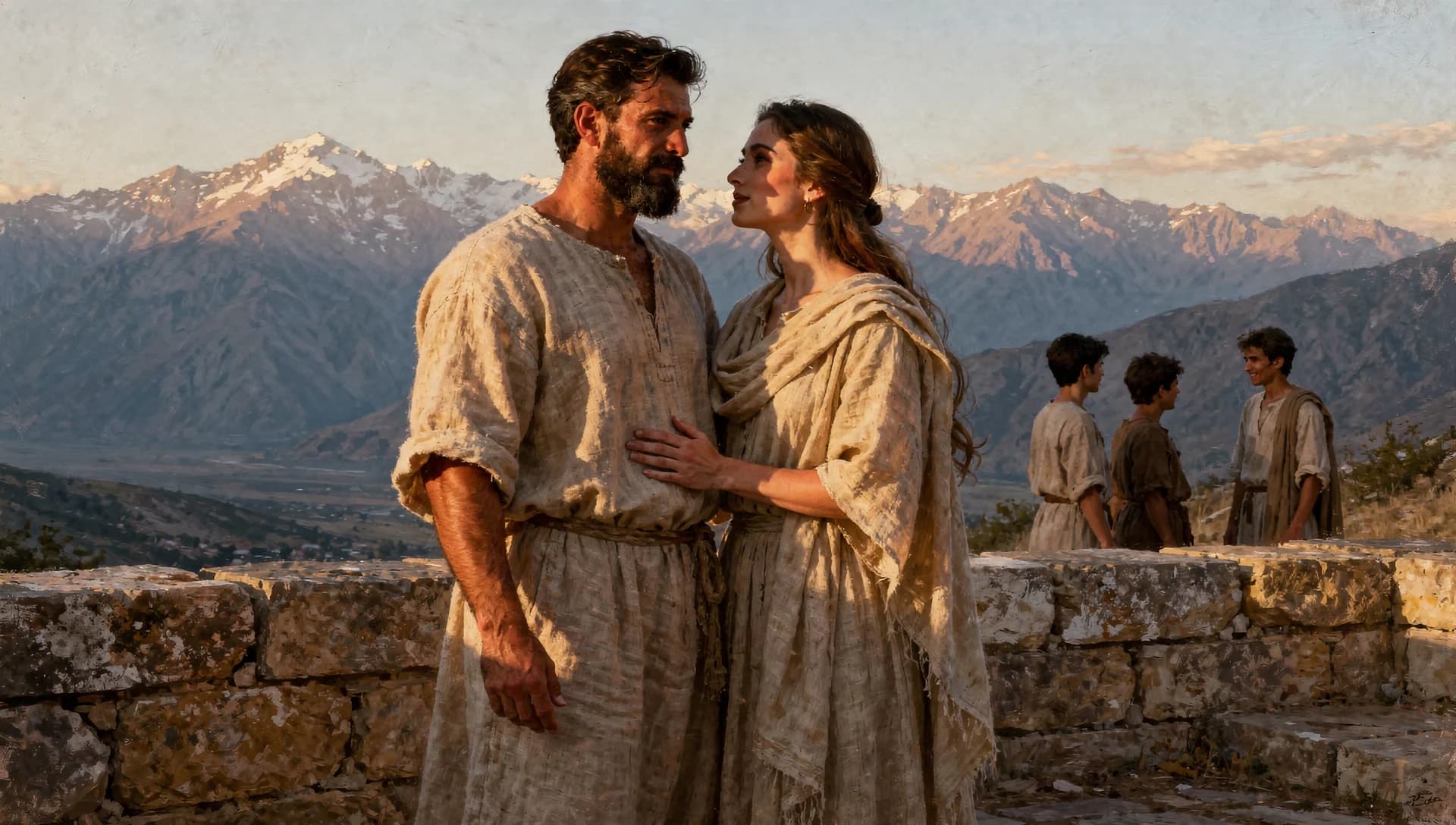
UBAdamson + Ratta, superhuman couple
Full Article
Read the deep-dive article on this connection
Adamson + Ratta, superhuman couple = Cronus + Rhea, Titan parents of the Olympians
The Connection
Cronus and Rhea are pre-Olympian beings who produce a generation of gods. Adamson and Ratta are pre-historical superhuman beings whose children had extraordinary abilities (some were "visible and invisible"). Both couples produce the "gods" of the next era.
UB Citation
Academic Source
Hesiod, Theogony
Historical Evidence(Moderate evidence)
Hesiod's Theogony (c. 700 BCE) describes a divine couple (Cronus + Rhea) whose superhuman children became the Olympians. Carolina Lopez-Ruiz demonstrates this represents "the Greek reception of the Kumarbi Cycle," establishing Near Eastern origins. Cambridge UP confirms the divine succession myth traveled from the ancient Near East to Greece via documented transmission routes.
Deep Dive
Hesiod, sometime around 700 BCE, sat in the shadow of Mount Helicon and dictated the Theogony, a poem about how the gods came to be. He did not invent his material. He inherited it. The Titans who preceded the Olympians, Cronus and Rhea above all, were already old when he wrote them down: a primordial couple whose union produced the generation of gods that ruled Olympus. The crucial structural detail is the doubling. The Titans are not the Olympians; they are the parents of the Olympians, a pre-Olympian race of superhuman beings from whom a younger and more famous generation descended. Cronus is described as the youngest of the Titans, taking his sister Rhea to wife, and from that union springing Hestia, Demeter, Hera, Hades, Poseidon, and Zeus.
The Urantia Book gives us, in Paper 77 section 5, a structurally identical pre-historical couple. Adamson, the firstborn son of Adam and Eve in the second garden, traveled north out of Mesopotamia and discovered, surviving in the highland country, a small remnant of the Prince's loyal staff lineage. Among them he found Ratta, the last pure-line descendant of two of the original loyal staff members, a beautiful and superhuman woman who had decided not to mate. Adam's son and the staff's last daughter married. Paper 77:5.6 states plainly that "Adamson and Ratta had a family of sixty-seven children. They gave origin to a great line of the world's leadership, but they did something more. It should be remembered that both of these beings were really superhuman. Every fourth child born to them was of a unique order. It was often invisible." Almost two thousand secondary midwayers were born from this union before the phenomenon ceased.
Two superhuman beings of distinct lineages combine and produce a generation of extraordinary children. That is the Cronus and Rhea pattern. That is also the Adamson and Ratta pattern. The match is not loose. It is exact at the structural level: pre-historical, superhuman, of two different but kindred lineages, parents of a more famous generation.
Carolina Lopez Ruiz, in When the Gods Were Born (Harvard, 2010), traces the Theogony's succession sequence back through the Hittite Song of Kumarbi to the Hurrian and ultimately the Mesopotamian theological imagination. The transmission route runs from the Sumerian-Akkadian heartland up through Anatolia, across to Crete, and into mainland Greece. That is the same corridor through which the UB places the Andite migrations after Adamson and Ratta's settlement near Lake Van and the Caucasus, the highland country of Urartu. Lopez Ruiz's case is that the Greek succession myth is the Greek reception of the Near Eastern succession myth, and the chain of transmission is documentable. The UB layer adds the missing premise: that the original Near Eastern memory was itself the cultural residue of a real superhuman couple whose offspring really were extraordinary by the standards of any neighboring tribe.
Walter Burkert, in Greek Religion (Harvard, 1985) and again in The Orientalizing Revolution (Harvard, 1992), independently confirmed the Near Eastern origin of the Greek succession sequence. Burkert showed that the castration of Ouranos by Cronus, with the sickle, follows the Hittite Anu and Kumarbi pattern almost gesture for gesture, with the difference that Hurrian Kumarbi castrates Anu by biting rather than by sickle. The dependence is a settled question in classical scholarship; the question that remains open is what was at the bottom of the Mesopotamian original.
The UB's answer, in this mapping, is that the bottom of the original is the historical Adamson and Ratta. They were the proximate ancestors of every Andite line that radiated outward across Europe and Asia. Their grandchildren and great-grandchildren are the heroic founders that show up in the genealogies of the Greek city-states, the Anatolian dynasties, and the Indo-European migrations. By the time the cultural memory reaches Hesiod the parents have become Cronus and Rhea, the proximate generation has become Zeus and his siblings, and the genuine memory of two superhuman beings whose offspring sometimes appeared invisible has hardened into the canonical theogony.
The strongest counterargument is that Adamson and Ratta are the UB's own scheme and the academic consensus has Cronus and Rhea as purely mythological constructs deriving from cosmogonic speculation rather than any historical referent. The reply is that the structural specificity is striking. Hesiod did not need to invent a Titan generation distinct from and prior to the Olympian generation, with a marriage between two Titans of different lines yielding the named ruling generation. He could have begun with Zeus and his siblings as primordial. He did not. He preserved a doubled structure that maps to nothing in the cosmogonic imagination but fits the UB account precisely.
What the parallel implies is modest but real. The Greek mythic doubling, where one superhuman couple is the parent of the famous gods, is the fingerprint of a real biographical event remembered through five thousand years of priestly retelling. The names are wrong. The number of children is wrong. The locations are slightly off. The structure preserved across two-and-a-half millennia of transmission is the right structure: a pre-historical superhuman couple who became, in cultural memory, the parents of the gods.
Key Quotes
“Adamson and Ratta had a family of sixty-seven children. They gave origin to a great line of the world's leadership, but they did something more. It should be remembered that both of these beings were really superhuman. Every fourth child born to them was of a unique order. It was often invisible.”
“A company of twenty-seven followed Adamson northward in quest of these people of his childhood fantasies. In a little over three years Adamson's party actually found the object of their adventure, and among these people he discovered a wonderful and beautiful woman, twenty years old, who claimed to be the last pure-line descendant of the Prince's staff.”
“Lopez-Ruiz traces the Hesiodic succession sequence through the Hittite Song of Kumarbi back to the Hurrian and Mesopotamian theological imagination, documenting the Greek reception of Near Eastern divine genealogies.”
Cultural Impact
The Cronus and Rhea pattern, two pre-Olympian superhuman parents of the ruling gods, is the template for almost every Indo-European pantheon's pre-history. The Hindu tradition has Aditi and Kashyapa producing the Adityas. The Iranian Avesta has primordial divine couples preceding the active pantheon. The Norse have the giants Bestla and Borr producing Odin and his brothers. Each of these is, in the comparative-religion analysis pioneered by Georges Dumezil, the same Indo-European inheritance of a doubled-generation divine genealogy. Through Hesiod the pattern entered Western literary culture and shaped two millennia of poetry from Ovid's Metamorphoses through Milton to the nineteenth-century Romantics. The very idea of a "Titanic" age, a generation of giants before the gods, owes its conceptual existence to Hesiod's preservation of the Adamson-Ratta-style memory. Renaissance humanism revived the Titans as figures of creative power; Goya painted Saturn devouring his children; Keats wrote Hyperion; nineteenth-century scholars reconstructed the Indo-European theogony partly on this Greek foundation. The cultural inheritance is not narrow. The structural commitment to a doubled superhuman parental generation is one of the deepest substrates of Western religious imagination.
Modern Resonance
The euhemerist reading of the Titans, that they were a real superhuman generation whose memory hardened into myth, has been a minority academic position since Euhemerus himself in the fourth century BCE, but it has never died out. Robert Graves's The Greek Myths (1955) treated the Titans as the cultural memory of a pre-Hellenic ruling caste. Marija Gimbutas's Old Europe hypothesis put a real prehistoric matrifocal civilization behind the older goddess strands. The UB account is the cleanest version of the euhemerist reading: a real superhuman couple with documentable descendants, whose memory propagated through Mesopotamia and Anatolia into Greece across five thousand years of transmission. The modern resurgence of interest in the lost civilizations of the late Pleistocene and early Holocene, pushed by Gobekli Tepe (c. 9500 BCE) and the wider archaeology of pre-pottery Neolithic Anatolia, has reopened the question of what kind of cultural sophistication existed in the highland-Mesopotamian arc before the conventional dawn of civilization. The UB's Adamson and Ratta story fits comfortably into that reopened space and provides a parsimonious account of why Hesiod's Titan generation has the structural shape it has.
Related Mappings
16 children of Adamson + Ratta
= Olympian Gods: Zeus, Hera, Poseidon, etc.
Caligastia, invisible sky ruler
= Ouranos, Greek sky father (via Hittite Anu transmission)
Salem missionaries' purest European teaching
= Cynics, philosophical school preserving Salem monotheism
Rodan of Alexandria, Greek philosopher
= Greek thinker who engaged directly with Jesus' teaching
Related Articles
Where to next
The free newsletter. The research behind each piece, no spam.