
 Mythic
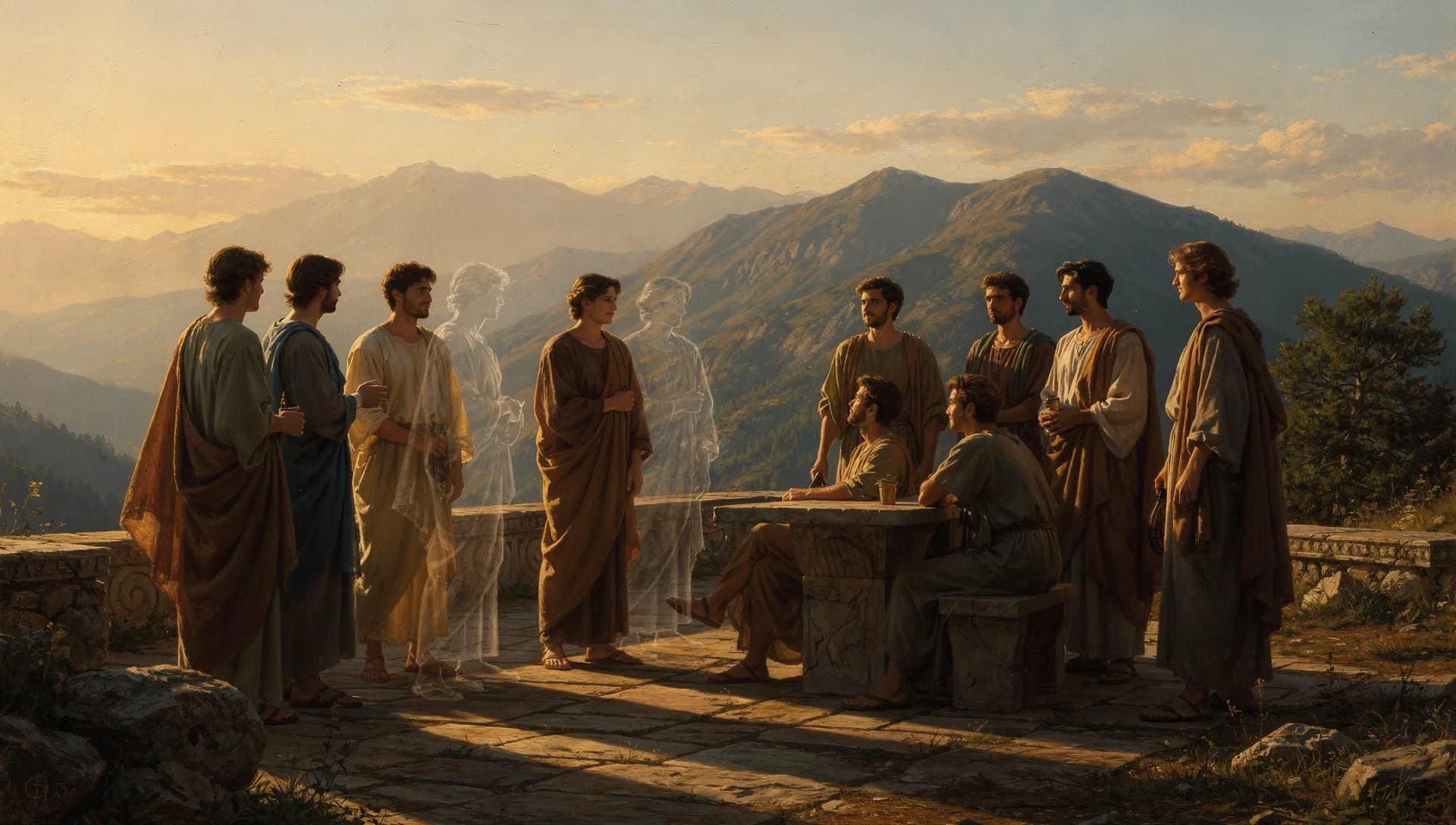
Olympian Gods: Zeus, Hera, Poseidon, etc.
 UB
UB16 children of Adamson + Ratta
Full Article
Read the deep-dive article on this connection
16 children of Adamson + Ratta = Olympian Gods: Zeus, Hera, Poseidon, etc.
The Connection
Superhuman children with powers beyond normal mortals, born of a union between two different superhuman lineages (Adamic + Nodite). The Greek tradition of gods with diverse powers, born of a powerful couple, is a plausible cultural memory of Adamson and Ratta's extraordinary children.
UB Citation
Academic Source
Hesiod, Theogony; Homeric Hymns
Historical Evidence(Suggestive evidence)
Euhemerism (Euhemerus, 4th century BCE) is the established academic framework that mythological gods originated as historical human rulers whose deeds were inflated into divine mythology. Joseph Campbell and Mircea Eliade document the universal pattern of exceptional ancestors being deified. The euhemerist reading is academically legitimate though not the dominant interpretation.
Deep Dive
Stand on the Athenian Acropolis at dawn, look out across the plain of Attica, and you are standing where for two and a half millennia people prayed to a generation of gods whose distinguishing feature was that they each had specific, named, biographically rich personalities. Zeus the storm-king, Hera the marriage-bound queen, Poseidon the sea-shaker, Demeter the grain-mother, Apollo the archer-singer, Artemis the huntress, Ares the war-rager, Aphrodite the love-power, Hephaestus the lame smith, Hermes the messenger, Athena the city-protector, Dionysus the wine-ecstatic. They are not abstractions. They are persons, with quarrels and marriages and visible portfolios of skill. They are the named children of Cronus and Rhea, and the cultural deposit they left across the Mediterranean is unparalleled.
The Urantia Book gives us, in Paper 77:5.6 and following, the children of Adamson and Ratta. Sixty-seven biological children, of whom every fourth was of the unique invisible order that produced the secondary midwayers. The remaining biological line gave origin to a great line of the world's leadership. They were superhuman by inheritance, half-violet-Adamic and half-pure-staff-lineage, with capacities and longevity that ordinary mortals had no way of approaching. Their offspring spread north into the Caucasus, west across Anatolia and into the Aegean, and east into the highlands of Iran, becoming the seed-stock of the post-Adamic Andite expansion.
The euhemerist reading of the Olympians, articulated by Euhemerus of Messene in the fourth century BCE in the Sacred Inscription, held that the gods were originally great kings and benefactors of humanity who were deified after their deaths. Euhemerus's book is lost; we know it through Diodorus Siculus and Lactantius. It was treated, in its own time and ever since, as a serious if unprovable theory. Cicero gives it respectful attention. The early Christian apologists used it polemically against the pagan gods. Modern scholarship in classics has tended to dismiss euhemerism as ancient rationalization, but the pattern recurs in real cases: Alexander deified, the Roman emperors deified, Asklepios likely a real healer deified. The mechanism is not in dispute, only the question of whether it applies to the Olympians.
What the UB adds is the missing piece. The euhemerist reading of the Olympians fits if their proximate ancestors really were superhuman, in the strict sense of carrying inherited capacities beyond normal mortal range. The Adamson and Ratta children, with violet-stock physical and intellectual gifts and pure-staff-line longevity and minor abilities such as occasional invisibility, would have been remembered by ordinary Andonite-stock contemporaries as something between human and divine. Their grandchildren and great-grandchildren, distributed across the Aegean basin and Anatolia by 3000 BCE, would have been the founding heroes of the prehistoric communities whose memory survived into archaic Greek genealogy. By the time Homer is recording the Iliad in the late eighth century BCE, the figures have ascended fully into the immortal Olympian register, but the underlying memory is preserved in the names, the family structures, and the persistent attribution to them of specific cultural inventions: agriculture from Demeter, music and prophecy from Apollo, weaving and wisdom from Athena, metallurgy from Hephaestus.
The structural fit is closest with the older Olympians, those most closely associated with civilization-giving rather than purely cosmic-elemental functions. Demeter the grain-mother, Athena the inventor of the olive and patroness of all crafts, Hephaestus the smith, Hermes the patron of writing and exchange. These are exactly the cultural inventories the UB attributes to the Adamic and post-Adamic period: agriculture intensified, metallurgy advanced, writing developing, exchange networks expanding. Apollo as cithara-player and prophetic singer maps onto the cultural memory of post-Adamic music and the priestly-poetic tradition. The pattern is recognizable across the pantheon.
The strongest counterargument is that the Olympians are too cosmically integrated to be euhemeristically reduced. Zeus is the sky, Poseidon is the sea, Hades is the underworld; you cannot reduce a sky-god to a deified ancestor. The reply is that the cosmic-elemental layer is the priestly overlay on top of an originally biographical layer. The Greek tradition combines two distinct strata, an elder Indo-European sky-god and storm-god inheritance with a more proximate cultural memory of named ancestors who became culture-bringing figures. Hesiod and Homer present them as already fused, but the texts preserve seams where the fusion is visible. Zeus is sometimes the abstract sky-power and sometimes a specific personality with brothers and a wife. The biographical stratum, the UB suggests, is the post-Adamic memory of Adamson and Ratta's descendants.
What the parallel implies is that the Olympians are not pure invention or pure cosmogonic abstraction. They are the cultural deposit of a real generation of superhuman beings whose biological reality was sufficient to leave a four-thousand-year imprint on the religious imagination of an entire region. The euhemerist reading, vindicated by the UB account, restores the historical referent without sacrificing the religious meaning the Greeks attached to their gods.
Key Quotes
“Adamson and Ratta had a family of sixty-seven children. They gave origin to a great line of the world's leadership, but they did something more. It should be remembered that both of these beings were really superhuman.”
“Adamson lived for 396 years. Many times he returned to visit his father and mother. Every seven years he and Ratta journeyed south to the second garden, and meanwhile the midwayers kept him informed regarding the welfare of his people.”
“Burkert documents the Greek pantheon as a layered inheritance combining Indo-European sky-god material, Near Eastern succession patterns, and indigenous Aegean cultural memory, with the named Olympians functioning as personalized inheritors of multiple traditions.”
Cultural Impact
The Olympian pantheon is, after the Bible, the deepest single source of Western imagery, narrative, and conceptual vocabulary. Through the Iliad and Odyssey, the Theogony, the Homeric Hymns, the tragedies of Aeschylus, Sophocles, and Euripides, and the epic poetry of Hellenistic Alexandria, the Olympians shaped how Greeks and then Romans understood divinity, fate, sex, war, kingship, and skill. Through Roman adoption (Jupiter, Juno, Neptune, Mars, Venus, Vulcan, Mercury, Minerva, Diana, Bacchus, Ceres, Vesta), the pantheon became the religious substrate of imperial Rome. Through the Renaissance, Botticelli and Raphael and Titian repainted the Olympians as the visible language of European high culture. Through Milton and Shakespeare and Keats and Shelley, they entered modern English poetry. Freud took Oedipus, Eros, Thanatos, and Narcissus directly from the Olympian narrative repertoire. Jung built his archetypal psychology partly on Olympian patterns. Disney films, video games, fantasy literature, contemporary cinema, all draw continuously on the same well. The cultural inheritance of Adamson and Ratta's biological line, refracted through five thousand years of priestly elaboration, is not a small thing. It is one of the major substrates of how the West thinks about almost everything.
Modern Resonance
Greek mythology is currently more present in popular culture than at any time since the Renaissance. The Percy Jackson novels and films, the God of War video game series, Hadestown on Broadway, Madeline Miller's Circe and The Song of Achilles, the Disney Hercules, Marvel's Eternals, Wonder Woman: the Olympians are everywhere. The question of what these figures originally were has reopened in a way that classical scholarship would not have predicted. The Sitchin-influenced Ancient Astronaut subculture has tried to reduce the Olympians to extraterrestrial visitors. Joseph Campbell-influenced mythopoeic readings have tried to abstract them into archetypal psychic functions. The Urantia Book's account is the parsimonious middle path: the Olympians are the cultural memory of real superhuman ancestors whose existence was biological rather than extraterrestrial or archetypal. The named children of Adamson and Ratta were real people with real capacities, and their descendants founded the heroic genealogies of archaic Greece. That the cultural memory inflated into full divinization across three thousand years is exactly what would be expected. The UB reading lets you take the gods seriously as memory while not committing to the metaphysics the Greek priests later attached to them.
Related Mappings
Adamson + Ratta, superhuman couple
= Cronus + Rhea, Titan parents of the Olympians
Caligastia, invisible sky ruler
= Ouranos, Greek sky father (via Hittite Anu transmission)
Salem missionaries' purest European teaching
= Cynics, philosophical school preserving Salem monotheism
Rodan of Alexandria, Greek philosopher
= Greek thinker who engaged directly with Jesus' teaching
Related Articles
Where to next
The free newsletter. The research behind each piece, no spam.