
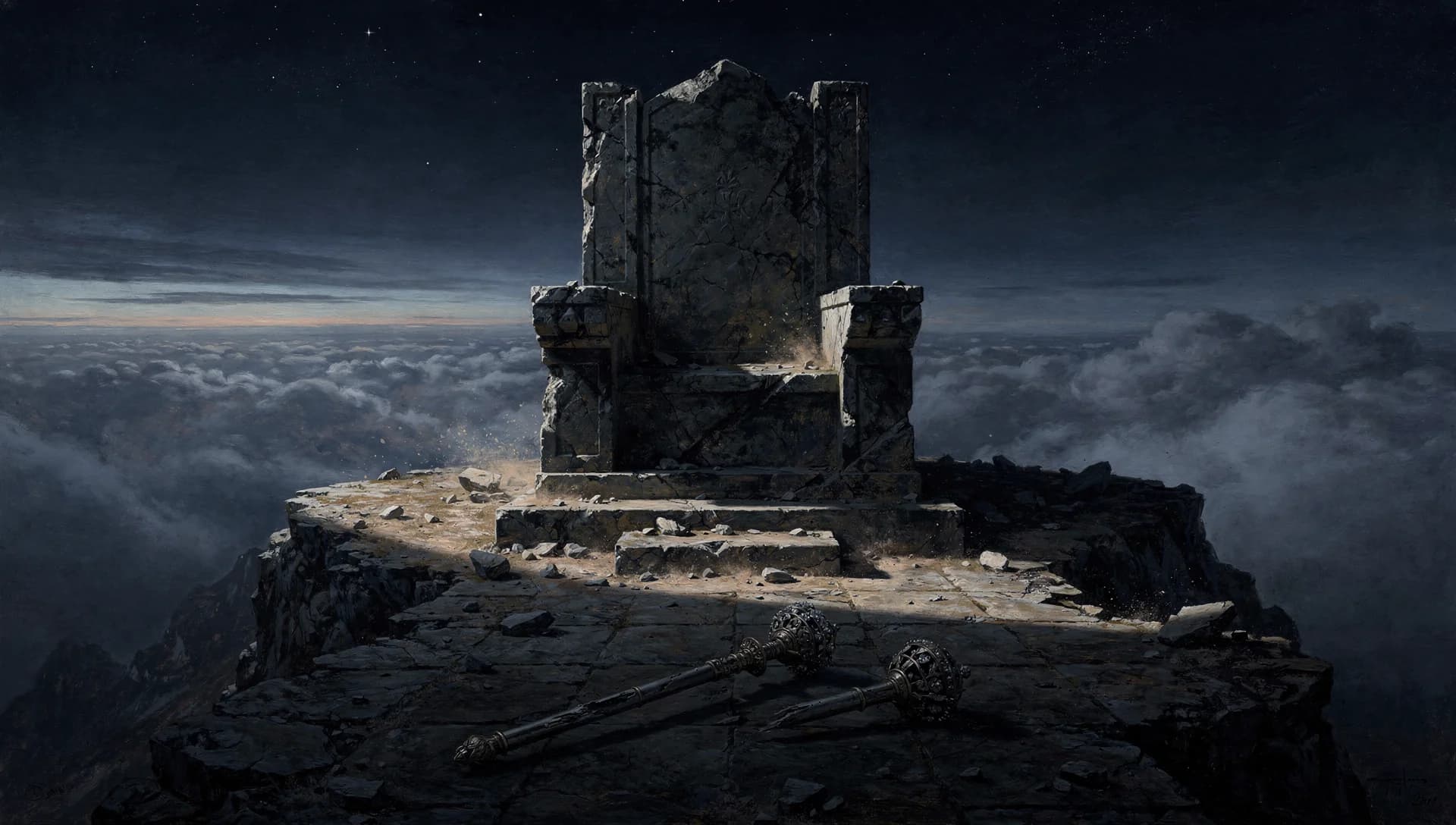
 Mythic
Ouranos, Greek sky father (via Hittite Anu transmission)
 UB
UBCaligastia, invisible sky ruler
Full Article
Read the deep-dive article on this connection
Caligastia, invisible sky ruler = Ouranos, Greek sky father (via Hittite Anu transmission)
The Connection
Scholars have established that Ouranos derives from the Hittite adaptation of Mesopotamian Anu via the Kumarbi myth cycle. If Anu equals Caligastia in the Sumerian layer, then Ouranos equals Caligastia in the Greek layer. The sky father who is deposed and displaced.
UB Citation
UB 66:1, 67:1
Academic Source
Hoffner, Hittite Myths (1998); Burkert, The Orientalizing Revolution (1992)
Historical Evidence(Strong evidence)
The Song of Kumarbi (Hittite, first presented 1946) establishes the succession Anu to Kumarbi to Teshub, paralleling Ouranos to Kronos to Zeus. Academic consensus: "the clearest evidence for the Greek reception of Near Eastern mythology." Anu is castrated by Kumarbi with his teeth; Ouranos is castrated by Kronos with a sickle. The Anu = Ouranos identification is established academic consensus via Duke University (GRBS journal) and Oxford.
Deep Dive
In 1936 a German excavation team at Bogazkoy in central Anatolia, the site of the Hittite capital Hattusa, uncovered a clay tablet carrying the text known to scholars as the Song of Kumarbi. The tablet, in cuneiform Hittite, told a succession story: Anu the sky-king is overthrown by Kumarbi who bites off his genitals, and Kumarbi in turn is destined to be overthrown by Teshub the storm-god. When Hans Gustav Guterbock published the tablet in 1946 the classical world was electrified. Hesiod's Theogony, written in Greek some six hundred years after the Hittite tablet, contained the same succession sequence: Ouranos the sky-king is overthrown by Kronos who castrates him with a sickle, and Kronos in turn is overthrown by Zeus the storm-god. The match was too tight to be coincidence. The Greek succession myth was demonstrably the Greek reception of the Hittite, which was itself the Hittite reception of the older Hurrian and Mesopotamian Anu tradition.
Walter Burkert, in The Orientalizing Revolution (Harvard, 1992), made the case that this transmission ran through specific eighth-century-BCE channels, with itinerant craftsmen, healers, and seers carrying the material from the Levant and Anatolia into the Aegean during the Greek archaic period. M. L. West, in The East Face of Helicon (Oxford, 1997), pushed the documentation further, showing line-by-line Hesiodic dependence on Near Eastern templates. The Anu-equals-Ouranos identification is settled scholarship.
What the Decoder adds is the upstream identification: Anu is the cultural memory of Caligastia, the Planetary Prince. Paper 66:1.1 introduces him as Lanonandek Son number 9,344 of the secondary order. Throughout his three hundred thousand year administration he was an invisible spiritual ruler, never seen directly by mortals, sensed only as the source of administrative legitimacy. The Sumerian An, written with the cuneiform sign DINGIR which is also the generic mark for any god, carries exactly this signature: the supreme deity who is theoretically central but functionally remote, the source of the An-ship that legitimates kingship, the otiose-supreme-deity of comparative-religion typology. If An at the bottom of the Mesopotamian tradition is Caligastia, and Ouranos at the top of the Greek tradition is Anu by direct documentable transmission, then Ouranos is Caligastia at one further remove.
The structural details fit. Ouranos is the first ruler, the original sky-power. Caligastia was the original ruler of Urantia, the Planetary Prince installed at the planet's first administrative organization. Ouranos is invisible in the sense of being the sky itself, present everywhere but never approached as a person. Caligastia was literally invisible to mortals throughout his administration. Ouranos is overthrown by his own son: Kronos castrates him at the prompting of Gaia his consort. Caligastia was effectively overthrown not by his own son but by his own delegation, with Daligastia his immediate subordinate carrying the rebellion into the staff and Lucifer the system sovereign supplying the doctrinal frame. The overthrow is from within the ruling structure rather than by an external enemy.
The castration motif is the place where the parallel gets uncomfortable, and it deserves direct treatment. Kumarbi castrates Anu by biting; Kronos castrates Ouranos with a sickle. The motif in the Mesopotamian original is the symbolic stripping of the supreme deity's generative power and the transferring of that power to the next ruling generation. In the UB account the Lucifer rebellion stripped Caligastia of his system-circuit access, his life-circuit sustenance, and ultimately his administrative authority, with the formal sovereignty later passing to Christ Michael through the bestowal. Kronos castrating Ouranos is the cultural memory of an authority figure being functionally desexed, that is, deprived of the capacity to generate further legitimacy. The biographical specificity of the castration image is exactly what one would expect from a real administrative dethronement remembered through three thousand years of priestly retelling.
The strongest counterargument is that the castration motif is so peculiar to the Mesopotamian tradition that it must reflect cosmogonic speculation rather than memory. The reply is that the same motif occurs in the Hittite, the Hurrian, the Sumerian, and the Greek strata, with consistent placement in the succession sequence. Cultural inventions do not preserve that kind of structural specificity across that many cultural transitions and that much time. Memories do.
Carolina Lopez Ruiz, in When the Gods Were Born (Harvard, 2010), argues that the Greek succession sequence is one of the most clearly documented Near Eastern inheritances in Greek mythology. The UB account adds the only piece the academic case has been missing: the historical referent at the bottom of the chain. Caligastia, the invisible Planetary Prince of Urantia, is the originating personality whose memory propagated through Sumerian An, Hurrian Alalu, Hittite Anu, and Greek Ouranos, accumulating priestly elaboration at each transmission step but preserving the structural signature: an invisible sky-king, the original ruler, eventually deposed by his own subordinate.
What the parallel implies is that the most carefully traced line of transmission in classical scholarship terminates at a real historical individual. That is a falsifiable claim, and it is exactly the kind of claim the UB makes confidently. The decoder's job is to make the claim visible.
Key Quotes
“Caligastia was a Lanonandek Son, number 9,344 of the secondary order. He was experienced in the administration of the affairs of the local universe in general and, during later ages, with the management of the local system of Satania in particular.”
“The last act of Michael before leaving Urantia was to offer mercy to Caligastia and Daligastia, but they spurned his tender proffer. Caligastia, your apostate Planetary Prince, is still free on Urantia to prosecute his nefarious designs, but he has absolutely no power to enter the minds of men, neither can he draw near to their souls to tempt or corrupt them unless they really desire to be cursed with his wicked presence.”
“Burkert documents the eighth-century-BCE transmission of Near Eastern mythological material into the Greek archaic tradition through itinerant specialists, with the succession sequence Anu-Kumarbi-Teshub being the clearest example of dependence.”
Cultural Impact
The Ouranos figure, the sky-father deposed by his own son, is the deepest Indo-European template of dynastic succession in religious imagination. Through Hesiod the figure entered Greek philosophy as Plato's primordial cosmic principle and Aristotle's prime mover. The medieval Christian theological tradition absorbed the figure indirectly through the Father-Son-Holy-Spirit Trinity, with the deposed sky-father transmuting into the inscrutable Father whose Son is the active redeemer. Through Roman appropriation as Caelus and through Renaissance neoplatonism, Ouranos became the philosophical name for the cosmic outermost, the vault of fixed stars, the unmoved limit of the heavens. William Herschel named the seventh planet Uranus in 1781, putting the deposed sky-father into permanent astronomical visibility. The element uranium, named after the planet in 1789, carries the same root. The cultural inheritance from Caligastia through Anu through Ouranos is everywhere a writer reaches for the image of the original cosmic ruler displaced by his own offspring, from Freud's primal-horde patricide in Totem and Taboo to the long Hollywood lineage of fallen-king narratives.
Modern Resonance
The Caligastia layer of the Ouranos tradition matters for contemporary religious thought because it provides a falsifiable historical referent for what mainstream classics treats as pure mythological succession. The Sitchin-influenced Ancient Astronaut subculture has tried to read Anu as the alien king of the Anunnaki and Ouranos as his Greek alias. The UB account is parsimonious: Anu and Ouranos are both the cultural memory of one real being, Caligastia, who really did rule Urantia and really was overthrown. No extraterrestrials are required. The transmission chain Sumerian-Hurrian-Hittite-Greek is documented by mainstream classical scholarship; only the historical referent at the bottom is added by the UB. For contemporary readers who have absorbed the Ancient Astronaut framing, the UB account offers a sober historical correction that preserves the genuine memory while restoring the right metaphysical scale: a Lanonandek-class personality in administrative rebellion, not an extraterrestrial overlord.
Related Mappings
Adamson + Ratta, superhuman couple
= Cronus + Rhea, Titan parents of the Olympians
16 children of Adamson + Ratta
= Olympian Gods: Zeus, Hera, Poseidon, etc.
Salem missionaries' purest European teaching
= Cynics, philosophical school preserving Salem monotheism
Rodan of Alexandria, Greek philosopher
= Greek thinker who engaged directly with Jesus' teaching
Related Articles
Where to next
The free newsletter. The research behind each piece, no spam.