
 Mythic
Cross-cultural sacred world-tree motif: Yggdrasil, Bodhi tree, ceiba, Ashvattha, huluppu
 UB
UBUniversal cult of the Tree of Life (UB 85:2.4)
Full Article
Read the deep-dive article on this connection
Universal cult of the Tree of Life (UB 85:2.4) = Cross-cultural sacred world-tree motif: Yggdrasil, Bodhi tree, ceiba, Ashvattha, huluppu
The Connection
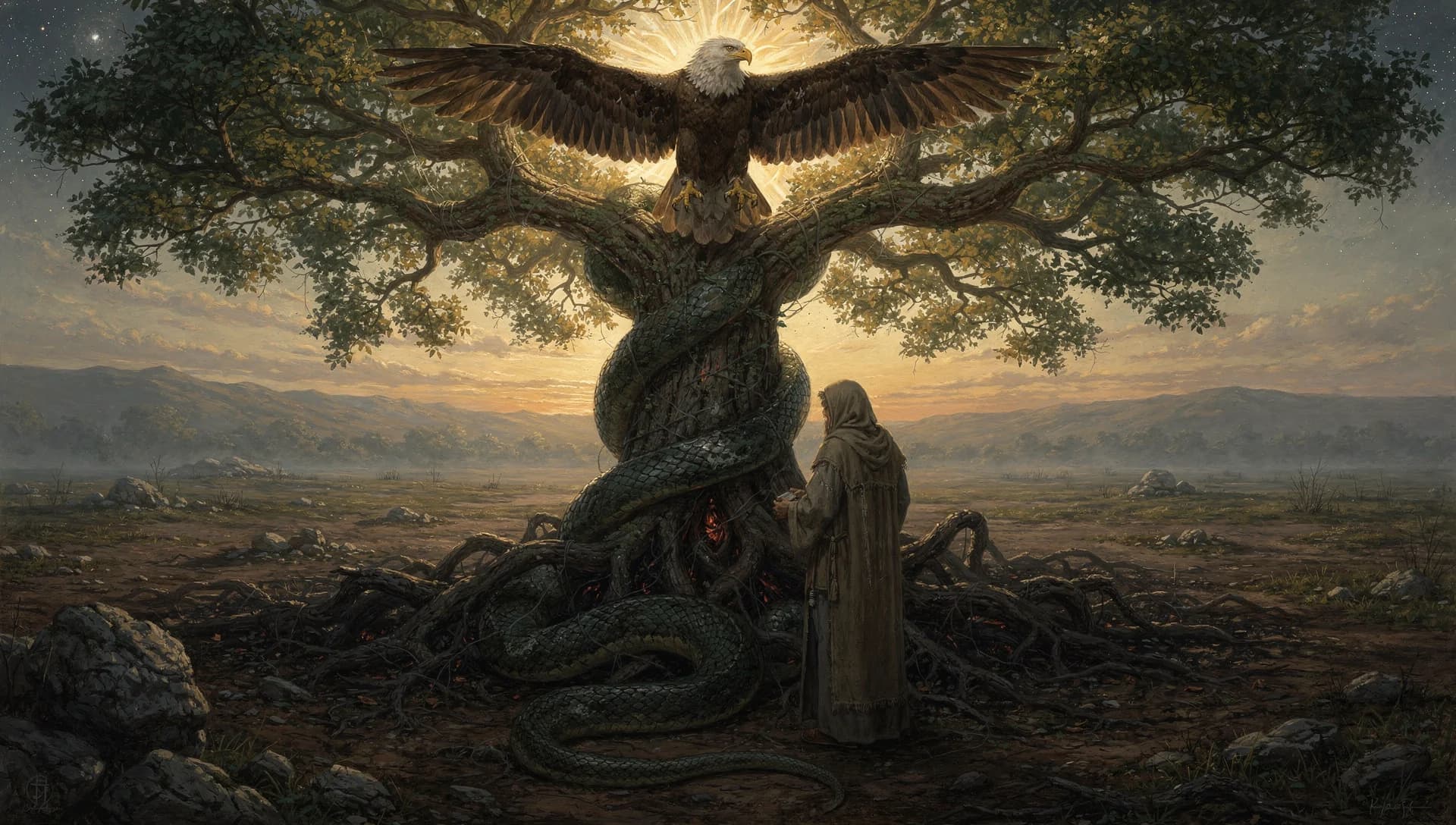
The UB states plainly: "Except in China, there once existed a universal cult of the tree of life." The world-tree appears with astonishing consistency across cultures: Norse Yggdrasil, Hindu Ashvattha, Buddhist Bodhi tree, Sumerian huluppu, Maya ceiba, Slavic Dub, Assyrian Sacred Tree. In nearly every case, a bird inhabits the crown, a serpent the roots, and a divine or royal figure stands in the axis. The frequency of this exact three-element composition across non-contacted cultures is the strongest single cross-cultural case the decoder can make for a common seed memory, which the UB identifies as the actual Tree of Life on Dalamatia and in the first Eden.
UB Citation
UB 85:2.4, 66:4.13, 73:6.1
Academic Source
Cook, The Tree of Life (1974); James, The Tree of Life (1966); Eliade, Patterns in Comparative Religion (1958)
Historical Evidence(Strong evidence)
Roger Cook's The Tree of Life catalogued the motif across dozens of non-contacted cultures, noting the recurrent three-element composition (bird-in-crown, serpent-at-roots, divine figure at trunk). E.O. James' The Tree of Life surveyed the Near Eastern branch and its diffusion. Mircea Eliade's Patterns in Comparative Religion treated the cosmic tree as one of the most widely attested religious symbols. The UB's statement that a universal cult of the Tree of Life existed is directly supported by this cross-cultural survey, and the decoder identifies the seed as the real Tree at Dalamatia.
Deep Dive
Imagine spreading on a table the following images: the Norse Yggdrasil with its serpent Nidhogg at the roots and the eagle Hraesvelg in its crown, an animal-pillar capital from Bodh Gaya in India where the Buddha attained enlightenment beneath the Bodhi tree, the Maya Yaxche' depicted on King Pakal's sarcophagus lid at Palenque with a quetzal in its branches and a snake at its base, the Sumerian huluppu tree from Gilgamesh, Enkidu, and the Netherworld with the Anzu bird in the crown and the unconchantable serpent in the roots, the Slavic Dub of Russian folk tradition with falcon and serpent in the same configuration, and the Assyrian Sacred Tree from Ashurnasirpal II's palace at Nimrud with winged figures attending it.
The cultures that produced these images had no contact with each other for the periods relevant to their formation. The Maya Yaxche' was developed in Mesoamerica without contact with Eurasia. The Norse Yggdrasil developed in northern Europe without contact with Mesoamerica or India. The Sumerian huluppu predates any conceivable diffusion to most of these locations. And yet the three-element composition (bird in crown, serpent at roots, divine or royal figure attending the trunk) recurs with statistically extraordinary consistency.
The standard academic responses fall into three camps. The Jungian camp, drawing on Carl Jung's collective unconscious, treats the world-tree as an archetype rooted in universal human psychology. The structuralist camp, drawing on Levi-Strauss, treats the world-tree as the universal expression of the structural opposition between heaven, earth, and underworld. The diffusionist camp, drawing on Eliade and the Vienna school, treats the pattern as evidence of an extremely ancient cultural diffusion from a single Eurasian source.
Each of these explanations has its difficulties. The Jungian archetype theory cannot explain why the specific three-element composition recurs rather than infinite variations of tree-symbolism. The structuralist account cannot explain the specific identity of the elements (why a bird and a serpent specifically, rather than any other pair of opposing animals). The diffusionist account cannot identify a clean transmission path that reaches all the way to the Maya Yaxche' from a Eurasian source.
The UB intervention is direct and theologically provocative. UB 85:2.4 states plainly: "Except in China, there once existed a universal cult of the *tree of life.*" The UB does not treat this as metaphor or archetype. It treats it as a historical claim about a real religious practice that once spanned the world. UB 66:4.13 then identifies the seed: an actual plant called the tree of life that "grew in the central courtyard of the temple of the unseen Father" at Dalamatia, "a shrub of Edentia which was sent to Urantia by the Most Highs of Norlatiadek at the time of Caligastia's arrival."
This is not symbolic. The UB treats the tree of life as a real biological entity, imported from the constellation headquarters at Edentia, growing physically in the Prince's temple, with fruit that "enabled the material and otherwise mortal beings of the Prince's staff to live on indefinitely." After the Lucifer rebellion, the tree was preserved by loyal cherubim and seraphim with three faithful midwayers (UB 67:3.5), and Van and Amadon were sustained by it for over 150,000 years (UB 67:6.4). It was eventually replanted by Van in the central temple of the first Garden of Eden (UB 73:6.1).
If the UB account is correct, the universal cross-cultural tree-of-life pattern is not archetype, not structuralism, not generic diffusion. It is the cultural memory of a specific physical plant, located in a specific place (the Prince's temple at Dalamatia, later the first Garden), that ceased physical existence with the destruction of the second Garden but persisted as an iconographic memory in cultures descended from peoples who had once seen or heard of it.
The three-element composition becomes intelligible on this reading. The bird in the crown is the iconographic memory of seraphic ministry attending the tree. The serpent at the roots is the iconographic memory of the Caligastia rebellion attempting to corrupt the tree (the connection that survives in altered form in the Genesis serpent and Eden narrative). The divine or royal figure attending the trunk is the iconographic memory of Van, Amadon, and the loyal staff who preserved the tree across 150,000 years. The Maya Yaxche' shows King Pakal in the trunk position not because every world tree must have a king but because the underlying memory contained a custodial divine figure who was royal in function.
The strongest counterargument is that one cannot prove a worldwide pre-historical cultural diffusion that extends to the Maya. The UB response is that the diffusion is older than the Maya as a culture: the Andite migration to South America at 6000 BCE (UB 78:5.7, 79:5.9) carried the iconographic memory westward, and the Maya inherited it from the cultural substrate the Andite sailors helped seed. The 132 Andite sailors who reached the Andes carried the entire cultural package, including the world-tree iconography, and the Mesoamerican civilizations that arose subsequently inherited the memory.
Key Quotes
“Except in China, there once existed a universal cult of the tree of life.”
“These antidotal complements of the Satania life currents were derived from the fruit of the tree of life, a shrub of Edentia which was sent to Urantia by the Most Highs of Norlatiadek at the time of Caligastia's arrival. In the days of Dalamatia this tree grew in the central courtyard of the temple of the unseen Father.”
“In the center of the Garden temple Van planted the long-guarded tree of life, whose leaves were for the "healing of the nations," and whose fruit had so long sustained him on earth.”
Cultural Impact
The world-tree motif is one of the most thoroughly documented patterns in comparative mythology. It anchors major works in religious studies (Eliade), depth psychology (Jung), and literary criticism (Frye). The pattern is so widely recognized that it has become a kind of background commonplace in educated discussion of myth. What the UB framework adds is a specific historical referent. The pattern is no longer free-floating archetype but the cultural memory of a real botanical entity. This reframing has significant implications for how we read iconography from non-contacted cultures: the Maya Yaxche' and the Norse Yggdrasil are not parallel inventions but parallel preservations of a single underlying memory. The cumulative effect is to dignify pre-modern iconography in a way that pure-archetype or pure-structuralism readings cannot. The Maya and Norse artists were not just expressing universal human cognitive structures. They were preserving, in their own cultural idiom, a specific memory that their ancestors had received. The decoder takes their iconography as historical testimony rather than as exclusively psychological projection.
Modern Resonance
Contemporary ecological theology, particularly in the work of writers like Robin Wall Kimmerer and Norman Wirzba, has begun to recover the world-tree motif as a resource for thinking about humanity's relationship with the natural world. The recognition that nearly every pre-modern culture preserved the image of a sacred central tree at the heart of the cosmos is taken as evidence that humanity's deepest religious imagination is rooted in actual ecological dependence. The UB framework adds historical depth to this contemporary ecological reading. The sacred tree is not just a metaphor for ecological interdependence; it is the cultural memory of a real plant that genuinely sustained the original superhuman teachers of humanity. The reverence pre-modern cultures showed toward sacred groves and sacred trees was not generic nature-worship but the persistence of a specific historical memory. This framing offers contemporary ecological spirituality a deeper theological footing. When we revere ancient trees today, when we mourn the loss of old-growth forests, when we recognize the genuinely sacred character of botanical life, we are responding to something more than a recent cultural sentiment. We are responding to a memory that runs back, on the UB account, to a literal sacred plant at the center of the original human civilization.
Related Mappings
Salem missionaries, universal thread through all religions
= Melchizedek missionaries as the hidden link between traditions
Ganid's world religion compilation
= First comparative religion study in human history
Seven outstanding human teachers
= Sethard, Moses, Zoroaster, Lao-tse, Buddha, Philo, Paul
Plural historical floods (Dalamatia 162 years after rebellion, Eden sinking, Mesopotamian regional floods)
= Universal flood traditions across ~300 world cultures
Related Articles
Where to next
The free newsletter. The research behind each piece, no spam.