
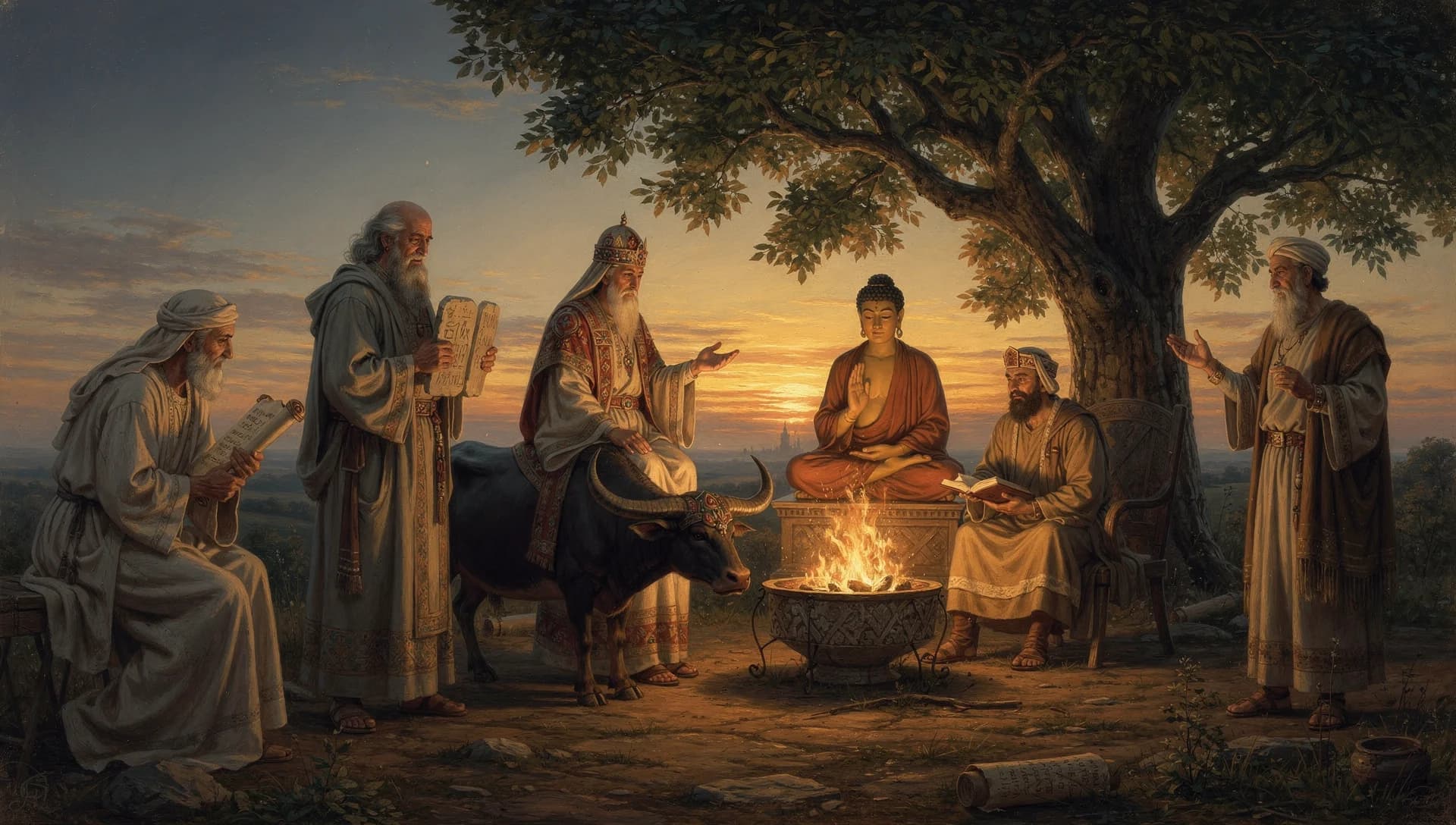
 Mythic
Sethard, Moses, Zoroaster, Lao-tse, Buddha, Philo, Paul
 UB
UBSeven outstanding human teachers
Full Article
Read the deep-dive article on this connection
Seven outstanding human teachers = Sethard, Moses, Zoroaster, Lao-tse, Buddha, Philo, Paul
The Connection
The UB identifies seven human teachers whose work was most significant in preparing the world for Michael's bestowal. Each represents a different cultural tradition and a different aspect of truth: Sethard (Adamite heritage), Moses (law and monotheism), Zoroaster (ethical dualism), Lao-tse (cosmic unity), Buddha (compassion), Philo (Hellenistic Judaism), and Paul (global Christian mission). Together they form a global preparation for the incarnation.
UB Citation
Academic Source
Armstrong, The Great Transformation (2006); Jaspers, The Origin and Goal of History (1953)
Historical Evidence(Moderate evidence)
The UB lists these seven teachers as preparation for Michael's bestowal. Karl Jaspers' "Axial Age" concept (1949) independently identified the 800-200 BCE period as the pivot of human spiritual development, when Zoroaster, Lao-tse, Buddha, the Hebrew prophets, and Greek philosophers simultaneously transformed human consciousness. The UB's list overlaps significantly with Jaspers' analysis while extending further back (Sethard) and forward (Paul), providing a larger historical frame for the same observation.
Deep Dive
Stand in the courtyard of Confucius' tomb at Qufu and read the inscription that names him Sage of the Ages. Walk through the Lumbini garden in Nepal where the Buddha was born. Visit the rock-cut tombs of Naqsh-e Rustam where Persia's Zoroastrian kings were buried. Stand at the Acropolis where Plato studied. These five places, scattered across thousands of miles, are the geographical anchors of what Karl Jaspers in 1949 called the Axial Age, the roughly 800-200 BCE period in which humanity's spiritual horizons reorganized themselves simultaneously across five major civilizations.
The UB names seven teachers, not five, and extends the list at both ends. The Paper 121 list, presented as the human teaching tradition that prepared the world for Michael's bestowal, includes Sethard (carrying the older Adamite-priestly transmission), Moses (Hebrew law and ethical monotheism), Zoroaster (Persian ethical dualism and the cosmic moral struggle), Lao-tse (Chinese cosmic unity and natural action), Buddha (Indian compassion and liberation from craving), Philo (Hellenistic Jewish synthesis of Greek philosophy with Hebrew revelation), and Paul (the global Christian mission that carried the bestowal teaching to the gentile world).
The list is striking for two reasons. First, it overlaps almost exactly with Jaspers' independent academic identification of the Axial figures, with the addition of Sethard at the front and Philo and Paul at the back. The fact that an early-twentieth-century existentialist German philosopher and a 1930s mid-Atlantic revelation arrived at substantially the same list of pivotal pre-Christian spiritual teachers is noteworthy. Second, the UB list explicitly identifies the function of these teachers: they are the preparatory stage for the Michael bestowal. The Axial Age, on this reading, is not a coincidental civilizational pivot but the orchestrated human-side groundwork for the most important event in planetary history.
The strongest counterargument is that the seven figures had no contact with each other and no shared theological framework. Confucius and Buddha were rough contemporaries but operated in completely different conceptual languages. Zoroaster predates them by several centuries on most chronologies. Moses predates Zoroaster by centuries. Philo and Paul are first-century CE figures separated from the rest by hundreds of years. To call them a single coordinated teaching tradition seems to flatten enormous differences in language, doctrine, and cultural context.
The UB response is that the coordination was not surface-level theological agreement but underlying providential function. Each teacher addressed the deficit most acute in his own culture. Moses addressed the polytheistic chaos of late-Bronze-Age Canaan with a covenantal monotheism. Zoroaster addressed the moral relativism of pre-Achaemenid Persian religion with an ethical-cosmological framework. Lao-tse addressed the rigid ritualism of the Chinese state cult with a teaching of natural unity. Buddha addressed the caste-bound Vedic ritual system with a teaching of inward liberation. Philo addressed the Greek-Jewish synthesis problem with a Logos doctrine that prepared the conceptual ground for Christology. Paul addressed the question of how Jesus' bestowal could become a global rather than tribal teaching by inventing the gentile-Christian theological category.
Each teaching, on this reading, was perfectly adapted to the cultural vacuum it filled. Each was inadequate to fill the vacuums elsewhere, which is why the seven were needed rather than one. The Axial Age becomes, in the UB framing, a coordinated curriculum delivered through seven curricula adapted to seven student bodies.
Karl Jaspers himself, working from a secular philosophical framework, argued that the simultaneity of the Axial Age requires explanation. He proposed that similar urban-political conditions across the five great civilizations produced similar reflective-philosophical responses. The UB does not contradict this explanation but supplements it: the social conditions were necessary, but the actual teachers who arose to address those conditions were the providential element. Without the social conditions there would have been no audience. Without the teachers there would have been no message.
The practical lesson the UB draws from the seven-teachers framework is direct. The UB does not propose to replace any of the seven teachings but to complete them. Christianity is not the substitution of Paul for Buddha but the fulfillment of what Buddha was reaching toward. Confucian harmony is not a competitor to gospel-living but a partial expression of the same underlying truth. The seven teachers are members of one preparatory team, and the bestowal of Michael was the fulfillment of what they had jointly prepared.
Key Quotes
“Salem missionaries penetrated all Europe, even to the British Isles. One group went by way of the Faroes to the Andonites of Iceland, while another traversed China and reached the Japanese of the eastern islands.”
“THE early teachers of the Salem religion penetrated to the remotest tribes of Africa and Eurasia, ever preaching Machiventa's gospel of man's faith and trust in the one universal God as the only price of obtaining divine favor.”
Cultural Impact
Jaspers' Axial Age concept, originally a secular philosophical observation about civilizational pivots, has been progressively absorbed into religious-studies pedagogy across the past three generations. Robert Bellah's Religion in Human Evolution (2011) made it the centerpiece of his comparative theology. Charles Taylor's A Secular Age (2007) used it as a structural reference. Karen Armstrong's The Great Transformation (2006) brought it to a popular audience. What the UB framing adds is the providential reading: the Axial Age is not just a fact in need of explanation but the planned preparatory phase of a coordinated divine pedagogy. This reframing has significant implications for interfaith work. If Buddha and Lao-tse and Zoroaster and Moses are members of one preparatory team, then Christian-Buddhist or Christian-Confucian dialogue is not a meeting of strangers but a family reunion. Each tradition holds part of the picture, and the picture as a whole is what Michael came to fulfill. This frame is significantly different from the conventional Christian missionary stance, which has historically treated other traditions as wholly false or at best as preparatio evangelii in a thin and condescending sense. The UB Axial-Age frame treats each tradition as a fully respected member of the preparatory team, with its own assigned function and its own genuine contribution to the planetary spiritual heritage.
Modern Resonance
In an era of growing religious diversity within Western societies, the seven-teachers framework offers a way to honor the genuine spiritual contributions of traditions other than one's own without sliding into the relativism that empties all traditions of distinctive content. Each of the seven taught something genuinely true, something genuinely needed in its time and place. None of them taught everything. The bestowal of Michael completes rather than replaces. For Christian readers, the framework relieves the pressure of having to dismiss the Buddha or Lao-tse as merely false. For Buddhist or Confucian readers, it relieves the pressure of having to dismiss Christianity as merely Western. For all readers, it provides a frame in which genuine differences between traditions can be discussed honestly, with each tradition's contribution recognized for what it actually was. The frame also offers a useful corrective to contemporary academic accounts that treat the Axial Age as a coincidence in need of social-scientific explanation. The simultaneity is not a coincidence. The teachers were doing distinct but coordinated work. The coordination was not at the surface but at the providential level. This reading dignifies the achievement of each Axial figure rather than reducing them to symptoms of urbanization.
Related Mappings
Salem missionaries, universal thread through all religions
= Melchizedek missionaries as the hidden link between traditions
Ganid's world religion compilation
= First comparative religion study in human history
Plural historical floods (Dalamatia 162 years after rebellion, Eden sinking, Mesopotamian regional floods)
= Universal flood traditions across ~300 world cultures
Corrupted Salem teaching in ritual form, expectation of a returning Son
= The dying-and-rising god pattern: Osiris, Tammuz, Attis, Adonis, Dionysus
Related Articles
Where to next
The free newsletter. The research behind each piece, no spam.