
 Mythic
Melchizedek missionaries as the hidden link between traditions
 UB
UBSalem missionaries, universal thread through all religions
Full Article
Read the deep-dive article on this connection
Salem missionaries, universal thread through all religions = Melchizedek missionaries as the hidden link between traditions
The Connection
The UB reveals that the striking similarities between world religions are not coincidental but trace back to a common source: Salem missionaries who traveled the entire world after Melchizedek's incarnation (~1973 BC). Every major religion received some version of the Salem teaching: one God, salvation by faith, preparation for a future bestowal Son. The missionaries are the universal thread.
UB Citation
Academic Source
Eliade, A History of Religious Ideas (1978); Armstrong, The Great Transformation (2006)
Historical Evidence(Moderate evidence)
The UB states that Melchizedek's missionaries "penetrated to all the tribes and races of the Old World." Mircea Eliade documents the remarkable parallel emergence of monotheistic/ethical reform movements worldwide between 800-200 BCE (the "Axial Age"). Karen Armstrong's analysis of the Axial Age identifies the simultaneous appearance of similar spiritual insights across China, India, Greece, Israel, and Persia. While mainstream scholarship attributes this to independent development under similar social conditions, the UB provides a specific historical mechanism: Salem missionary influence radiating from Palestine.
Deep Dive
Sit in any large library and pull down the comparative religion shelf. You will find, eventually, a striking observation that recurs across nearly every serious survey: between roughly 800 and 200 BCE, in cultures that had no obvious means of communicating with each other, a remarkably similar spiritual reform took place. In China, Confucius and Lao-tse refined the older state religion into ethical and metaphysical teachings of cosmic order. In India, the Buddha and the authors of the Upanishads moved beyond Vedic ritual toward inward liberation. In Persia, Zoroaster reframed the older Indo-Iranian polytheism as a moral struggle between truth and the lie. In Greece, the pre-Socratics and then Socrates, Plato, and Aristotle turned philosophical attention from cosmogony to ethics and metaphysics. In Israel, the great prophets pushed the older tribal cult toward universal ethical monotheism. Karl Jaspers, in his 1949 The Origin and Goal of History, gave this period a name that has stuck: the Axial Age. Karen Armstrong, in her 2006 The Great Transformation, expanded the survey and confirmed the pattern.
The standard academic explanation is that similar social conditions, the rise of cities, the emergence of literate elites, the breakdown of older tribal frameworks, produced similar spiritual responses independently. This is a perfectly respectable position. It is also a position that has never quite explained why the responses are so structurally similar. Why one God or one ultimate reality across all five traditions? Why the move from sacrifice to ethics in five places at once? Why the same emphasis on the inward life as the locus of truth?
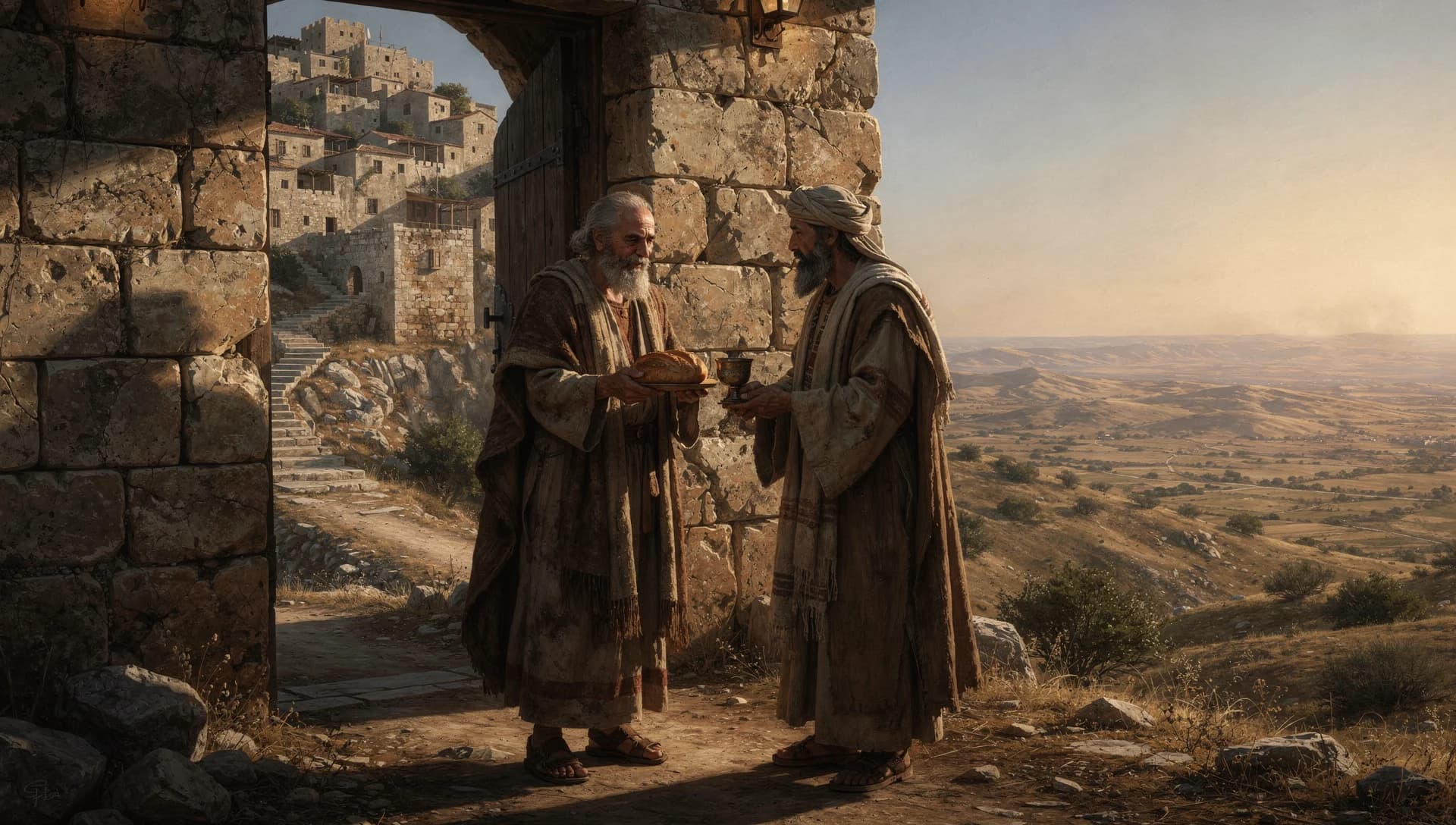
The UB offers a specific historical mechanism. Between roughly 1973 BCE and the Axial Age itself, the Salem teachers, working from Machiventa Melchizedek's Palestinian center, dispatched missionaries who reached, in the UB's account, every major center of the Old World. UB 93:7.1 is unambiguous: Melchizedek trained missionaries who "penetrated to all the surrounding tribes, especially to Egypt, Mesopotamia, and Asia Minor." UB 93:7.2 extends the reach: "Salem missionaries penetrated all Europe, even to the British Isles." Even further: "another traversed China and reached the Japanese of the eastern islands." The UB names these teachers in plural and describes their effort as "a heroic chapter in the annals of the human race."
The Salem teaching was not abstract philosophy. It was a specific theological-ethical package: one God, salvation by faith rather than by ritual, preparation for a future bestowal Son. Wherever it landed, it landed in cultures that already had their own gods, their own rituals, their own priestly establishments. It did not displace those traditions. It seeded them. Over the centuries, the Salem seed grew into the inward, ethical, universalizing reform that we now call the Axial Age. Confucius and Lao-tse received the seed in China and produced ethical philosophy and the Taoist mystical tradition. Zoroaster received it in Persia and reframed it as the cosmic moral struggle. The Hebrew prophets received it through their own line of descent from Abraham, who had been Melchizedek's direct disciple, and produced the most thoroughly monotheistic of the Axial reforms. The Vedic priests received it through Aryan-Dravidian transmission and produced the Upanishadic non-dual reform.
This account does not require any special pleading. The Axial Age is a fact. The simultaneity is a fact. The structural similarity is a fact. The standard "similar conditions" explanation is plausible but partial. The Salem-missionary mechanism, if accepted, completes the picture: the Axial reforms are not parallel inventions but parallel cultivations of one seed.
The strongest counterargument is that the Salem missionaries are not attested in any non-UB source. The Tell el-Amarna correspondence and the Mari archives, both rich in religious texts from the relevant period, do not mention them by name. This is a real difficulty. It is also exactly what the UB predicts: the Salem teaching worked through native converts, who carried it back to their own peoples and adapted it to local idiom. Once adapted, the original Salem source became invisible. What we have left is the structural fingerprint, and the fingerprint is consistent across five major traditions emerging at the same time.
Key Quotes
“Melchizedek continued for some years to instruct his students and to train the Salem missionaries, who penetrated to all the surrounding tribes, especially to Egypt, Mesopotamia, and Asia Minor.”
“Salem missionaries penetrated all Europe, even to the British Isles. One group went by way of the Faroes to the Andonites of Iceland, while another traversed China and reached the Japanese of the eastern islands.”
“THE early teachers of the Salem religion penetrated to the remotest tribes of Africa and Eurasia, ever preaching Machiventa's gospel of man's faith and trust in the one universal God as the only price of obtaining divine favor.”
Cultural Impact
The Axial Age framing has reshaped how the academy thinks about world religion. Before Jaspers, the standard textbook treated each tradition as a self-contained civilizational achievement. After Jaspers, the comparative move became respectable: Confucius, Buddha, Zoroaster, the Hebrew prophets, and the Greek philosophers belong on the same shelf. Karen Armstrong's popularization of the concept in The Great Transformation made it a household frame for educated readers. The Salem-missionary thesis sits beneath this academic shift like an unrecovered foundation. If the UB account is correct, the universities have noticed the structural similarity but missed the historical cause. Comparative religion programs from Chicago to Harvard treat the Axial Age as a fact in search of a mechanism. Wilhelm Schmidt's earlier Urmonotheismus thesis (the claim that primitive monotheism preceded later polytheism, and survives in scattered tribal high-gods) gestured toward the same idea but lacked a concrete historical anchor. The UB supplies the anchor: an actual missionary movement, with named teachers, working from a known geographic center over several centuries. The downstream cultural effect of recognizing the pattern is significant. If every major world religion is rooted in the same Salem seed, then interfaith dialogue moves from the assertion of moral equivalence ("all paths are equal") to the much stronger position of common ancestry ("we are family"). This is the practical theological effect the UB is reaching for: the recognition of a single source beneath the surface diversity, leading to genuine respect rather than merely tolerant relativism.
Modern Resonance
The Axial Age idea is having a moment in popular culture. Yuval Harari's Sapiens treats the period as the pivot of human spiritual development. Robert Bellah's Religion in Human Evolution made it the centerpiece of his magnum opus. Documentary filmmakers from PBS to Netflix return to it because it gives narrative shape to what is otherwise a confusing pluralism of traditions. What the public has not yet fully absorbed is what the simultaneity actually implies. If five major traditions reformed at once, by independent invention, the coincidence requires extraordinary explanation. If they reformed at once because they all received the same seed, the explanation becomes simple. The Salem-missionary thesis is not a fringe or sectarian claim. It is a reasonable hypothesis about a real historical pattern. In an era when interfaith dialogue is more urgent than at any time in living memory, the recognition of a common Salem source matters. It does not require any tradition to abandon its distinctive teaching. It only requires the recognition that the distinctive teaching grew from a shared seed. That is the practical bridge the decoder is offering: a way to honor every tradition while recognizing that the family resemblance is not accidental.
Related Mappings
Ganid's world religion compilation
= First comparative religion study in human history
Seven outstanding human teachers
= Sethard, Moses, Zoroaster, Lao-tse, Buddha, Philo, Paul
Plural historical floods (Dalamatia 162 years after rebellion, Eden sinking, Mesopotamian regional floods)
= Universal flood traditions across ~300 world cultures
Corrupted Salem teaching in ritual form, expectation of a returning Son
= The dying-and-rising god pattern: Osiris, Tammuz, Attis, Adonis, Dionysus
Related Articles
Where to next
The free newsletter. The research behind each piece, no spam.