
 Mythic
Universal flood traditions across ~300 world cultures
 UB
UBPlural historical floods (Dalamatia 162 years after rebellion, Eden sinking, Mesopotamian regional floods)
Full Article
Read the deep-dive article on this connection
Plural historical floods (Dalamatia 162 years after rebellion, Eden sinking, Mesopotamian regional floods) = Universal flood traditions across ~300 world cultures
The Connection
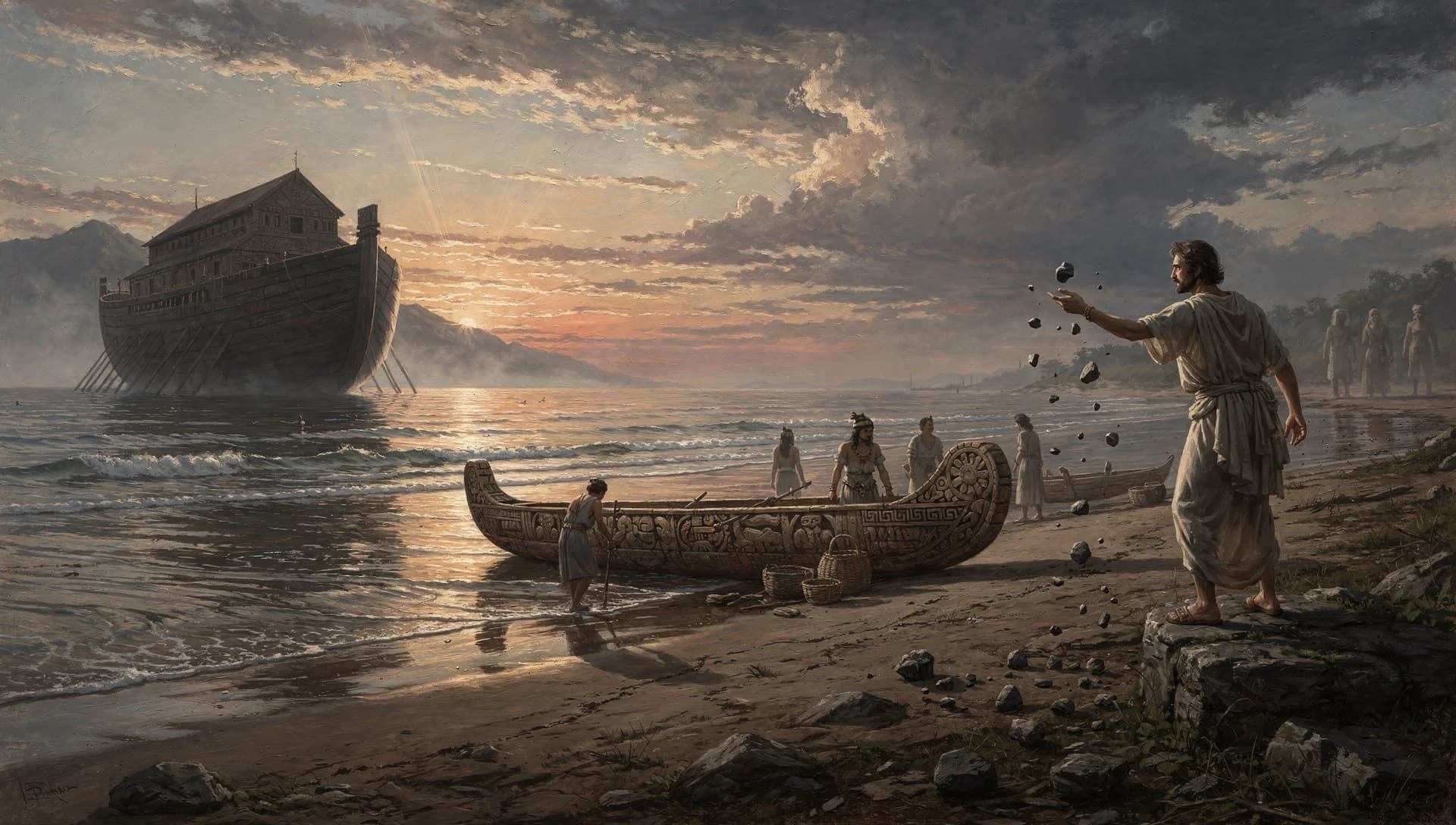
Catastrophic flood narratives appear in the mythology of nearly every world culture: Mesopotamian (Ziusudra, Atrahasis, Utnapishtim), Hebrew (Noah), Greek (Deucalion), Hindu (Manu and the fish), Chinese (Yu the Great), Aztec (the Fifth Sun preceded by a flood), Incan (Viracocha), and many more. The UB identifies this not as a single global event but as the composite memory of several distinct catastrophes: the Dalamatia submergence, the sinking of the first Eden, the later Mesopotamian regional floods, and the general post-glacial coastal drowning. The universal pattern preserves the reality of real floods, compressed into a single narrative.
UB Citation
UB 67:5.4, 73:7.1, 78:7.2-5
Academic Source
Dundes, The Flood Myth (1988); Ryan & Pitman, Noah's Flood (1998); Nunn & Reid, "Aboriginal Memories of Inundation" (2016)
Historical Evidence(Moderate evidence)
Alan Dundes' The Flood Myth collects flood narratives from nearly every continent, arguing the tradition is too widespread for local explanation alone. William Ryan and Walter Pitman's Black Sea hypothesis proposed a specific catastrophic inundation of the Black Sea basin around 5600 BCE as a partial historical anchor. Patrick Nunn's work on Aboriginal coastal-inundation memory demonstrates that 10,000-year flood memories can survive in accurate oral form. The UB's plural-flood framework matches the evidence better than either "one global flood" (Genesis literalism) or "no historical flood" (full-skeptic) positions do.
Deep Dive
In 1872, the British Museum cuneiformist George Smith was working through tablets recovered from the library of Ashurbanipal at Nineveh when he stumbled on something startling: a flood narrative in Akkadian that closely paralleled the Genesis account of Noah. The hero was named Utnapishtim. The flood was sent by the gods. A boat was built to specification. Animals were saved. The boat came to rest on a mountain. Birds were sent out to test the receding waters. Smith, when he realized what he had found, reportedly began to undress in the reading room. The discovery became one of the foundational moments of modern Assyriology.
The Utnapishtim flood is just one of perhaps three hundred flood narratives that survive in world mythology. Mesopotamia alone produced four distinct versions: Ziusudra in the Sumerian Eridu Genesis, Atrahasis in the Akkadian Atrahasis Epic, Utnapishtim in the Standard Babylonian Gilgamesh, and the Berossus account in Hellenistic-period Babylonian tradition. Greek tradition has Deucalion, Hindu tradition has Manu and the fish, Chinese tradition has Yu the Great's flood control, Aztec tradition has the flood that ended the Fourth Sun, K'iche' Maya tradition has the flood that destroyed the wooden men, and dozens of indigenous American, African, and Pacific traditions preserve their own flood accounts.
The standard academic responses to this universality have varied over the past two centuries. The nineteenth-century diffusionist view held that all flood narratives descend from a single Mesopotamian original carried outward by trade and migration. The early twentieth-century structuralist view held that flood narratives are independent expressions of a universal human concern with cosmic destruction and renewal. The mid-twentieth-century environmentalist view (Ryan and Pitman, with their Black Sea hypothesis) proposed a single catastrophic inundation around 5600 BCE as the historical anchor for at least the Mesopotamian-derived traditions.
The UB framework is genuinely different from any of these. It identifies multiple historical floods, each leaving its own memory in different cultures, eventually merging in some traditions and remaining distinct in others. The Dalamatia submergence happened 162 years after the Lucifer rebellion, when "a tidal wave swept up over Dalamatia, and the planetary headquarters sank beneath the waters of the sea" (UB 67:5.4). The first Garden of Eden submerged when "the eastern floor of the Mediterranean Sea sank, carrying down beneath the waters the whole of the Edenic peninsula" (UB 73:7.1). The Mesopotamian regional floods, including the specific Noah flood at Aram, are dated by the UB to roughly 5000 BCE and identified as actual local events later universalized by Hebrew scribal compression (UB 78:7.3-5).
The UB's plural-flood framework matches the evidence better than either pole of the standard debate. It explains why so many cultures have flood traditions: there were many real floods, scattered across hundreds of thousands of years, with the major ones leaving deep cultural imprints. It explains why the traditions cluster geographically: the Sumerian, Hebrew, and Greek versions all derive from regional Mesopotamian and Mediterranean events, while the Aztec and K'iche' versions derive from independent Mesoamerican coastal inundations. It explains why some cultures (the Egyptians notably) lack a flood tradition entirely: their ancestral homeland was high enough above sea level not to suffer the relevant catastrophes.
Patrick Nunn's 2016 paper in Australian Geographer is one of the most important recent contributions to this question. Nunn and Reid demonstrated that twenty-one distinct Aboriginal Australian oral traditions preserve accurate geographic memories of coastline inundation from the Last Glacial Maximum, roughly 10,000 years ago. This was the strongest empirical demonstration ever made that ten-thousand-year-old oral memories of real geological events can survive intact in pre-literate cultures. If Aboriginal Australian traditions can preserve accurate memories of post-glacial sea-level rise across ten thousand years, the broader flood-tradition corpus must be re-evaluated as potentially containing similar deep memories.
The UB's account requires no special pleading on the question of how the memories were preserved. Catastrophic floods are exactly the kind of events that get remembered, retold, and ritually commemorated for thousands of years. The Genesis-style compression, in which multiple regional floods become one universal flood, is exactly what scribal harmonization would produce as cultures encountered each other's flood traditions and tried to fit them into a single narrative. The original plurality is preserved in cultures that did not undergo Hebrew-Christian harmonization, like the Mesoamerican five-suns cosmology and the Hindu yuga-flood cycles.
The strongest counterargument to the UB framing is that no archaeological evidence directly attests to the Dalamatia submergence or the first Eden submergence. The Persian Gulf floor and the eastern Mediterranean basin are difficult to survey for very ancient submerged settlement layers. The UB acknowledges this directly when it notes that Dalamatia's remains lie "under the waters of the Persian Gulf" and that the first Eden lies "submerged under the eastern end of the Mediterranean Sea" (UB 78:7.7). What the UB offers, in lieu of direct archaeological evidence, is a coherent framework for the universal flood-tradition phenomenon, and the framework matches the evidence better than the alternatives.
Key Quotes
“One hundred and sixty-two years after the rebellion a tidal wave swept up over Dalamatia, and the planetary headquarters sank beneath the waters of the sea, and this land did not again emerge until almost every vestige of the noble culture of those splendid ages had been obliterated.”
“But still older vestiges of the days of Dalamatia exist under the waters of the Persian Gulf, and the first Eden lies submerged under the eastern end of the Mediterranean Sea.”
“But Noah really lived; he was a wine maker of Aram, a river settlement near Erech.”
Cultural Impact
The flood-tradition question has been one of the most contested touchpoints between religious tradition and scientific scholarship for the past two centuries. Genesis literalism insisted on a single global flood, requiring geological and biological miracles to be plausible. Critical scholarship insisted on no historical flood at all, treating the universal tradition as a coincidence of independent invention or a single Mesopotamian narrative diffused outward. The UB plural-flood framework cuts the Gordian knot. There were many real floods. The Hebrew scribes compressed regional traditions into one universal narrative for theological reasons (UB 78:7.3 explicitly identifies this scribal motive). The universality of the flood-tradition is real and reflects real historical events, but the events were plural rather than singular. This framing has the practical effect of vindicating the genuine memory preserved in world cultures while acknowledging the scribal-harmonization process that produced the Genesis form of the tradition. For Christian readers struggling with Genesis 6-9, the UB framework offers a way to honor the tradition without committing to geological impossibilities. For secular scholars, it offers a way to explain the universal flood-tradition pattern without invoking either single-event diffusionism or implausible parallel-invention. For comparative religion, it offers a unifying account that respects rather than dismisses the cross-cultural evidence.
Modern Resonance
Climate change has made the flood-tradition question newly relevant. Sea-level rise is now an active concern in coastal cities worldwide, and the prospect of significant inundation in the coming century is part of mainstream climate-policy discussion. The cultural memory of past inundations, preserved in traditions from Mesopotamia to the Pacific to coastal Australia, is no longer just a topic of academic interest but a resource for understanding how human communities have remembered and responded to similar catastrophes in the past. The Patrick Nunn research on Aboriginal coastal memories has direct policy implications: if pre-literate cultures can preserve accurate memories of geological events for ten thousand years, then the flood traditions are not merely religious symbolism but functional records of real human experience with rising seas. The UB framework, which treats the flood traditions as composite memories of real catastrophic events spread over hundreds of thousands of years, fits with this contemporary recognition that catastrophe-memory is one of the most enduring forms of cultural transmission. The practical lesson for readers in 2026 is that the universal flood-tradition is not a relic of pre-scientific superstition but a deep human archive of catastrophe-experience that deserves to be read carefully rather than dismissed. The UB offers a framework for that careful reading.
Related Mappings
Salem missionaries, universal thread through all religions
= Melchizedek missionaries as the hidden link between traditions
Ganid's world religion compilation
= First comparative religion study in human history
Seven outstanding human teachers
= Sethard, Moses, Zoroaster, Lao-tse, Buddha, Philo, Paul
Corrupted Salem teaching in ritual form, expectation of a returning Son
= The dying-and-rising god pattern: Osiris, Tammuz, Attis, Adonis, Dionysus
Related Articles
Where to next
The free newsletter. The research behind each piece, no spam.