
 Mythic
Tibetan concept of Buddha-nature (Tathagatagarbha) and the subtle body
 UB
UBThought Adjuster indwelling and fusion as the goal of mortal life (UB 108-111)
Full Article
Read the deep-dive article on this connection
Thought Adjuster indwelling and fusion as the goal of mortal life (UB 108-111) = Tibetan concept of Buddha-nature (Tathagatagarbha) and the subtle body
The Connection
Tibetan Buddhism teaches that every sentient being possesses the Buddha-nature, an indwelling seed of enlightenment identical in essence with the Dharmakaya (the absolute reality), and that liberation consists in realizing this indwelling nature. This is structurally the same as the UB teaching of the Thought Adjuster: a divine fragment actually indwelling the mortal mind, identical in nature with the Universal Father, whose fusion with the mortal is the goal of the ascending career. The UB's explicit comparison of the Adjuster with the Hindu Atman (111:0.4) extends naturally to the Buddhist Tathagatagarbha, which is the Mahayana Buddhist refinement of the same Upanishadic concept.
UB Citation
UB 108-111, especially 111:0.4
Academic Source
Hookham, The Buddha Within (1991); Ruegg, La théorie du tathāgatagarbha (1969)
Historical Evidence(Moderate evidence)
S.K. Hookham's The Buddha Within documents the Tathagatagarbha ("embryo of the Thus-Gone") teaching as central to Tibetan Kagyu and Nyingma schools: an indwelling Buddha-seed that is not created but realized. David Seyfort Ruegg's standard work on Tathagatagarbha theory traces its origins to Indian Mahayana sutras (Tathagatagarbha-sutra, Ratnagotravibhaga) and its structural continuity with Upanishadic Atman. The UB's explicit comparison of Adjuster and Atman (111:0.4) covers the same theological territory that Tibetan Tathagatagarbha occupies.
Deep Dive
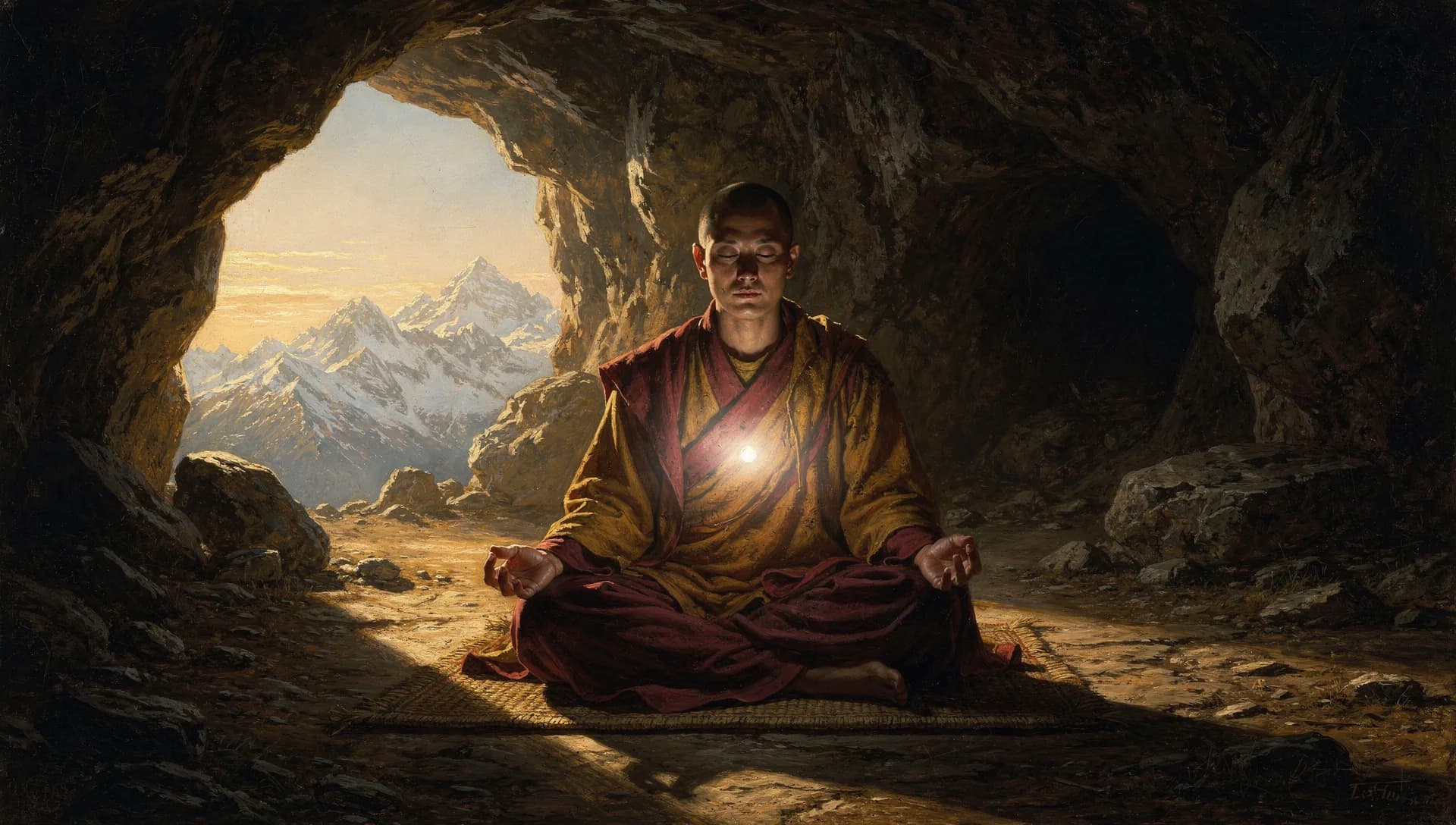
In a Tibetan monastery, a Kagyu lama is teaching a small group of advanced students. He is explaining the doctrine of Tathagatagarbha, the Buddha-nature, the inner seed of enlightenment that every sentient being possesses from beginningless time. The teaching is subtle and difficult. Every being, however degraded their current state, carries within their own consciousness the indwelling presence of the Buddha. The path of Buddhist practice is not adding something foreign to the practitioner but uncovering what has always been there. Liberation is not the achievement of a new state but the recognition of the original state.
The Tathagatagarbha doctrine is one of the most distinctive teachings of Mahayana Buddhism, and it has been particularly emphasized in Tibetan Kagyu and Nyingma schools. The teaching traces back to specific Indian Mahayana sutras (the Tathagatagarbha-sutra, the Mahaparinirvana-sutra, the Srimaladevi-sutra) and to the systematic treatise the Ratnagotravibhaga (Uttaratantra) attributed to Maitreya and Asanga. David Seyfort Ruegg's La theorie du tathagatagarbha et du gotra (1969) is the standard scholarly treatment of the doctrine's development.
The structural features of Tathagatagarbha doctrine are striking. Every sentient being has the Buddha-nature. The Buddha-nature is not created but pre-existent, eternally present in all beings. Liberation consists in recognizing this innate Buddha-nature rather than achieving some external state. The Buddha-nature is identical in essence with the Dharmakaya, the absolute reality that is the actual nature of all things. The journey from ordinary consciousness to enlightenment is therefore a journey of recognition rather than acquisition.
S.K. Hookham's The Buddha Within (1991) documented the centrality of Tathagatagarbha in Tibetan Kagyu thought, particularly in the Shentong (other-emptiness) tradition that contrasts with the more dominant Rangtong (self-emptiness) tradition of the Gelug school. The Shentong tradition treats the Buddha-nature as positively existent rather than as merely-empty, and emphasizes the indwelling-divine character of the Buddha-nature in a way that approaches theistic theology while remaining within Buddhist philosophical discipline.
The UB framework offers a specific theological framework that closely parallels the Tathagatagarbha doctrine. UB 108:0.1 describes the Thought Adjusters: "THE mission of the Thought Adjusters to the human races is to represent, to be, the Universal Father to the mortal creatures of time and space; that is the fundamental work of the divine gifts. Their mission is also that of elevating the mortal minds and of translating the immortal souls of men up to the divine heights and spiritual levels of Paradise perfection."
The Thought Adjuster is described as a fragment of the Universal Father indwelling the mortal mind. It is divine in nature, identical in essence with the Father from whom it derives. It is not created in the moment of indwelling but pre-existent in some form. The mortal's journey toward fusion with the Adjuster is therefore a journey of recognition and cooperation with what is already inwardly present rather than an acquisition of something foreign.
UB 111:0.4 explicitly compares the Adjuster doctrine to the Hindu Atman: "In the conception of the *atman* the Hindu teachers really approximated an appreciation of the nature and presence of the Adjuster, but they failed to distinguish the copresence of the evolving and potentially immortal soul." The UB acknowledges that Hindu Upanishadic teaching about the Atman approaches but does not quite reach the full Adjuster doctrine. The Tibetan Buddhist Tathagatagarbha doctrine, which represents the Mahayana refinement of the same Upanishadic insight, occupies similar theological territory.
The structural parallel between the Thought Adjuster and the Tathagatagarbha is precise. Both are inner divine presences. Both are the actual ground of consciousness rather than additions to it. Both are the basis of the journey toward ultimate union with divine reality. Both make liberation/fusion possible because they are the inward reality with which the outward consciousness is invited to align.
The metaphysical differences are real. The Adjuster is described as a fragment of the actual Universal Father, with specific origin in Divinington. The Tathagatagarbha is described as the indwelling Buddha-nature without specific creation-narrative. The Adjuster framework treats fusion as a specific achievement that produces a unique post-fusion personality. The Tathagatagarbha framework treats recognition as the dispelling of obscuration that has hidden what has always been present.
These differences are not trivial, and they reflect genuinely distinct theological commitments. But the structural similarity at the level of "inner divine presence as the basis of the path toward union with divine reality" is striking enough to be theologically significant. Both frameworks reject the alternative of "soul-as-created-thing-that-must-acquire-divine-relationship" and instead affirm "soul-as-already-having-divine-presence-that-must-be-recognized-and-cooperated-with."
The strongest counterargument is that the Tathagatagarbha doctrine has been controversial within Buddhism itself, with major schools (particularly the Gelug) rejecting or minimizing it as too close to non-Buddhist substantialist theology. The UB Adjuster framework is similarly distinctive within Christian theology, since most mainstream Christian traditions do not affirm an indwelling fragment of the Father as the standard structure of human spirituality. The structural parallel between the two doctrines is therefore a parallel between the more theologically distinctive elements of each tradition rather than between mainstream consensus positions.
The defense is that the most theologically distinctive elements of mature spiritual traditions often converge on similar insights even when the surface theology differs. The Tathagatagarbha and the Adjuster represent the points where Buddhism and the UB respectively reach the deepest understanding of inward divine presence. The structural parallel reflects genuine spiritual reality rather than coincidence or borrowing.
Key Quotes
“THE mission of the Thought Adjusters to the human races is to represent, to be, the Universal Father to the mortal creatures of time and space; that is the fundamental work of the divine gifts. Their mission is also that of elevating the mortal minds and of translating the immortal souls of men up to the divine heights and spiritual levels of Paradise perfection.”
“In the conception of the atman the Hindu teachers really approximated an appreciation of the nature and presence of the Adjuster, but they failed to distinguish the copresence of the evolving and potentially immortal soul.”
Cultural Impact
The Tathagatagarbha doctrine has been one of the most generative concepts in Tibetan Buddhist thought, particularly in Kagyu and Nyingma schools. The doctrine has supported the development of sophisticated meditative practices oriented toward recognition of the indwelling Buddha-nature, including the Mahamudra and Dzogchen traditions that represent some of the deepest contemplative achievements of Tibetan religious tradition. The UB framework offers a way to engage with these Tibetan contemplative traditions that takes their structural insights seriously while connecting them to the broader UB theology. The Tathagatagarbha and the Thought Adjuster represent parallel insights into inward divine presence, and engaging with the Tibetan tradition through this lens enriches rather than diminishes its distinctive philosophical commitments. For Tibetan Buddhist practitioners, the framework offers a way to engage with parallel Western theological developments without compromising Buddhist philosophical commitments. The structural parallel does not require Buddhist practitioners to adopt Christian theological commitments, and vice versa. It simply recognizes that the underlying spiritual reality may be the same even when the conceptual frameworks differ.
Modern Resonance
Contemporary Western interest in Tibetan Buddhism has been substantial, with thousands of Western practitioners engaged with Kagyu, Nyingma, Sakya, and Gelug traditions. Many of these practitioners come from Christian, Jewish, or post-religious backgrounds and are searching for contemplative resources that mainstream Western religion has not adequately supplied. The Tathagatagarbha doctrine, with its affirmation of innate divine presence as the basis of the spiritual path, has been particularly attractive to Western practitioners. The doctrine's structural similarity to certain Christian mystical traditions (Meister Eckhart's "spark of the soul," the Pauline "Christ in you" teaching) has been noted by various commentators on Christian-Buddhist dialogue. The UB framework adds a specific theological resource to this dialogue. The Thought Adjuster doctrine occupies similar theological territory to the Tathagatagarbha, but does so within a framework that explicitly engages with both Christian and broader theistic commitments. For Western practitioners drawn to the Tathagatagarbha but uncomfortable with abandoning theistic commitments, the UB Adjuster doctrine offers a parallel structure that maintains theistic personalism while affirming the same underlying insight about indwelling divine presence.
Related Mappings
The seven mansion worlds and the morontia progression after death (UB 47-48)
= Bardo Thödol: the Tibetan Book of the Dead and its post-mortem stages
Pre-rebellion monotheistic high-god layer (UB 93:7, 94:0.1)
= Bön tradition of Shenlab Miwoche, the primordial teacher
Sacred-mountain cosmology of Edentia and Jerusem, the constellation and system headquarters
= Mount Kailash and Mount Meru: the cosmic axis of Himalayan religion
Andonic highland origins: the first human family emerged in the Himalayan foothills
= Himalayan creation traditions placing humanity's origin in the mountains
Related Articles
Where to next
The free newsletter. The research behind each piece, no spam.