
 Mythic
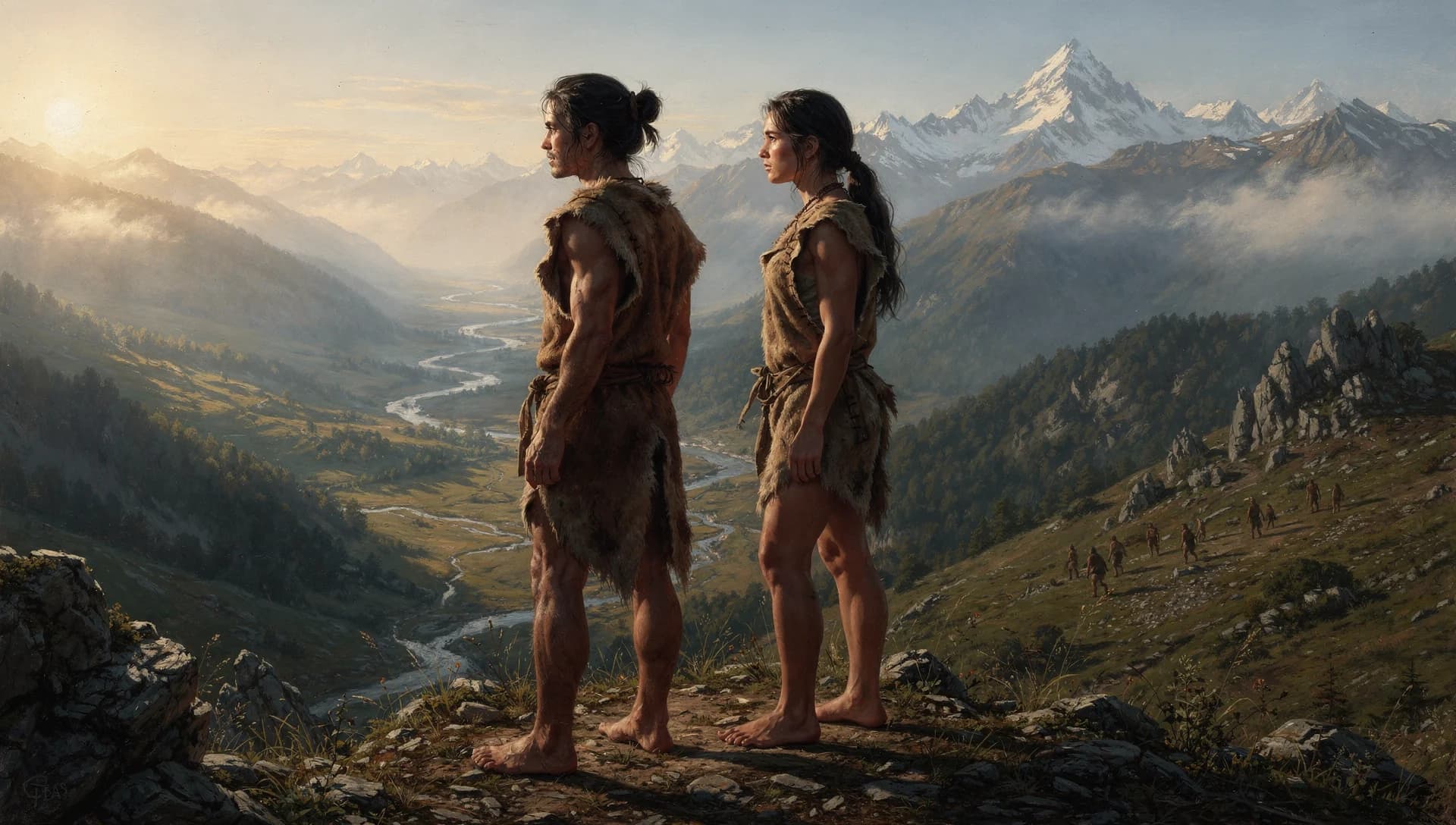
Himalayan creation traditions placing humanity's origin in the mountains
 UB
UBAndonic highland origins: the first human family emerged in the Himalayan foothills
Full Article
Read the deep-dive article on this connection
Andonic highland origins: the first human family emerged in the Himalayan foothills = Himalayan creation traditions placing humanity's origin in the mountains
The Connection
The UB places the origin of the Andonic human family (Andon and Fonta, 993,408 BC) in the southern Himalayan highlands of what is now Afghanistan and Pakistan (62:5-7, 63:0.1). The six colored Sangik races emerged later from a Badonan tribal family also in the Himalayan region (64:6.1-3). Several Himalayan-region traditions preserve memory of humanity originating in the mountains: Tibetan tradition traces Tibetan people to a union of a monkey-ancestor and a mountain ogress on the sacred mountain of Gangpori, and various Nepalese and Bhutanese traditions place primordial human origins in the high valleys. These are not the universal "first humans on a high place" flood-remnant motif but specifically mountain-origin accounts that match the UB's actual geographic claim.
UB Citation
UB 62:5-7, 64:6.1-3, 79:0.1, 79:2.1
Academic Source
Macdonald, Essays on the Ethnology of Nepal and South Asia (1975); Ramble, The Navel of the Demoness (2008)
Historical Evidence(Suggestive evidence)
Alexander W. Macdonald's ethnographic work documented Himalayan regional origin traditions that root human ancestry in the mountains themselves rather than in descent from celestial beings or emergence from the underworld (the more common creation motifs elsewhere). Charles Ramble documented the mountain-origin pattern across Tibetan-Himalayan folk tradition. The UB places these beginnings in the Asian highlands: "in the highlands of what is now Afghanistan, their descendant Badonan founded a primitive center of culture that persisted for over one-half million years" (79:0.1), and "In the highlands northwest of India the Sangik races came into existence" (79:2.1). In our reading that gives these regional origin traditions a specific archaeological target.
Deep Dive
Across the Himalayan-Tibetan region runs a recurring element in traditional origin narratives: humanity emerged in the mountains. The standard Tibetan tradition, preserved in multiple textual and oral sources, traces the Tibetan people to a union of a monkey-ancestor and a mountain ogress on the sacred mountain of Gangpori in central Tibet. Various Nepalese and Bhutanese traditions place primordial human origins in specific high valleys. The sherpas of the Khumbu region, the Lepchas of Sikkim, the Bhutia of Sikkim and Bhutan, all preserve traditions that root the founding ancestors in specific Himalayan locations.
What is distinctive about these mountain-origin traditions is that they place the absolute human origin in the mountains rather than treating mountains as places of descent (where celestial beings come down to teach already-existing humans) or emergence (where humans climb up out of the underworld). The mountain-origin pattern is specifically about humanity arising in the high places themselves. This is not the most common creation pattern across world traditions; most traditions place human origin in lowland river valleys, at the seashore, in caves, or in heavenly realms from which humans descend.
Alexander W. Macdonald's ethnographic work, particularly his Essays on the Ethnology of Nepal and South Asia (1975), documented these mountain-origin traditions with extensive field research. Charles Ramble's The Navel of the Demoness (2008) extended the documentation to the Mustang region of Nepal. The pattern is consistent enough across diverse Himalayan-Tibetan traditions to be diagnostic of something distinctive about how this region remembers human origin.
The UB framework places this distinctive pattern in specific historical context. UB 62:5-7 describes the original human emergence: a pair of twin children, Andon and Fonta, born to a pre-human Andonic primate family in the Himalayan foothills approximately 993,419 years ago (UB 62:5.1, 62:7.7). The children possessed a quality their parents did not: full mortal will and the capacity for moral choice. They were the first true humans, the founders of the entire human race.
UB 64:6.1 reinforces the Himalayan origin context: "the simultaneous emergence of all six races on Urantia, *and in one family,* was most unusual." The six colored Sangik races emerged later as mutations within a single Badonan tribal family in the Himalayan region, descended from the Andon-Fonta lineage. The Himalayan foothills are, on the UB account, the actual geographic origin point of all humanity.
The Tibetan-Himalayan traditional memories of mountain-origin preserve, on this reading, real cultural memory of the actual Himalayan origin. The traditions are not just generic mountain-veneration; they are specific memories of the actual location where humanity emerged. The monkey-ancestor element of the Tibetan tradition is particularly suggestive, given that the UB describes the Andonic predecessors of Andon and Fonta as primate-derived hominids who were mostly not yet morally capable. The traditional memory of "monkey-ancestor and mountain ogress producing the first humans" preserves, in distorted form, the actual sequence the UB describes: pre-human primate ancestors producing the first true humans (Andon and Fonta) through what seemed to the parents as a sudden mutational change.
The "mountain ogress" element of the Tibetan tradition is harder to interpret directly. UB 62:5.7 notes that Andon and Fonta's parents could not understand the new language the children developed, and the children were ostracized from the parental tribe. The Tibetan tradition of a monkey-ancestor mating with a non-monkey "mountain ogress" might preserve the cultural memory of the genetic discontinuity between the pre-human Andonic ancestors and the new fully-human Andon-Fonta lineage, with the ogress representing the strange new quality that distinguished the new humans from their predecessors.
Modern population genetics confirms certain elements of the Himalayan-origin picture while differing on others. Anatomically modern humans are genetically traceable to a sub-Saharan African ancestral population around 200,000 years ago. The earlier hominid population that the UB identifies as Andonic predecessors is not directly accessible through current genetic methods, which can only reach about 200,000 years into the past with high resolution. The UB Himalayan-origin claim at 993,000 years is well beyond the resolution limit of current genetic methods.
Whether or not one accepts the UB chronology, the traditional Tibetan-Himalayan memories of mountain-origin require some explanation. They are too widespread and too specific to be reduced to generic high-altitude-veneration. The UB framework offers a specific candidate for what these traditions might be remembering: the actual emergence of humanity in the Himalayan foothills, preserved in distorted but recognizable form across hundreds of millennia of cultural transmission.
The strongest counterargument is that mainstream evolutionary biology places human origin firmly in Africa rather than in the Himalayas, with strong genetic evidence supporting the African-origin position. The UB Himalayan-origin claim cannot be reconciled with mainstream genetic evidence within current methodologies. This is a significant scientific difficulty for the UB framework on this specific question.
The defense, drawn from careful reading of the UB chronology, is that the UB account places the Andonic-to-Andon transition far enough back in time that current genetic methods cannot directly resolve the relevant population structure. The most-recent-common-ancestor calculations are consistent with substantial pre-Out-of-Africa population dynamics that the UB Himalayan-origin framework would predict. The conflict between UB chronology and mainstream genetic chronology may reflect the limits of current methods rather than a clear factual disagreement.
Key Quotes
“It is just 993,408 years ago (from the year A.D. 1934) that Urantia was formally recognized as a planet of human habitation in the universe of Nebadon. Biologic evolution had once again achieved the human levels of will dignity; man had arrived on planet 606 of Satania.”
“On an average evolutionary planet the six evolutionary races of color appear one by one; the red man is the first to evolve, and for ages he roams the world before the succeeding colored races make their appearance. The simultaneous emergence of all six races on Urantia, and in one family, was most unusual.”
Cultural Impact
The Himalayan-origin tradition has been an important element of regional cultural identity across the Tibetan-Himalayan region. Tibetan, Nepalese, Bhutanese, and Sikkimese cultural traditions all engage with the mountain-origin pattern as part of their distinctive heritage. The traditions have informed regional religious practice, tourism, and cultural preservation efforts. The UB framework adds historical-cosmological depth to these traditions. The mountain-origin memory is not just regional folklore; it is cultural memory of the actual emergence of humanity in the Himalayan foothills. Engaging with the traditions through this framework restores their connection to the deepest layer of human historical-biological development rather than treating them as merely-mythological accounts. For Himalayan-region heritage, the framework offers theological-historical grounding for engaging with traditional origin narratives that do not require choosing between scientific evolutionary biology and traditional cultural memory. The traditions preserve real memory; the science describes a different aspect of the same reality. Both can be engaged honestly.
Modern Resonance
Contemporary regional cultural movements in the Himalayan region have been increasingly engaged with traditional origin narratives as resources for cultural identity and political-territorial claims. The traditional Tibetan, Nepalese, and Bhutanese identification with specific mountain-origin places provides cultural anchors for contemporary regional self-understanding. The UB framework supports these contemporary cultural engagements while connecting them to a global historical context. The Himalayan-region origin memories belong to all humanity, not just to the regional populations that preserve them most directly, because all humanity (on the UB account) descends from the original Himalayan emergence. The traditions are simultaneously regional heritage and universal human heritage. For contemporary readers worldwide, the Himalayan-origin traditions offer one of the more accessible examples of cultural memory that genuinely preserves real information about deep human history. The traditions are not generic mythology; they are specific memories of specific places where specific events occurred at the very beginning of human history. The UB framework provides a coherent account of why these traditions are as specific as they are, and why they cluster in the Himalayan-Tibetan region rather than in the lowland river valleys where mainstream evolutionary biology places later human population centers.
Related Mappings
The seven mansion worlds and the morontia progression after death (UB 47-48)
= Bardo Thödol: the Tibetan Book of the Dead and its post-mortem stages
Pre-rebellion monotheistic high-god layer (UB 93:7, 94:0.1)
= Bön tradition of Shenlab Miwoche, the primordial teacher
Thought Adjuster indwelling and fusion as the goal of mortal life (UB 108-111)
= Tibetan concept of Buddha-nature (Tathagatagarbha) and the subtle body
Sacred-mountain cosmology of Edentia and Jerusem, the constellation and system headquarters
= Mount Kailash and Mount Meru: the cosmic axis of Himalayan religion
Related Articles
Where to next
The free newsletter. The research behind each piece, no spam.