
 Mythic
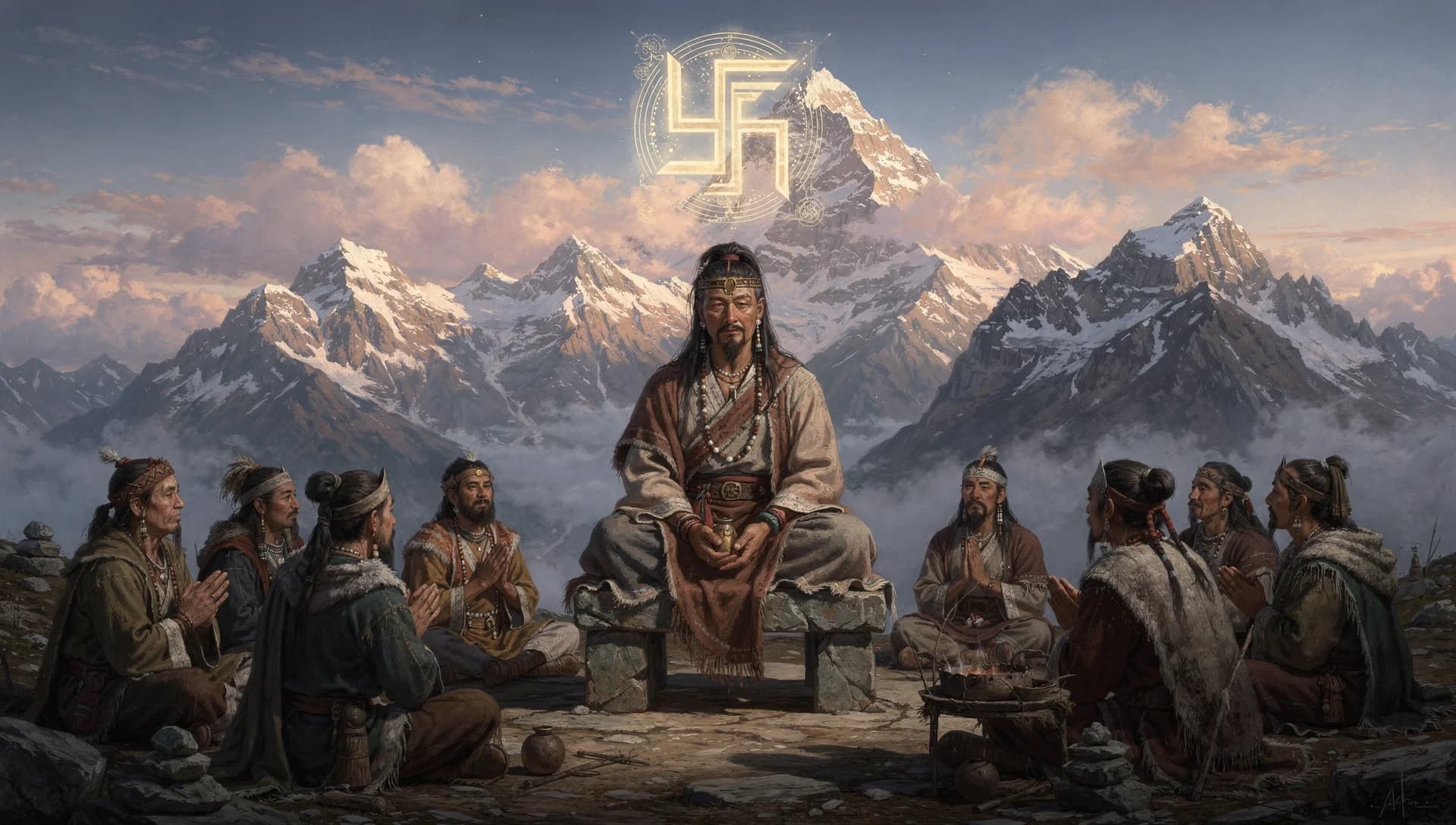
Bön tradition of Shenlab Miwoche, the primordial teacher
 UB
UBPre-rebellion monotheistic high-god layer (UB 93:7, 94:0.1)
Full Article
Read the deep-dive article on this connection
Pre-rebellion monotheistic high-god layer (UB 93:7, 94:0.1) = Bön tradition of Shenlab Miwoche, the primordial teacher
The Connection
Bön is the pre-Buddhist religious tradition of Tibet. Its Yungdrung Bön lineage traces itself to Tonpa Shenrab Miwoche, a primordial enlightened teacher who predates Buddha Shakyamuni and taught the original dharma. The pattern is the same one the UB identifies in China (proto-Taoist Salem transmission), India (Brahman preservation of older teaching), and Polynesia (the Io teaching): an older monotheistic or unity-oriented teaching beneath the surface polytheism, preserved by a specialist priestly lineage. The Andite passage through Tibet (UB 78:5.6, 79:1.1-8) gave Tibet direct exposure to the upstream Salem-Mesopotamian teaching stream.
UB Citation
UB 78:5.6, 79:1.1-8, 93:7
Academic Source
Snellgrove, The Nine Ways of Bon (1967); Kvaerne, The Bon Religion of Tibet (1995)
Historical Evidence(Moderate evidence)
David Snellgrove's The Nine Ways of Bon documented the Bön canonical structure, with Tonpa Shenrab Miwoche as a pre-Buddhist enlightened teacher figure. Per Kvaerne's The Bon Religion of Tibet demonstrates that while modern Yungdrung Bön has been heavily Buddhized, it preserves distinctive non-Buddhist elements (sky-burial origins, sacred-mountain cosmology, specific cosmic-egg creation narratives) that appear to represent genuinely older strata. The UB's specific detail that Andite blood mixed extensively with Tibetan populations (79:1.8) provides a vector for upstream teaching to have entered the Tibetan substrate.
Deep Dive
Walk through any major Bonpo monastery in Tibet or in the Tibetan diaspora communities of northern India and Nepal. You will see ritual practices that are visually almost identical to Tibetan Buddhist practice: similar prayer wheels (though spun in the opposite direction), similar mandalas, similar protector deities. You will also see things that are different: a primary teacher figure named Tonpa Shenrab Miwoche rather than Buddha Shakyamuni, sacred texts in Zhang-Zhung script rather than Sanskrit-derived Tibetan, ritual practices that include mountain-veneration and sky-burial that have no Buddhist parallel.
Bon is the pre-Buddhist religious tradition of Tibet. The contemporary Yungdrung ("eternal") Bon tradition has been heavily influenced by Buddhism since the 11th-century Tibetan Buddhist consolidation, and contemporary Bonpo monks operate within institutional structures very similar to the various Tibetan Buddhist orders. But the distinctive elements of Bon that distinguish it from Buddhism trace back to older strata of Tibetan religion that were largely displaced by Buddhism but never entirely erased.
Tonpa Shenrab Miwoche, the central teacher figure of Yungdrung Bon, is treated by tradition as a pre-Buddha enlightened teacher who taught the original dharma in Olmolungring (a paradisal realm) some 18,000 years ago, then descended to Mount Kailash region to propagate his teaching. The chronology and content of the Tonpa Shenrab tradition cannot be directly verified, but the Bonpo claim that their tradition predates Buddhism is consistent with the broader pattern of pre-Buddhist Tibetan religious history that mainstream Tibetology accepts in broad outline.
David Snellgrove's The Nine Ways of Bon (1967) and Per Kvaerne's The Bon Religion of Tibet (1995) are the standard scholarly treatments. Snellgrove's work documented the Bonpo canonical structure (the Nine Ways or Vehicles, parallel to but distinct from the Buddhist progression of vehicles). Kvaerne's work analyzed the relationship between contemporary Yungdrung Bon and older Tibetan religious strata, identifying elements (sky-burial, mountain-veneration, specific cosmogonic narratives) that appear genuinely older than Buddhist influence. Samten Karmay's The Arrow and the Spindle (1998) further documented the deep stratum of pre-Buddhist Tibetan religious tradition.
The UB framework places Bon in specific historical context. UB 78:5.6 describes Andite movements through Tibet: "Many of this race journeyed to China by way of both Sinkiang and Tibet and added desirable qualities to the later Chinese stocks." UB 79:1.8 confirms ongoing Andite genetic presence: "even in the twentieth century after Christ there are traces of Andite blood among the Turanian and Tibetan peoples, as is witnessed by the blond types occasionally found in these regions." UB 93:7 describes Salem-missionary penetration of central Asia. The combination of Andite genetic-cultural presence and Salem-missionary teaching reaching Tibet provides a specific historical context for what the original pre-Buddhist Tibetan religion might have been.
The Tonpa Shenrab tradition fits the pattern of post-Adamic-era teaching reception that the UB describes across many cultures. A primordial enlightened teacher who arrived from a paradisal realm (Olmolungring), taught a structured dharma, and established a religious tradition that subsequently underwent institutional development. The tradition's specifically pre-Buddhist character marks it as belonging to an older stratum of Central Asian religious tradition that traces back, on the UB account, to the same Andite-era teaching streams that reached the broader region.
The structural features of pre-Buddhist Tibetan religion that distinguish Bon from Buddhism include: an emphasis on sacred mountain cosmology (with Mount Kailash as the central axis); sky-burial as the standard funerary practice (where the body is offered to vultures rather than buried, cremated, or interred); specific cosmogonic narratives involving cosmic eggs and primordial light; a pantheon of mountain-and-sky deities that does not map onto the Indian Buddhist pantheon. These features cluster around themes (sacred mountain, sky-orientation, cosmic light) that appear in older central Asian and Iranian religious traditions but not in mainstream Indian Buddhist tradition.
The pattern fits the UB framework of Andite-era teaching influence preserved in older religious strata that pre-date the major historical-religious systems (Buddhism, Hinduism, Christianity, Islam). The Salem-missionary teaching of one supreme creator-God could have been received in pre-Bonpo Tibet, partially preserved through the institutional channels that became Yungdrung Bon, and integrated into a religious framework that retained its distinctive central Asian character even as it absorbed Buddhist influence in the second millennium CE.
The strongest counterargument is that mainstream Tibetology does not generally accept the Bonpo tradition's claim of pre-Buddhist enlightenment. Most academic Tibetologists treat Tonpa Shenrab as a partly mythological figure whose biographical details cannot be historically verified, and treat contemporary Yungdrung Bon as a religion shaped primarily by post-tenth-century interaction with Buddhism rather than by direct preservation of pre-Buddhist Tibetan religious tradition.
The UB defense is that the distinguishing structural features of Bon (sky-burial, sacred-mountain cosmology, cosmic-egg cosmogony, sky-orientation) are demonstrably older than the Buddhist consolidation and reflect genuine pre-Buddhist Tibetan religious heritage. Whether or not Tonpa Shenrab was a specific historical figure, the older religious heritage that preceded Tibetan Buddhism is real and required some explanation for its origins. The UB Andite-and-Salem framework provides one specific candidate for what those origins might have been.
Key Quotes
“These Andites were the so-called Dravidian and later Aryan conquerors of India; and their presence in central Asia greatly upstepped the ancestors of the Turanians. Many of this race journeyed to China by way of both Sinkiang and Tibet and added desirable qualities to the later Chinese stocks.”
“But even in the twentieth century after Christ there are traces of Andite blood among the Turanian and Tibetan peoples, as is witnessed by the blond types occasionally found in these regions.”
Cultural Impact
Bon has long been the most marginalized of the major Tibetan religious traditions, treated even within Tibet as something of a poor relation to the dominant Buddhist orders. The contemporary recovery of Bon as a serious religious-academic subject has been a significant development of late-twentieth and early-twenty-first century Tibetology. Snellgrove, Kvaerne, Karmay, and others have made the case that Bon deserves serious engagement on its own terms rather than dismissal as either degraded shamanism or merely-Buddhized syncretism. The UB framework supports this recovery. Bon is not just a degraded form of Buddhism or a primitive shamanic tradition; it preserves real elements of pre-Buddhist Tibetan religion that connect to the broader Andite-era and Salem-era teaching streams that reached Central Asia. Engaging with Bon as such a custodian of older tradition, rather than as a deviation from Buddhist norm, restores its proper dignity within the global heritage of religious tradition. For contemporary Bonpo communities (concentrated in eastern Tibet, in the Tibetan diaspora in northern India and Nepal, and in scattered Western practice communities), the framework offers theological-historical depth that goes beyond comparative-religion description. Bon is part of a global heritage of post-Adamic teaching reception, and its distinctive features connect to the broader pattern that the UB documents across many traditions.
Modern Resonance
Contemporary Tibetan religious life is under significant pressure from Chinese government policy, with both Buddhism and Bon facing institutional restrictions and surveillance. The recovery and preservation of Bon's distinctive religious heritage, particularly its older non-Buddhist elements, is increasingly urgent as the institutional structures that have preserved this heritage face growing constraints. The UB framework adds gravity to this preservation effort. Bon preserves elements of religious tradition that trace back, on the UB account, to the original Andite-era and Salem-era teaching streams that reached Central Asia. The tradition is therefore not just a Tibetan-cultural artifact but part of the global heritage of post-Adamic religious development. Its preservation matters not just for Tibetan cultural identity but for the broader human heritage of religious tradition. For Western readers interested in Tibetan religion, Bon offers an alternative to the now-mainstream Tibetan Buddhist traditions that have been thoroughly assimilated into Western contemplative culture. Bon's distinctive features (the sky-burial practice, the mountain-cosmology, the cosmic-egg cosmogony) connect to older religious patterns that the standard Western Buddhist engagement does not encounter. Engaging with Bon, even at the level of comparative-religion reading, opens dimensions of Tibetan religious heritage that mainstream Western Buddhism does not access.
Related Mappings
The seven mansion worlds and the morontia progression after death (UB 47-48)
= Bardo Thödol: the Tibetan Book of the Dead and its post-mortem stages
Thought Adjuster indwelling and fusion as the goal of mortal life (UB 108-111)
= Tibetan concept of Buddha-nature (Tathagatagarbha) and the subtle body
Sacred-mountain cosmology of Edentia and Jerusem, the constellation and system headquarters
= Mount Kailash and Mount Meru: the cosmic axis of Himalayan religion
Andonic highland origins: the first human family emerged in the Himalayan foothills
= Himalayan creation traditions placing humanity's origin in the mountains
Related Articles
Where to next
The free newsletter. The research behind each piece, no spam.