
 Mythic
Mount Kailash and Mount Meru: the cosmic axis of Himalayan religion
 UB
UBSacred-mountain cosmology of Edentia and Jerusem, the constellation and system headquarters
Full Article
Read the deep-dive article on this connection
Sacred-mountain cosmology of Edentia and Jerusem, the constellation and system headquarters = Mount Kailash and Mount Meru: the cosmic axis of Himalayan religion
The Connection
Tibetan Buddhism, Hindu Shakta, Jain, and Bön traditions all center their sacred geography on a cosmic mountain: Mount Meru in Hindu-Buddhist cosmology and Mount Kailash as its physical anchor in the western Tibetan Plateau. The mountain is the axis of the cosmos, the dwelling of the gods, the source of the four great rivers, the gathering point of spiritual pilgrimage. The UB's cosmic architecture centers on real physical headquarters worlds (Jerusem for the system, Edentia for the constellation, Salvington for the local universe), each an actual administrative and spiritual center. The cross-cultural sacred-mountain pattern preserves the structural memory of a genuine cosmic hierarchy.
UB Citation
UB 43 (Edentia); UB 46 (Jerusem)
Academic Source
Eck, India: A Sacred Geography (2012); Kinsley, Hindu Goddesses (1988)
Historical Evidence(Suggestive evidence)
Diana Eck's India: A Sacred Geography documented the Mount Meru cosmology and Kailash as its physical embodiment, the mountain circumambulated by Tibetan Buddhist, Hindu, Jain, and Bön pilgrims in often-opposite directions. David Kinsley traced the recurring sacred-mountain motif across South Asian religion. The UB's literal cosmic-administration architecture provides a concrete structural referent for what cross-cultural religion preserves as sacred-mountain symbolism: a real cosmic hierarchy remembered in geographical form.
Deep Dive
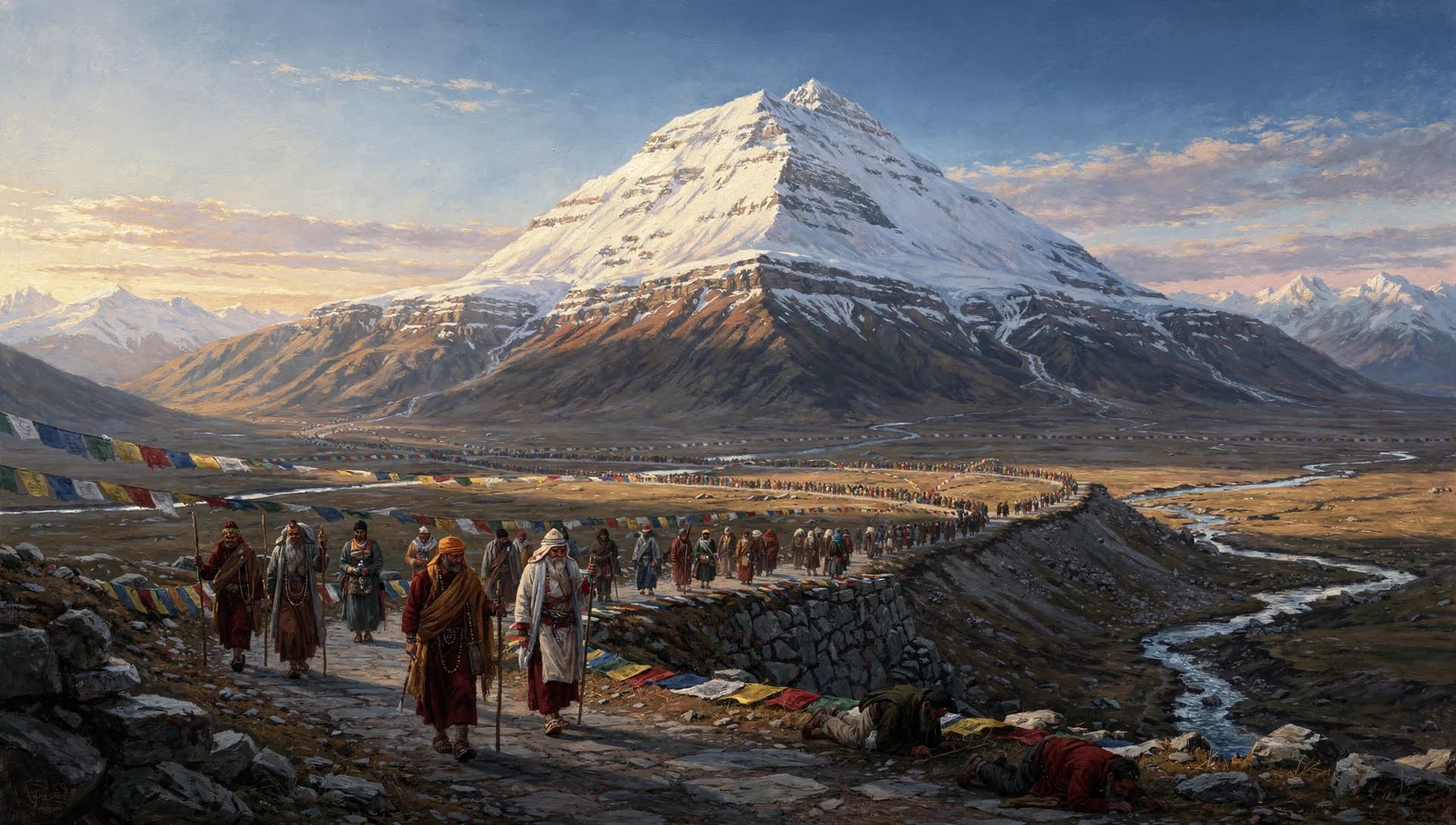
Mount Kailash rises 6,638 meters above the western Tibetan Plateau, a near-perfect pyramidal peak that seems almost engineered in its symmetrical form. Around its base flows a circumambulation route, the kora, that pilgrims walk in a 52-kilometer loop, climbing to nearly 5,600 meters at the Drolma La pass. Tibetan Buddhists walk the kora clockwise. Bonpos walk it counter-clockwise. Hindus consider Kailash the abode of Shiva. Jains consider it the place where their first tirthankara, Rishabhanatha, attained liberation. The mountain is one of the most thoroughly venerated sacred geographies on the planet, drawing pilgrims from at least four major religious traditions.
In Hindu and Buddhist cosmology, Kailash is the physical embodiment of Mount Meru, the cosmic mountain at the center of the universe. Mount Meru is described in the Puranas and the Mahabharata as a five-peaked mountain rising at the center of the cosmic disk, surrounded by concentric rings of continents and oceans, with the various heavens stacked above its summit. The four rivers of paradise flow from its base in the four cardinal directions. The gods dwell in palaces on its slopes. The cosmic axis of reality runs through its center.
Diana Eck's India: A Sacred Geography (2012) documented the Mount Meru cosmology and Kailash as its physical anchor with extensive scholarly detail. The Mount Meru tradition appears across Hindu, Buddhist, Jain, and Bonpo religious frameworks, with each tradition adapting the basic structure to its own theological commitments while preserving the underlying pattern. David Kinsley's Hindu Goddesses (1988) traced the sacred-mountain motif across South Asian religion, showing how it organizes much of the religious-geographical imagination of the subcontinent.
The Mount Meru cosmology is not unique to South Asia. The pattern of "cosmic mountain at the center of the universe" appears in many traditions: the Mesopotamian ziggurat as a representation of the cosmic mountain, the Egyptian primordial mound from which creation emerges, the Greek Mount Olympus, the Norse Yggdrasil (a tree rather than a mountain but functioning as cosmic axis), the Aztec sacred mountains. Mircea Eliade's Patterns in Comparative Religion treated the cosmic mountain as one of the most widespread religious symbols, recurring across cultures with remarkable consistency.
The UB framework provides a specific structural referent for what this widespread cosmic-mountain symbolism preserves. The UB cosmic-administrative architecture is literally hierarchical and literally mountain-shaped in some senses. UB 43:0.1 begins with the planetary classification: "URANTIA is commonly referred to as 606 of Satania in Norlatiadek of Nebadon, meaning the six hundred sixth inhabited world in the local system of Satania, situated in the constellation of Norlatiadek, one of the one hundred constellations of the local universe of Nebadon." Each level of administration has its own headquarters world: Jerusem for the system, Edentia for the constellation, Salvington for the local universe.
UB 46:0.1 describes Jerusem as "the headquarters of Satania ... an average capital of a local system." The headquarters worlds are real physical-spiritual locations with specific architectural features, populations, and administrative functions. They are organized in a hierarchical structure that ascends from the local through successive levels to the universal central administration at Paradise. The cosmic architecture is real, hierarchical, and organized around specific central locations that function as the administrative anchors of cosmic order.
The cross-cultural sacred-mountain pattern preserves, on the UB account, the cultural memory of this real cosmic-administrative hierarchy. The cosmic mountain at the center of the universe is the symbolic representation of the actual cosmic-administrative center. The four rivers flowing from its base preserve the iconographic memory of the actual cosmic structure with its multiple administrative streams flowing outward to local systems. The gods dwelling on the slopes preserve the memory of the actual personality-orders that staff the headquarters worlds.
This is a structural rather than a literal mapping. The UB does not claim that Mount Kailash is literally the cosmic axis or that the Hindu Mount Meru is the literal headquarters world. The claim is that the widespread cosmic-mountain symbolism preserves cultural memory of the literal cosmic-administrative hierarchy that the UB describes in detail. The symbolic-iconographic preservation has attached itself to physical mountains in many cultures because mountains are the most natural physical analog for the literal cosmic-axis structure that the symbolism is preserving.
The strongest counterargument is that the cross-cultural sacred-mountain motif can be fully explained by environmental factors (mountains are impressive physical features that naturally attract religious veneration) without invoking any specific underlying cosmic-administrative architecture. This is partially true. Mountains are indeed naturally impressive, and any culture located near significant mountains would likely develop some form of sacred-mountain tradition.
But the specific structural features of the cosmic-mountain motif (cosmic axis, four rivers from the base, gods on the slopes, multi-tiered cosmic structure organized around the central mountain) are not predicted by generic environmental-mountain-veneration. They are predicted by cultural memory of an actual cosmic-administrative hierarchy that is preserved through symbolic-iconographic attachment to local physical mountains. The UB framework provides one specific candidate for what that underlying hierarchy might be.
Key Quotes
“URANTIA is commonly referred to as 606 of Satania in Norlatiadek of Nebadon, meaning the six hundred sixth inhabited world in the local system of Satania, situated in the constellation of Norlatiadek, one of the one hundred constellations of the local universe of Nebadon.”
“JERUSEM, the headquarters of Satania, is an average capital of a local system, and aside from numerous irregularities occasioned by the Lucifer rebellion and the bestowal of Michael on Urantia, it is typical of similar spheres.”
Cultural Impact
The Mount Kailash pilgrimage has been one of the great unbroken religious traditions of the Himalayan region. Despite political tensions and access difficulties, pilgrims from Hindu, Buddhist, Jain, and Bon traditions continue to walk the kora around the mountain. The pilgrimage is one of the most physically demanding religious practices in the world, requiring three weeks of high-altitude trekking in often severe conditions. The UB framework adds theological-cosmological depth to this pilgrimage tradition. The mountain is not just an impressive physical feature; it is the South Asian anchor of the cross-cultural cosmic-mountain motif that preserves cultural memory of the actual cosmic-administrative hierarchy. Pilgrims walking the Kailash kora are participating in a tradition that, on the UB account, ultimately traces back to the original superhuman teaching about cosmic structure. For contemporary South Asian religious life, the Mount Meru / Kailash cosmology offers theological resources that the more abstract metaphysical traditions (mainstream Vedantic non-dualism, mainstream Madhyamika emptiness-philosophy) sometimes do not. The cosmic-mountain tradition affirms the literal-physical reality of the cosmic structure rather than treating it as merely-symbolic, and this affirmation connects with the UB literal-cosmic-architecture theology in ways that the more abstract traditions do not.
Modern Resonance
Contemporary scientific cosmology has thoroughly displaced the Mount Meru framework as a literal physical-cosmological account. We know the universe does not have a physical center axis around which everything rotates, and the multi-tiered heavens-and-realms structure is not consistent with physical cosmology as currently understood. The UB framework offers a way to engage with the Mount Meru tradition that respects both the contemporary scientific understanding and the genuine insight the tradition preserves. The Mount Meru cosmology is not literal physical cosmology, but it is also not just symbolic projection. It is cultural-iconographic memory of an actual cosmic-administrative hierarchy that exists at a different metaphysical level than physical cosmology. The administrative hierarchy is real (in UB framework terms) but it is not located in physical space the way a physical mountain is located. This framing offers a way for contemporary readers from South Asian religious traditions to engage with traditional cosmology without committing to literal claims that contemporary science has refuted. The traditional cosmology preserves real spiritual content, but the content concerns the cosmic-administrative hierarchy of personalities and powers rather than the physical structure of stars and planets. Contemporary scientific cosmology is correct about physical structure. Traditional cosmic-mountain symbolism is correct about something else, something the UB articulates explicitly: the actual hierarchical organization of the universe administration through specific headquarters worlds and their personality complements.
Related Mappings
The seven mansion worlds and the morontia progression after death (UB 47-48)
= Bardo Thödol: the Tibetan Book of the Dead and its post-mortem stages
Pre-rebellion monotheistic high-god layer (UB 93:7, 94:0.1)
= Bön tradition of Shenlab Miwoche, the primordial teacher
Thought Adjuster indwelling and fusion as the goal of mortal life (UB 108-111)
= Tibetan concept of Buddha-nature (Tathagatagarbha) and the subtle body
Andonic highland origins: the first human family emerged in the Himalayan foothills
= Himalayan creation traditions placing humanity's origin in the mountains
Related Articles
Where to next
The free newsletter. The research behind each piece, no spam.