
 Mythic
Bardo Thödol: the Tibetan Book of the Dead and its post-mortem stages
 UB
UBThe seven mansion worlds and the morontia progression after death (UB 47-48)
Full Article
Read the deep-dive article on this connection
The seven mansion worlds and the morontia progression after death (UB 47-48) = Bardo Thödol: the Tibetan Book of the Dead and its post-mortem stages
The Connection
The Bardo Thödol describes the post-mortem experience as a structured sequence of phases (the bardo of dying, the bardo of dharmata, the bardo of becoming), each with characteristic perceptions, encounters with peaceful and wrathful deities, and opportunities for liberation. The UB describes post-mortem ascent as a structured progression through seven mansion worlds, each with its own developmental focus, its own specialized personalities who assist the ascender, and its own tests that must be passed before advancement. The shared structure (staged post-mortem progression, personalities encountered at each stage, testing and refinement at each level) is precise.
UB Citation
UB 47-48
Academic Source
Evans-Wentz, The Tibetan Book of the Dead (1927); Fremantle & Trungpa, The Tibetan Book of the Dead (1975)
Historical Evidence(Moderate evidence)
W.Y. Evans-Wentz's translation of the Bardo Thödol (attributed to Padmasambhava, 8th century CE, with earlier oral roots) presents a sophisticated post-mortem psychology with staged transitions. Chögyam Trungpa and Francesca Fremantle's later translation foregrounds the Bardo as a map of consciousness states rather than literal geography. The UB's mansion-world sequence is literal but functions psychologically the same way: staged refinement toward fusion with the divine. No direct transmission is claimed, but the structural parallel is distinctive enough to merit comparison.
Deep Dive
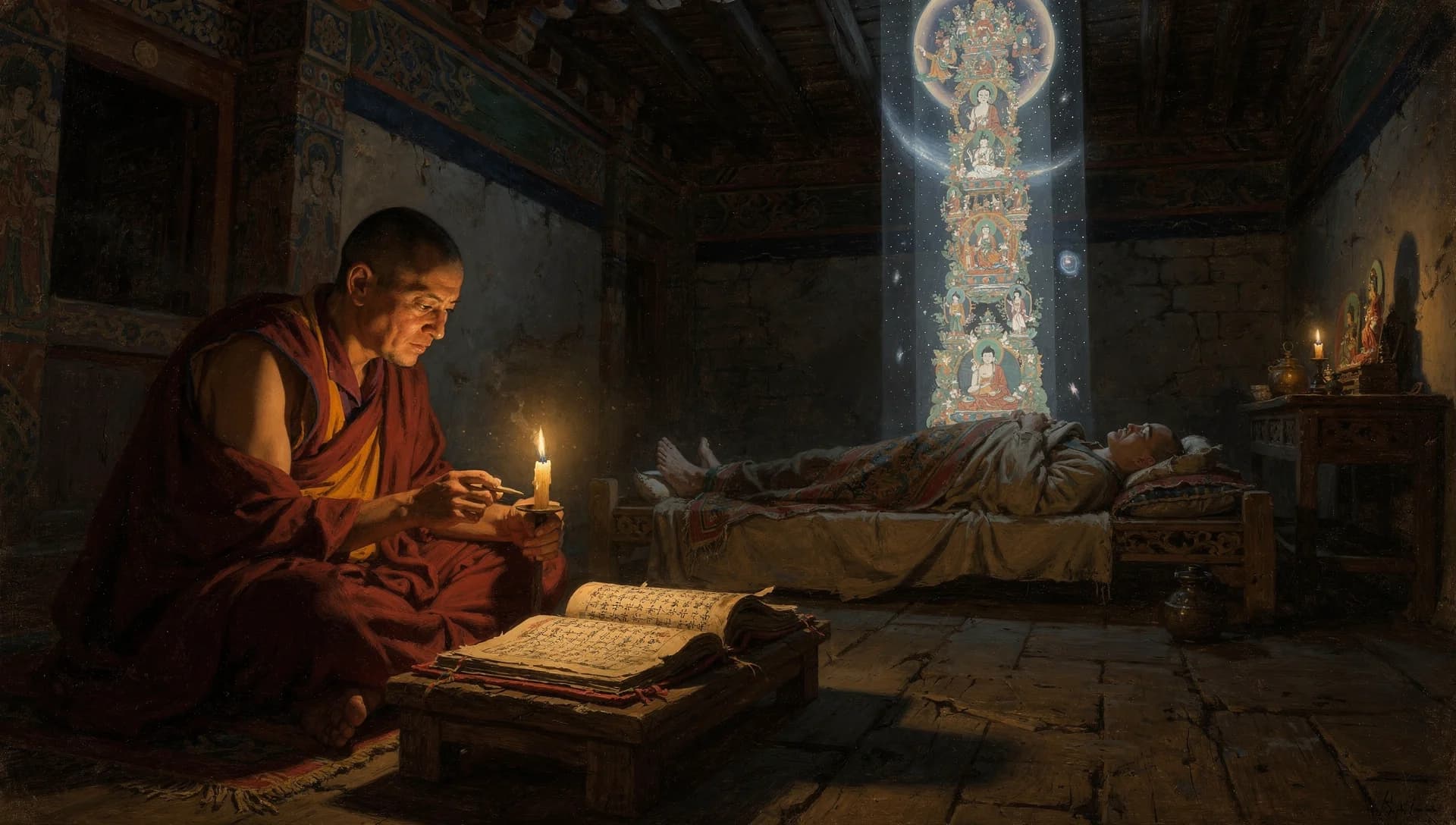
Sit in the cold air of a Tibetan monastery in the high passes of the Himalayas. A lama is reading the Bardo Thodol over a recently deceased monk. The lama's voice is steady, the words specific. He is guiding the consciousness of the dead through a precisely ordered sequence of post-mortem states. The first bardo, the moment of dying, with its experience of the clear light. The second bardo, of dharmata, with its succession of peaceful and wrathful deities arising from the deceased's own consciousness. The third bardo, of becoming, with its impulses toward rebirth in one of the six realms of existence. Each stage has its characteristic perceptions, its standard challenges, its opportunities for liberation if the deceased can recognize the experiences for what they are.
The Bardo Thodol, the Tibetan Book of the Dead, is one of the most sophisticated post-mortem psychologies in any religious tradition. Attributed by tradition to the eighth-century master Padmasambhava who is said to have hidden the text as a treasure (terma) to be discovered when the time was right, it was actually rediscovered (according to tradition) by Karma Lingpa in the fourteenth century. Whatever its exact composition history, it presents a developed framework for the transitional states between death and rebirth.
W.Y. Evans-Wentz's 1927 English translation introduced the text to the West and gave it the popular title "Tibetan Book of the Dead." Carl Jung wrote an influential commentary treating the text as a sophisticated psychological-symbolic system. Chogyam Trungpa and Francesca Fremantle's 1975 retranslation re-emphasized the text's status as a guidebook for actual post-mortem experience rather than as merely psychological metaphor. Robert Thurman's 1994 translation made the text more accessible to general readers and emphasized its philosophical-meditative content.
The structural features of the Bardo Thodol are striking from a comparative perspective. The post-mortem journey is staged rather than instantaneous. Each stage has its specific challenges and opportunities. Personalities are encountered at each stage who help or hinder progress depending on how they are recognized. Liberation is possible at any stage if the deceased achieves the right recognition. The journey is not arbitrary but reflects the structure of the consciousness undergoing it.
The UB framework presents a structurally similar though metaphysically different post-mortem progression. UB Papers 47 and 48 describe the seven mansion worlds, the transition spheres on which ascending mortals advance after death. UB 47:0.1 begins with explicit reference to John 14:2: "THE Creator Son, when on Urantia, spoke of the 'many mansions in the Father's universe.' In a certain sense, all fifty-six of the encircling worlds of Jerusem are devoted to the transitional culture of ascending mortals, but the seven satellites of world number one are more specifically known as the mansion worlds." UB 48:1.1 notes that "this morontia life has been known on Urantia since the early days of the Planetary Prince. From time to time this transition state has been taught to mortals, and the concept, in distorted form, has found a place in present-day religions."
The structural parallel between the UB mansion-world sequence and the Bardo Thodol bardos is precise. Both describe staged post-mortem progression. Both describe specific personalities encountered at each stage. Both describe testing and refinement at each level. Both describe the possibility of advancement or stagnation depending on the readiness of the consciousness undergoing the transition. Both treat the post-mortem journey as preparation for ultimate union with divine reality (fusion with the Thought Adjuster in the UB framework, recognition of one's primordial Buddha-nature in the Tibetan framework).
The metaphysical differences are real. The UB mansion worlds are described as actual physical-morontia worlds with specific locations, populations, and developmental functions. The Bardo Thodol bardos are described as states of consciousness that arise during the post-mortem transition without specific spatial-temporal location. The UB framework asserts the literal geography of the post-mortem journey; the Tibetan framework treats the journey as primarily phenomenological.
Despite this metaphysical difference, the structural-functional similarity is striking. Both frameworks present staged post-mortem progression as the actual structure of what happens after death. Both frameworks emphasize specific personality-encounters as features of the journey. Both frameworks treat the journey as developmental rather than as static reward or punishment. Both frameworks see the journey as preparation for ultimate union with divine reality.
UB 48:1.1's acknowledgment that "the concept, in distorted form, has found a place in present-day religions" is significant. The UB explicitly recognizes that the morontia-progression teaching has reached human religions, even if in distorted form. The Bardo Thodol may preserve a particularly clear (if metaphysically transposed) version of this teaching, with its specific structural features (staging, personality-encounters, developmental progression, ultimate union) corresponding to the UB description with surprising precision.
The strongest counterargument is that no direct transmission is claimed in either direction. The UB does not specifically identify Tibetan tradition as a recipient of the morontia-progression teaching, and the Tibetan tradition does not specifically claim Andite-era origin for the Bardo Thodol. The structural parallel may be coincidental or may reflect the limited number of plausible structures for any post-mortem progression psychology.
The UB defense is that the structural parallel is detailed enough to be more than coincidence. Both frameworks specify seven major stages (the seven mansion worlds in the UB; the Bardo Thodol's elaborated sequence with its multiple sub-stages adding to a similar count). Both frameworks have standard personalities encountered at each stage. Both frameworks emphasize developmental progression toward divine union. The detail of the parallel suggests common origin in a teaching tradition that both inherited, even if the inheritance pathways are not directly traceable.
Key Quotes
“THE Creator Son, when on Urantia, spoke of the "many mansions in the Father's universe." In a certain sense, all fifty-six of the encircling worlds of Jerusem are devoted to the transitional culture of ascending mortals, but the seven satellites of world number one are more specifically known as the mansion worlds.”
“The morontia realms are the local universe liaison spheres between the material and spiritual levels of creature existence. This morontia life has been known on Urantia since the early days of the Planetary Prince. From time to time this transition state has been taught to mortals, and the concept, in distorted form, has found a place in present-day religions.”
Cultural Impact
The Bardo Thodol has had outsized cultural impact in the West for a Tibetan religious text. The Evans-Wentz 1927 translation, the Jung commentary, and subsequent translations have made the text one of the most widely read works of Asian religious literature in Western languages. Timothy Leary's The Psychedelic Experience (1964) controversially reframed the text as a guidebook for psychedelic states. The text continues to be used in Western Buddhist and contemplative traditions as a meditation aid and as a guide for thinking about death. The UB framework offers a way to engage with this widely-read text that takes its post-mortem-progression structure seriously while connecting it to a global comparative pattern. The Bardo Thodol is not just an exotic Tibetan text; it is the Tibetan instantiation of a universal pattern of staged post-mortem progression that has reached human religions in many forms across many cultures. For Tibetan-heritage readers and Western Buddhist practitioners, the framework offers a way to engage with the Bardo Thodol that connects it to the broader UB description of mansion-world progression without flattening the metaphysical differences. The structural parallel does not require the Tibetan tradition to abandon its distinctive philosophical commitments; it simply recognizes that the underlying post-mortem reality may have been preserved in different cultural forms across many traditions.
Modern Resonance
Contemporary near-death experience research has produced a substantial empirical literature documenting consistent features of the post-mortem transition: out-of-body experiences, encounter with light or beings of light, life review, choice point about return to embodied existence. The cross-cultural consistency of NDE features has been documented by researchers like Raymond Moody, Bruce Greyson, and Jeffrey Long. The Bardo Thodol structural framework matches several features of the empirical NDE literature. The staged progression, the encounter with personalities, the developmental character of the experience, the ultimate orientation toward light and divine union all appear in both the Tibetan tradition and the contemporary empirical research. This is not direct corroboration of the Bardo Thodol metaphysics, but it suggests the underlying experiential structure may be real and consistent across cultural settings. The UB mansion-world framework similarly matches features of the empirical NDE literature. The UB framework predicts staged transitional spheres with specific personalities, developmental functions, and orientation toward divine union. The empirical NDE literature documents these features without invoking the UB framework. The convergence of UB metaphysics, Tibetan Bardo tradition, and contemporary NDE research on similar structural features of post-mortem experience is striking and merits continued comparative analysis.
Related Mappings
Pre-rebellion monotheistic high-god layer (UB 93:7, 94:0.1)
= Bön tradition of Shenlab Miwoche, the primordial teacher
Thought Adjuster indwelling and fusion as the goal of mortal life (UB 108-111)
= Tibetan concept of Buddha-nature (Tathagatagarbha) and the subtle body
Sacred-mountain cosmology of Edentia and Jerusem, the constellation and system headquarters
= Mount Kailash and Mount Meru: the cosmic axis of Himalayan religion
Andonic highland origins: the first human family emerged in the Himalayan foothills
= Himalayan creation traditions placing humanity's origin in the mountains
Related Articles
Where to next
The free newsletter. The research behind each piece, no spam.