
 Mythic
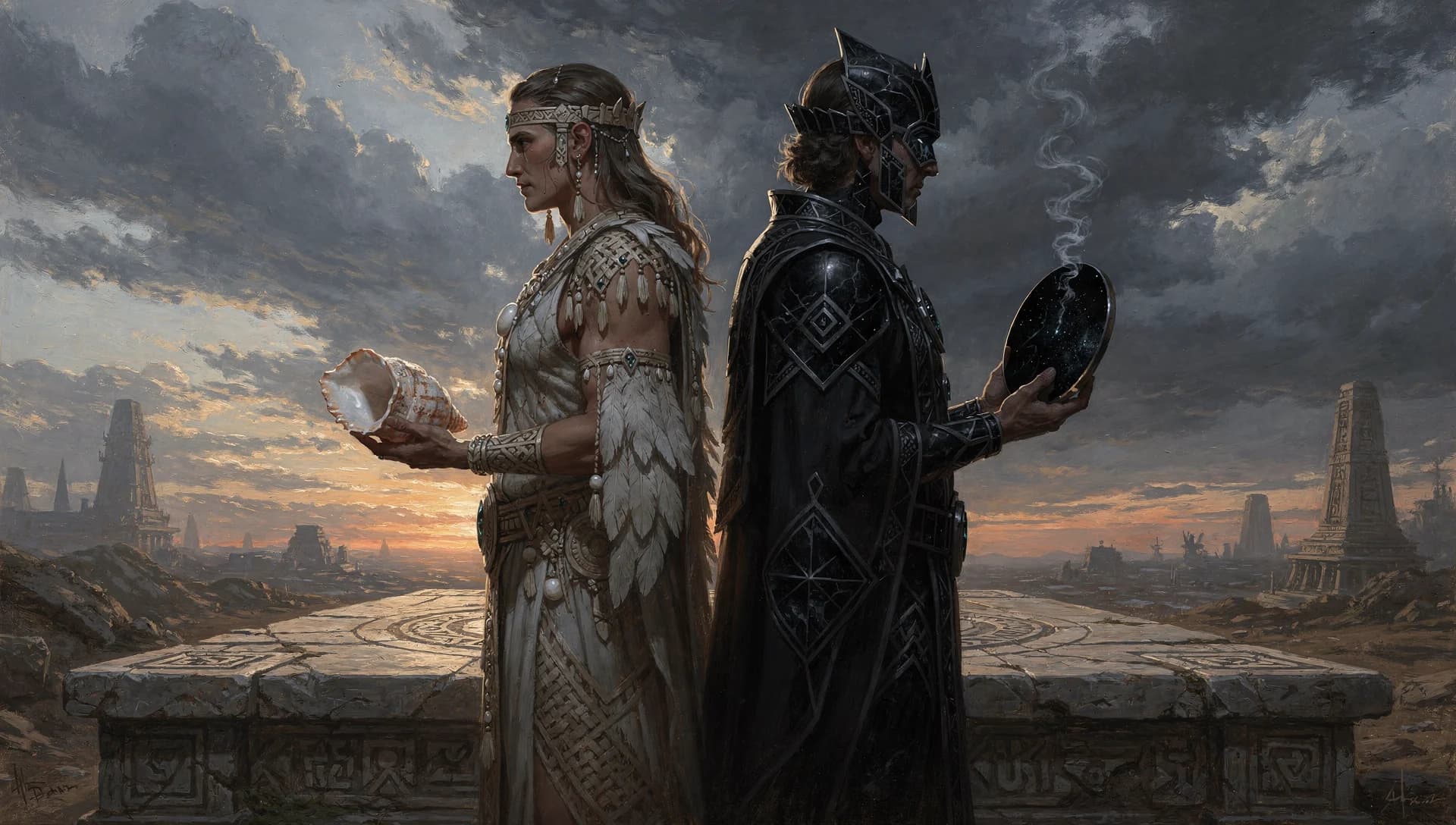
Quetzalcoatl and Tezcatlipoca, cosmic brothers who contest creation
 UB
UBTeaching-pair pattern: a god of wisdom and his brother or rival
Full Article
Read the deep-dive article on this connection
Teaching-pair pattern: a god of wisdom and his brother or rival = Quetzalcoatl and Tezcatlipoca, cosmic brothers who contest creation
The Connection
Mesoamerican cosmology has Quetzalcoatl (feathered serpent, teacher, wind, civilization) opposed by Tezcatlipoca (smoking mirror, night, warfare, sacrifice), the two constantly contesting control of the cosmic ages. The structural pattern is the same split the UB describes in the Prince's staff: a wisdom-teaching faction and a power-seeking faction locked in opposition. The Van-Nod pair, the Enki-Enlil pair, and the Quetzalcoatl-Tezcatlipoca pair all encode the same primordial rebellion-versus-loyalty contrast.
UB Citation
UB 67:2.2, 67:3.5, 67:4.1
Academic Source
Carrasco, Quetzalcoatl and the Irony of Empire (1982); Read, Time and Sacrifice in the Aztec Cosmos (1998)
Historical Evidence(Moderate evidence)
David Carrasco documents Tezcatlipoca's role as Quetzalcoatl's cosmic opponent: it is Tezcatlipoca who eventually drives Quetzalcoatl into exile from Tula, ending the golden age. Kay Read's Time and Sacrifice shows the two gods alternating cosmic rule across the ages. The "two brothers contest creation" motif appears widely in world mythology (Osiris / Set, Enki / Enlil, Van / Nod, Hesiod's Prometheus / Zeus), and the UB's original rebellion-versus-loyalty split provides a single historical seed for what is otherwise a remarkable worldwide pattern.
Deep Dive
In the Toltec capital Tula around the year 1000 CE, according to the cultural memory preserved in later Aztec sources, the priest-king Topiltzin Quetzalcoatl had established a golden age. He had banned human sacrifice. He had organized the city around peaceful cultivation of the arts, the calendar, and ethical teaching. His symbol was the feathered serpent (quetzal-coatl, the bird-of-many-colors-and-the-snake), combining the upward-aspiring (bird) and the earthward-grounded (serpent) into a single integrated figure.
Then the cosmic adversary arrived. Tezcatlipoca, the Smoking Mirror, the night-jaguar god of warfare, sorcery, and dark obsidian, came to Tula in disguise. He tricked Topiltzin Quetzalcoatl into drunkenness and shameful behavior. He undermined the priest-king's authority. Eventually he drove Quetzalcoatl into exile. The priest-king departed eastward by sea, on a raft of serpents, promising to return one day to reclaim what had been lost. Tula fell into decline. Human sacrifice was reinstated. The golden age ended.
This narrative, preserved in multiple Aztec sources including the Anales de Cuauhtitlan and the Florentine Codex, is the most thoroughly developed Mesoamerican expression of the cosmic-brothers-contest pattern. David Carrasco's Quetzalcoatl and the Irony of Empire (1982) treats it as the central organizing narrative of Mesoamerican religious imagination. Kay Read's Time and Sacrifice in the Aztec Cosmos (1998) extends the analysis to show how Quetzalcoatl and Tezcatlipoca alternate cosmic rule across the Five Suns, with each god having his cosmic age before being supplanted by the other.
The structural pattern is identical to versions of the same motif across many world mythologies. The Egyptian Osiris vs. Set, where Osiris represents civilization, agriculture, and ethical order, and Set represents the desert, violence, and chaos. The Hebrew Cain vs. Abel, where Abel's offering is accepted and Cain's is rejected, leading to fratricide. The Greek Prometheus vs. Zeus, where Prometheus champions humanity and Zeus enforces divine sovereignty. The Sumerian Enki vs. Enlil, where Enki saves humanity from the flood that Enlil decreed. The Norse Loki vs. the other Aesir, with Loki as the trickster who is also the catalyst for cosmic disruption. The Hindu Indra vs. Vritra, with the thunder-warrior overcoming the cosmic serpent.
The pattern is so widespread that it cannot be reduced to coincidence or to generic cognitive structuralism. The specific elements (two related figures, often described as brothers, cosmic in scope, with one favoring civilization and ethics and the other favoring power and disruption, locked in perpetual conflict) recur across cultures that had no contact with each other.
The UB framework provides a single historical seed for this worldwide pattern. UB 67:4.1-3 describes the Lucifer rebellion as splitting the Prince's corporeal staff into two factions: forty members who remained loyal under Van's leadership, sixty who defected with Caligastia and Daligastia. The split was structural and lasting. The two factions represented genuinely different orientations: the loyal faction emphasized worship of the unseen Father, ethical teaching, and obedience to universe authority; the rebel faction emphasized self-determination, immediate material rewards, and dramatic worldly accomplishment.
UB 67:4.3 makes the explicit connection between this rebellion split and the cross-cultural memory of cosmic-brothers conflict: "The presence of these extraordinary supermen and superwomen, stranded by rebellion and presently mating with the sons and daughters of earth, easily gave origin to those traditional stories of the gods coming down to mate with mortals. And thus originated the thousand and one legends of a mythical nature, but founded on the facts of the postrebellion days, which later found a place in the folk tales and traditions of the various peoples whose ancestors had participated in these contacts with the Nodites and their descendants."
The Quetzalcoatl-Tezcatlipoca opposition is, on this reading, the Mesoamerican expression of the universal post-rebellion structural split. Quetzalcoatl preserves the cultural memory of the loyal-Van-Adamic civilizational stream: peaceful, ethical, calendrical, agricultural, opposed to human sacrifice. Tezcatlipoca preserves the cultural memory of the rebel-Caligastia-Nodite civilizational stream: warlike, magical, dominating, obsidian-blade and obsidian-mirror, requiring blood sacrifice for the cosmic order to continue.
The Mesoamerican cultural arrival of these traditions traces, on the UB account, through the Andite migration stream that reached the Americas via Polynesia and the Pacific. The 132 Andite sailors carried the Adamic-loyal civilizational tradition with them, but the tradition encountered and partially fused with pre-existing indigenous traditions, including possibly post-rebellion-influenced traditions that had reached the Americas through earlier Sangik dispersions. The result was a fully-developed dual-pantheon structure with the Quetzalcoatl-Tezcatlipoca opposition at its center.
The strongest counterargument is the structuralist response: humans naturally produce dualistic mythological pairs, and the appearance of the pattern across many cultures reflects universal cognitive architecture rather than common historical descent. This is partially true. But the specific consistency of the elements paired (always civilization vs. dominance, always ethics vs. power, always agriculture vs. warfare) is not predicted by generic structuralism. The UB framework offers a specific historical reason for the consistency.
Key Quotes
“When the final roll was called, the corporeal members of the Prince's staff were found to have aligned themselves as follows: Van and his entire court of co-ordination had remained loyal. ... Nod and all of the commission on industry and trade joined Caligastia. ... Thus were forty out of the one hundred saved.”
“The presence of these extraordinary supermen and superwomen, stranded by rebellion and presently mating with the sons and daughters of earth, easily gave origin to those traditional stories of the gods coming down to mate with mortals. And thus originated the thousand and one legends of a mythical nature, but founded on the facts of the postrebellion days, which later found a place in the folk tales and traditions of the various peoples whose ancestors had participated in these contacts with the Nodites and their descendants.”
Cultural Impact
The Quetzalcoatl-Tezcatlipoca dichotomy has been one of the most thoroughly studied themes in Mesoamerican religious studies. The structural opposition organizes much of pre-Columbian religious art, ritual practice, and cosmological speculation. The Aztec calendar, the temple architecture at major sites like Teotihuacan and Tenochtitlan, and the iconographic programs of Mesoamerican codices all reflect the underlying dualistic structure. The UB framework places this Mesoamerican dualism in the global comparative context. The Quetzalcoatl-Tezcatlipoca opposition is not unique to Mesoamerica; it is the Mesoamerican expression of a structural pattern that appears across world mythology. Recognizing this connection enriches the comparative reading of Mesoamerican religion without diminishing its distinctive features. For contemporary Mesoamerican-heritage readers, this framing offers a way to engage with traditional religious heritage as part of a global pattern rather than as exclusive ethnic property. The Quetzalcoatl-Tezcatlipoca dichotomy connects to the universal post-rebellion structural split that the UB documents across all major civilizational centers. Engaging with it as such a global pattern, rather than as ethnically isolated tradition, opens it to fuller comparative engagement.
Modern Resonance
In contemporary Mexican cultural and political discourse, the Quetzalcoatl-Tezcatlipoca dichotomy has been mobilized in various ways. Some commentators identify Quetzalcoatl with progressive ethical traditions and Tezcatlipoca with regressive violent ones, using the dichotomy as a frame for contemporary political analysis. Others reverse the polarity, identifying Tezcatlipoca with authentic indigenous resistance and Quetzalcoatl with assimilationist accommodation. The UB framework offers a way to engage with these contemporary appropriations that takes the structural opposition seriously without reducing it to political polemic. The Quetzalcoatl-Tezcatlipoca opposition is a real cultural inheritance that preserves genuine memory of the post-rebellion structural split. Both figures are part of authentic Mesoamerican heritage. The opposition between them is not a simple good-vs-evil dichotomy but a structural tension that has shaped Mesoamerican religious imagination across millennia. For readers in 2026, the dichotomy offers a frame for thinking about the relationship between civilization and power, ethics and dominance, peace and violence, that the Western linear-progress narrative often suppresses. The Mesoamerican recognition that these tensions are perpetual rather than resolvable, that they alternate cosmic rule rather than reach final synthesis, may be a wiser approach to contemporary political and ethical challenges than the Western expectation of progressive resolution.
Related Mappings
The 132 Andite sailors who crossed the Pacific from Japan to South America
= Quetzalcoatl / Kukulkan, the bearded culture-bringer remembered as arriving from the east
Post-rebellion flood memory (Dalamatia submergence, Eden submergence, regional floods)
= Aztec, Maya, and K'iche' flood cycles (Popol Vuh; the Five Suns)
Sacred tree at the center of the world, carrying blood, water, and spirit
= The Maya Ceiba Yaxche', the World Tree at the center of the cosmos
Amadonite and Sethite priesthoods preserving astronomical knowledge
= Maya calendrical and astronomical priesthood
Related Articles
Where to next
The free newsletter. The research behind each piece, no spam.