
 Mythic
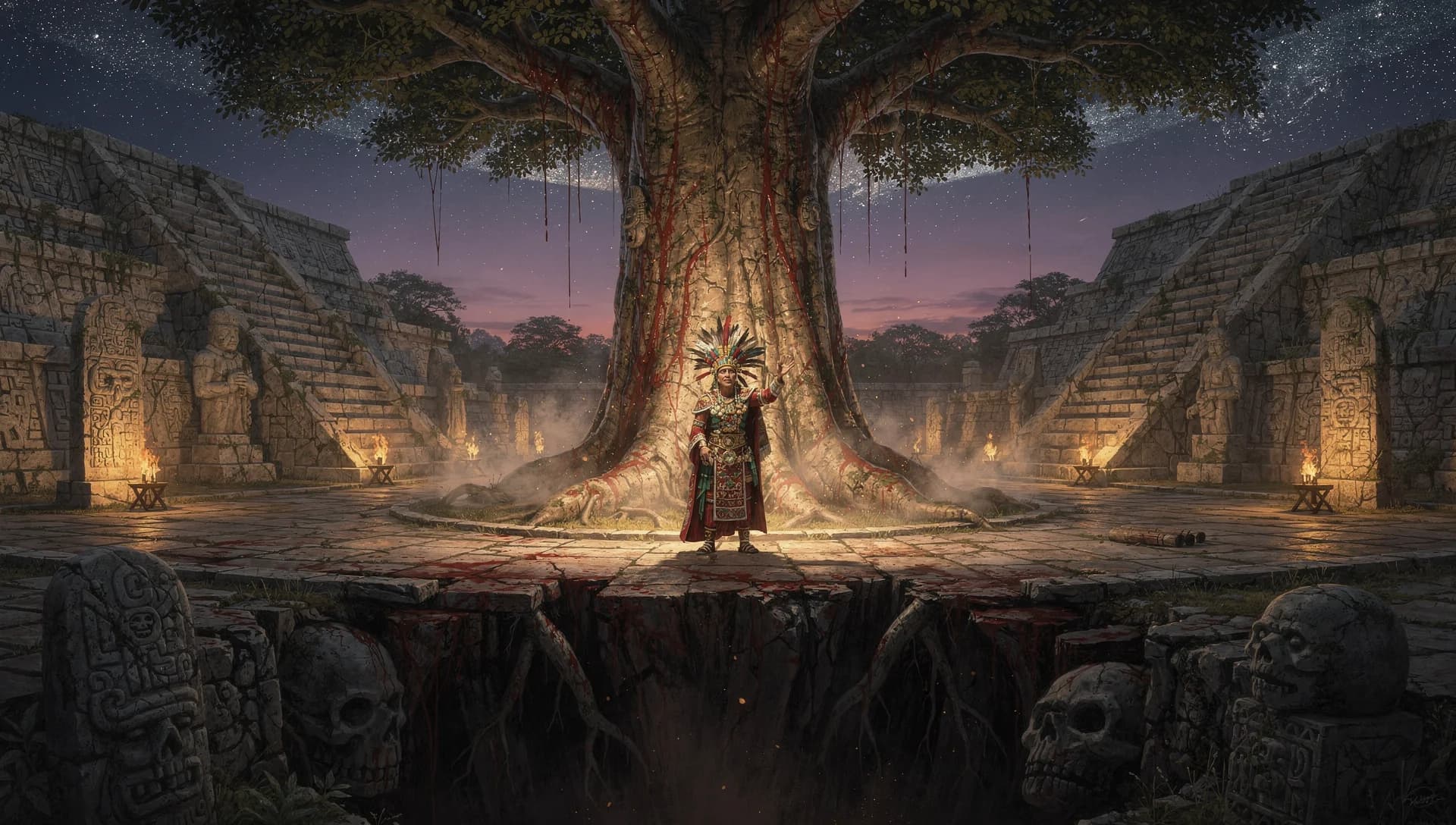
The Maya Ceiba Yaxche', the World Tree at the center of the cosmos
 UB
UBSacred tree at the center of the world, carrying blood, water, and spirit
Full Article
Read the deep-dive article on this connection
Sacred tree at the center of the world, carrying blood, water, and spirit = The Maya Ceiba Yaxche', the World Tree at the center of the cosmos
The Connection
The Maya cosmos is organized around the Yaxche', the great ceiba tree whose roots reach the underworld, whose trunk supports the middle world, and whose crown holds the heavens. Maya kings are depicted at Palenque and Tikal sitting in the axis of this world-tree. The UB identifies the Tree of Life as the actual plant at the center of the Prince's temple on Dalamatia, later moved to the first Garden, and notes that "there once existed a universal cult of the tree of life" across the ancient world. The Yaxche' is the Mesoamerican expression of the same universal memory.
UB Citation
UB 66:4.13, 73:6.1, 85:2.4
Academic Source
Schele & Freidel, A Forest of Kings (1990); Freidel, Schele & Parker, Maya Cosmos (1993)
Historical Evidence(Strong evidence)
Linda Schele documented the Yaxche' as the central organizing axis of Maya royal cosmology, depicted on King Pakal's sarcophagus lid at Palenque with a bird in its crown and a serpent at its base, the same three-level structure that characterizes the Assyrian Sacred Tree, the Norse Yggdrasil, and the Slavic Dub. The worldwide persistence of the cosmic-tree motif with bird, serpent, and divine king attending is hard to account for on independent-invention grounds alone, and the UB's Tree of Life offers a single seed for what spreads into these cultural variants.
Deep Dive
In 1952, the Mexican archaeologist Alberto Ruz Lhuillier descended into the Temple of the Inscriptions at Palenque and discovered the burial chamber of King Pakal, the great seventh-century Maya ruler. The sarcophagus lid carved into the stone of the burial bears one of the most elaborate iconographic compositions in pre-Columbian art. King Pakal is depicted at the moment of his death and rebirth, falling backward into the maw of the underworld monster, with his body aligned along the trunk of the great Yaxche, the Maya world-tree. Above his body, in the crown of the tree, perches the celestial bird-deity Itzam-Yeh. Below his body, at the roots of the tree, lies the underworld with its dragon-serpent forms.
The composition is a textbook expression of the universal three-level world-tree pattern: bird in the crown, serpent at the roots, divine or royal figure at the trunk. Linda Schele's A Forest of Kings (1990, with David Freidel) and Maya Cosmos (1993, with Freidel and Joy Parker) made the iconographic analysis of Pakal's sarcophagus a foundational text of late-twentieth-century Maya studies. The Yaxche stands at the center of Maya cosmology in a position structurally identical to the Norse Yggdrasil, the Slavic Dub, the Sumerian huluppu, the Hindu Ashvattha, and the Assyrian Sacred Tree.
The Maya called it the Yaxche', "the green tree" or "the first tree," typically identified with the ceiba (Ceiba pentandra), the great silk-cotton tree native to the Yucatan and Central American lowlands. The ceiba is one of the most impressive trees of the Mesoamerican forest, growing to heights of seventy meters with massive buttress roots and a wide-spreading crown. Living examples of sacred ceibas survive in Maya communities to the present day, often planted at the center of village plazas as living embodiments of the cosmic-tree tradition.
The standard archaeological account treats the Yaxche' as a Mesoamerican expression of widespread religious imagination about cosmic-axis trees, with no specific historical referent beyond the actual ecological prominence of the ceiba in Mesoamerican forests. This is a coherent reading. It does not, however, explain why the iconographic structure is so precisely identical to the Norse Yggdrasil and the Sumerian huluppu, both developed in cultures that had no contact with Mesoamerica during the formation of these traditions.
The UB framework provides a single underlying explanation. UB 85:2.4 states that "there once existed a universal cult of the *tree of life*" across all peoples except China. UB 66:4.13 identifies the seed: an actual plant called the tree of life that "grew in the central courtyard of the temple of the unseen Father" at Dalamatia, "a shrub of Edentia which was sent to Urantia by the Most Highs of Norlatiadek at the time of Caligastia's arrival." UB 73:6.1 describes the tree being replanted by Van in the central temple of the first Garden of Eden.
The cultural memory of this tree, on the UB account, spread outward with the post-Adamic and Andite migrations. As the memory reached different cultures, it attached to whatever the most impressive tree of the local ecology was: the ash for the Norse Yggdrasil, the oak for the Slavic Dub and Celtic druidic tradition, the pipal/Bodhi tree for the Hindu and Buddhist traditions, the ceiba for the Maya. The local botanical referent varied; the underlying iconographic structure (bird in crown, serpent at roots, divine figure at trunk) remained remarkably consistent because the original referent had had specific iconographic associations that traveled with the cultural memory.
The Andite migration to the Americas (the 132 sailors of UB 78:5.7 and subsequent followers) provides the specific transmission vector for Mesoamerica. The Andites carried the cultural memory of the tree of life, which had survived through Adamic and pre-Adamic transmission across the post-rebellion era. As they reached and intermarried with indigenous Mesoamerican populations, the memory was integrated into emerging Mesoamerican cosmology and eventually attached to the ceiba as the natural local botanical referent.
The strongest counterargument is that the Maya iconography is so deeply integrated with Mesoamerican-specific religious-political concerns (royal apotheosis, the underworld journey of Xibalba, the agricultural cycle of maize) that it cannot reasonably be read as a transplant from any external source. This is partially true. The Maya Yaxche' is genuinely Mesoamerican. But the underlying three-level iconographic structure, with its specific elements of bird-crown and serpent-roots and divine-trunk-figure, is too consistent across non-contacted cultures to be reduced to independent invention. The local development is real, but it was development of an inherited memory rather than invention from nothing.
The cumulative effect is to dignify Maya religious art as part of a universal tradition rather than as isolated regional development. King Pakal's sarcophagus lid is one expression of an iconographic tradition that connects Mesoamerica to the broader global heritage of cosmic-tree imagery, with all of these traditions tracing back, on the UB account, to a single original referent at Dalamatia and the first Eden.
Key Quotes
“These antidotal complements of the Satania life currents were derived from the fruit of the tree of life, a shrub of Edentia which was sent to Urantia by the Most Highs of Norlatiadek at the time of Caligastia's arrival. In the days of Dalamatia this tree grew in the central courtyard of the temple of the unseen Father, and it was the fruit of the tree of life that enabled the material and otherwise mortal beings of the Prince's staff to live on indefinitely as long as they had access to it.”
“In the center of the Garden temple Van planted the long-guarded tree of life, whose leaves were for the "healing of the nations," and whose fruit had so long sustained him on earth.”
“Except in China, there once existed a universal cult of the tree of life.”
Cultural Impact
The Maya Yaxche' tradition has been one of the most thoroughly studied iconographic complexes in Mesoamerican archaeology. Linda Schele's work, in particular, transformed scholarly understanding of Maya royal religion in the 1980s and 1990s. The recognition that the Yaxche' organizes Maya cosmology in a structurally identical pattern to other world-tree traditions has become standard in comparative religious studies. The UB framework offers a way to read this tradition that takes its structural similarity to other world traditions seriously while honoring its specifically Maya developments. The underlying memory is universal. The local expression is genuinely Maya. Both elements deserve recognition. For contemporary Maya-heritage readers, this framing offers a way to engage with traditional cosmology that connects to the global tradition without diminishing its distinctive Maya character. The ceiba at the center of the village is part of a worldwide religious heritage, but it is also specifically Maya in its botanical form, its iconographic developments, and its integration with Maya social structure. Both dimensions are real and important.
Modern Resonance
Contemporary Maya communities across Mexico, Guatemala, Belize, and Honduras have been navigating complex questions of cultural revival, religious identity, and political struggle for several decades. The Maya cultural movement of the late twentieth century, the Zapatista uprising in Chiapas, and the various Maya rights movements have all engaged with traditional cosmology as a resource for contemporary identity. The Yaxche' tradition has been particularly important in these movements. The sacred ceiba is regularly invoked as a symbol of Maya cultural rootedness, ecological commitment, and political resistance to displacement. The iconographic tradition surrounding the Yaxche' provides a rich symbolic vocabulary for contemporary Maya cultural expression. The UB framework adds historical depth to these contemporary engagements. The Yaxche' tradition is not just a Maya cultural artifact; it is the Maya expression of a universal religious heritage that connects the Maya to the global tradition of cosmic-tree veneration. This connection enriches rather than dilutes Maya cultural identity, placing it within a global heritage that includes the Norse, the Sumerians, the Hindus, and many others. For Maya cultural revival, this framing offers theological grounding that is both authentically Maya and authentically connected to the broader human spiritual heritage.
Related Mappings
The 132 Andite sailors who crossed the Pacific from Japan to South America
= Quetzalcoatl / Kukulkan, the bearded culture-bringer remembered as arriving from the east
Post-rebellion flood memory (Dalamatia submergence, Eden submergence, regional floods)
= Aztec, Maya, and K'iche' flood cycles (Popol Vuh; the Five Suns)
Teaching-pair pattern: a god of wisdom and his brother or rival
= Quetzalcoatl and Tezcatlipoca, cosmic brothers who contest creation
Amadonite and Sethite priesthoods preserving astronomical knowledge
= Maya calendrical and astronomical priesthood
Related Articles
Where to next
The free newsletter. The research behind each piece, no spam.