
 Mythic
Aztec, Maya, and K'iche' flood cycles (Popol Vuh; the Five Suns)
 UB
UBPost-rebellion flood memory (Dalamatia submergence, Eden submergence, regional floods)
Full Article
Read the deep-dive article on this connection
Post-rebellion flood memory (Dalamatia submergence, Eden submergence, regional floods) = Aztec, Maya, and K'iche' flood cycles (Popol Vuh; the Five Suns)
The Connection
The UB describes multiple catastrophic floods in the ancient record: the Dalamatia submergence 162 years after the rebellion (67:5.4), the sinking of the first Eden (73:7.1, 78:7.7), and the regional floods around Mesopotamia that fed the Noah tradition (78:7.3-5). The Mesoamerican cycle-of-ages cosmology (the Aztec Five Suns, the Maya K'iche' flood that destroyed the "wooden men" in the Popol Vuh) preserves the same narrative logic: humanity has been destroyed and remade multiple times by cosmic catastrophe. Rather than a single flood, Mesoamerican tradition preserves the plural-flood structure the UB actually describes.
UB Citation
UB 67:5.4, 73:7.1, 78:7.3-5
Academic Source
Popol Vuh (trans. Tedlock, 1985); Sahagún, Florentine Codex; Miller & Taube, Gods and Symbols of Ancient Mexico (1993)
Historical Evidence(Moderate evidence)
The Popol Vuh (the K'iche' Maya creation account, as translated by Dennis Tedlock) describes three previous creations destroyed by the gods, the third ending in a great flood that drowns the "wooden people" who were only rough drafts of humanity. The Aztec Five Suns cosmology, preserved in the Codex Chimalpopoca and Sahagún, records four previous ages destroyed by jaguars, wind, fire, and flood. Mary Miller and Karl Taube document the motif across Mesoamerica. The UB's multi-flood chronology matches the plural-flood structure better than Genesis 6-9 does.
Deep Dive
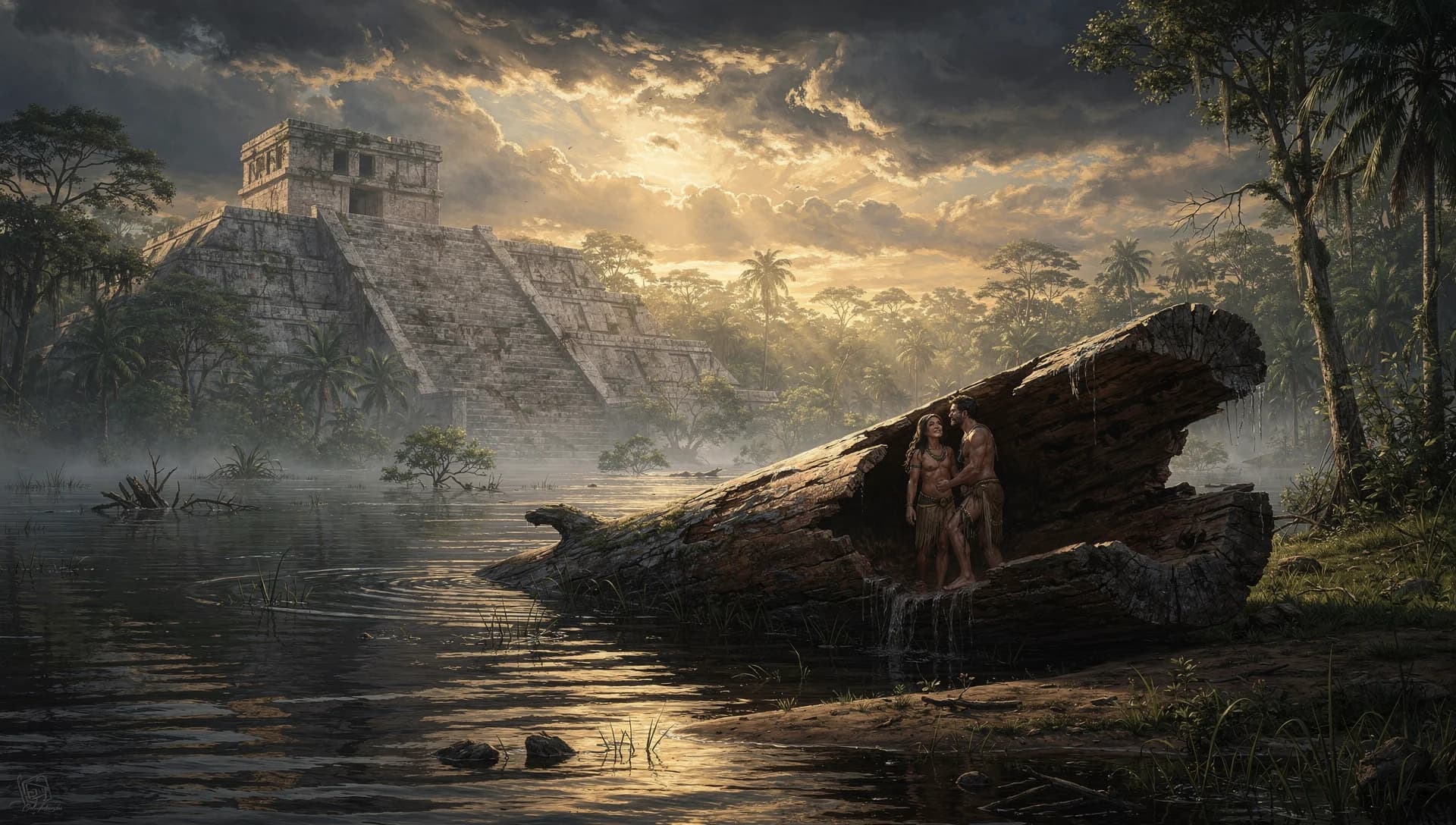
In the Popol Vuh, the K'iche' Maya creation account preserved in a sixteenth-century manuscript that draws on much older oral tradition, the gods make humanity three times before getting it right. The first attempt produces the animals, who can move and feed but cannot speak in praise of the gods. The second attempt produces creatures of mud, who dissolve back into the earth. The third attempt produces wooden people, who can speak and reproduce but lack hearts and minds, lack the capacity to remember their creator. The wooden people are destroyed by a great flood. The fourth attempt finally produces real humanity, fashioned from maize, who can speak, think, and remember.
This is one of the most extensively documented Mesoamerican flood traditions. The Popol Vuh, in Dennis Tedlock's 1985 translation, has become a foundational text of Mesoamerican literary heritage. The third-creation flood (which destroyed the wooden people) is a clear flood narrative within an explicitly multi-creation cosmology. The point is not that there was one flood once; the point is that there have been multiple cycles of creation and destruction, with floods being one of the destructive mechanisms.
The Aztec cosmology preserves a parallel structure. The Five Suns cosmology, preserved in multiple sources (Codex Chimalpopoca, the Florentine Codex, and the iconography of the Sun Stone in the Mexico City National Anthropological Museum), describes four previous ages, each ended by a different catastrophe. The first age (Sun of the Earth or Sun of the Jaguar) ended when jaguars devoured the inhabitants. The second age (Sun of Wind) ended when great winds destroyed the inhabitants, who were transformed into monkeys. The third age (Sun of Fire) ended in a great fire-rain. The fourth age (Sun of Water) ended in a great flood, with the inhabitants transformed into fish. The fifth age, our current age (Sun of Movement or Earthquake), is destined to end in great earthquakes.
Mary Miller and Karl Taube, in The Gods and Symbols of Ancient Mexico and the Maya (1993), document this multi-creation cosmology across Mesoamerican cultures. The pattern is too consistent to reduce to coincidence and too specific to dismiss as generic apocalypse-mythology. The Mesoamerican cosmology is fundamentally cyclical, with creation and destruction alternating across cosmic ages.
The UB framework recognizes this Mesoamerican plural-catastrophe structure as preserving the same underlying historical reality that the Genesis flood narrative compresses into a single event. UB 67:5.4 describes the Dalamatia submergence: "One hundred and sixty-two years after the rebellion a tidal wave swept up over Dalamatia, and the planetary headquarters sank beneath the waters of the sea." UB 73:7.1 describes the first Eden submergence: "The eastern floor of the Mediterranean Sea sank, carrying down beneath the waters the whole of the Edenic peninsula." UB 78:7.3-5 describes the regional Mesopotamian floods that fed the Noah tradition.
The Mesoamerican plural-creation cosmology is closer to the actual UB plural-flood structure than the Hebrew single-flood compression is. The Mesoamerican tradition preserves multiple destructive events rather than collapsing them into one. The Mesoamerican tradition recognizes that humanity itself has been re-created multiple times rather than treating the first humans as direct ancestors of the present population. The Mesoamerican tradition therefore matches the UB historical framework more faithfully than the Hebrew tradition does, despite being temporally and geographically much further from the original events.
This is an interesting reversal of the typical alignment of "biblical tradition matches the underlying historical reality more closely than other traditions." In the case of the flood narrative specifically, the Mesoamerican tradition appears to preserve a more accurate structural memory than the Hebrew tradition does. The Hebrew compression into a single flood was a scribal harmonization (UB 78:7.3 explicitly identifies this scribal motivation), while the Mesoamerican tradition preserved the original plural structure.
The strongest counterargument is that the Mesoamerican multi-creation cosmology is structured around astronomical and seasonal cycles rather than around historical events. The Five Suns cosmology may reflect the Mesoamerican preoccupation with astronomical periodicity (the precession of the equinoxes, the long count, the various calendrical cycles) rather than memory of actual geological catastrophes. This is a coherent reading and probably captures part of the truth.
The UB defense is that the astronomical-cyclical reading and the historical-memory reading are not mutually exclusive. The Mesoamerican cosmology may have organized multiple genuine historical memories of catastrophic events into an astronomically-cyclical framework, with the framework providing the structure and the historical events providing the content. Reading the Mesoamerican cosmology as both astronomical and historical, rather than as exclusively one or the other, captures more of what the tradition actually preserves.
Key Quotes
“One hundred and sixty-two years after the rebellion a tidal wave swept up over Dalamatia, and the planetary headquarters sank beneath the waters of the sea, and this land did not again emerge until almost every vestige of the noble culture of those splendid ages had been obliterated.”
“After the first garden was vacated by Adam, it was occupied variously by the Nodites, Cutites, and the Suntites. ... in connection with the violent activity of the surrounding volcanoes and the submergence of the Sicilian land bridge to Africa, the eastern floor of the Mediterranean Sea sank, carrying down beneath the waters the whole of the Edenic peninsula.”
Cultural Impact
The Popol Vuh has been one of the most significant cultural recoveries of postcolonial Mesoamerican scholarship. Dennis Tedlock's 1985 translation made the K'iche' Maya creation account widely available in English, and the text has been incorporated into university curricula in religious studies, comparative literature, and indigenous studies. The Aztec Five Suns cosmology has had similar academic impact, with the Sun Stone (often misnamed the Aztec Calendar) becoming one of the most recognizable icons of pre-Columbian Mesoamerica. The UB framework offers a way to engage with these traditions that takes them seriously as preserving genuine historical memory rather than treating them as primitive cosmological speculation. The Mesoamerican plural-creation cosmology preserves real memory of multiple catastrophic events, even if the specific events being remembered are not necessarily the ones the Mesoamerican cultures themselves identified. The UB chronology of Dalamatia submergence, first-Eden submergence, and regional Mesopotamian floods may underlie the Mesoamerican memories indirectly, with cultural transmission reaching the Americas through the Andite migrations. For contemporary Mesoamerican-heritage readers, this framing offers a way to honor traditional cosmology without flattening its content into either pure metaphor (the secular-academic reduction) or literal scientific cosmology (the religious-fundamentalist alternative). The traditions preserve real memory of real events, integrated into a sophisticated cosmological framework that does justice to both the historical content and the cyclical structure.
Modern Resonance
Climate change and the prospect of significant catastrophic events in the coming century have made the Mesoamerican plural-catastrophe cosmology newly relevant. The recognition that humanity has been through multiple cycles of catastrophe and renewal, far from being a primitive religious projection, may be a more accurate description of the actual long-term human relationship with environmental and geological catastrophe than the Hebrew "one flood, never again" tradition allows. The UB framework resonates with this contemporary recognition. Catastrophic events have shaped human history multiple times, and they will likely shape it again. The Mesoamerican cyclical cosmology preserves a wisdom about the impermanence of any particular human civilization that the linear Western tradition often lacks. Recovering this wisdom, taking it seriously rather than treating it as primitive fatalism, may help contemporary humanity respond more wisely to the catastrophic possibilities of our own era. For readers in 2026, the Mesoamerican plural-catastrophe cosmology offers a frame for thinking about climate change, geological hazard, and civilizational fragility that the Western linear-progress narrative tends to suppress. The Maya and Aztecs knew something about the fragility of human civilizational achievement that we are only now beginning to relearn.
Related Mappings
The 132 Andite sailors who crossed the Pacific from Japan to South America
= Quetzalcoatl / Kukulkan, the bearded culture-bringer remembered as arriving from the east
Teaching-pair pattern: a god of wisdom and his brother or rival
= Quetzalcoatl and Tezcatlipoca, cosmic brothers who contest creation
Sacred tree at the center of the world, carrying blood, water, and spirit
= The Maya Ceiba Yaxche', the World Tree at the center of the cosmos
Amadonite and Sethite priesthoods preserving astronomical knowledge
= Maya calendrical and astronomical priesthood
Related Articles
Where to next
The free newsletter. The research behind each piece, no spam.