
 Mythic
"One Truth" tradition → Tao / the Way
 UB
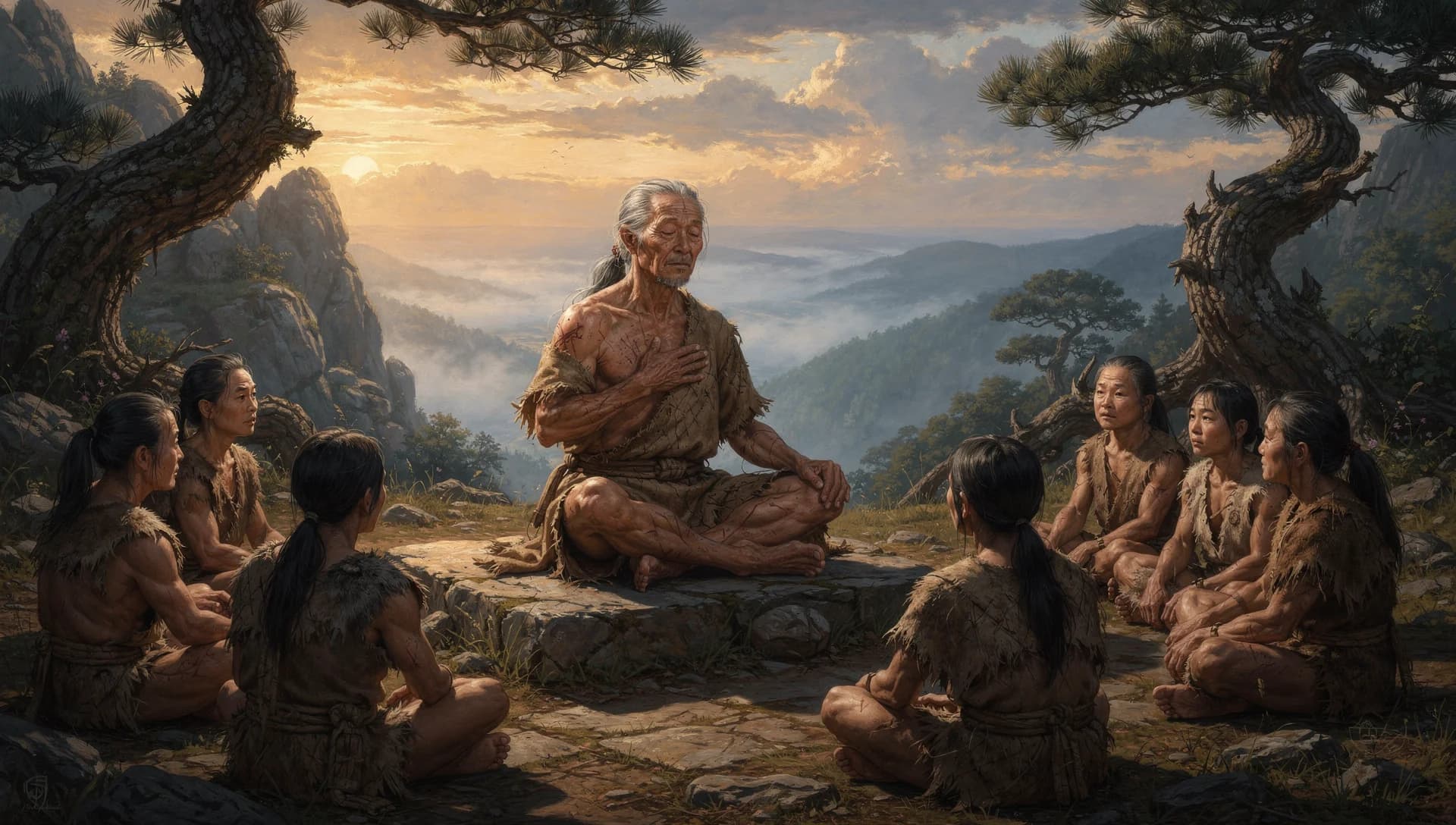
UBSinglangton, yellow race spiritual leader (~100,000 BC)
Full Article
Read the deep-dive article on this connection
Singlangton, yellow race spiritual leader (~100,000 BC) = "One Truth" tradition → Tao / the Way
The Connection
Singlangton proclaimed the worship of "One Truth" among the yellow race approximately 100,000 years ago. The UB traces a direct lineage: Singlangton's "One Truth" → preserved through millennia → Salem missionaries reinforce the tradition → Lao-tse builds "directly upon the concepts of the Salem traditions" to declare Tao as "the One First Cause of all creation." The Chinese concept of Tao has a 100,000-year pedigree.
UB Citation
UB 45:4.8, 64:6.15, 94:5.8, 94:6.3
Academic Source
Lao-tse, Tao Te Ching; Slingerland, Effortless Action (2003)
Historical Evidence(Moderate evidence)
The UB identifies Singlangton as member #6 of the Twenty-Four Counselors on Jerusem, recognized for spiritual achievement on a system-wide level. Lao-tse "built directly upon the concepts of the Salem traditions" and declared Tao to be the supreme first cause. His formulation, "Unity arises out of the Absolute Tao, and from Unity there appears cosmic Duality, and from such Duality, Trinity springs forth into existence," echoes both Melchizedek theology and Singlangton's ancient monotheism. The survival of the "One Truth" concept through 100,000 years of Chinese cultural continuity is unparalleled.
Deep Dive
Approximately one hundred thousand years ago, in the cultural region that would eventually become China, a leader named Singlangton emerged among the yellow race. Paper 64:6.15 records that the yellow race had traveled far from the influences of the spiritual headquarters of the world and drifted into great darkness following the Caligastia apostasy, but there occurred one brilliant age among this people when Singlangton, about one hundred thousand years ago, assumed the leadership of these tribes and proclaimed the worship of the One Truth. Paper 45:4.8 elaborates: Singlangton was the first of the yellow men to teach and lead his people in the worship of One Truth instead of many. Thousands of years ago the yellow man knew of the one God. Singlangton serves on Jerusem as member number six of the Twenty-Four Counselors, the system-level body that represents Urantia in the Local System governmental structure.
The One Truth concept that Singlangton proclaimed has unparalleled longevity in human religious history. Paper 94:5.3 records that the lingering teachings of Singlangton persisted in the concept of Shang-ti, the God of Heaven. In the times of Singlangton the Chinese people became virtually monotheistic; they concentrated their worship on the One Truth, later known as the Spirit of Heaven, the universe ruler. The yellow race never fully lost this early concept of Deity, although in subsequent centuries many subordinate gods and spirits insidiously crept into their religion. From Singlangton's One Truth to the later Shang-ti tradition to the Heaven (Tian) of Confucian theology to Lao-tse's Tao, the underlying concept of a single supreme reality at the cosmological center has persisted across one hundred thousand years of Chinese cultural continuity.
Paper 94:5.8 records that the Salem missionaries did not labor in vain in China. It was upon the foundations of their gospel that the great philosophers of sixth-century China built their teachings. The moral atmosphere and the spiritual sentiments of the times of Lao-tse and Confucius grew up out of the teachings of the Salem missionaries of an earlier age. The mechanism of transmission is named: a Singlangton-derived monotheistic substrate, reinforced by Salem missionary teaching transmitted from Mesopotamia through the Central Asian caravan routes, served as the foundation upon which the sixth-century BCE flowering of Chinese philosophical religion was built.
Paper 94:6.3 gives the specific account of Lao-tse's role: Lao-tse built directly upon the concepts of the Salem traditions when he declared Tao to be the One First Cause of all creation. Lao was a man of great spiritual vision. He taught that man's eternal destiny was everlasting union with Tao, Supreme God and Universal King. His comprehension of ultimate causation was most discerning, for he wrote: Unity arises out of the Absolute Tao, and from Unity there appears cosmic Duality, and from such Duality, Trinity springs forth into existence, and Trinity is the primal source of all reality. The structural parallel to UB Trinity theology is precise. Lao-tse's formulation captures, with unusual fidelity, the underlying Trinitarian structure of cosmic causation that the UB describes from its Paradise-and-superuniverses framework.
The Daodejing (Tao Te Ching), traditionally attributed to Lao-tse and dated by mainstream scholarship to the fourth century BCE, is the foundational text of Daoism. D.C. Lau's 1963 translation is the standard scholarly version, with subsequent translations by Victor Mair (1990) and Robert Henricks (1989, 2000) providing alternative renderings based on archaeological discoveries of earlier manuscript versions at Mawangdui and Guodian. Edward Slingerland's 2003 monograph Effortless Action: Wu-wei as Conceptual Metaphor and Spiritual Ideal in Early China provides the most sophisticated contemporary academic treatment of the underlying philosophical concepts.
Philip Ivanhoe's 2002 The Daodejing of Laozi notes the mystical monotheism of the text, presenting a single source behind all reality. The Tao is described as eternal, formless, the source of all things, transcendent of human concepts yet immanent in all manifestation. The structural parallel to Salem-derived monotheistic theology is unmistakable, even though the cultural and philosophical vocabulary is distinctively Chinese.
The structural fit with the UB account is precise. The persistence of monotheistic concept across one hundred thousand years of Chinese cultural continuity is unparalleled. No other major culture has maintained such durable structural memory of an underlying revelation. The mechanism the UB names, an original Dalamatian-period transmission through Singlangton, persistence through the long durée of Chinese cultural development, reinforcement by Salem missionary teaching transmitted along the trade routes, and culmination in the philosophical synthesis of the sixth century BCE with Lao-tse's Tao formulation, is consistent with the historical and textual evidence.
The strongest counterargument is that the academic study of Chinese religion does not require external revelatory input to explain the development of indigenous Chinese theological concepts. The Tao, the Heaven, and other supreme-reality concepts can be explained by internal Chinese philosophical development without invoking Salem influence. This is a fair point. The reply is that the unusual durability and structural sophistication of the Chinese monotheistic substrate, persisting across the longest continuous cultural tradition in human history with such structural consistency, is more parsimoniously explained by an underlying revelatory inheritance than by purely indigenous philosophical development.
What the parallel implies is significant for the contemporary engagement with Chinese religious tradition. The Tao is not an exotic Eastern alternative to Western monotheism. It is one of humanity's oldest preservations of underlying monotheistic revelation, transmitted through one hundred thousand years of cultural continuity.
Key Quotes
“6. *Singlangton,* the first of the yellow men to teach and lead his people in the worship of “One Truth” instead of many. Thousands of years ago the yellow man knew of the one God.”
“They traveled far from the influences of the spiritual headquarters of the world and drifted into great darkness following the Caligastia apostasy; but there occurred one brilliant age among this people when Singlangton, about one hundred thousand years ago, assumed the leadership of these tribes and proclaimed the worship of the “One Truth.””
“*Lao-tse* built directly upon the concepts of the Salem traditions when he declared Tao to be the One First Cause of all creation. Lao was a man of great spiritual vision. He taught that man’s eternal destiny was “everlasting union with Tao, Supreme God and Universal King.” His comprehension of ultimate causation was most discerning, for he wrote: “Unity arises out of the Absolute Tao, and from Unity there appears cosmic Duality, and from such Duality, Trinity springs forth into existence, and Trinity is the primal source of all reality.””
“Slingerland documents the philosophical sophistication of early Chinese theological and ethical concepts, with the Tao functioning as a transcendent ground of cosmological and moral order in ways that parallel mystical-monotheistic frameworks in other religious traditions.”
Cultural Impact
The One Truth concept and its Daoist articulation as Tao have shaped East Asian civilization for over two millennia in their classical formulation, and arguably for one hundred thousand years in their underlying structural form. Daoism became one of the three teachings (san jiao) of Chinese civilization alongside Confucianism and Buddhism, with significant influence on Chinese medicine, alchemy, martial arts, aesthetic theory, calligraphy, painting, and political philosophy. The Tao Te Ching itself is one of the most-translated books in human history, with hundreds of English translations and translations into nearly every major language. Through Buddhist-Daoist syncretism, particularly in the Chan (Zen) tradition, Daoist concepts entered the broader East Asian Buddhist tradition and shaped Korean, Japanese, and Vietnamese spiritual traditions. The Daoist concept of wu-wei (non-coercive action, effortless effectiveness) has shaped East Asian political philosophy, military strategy, and contemporary management theory. Beyond East Asia, the Tao Te Ching entered Western consciousness through nineteenth-century missionary translations and twentieth-century academic translations, becoming a foundational text for Western popular spirituality and counterculture from Aldous Huxley through Alan Watts to contemporary mindfulness writers. The Daoist-influenced concept of natural balance and non-coercive flourishing has shaped Western environmental ethics, holistic medicine, and ecospiritual movements.
Modern Resonance
The contemporary fascination with Daoism in Western spiritual culture is one of the most significant religious transmissions of the past century. The UB framework offers a way to take Daoism seriously without uncritical acceptance of any particular Daoist sectarian elaboration. The Tao really does point to something real: the underlying monotheistic reality that the Salem teaching also pointed to and that the UB makes available in fuller form. The structural parallel between Lao-tse's Trinitarian formulation and the UB's Trinity theology is too precise to be coincidental, and too underdeveloped in Lao-tse to be a derivative of later Christian Trinitarian theology. Both are pointing to the same underlying cosmological reality through different cultural channels. For contemporary Western seekers drawn to Daoism, the framework offers a way to keep the Daoist depth while extending it with the personal-deity element that Lao-tse's formulation underdevelops. For Chinese readers reconnecting with their classical heritage, the framework offers external validation of the theological sophistication of the indigenous tradition.
Related Mappings
Andite traditions of Eden and Dalamatia carried east
= Chinese "Land of the Gods in the West," Kunlun mythology
Machiventa Melchizedek, his incarnation remembered in Japan
= Shinto awareness of a divine incarnation at Salem
Soul and spirit, dual inner realities
= Yang and Yin, complementary cosmic forces
Salem monotheism in Chinese form
= Lao-tse's Tao, the One First Cause
Related Articles
Where to next
The free newsletter. The research behind each piece, no spam.