
 Mythic
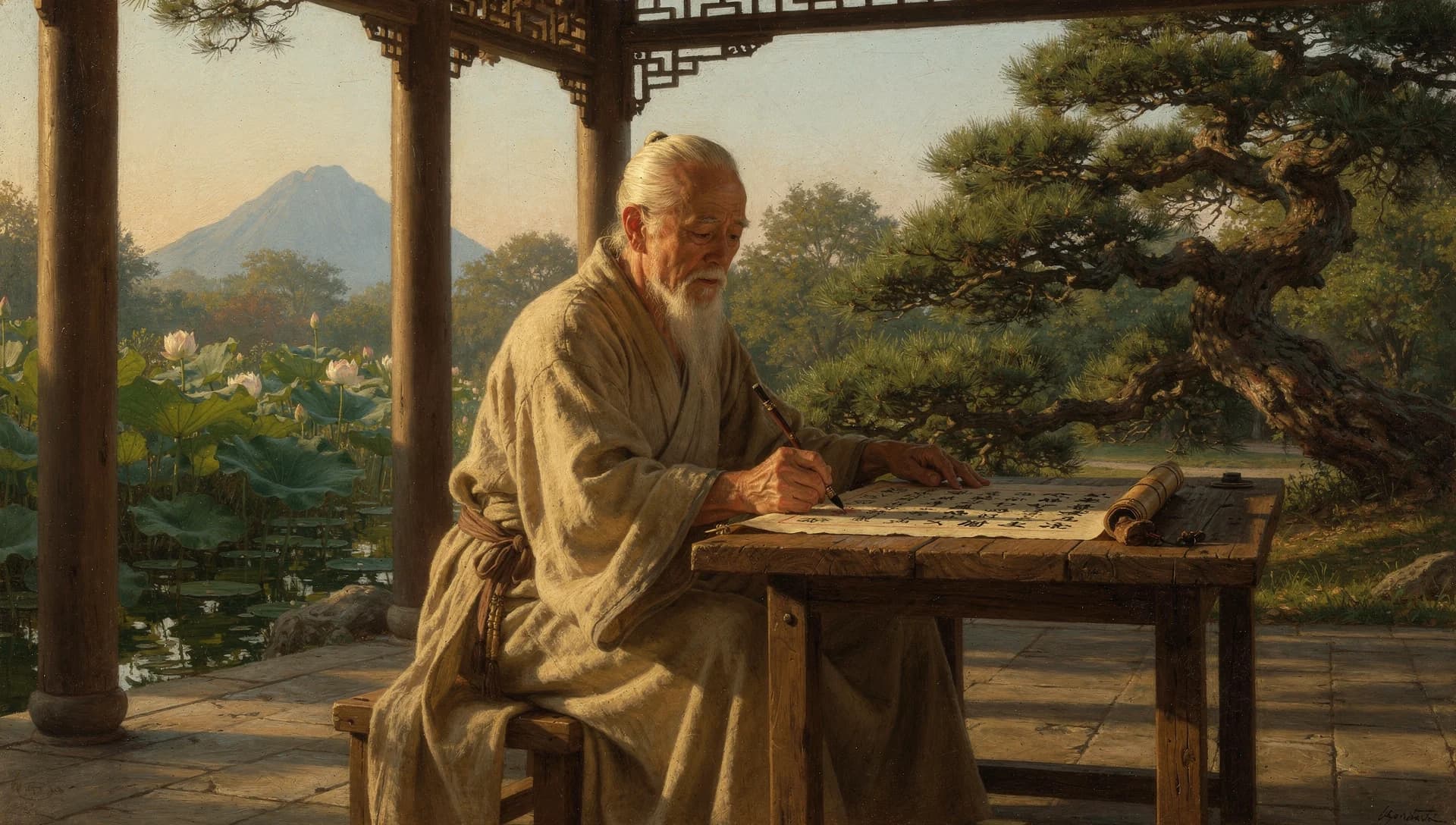
Lao-tse's Tao, the One First Cause
 UB
UBSalem monotheism in Chinese form
Full Article
Read the deep-dive article on this connection
Salem monotheism in Chinese form = Lao-tse's Tao, the One First Cause
The Connection
The UB directly states that Lao-tse "built directly upon the concepts of the Salem traditions" when he formulated the Tao. His declaration that "Tao is the One First Cause of all creation" is a Chinese reformulation of Melchizedek's monotheistic teaching. Tao represents the most successful Chinese preservation of the Salem gospel.
UB Citation
Academic Source
Lao-tse, Tao Te Ching; Ivanhoe, The Daodejing of Laozi (2002)
Historical Evidence(Moderate evidence)
The UB explicitly traces Lao-tse's Tao to Salem missionary influence. Lao-tse's formulation, "Unity arises out of the Absolute Tao, and from Unity there appears cosmic Duality, and from such Duality, Trinity springs forth into existence, and Trinity is the eternal source of all reality," closely echoes Melchizedek's Trinity teaching. Philip Ivanhoe notes the "mystical monotheism" of the Tao Te Ching, which presents a single source behind all reality, consistent with the UB claim of Salem transmission.
Deep Dive
Tradition places Lao-tse as a contemporary of Confucius, with the famous (though probably legendary) account in the Records of the Grand Historian (Sima Qian, c. 100 BCE) describing Confucius as having visited Lao-tse and come away awed by the older sage's depth. The historicity of Lao-tse as a single individual is debated in contemporary academic scholarship, with some scholars treating the figure as a composite of multiple early Daoist thinkers and others maintaining a single historical referent. What is not debated is that the Daodejing, the foundational text traditionally attributed to him, represents one of the most theologically sophisticated religious documents of the sixth-to-fourth-century BCE world. The text's core insight is the identification of a single transcendent ground of all reality, called Tao, that is the source of all manifestation and the proper goal of human life.
The Urantia Book at 94:6.3 makes one of its most specific historical claims about Chinese religious history: Lao-tse built directly upon the concepts of the Salem traditions when he declared Tao to be the One First Cause of all creation. Lao was a man of great spiritual vision. He taught that man's eternal destiny was everlasting union with Tao, Supreme God and Universal King. His comprehension of ultimate causation was most discerning, for he wrote: Unity arises out of the Absolute Tao, and from Unity there appears cosmic Duality, and from such Duality, Trinity springs forth into existence, and Trinity is the primal source of all reality. All reality is ever in balance between the potentials and the actuals of the cosmos, and these are eternally harmonized by the spirit of divinity.
This is a striking claim. The UB does not merely assert that Lao-tse was influenced by Salem teaching; it identifies Lao-tse as having directly built upon the concepts of the Salem traditions. The Daodejing's central concept, the Tao as One First Cause, is presented as a Chinese articulation of Salem-derived monotheistic theology. The structural parallel between Lao-tse's Trinitarian formulation (Unity, Duality, Trinity emerging from the Absolute Tao) and the UB's own Trinitarian theology is precise enough to deserve serious comparison.
The UB framework proposes a specific historical mechanism. Salem missionary teaching, transmitted from Mesopotamia through Central Asian caravan routes into China during the early second millennium BCE, established a monotheistic theological substrate that combined with the older Singlangton-derived One Truth tradition. By the time of the sixth-century BCE flowering of Chinese philosophy, this Salem-reinforced substrate was available to philosophical thinkers like Lao-tse, who articulated it in the philosophical-cosmological vocabulary of his own cultural moment. Paper 94:5.8 records that the Salem missionaries did not labor in vain, that it was upon the foundations of their gospel that the great philosophers of sixth-century China built their teachings, and that the moral atmosphere and the spiritual sentiments of the times of Lao-tse and Confucius grew up out of the teachings of the Salem missionaries of an earlier age.
D.C. Lau's 1963 translation of the Daodejing remains the standard English version, with subsequent translations by Robert Henricks (1989, 2000), Victor Mair (1990), and Philip Ivanhoe (2002) providing alternative renderings based on later manuscript discoveries. Ivanhoe's commentary in particular notes the mystical monotheism of the text, presenting a single transcendent source behind all reality. The Tao is described as eternal, formless, the source of all things, transcendent of human concepts yet immanent in all manifestation.
The structural fit with the UB account is precise. The Daodejing's theological framework matches Salem-derived monotheistic theology with unusual fidelity in its core features: a single transcendent source as the ground of all reality, an emergence-from-unity-into-multiplicity cosmological framework, an ethical orientation toward harmony with the underlying source, an eschatological orientation toward eventual return to or union with the source. The specific Trinitarian formulation Lao-tse provides is structurally close enough to UB Trinity theology that the parallel deserves explanation. Either Lao-tse independently arrived at a Trinitarian cosmology that happens to match Salem-derived formulations (unlikely given the structural specificity), or Lao-tse's formulation reflects Salem-derived inheritance.
The strongest counterargument is that the historical mechanism the UB proposes (Salem missionary transmission via Central Asia) is not directly attested in the surviving Chinese textual or archaeological record, and the parallel between Lao-tse's formulation and Salem theology may reflect convergent insight rather than direct transmission. This is a fair point. The reply is that the structural specificity of the parallel, particularly the explicit Trinitarian formulation in Lao-tse, makes convergent insight less plausible than transmission. The UB's proposed mechanism is also consistent with the broader evidence for Mesopotamia-China cultural exchange in the relevant period (the silk road predecessors, the documented exchange of agricultural and metallurgical technologies, the parallel astronomical and calendrical developments).
What the parallel implies is significant for the contemporary engagement with Chinese philosophical tradition. The Daodejing is not an exotic Eastern alternative to Western theological monotheism. It is one of humanity's most articulate philosophical preservations of underlying monotheistic revelation, with Trinitarian structural features that align with the UB's broader Trinity theology. For contemporary Western seekers drawn to Daoism, the framework offers a way to take the tradition seriously without uncritical acceptance of any sectarian Daoist elaboration. For Chinese readers, the framework offers external validation of the theological depth and historical significance of the indigenous tradition. For comparative theology, the Daodejing becomes intelligible as a Chinese philosophical articulation of the same Salem-derived monotheistic teaching that Christian, Jewish, Islamic, and Zoroastrian traditions also preserve in different cultural forms.
Key Quotes
“*Lao-tse* built directly upon the concepts of the Salem traditions when he declared Tao to be the One First Cause of all creation. Lao was a man of great spiritual vision. He taught that man’s eternal destiny was “everlasting union with Tao, Supreme God and Universal King.” His comprehension of ultimate causation was most discerning, for he wrote: “Unity arises out of the Absolute Tao, and from Unity there appears cosmic Duality, and from such Duality, Trinity springs forth into existence, and Trinity is the primal source of all reality.” “All reality is ever in balance between the potentials and the actuals of the cosmos, and these are eternally harmonized by the spirit of divinity.””
“But the Salemites did not labor in vain. It was upon the foundations of their gospel that the great philosophers of sixth-century China built their teachings. The moral atmosphere and the spiritual sentiments of the times of Lao-tse and Confucius grew up out of the teachings of the Salem missionaries of an earlier age.”
Cultural Impact
Lao-tse and the Daodejing have shaped East Asian civilization for over two millennia. As one of the three teachings (san jiao) alongside Confucianism and Buddhism, Daoism became foundational to Chinese culture, with significant influence on Chinese medicine (the qi theory derived from Daoist cosmology), alchemy (both internal and external alchemy traditions), martial arts (taiji, baguazhang, and related disciplines), aesthetic theory (the emphasis on naturalness, simplicity, and emergence), calligraphy, painting, poetry, and political philosophy. The Daodejing itself is one of the most-translated books in human history. Through Buddhist-Daoist syncretism, particularly in the Chan (Zen) tradition that emerged in Tang-period China, Daoist concepts entered the broader East Asian Buddhist tradition. Beyond East Asia, the Daodejing entered Western consciousness through nineteenth-century missionary translations (James Legge), early-twentieth-century philosophical translations (Arthur Waley), and mid-to-late-twentieth-century popular translations that made the text widely accessible. Western popular spirituality, counterculture (Aldous Huxley, Alan Watts, the Beat generation), and contemporary mindfulness culture all draw heavily on Daoist concepts. The Tao symbol and Daoist-influenced concepts of natural balance, non-coercive flourishing, and contemplative simplicity have shaped Western environmental ethics, holistic medicine, ecospiritual movements, and contemporary management theory.
Modern Resonance
Contemporary Western interest in Daoism is one of the most significant cross-cultural religious transmissions of the past century. The UB framework offers a way to take Daoism with full seriousness while placing it in the broader context of Salem-derived theological transmission. The Tao really does point to the underlying monotheistic reality. Lao-tse's Trinitarian formulation is too structurally specific to be coincidental and too philosophically articulate to be primitive cosmology. The UB framework explains both: Lao-tse was working from Salem-derived material as well as from the older Singlangton tradition, and his philosophical articulation captured the underlying cosmological structure with unusual fidelity. For contemporary Daoist practitioners, the framework offers a way to extend the Daoist insight with the personal-deity element that Lao-tse's formulation underdevelops. For contemporary Christian readers wrestling with how to take non-Christian traditions seriously, the framework offers a way to honor Daoism as carrying real revelatory content rather than as a rival or as a mere cultural alternative. For interfaith dialogue between Daoist and Christian traditions, the framework provides shared theological context grounded in common Salem-derived inheritance.
Related Mappings
Singlangton, yellow race spiritual leader (~100,000 BC)
= "One Truth" tradition → Tao / the Way
Andite traditions of Eden and Dalamatia carried east
= Chinese "Land of the Gods in the West," Kunlun mythology
Machiventa Melchizedek, his incarnation remembered in Japan
= Shinto awareness of a divine incarnation at Salem
Soul and spirit, dual inner realities
= Yang and Yin, complementary cosmic forces
Related Articles
Where to next
The free newsletter. The research behind each piece, no spam.