
 Mythic
Shinto awareness of a divine incarnation at Salem
 UB
UBMachiventa Melchizedek, his incarnation remembered in Japan
Full Article
Read the deep-dive article on this connection
Machiventa Melchizedek, his incarnation remembered in Japan = Shinto awareness of a divine incarnation at Salem
The Connection
The UB makes a remarkable claim: "In this country, far-distant from Salem of Palestine, the peoples learned of the incarnation of Machiventa Melchizedek, who dwelt upon earth that the name of God might not be forgotten by mankind." Salem missionary influence reached Japan through proto-Taoist transmission routes.
UB Citation
Academic Source
Hardacre, Shinto: A History (2017)
Historical Evidence(Suggestive evidence)
The UB text directly states that the Salem teachings reached Japan: "In Japan this proto-Taoism was known as Shinto, and in this country, far-distant from Salem of Palestine, the peoples learned of the incarnation of Machiventa Melchizedek." Early Shinto concepts of kami as spiritual presences pervading nature share structural similarities with the Salem teaching of one God manifest in creation. The transmission route (Salem to Mesopotamia to Central Asia to China to Japan) follows documented ancient trade and migration corridors.
Deep Dive
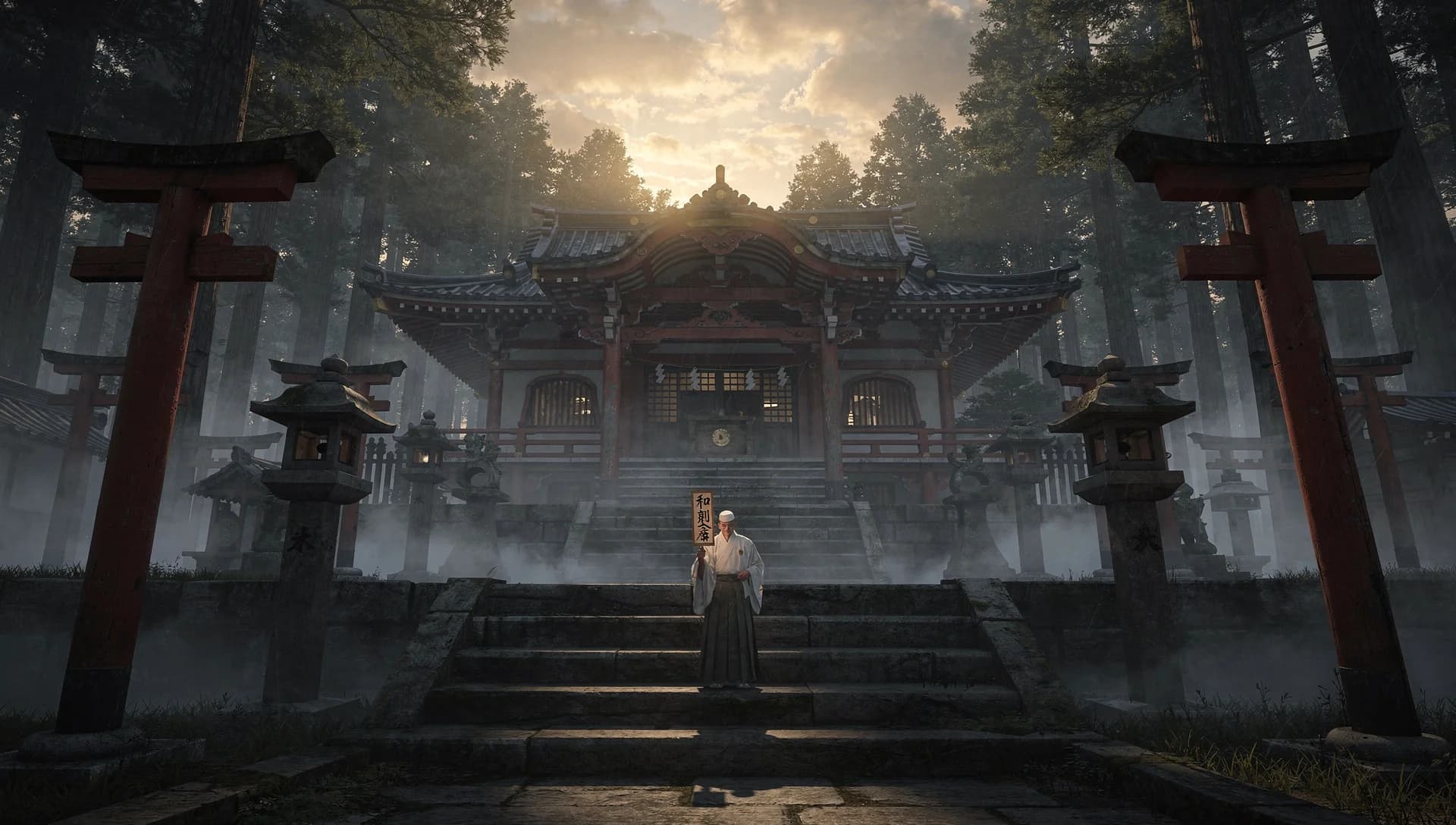
Approaching any traditional Shinto shrine in Japan, you pass through a torii gate marking the boundary between ordinary space and sacred space. You wash your hands and rinse your mouth at the temizuya. You approach the honden, the main hall, which houses the kami, the spiritual presence of the shrine. You bow, clap, offer prayer, bow again. The whole architectural and ritual vocabulary is organized around the recognition of kami, divine presences who pervade nature, ancestral lineages, and certain places and persons. Shinto, the indigenous religious tradition of Japan, is one of the most distinctive religious cultures in the world, having developed in relative isolation on the Japanese archipelago and having maintained a continuous tradition through the various waves of Buddhist, Confucian, and Daoist influence from the Asian mainland.
The Urantia Book makes a remarkable claim about Shinto in Paper 94:5.6. The composite belief that emerged in China through Salem missionary influence spread through the lands of the yellow and brown races as an underlying influence in religio-philosophic thought. In Japan this proto-Taoism was known as Shinto, and in this country, far-distant from Salem of Palestine, the peoples learned of the incarnation of Machiventa Melchizedek, who dwelt upon earth that the name of God might not be forgotten by mankind. This is one of the most specific and surprising historical claims the UB makes about a non-Western religion. Salem missionary teaching reached Japan. The Japanese learned of the actual incarnation of Machiventa Melchizedek. This learning is somehow embedded in the Shinto tradition.
The transmission route the UB names is consistent with the historical evidence for cultural exchange between continental Asia and the Japanese archipelago. Salem missionary teaching, transmitted from Mesopotamia through Central Asia into China during the early second millennium BCE, would have reached Korea through the established Sino-Korean cultural exchange and Japan through the Korea-Japan exchange. The Yayoi period (c. 1000 BCE to 300 CE) in Japanese history was marked by substantial cultural transmission from the continent, including the introduction of wet-rice agriculture, bronze and iron technology, and various religious and philosophical concepts. The proto-Shinto religious framework crystallized during this period, with continued development through the Asuka, Nara, and Heian periods.
Helen Hardacre's 2017 monograph Shinto: A History is the standard contemporary academic survey of the tradition. Hardacre traces the development of Shinto from its prehistoric roots through its various historical formations, with the Heian period (794-1185) marking the formalization of the imperial cult and the Edo period (1603-1868) marking the systematization of doctrinal Shinto. The kami concept itself is documented as having early roots, with kami being understood as spiritual presences pervading nature and certain locations rather than as personal deities in the Western sense.
The structural parallel with Salem-derived monotheism is real but indirect. The early kami concept, particularly in its formulation as the One Spirit pervading sacred reality, has structural similarities to the Salem teaching of one God manifest in creation. The honoring of certain ancestors as kami and the identification of certain mountains and natural features as kami-presences echo the broader pattern of recognizing divine presence within creation that Salem teaching also affirmed. The early Shinto did not develop into pure monotheism in the Hebrew or Islamic sense, but it preserved a structural orientation toward sacred unity beneath the manifold of natural phenomena.
The specific UB claim about Japanese learning of the Machiventa incarnation is more difficult to verify from the historical record. The Japanese textual tradition begins seriously with the Kojiki (712 CE) and the Nihon Shoki (720 CE), the foundational mythological-historical compilations of Japanese tradition. These texts, in the translations by Donald Philippi (Kojiki, 1968) and W.G. Aston (Nihon Shoki, 1896), preserve substantial older oral material but do not contain explicit references to Machiventa or to specific Salem-derived theological content. The UB claim therefore rests on the structural-influence reading of early Shinto rather than on explicit textual confirmation.
The structural fit with the UB account is suggestive rather than confirmed. The Salem influence on Shinto is plausible given the documented cultural transmission routes and the structural parallels in the early kami theology. The specific knowledge of Machiventa's incarnation is harder to verify directly. The UB account itself flags this as a remarkable claim, with the parenthetical observation about the country being far-distant from Salem of Palestine acknowledging the surprise of the transmission reaching so far.
The strongest counterargument is that Shinto's distinctive features are best explained by indigenous Japanese religious development without external Salem influence, and that the UB claim about Japanese knowledge of Machiventa's incarnation lacks textual confirmation in the actual Shinto tradition. This is a fair point. The reply is that the structural parallels in the early kami theology, while not requiring Salem influence, are consistent with it. The specific Machiventa claim is best read as a UB historical claim about what the early Japanese knew, not necessarily as a claim that the knowledge was preserved in the developed Shinto textual tradition. Cultural memory of a specific historical event can be lost in textual development while leaving structural traces in the broader religious framework.
What the parallel implies is that Salem-derived monotheistic teaching reached further across the ancient world than is commonly recognized, with even the Japanese archipelago having received some transmission of the underlying revelation. For contemporary readers of Shinto, this offers a way to read the early kami theology as carrying real revelatory content rather than as primitive nature-religion. For comparative religion, the framework places Shinto in the broader context of Salem-derived theological transmission, with the Japanese form being one of the easternmost preservations of the original teaching. The specific cultural elaboration belongs to the Japanese tradition. The underlying revelatory content is shared with the broader human inheritance.
Key Quotes
“This composite belief spread through the lands of the yellow and brown races as an underlying influence in religio-philosophic thought. In Japan this proto-Taoism was known as Shinto, and in this country, far-distant from Salem of Palestine, the peoples learned of the incarnation of Machiventa Melchizedek, who dwelt upon earth that the name of God might not be forgotten by mankind.”
“Hardacre documents the development of Shinto from prehistoric roots through historical formations, with the kami concept understood as spiritual presences pervading nature and certain sacred locations rather than as personal deities in the Western sense.”
Cultural Impact
Shinto has shaped Japanese culture, politics, and identity for over two millennia. The imperial cult, anchored to the descent of the imperial line from the kami Amaterasu, served as the foundational legitimating framework for the Japanese state from the Yamato period through the modern era. The Meiji Restoration (1868) elevated State Shinto to a quasi-state religion role that continued through the Pacific War, with the postwar Constitution legally separating Shinto from the state. Contemporary Japan continues to be shaped by Shinto practice in countless ways: the New Year shrine visits (hatsumode), the seven-five-three children's festival (shichigosan), wedding ceremonies, ground-breaking purifications for new buildings, and the rhythms of festival (matsuri) that punctuate the agricultural year. Beyond Japan, Shinto-influenced concepts have shaped global popular culture through anime, video games, and Japanese aesthetic sensibilities, with kami presences and shrine architecture recurring in contemporary Japanese cultural exports. The Shinto-influenced concept of mono no aware, the gentle melancholy of impermanence, has shaped Japanese literary tradition from the Heian-period Tale of Genji through contemporary fiction and poetry, and has entered Western literary consciousness through translations and through Japanese cultural exchange.
Modern Resonance
Contemporary Shinto offers a distinctive approach to spirituality that has attracted Western interest in recent decades, particularly through the work of figures like Yamaori Tetsuo and through Western Shinto practitioners. The UB framework offers a way to take Shinto seriously while placing it in the broader context of Salem-derived theological transmission. The early kami theology preserved real elements of underlying revelation. The specific Japanese cultural elaboration is one of the easternmost expressions of the global inheritance of Salem teaching. For contemporary Japanese readers reconnecting with the indigenous religious tradition, the framework offers external validation that takes the spiritual depth of the tradition seriously without flattening it into Western theological categories. For Western seekers drawn to Shinto's nature-orientation and aesthetic sensibility, the framework offers a way to engage respectfully with the tradition while recognizing its participation in the broader human inheritance of revelation. The specific UB claim about Japanese knowledge of Machiventa's incarnation, while not directly verifiable from the surviving Shinto textual tradition, is consistent with the overall pattern of Salem teaching reaching unexpectedly far across the ancient world.
Related Mappings
Singlangton, yellow race spiritual leader (~100,000 BC)
= "One Truth" tradition → Tao / the Way
Andite traditions of Eden and Dalamatia carried east
= Chinese "Land of the Gods in the West," Kunlun mythology
Soul and spirit, dual inner realities
= Yang and Yin, complementary cosmic forces
Salem monotheism in Chinese form
= Lao-tse's Tao, the One First Cause
Related Articles
Where to next
The free newsletter. The research behind each piece, no spam.