
 Mythic
Chinese "Land of the Gods in the West," Kunlun mythology
 UB
UBAndite traditions of Eden and Dalamatia carried east
Full Article
Read the deep-dive article on this connection
Andite traditions of Eden and Dalamatia carried east = Chinese "Land of the Gods in the West," Kunlun mythology
The Connection
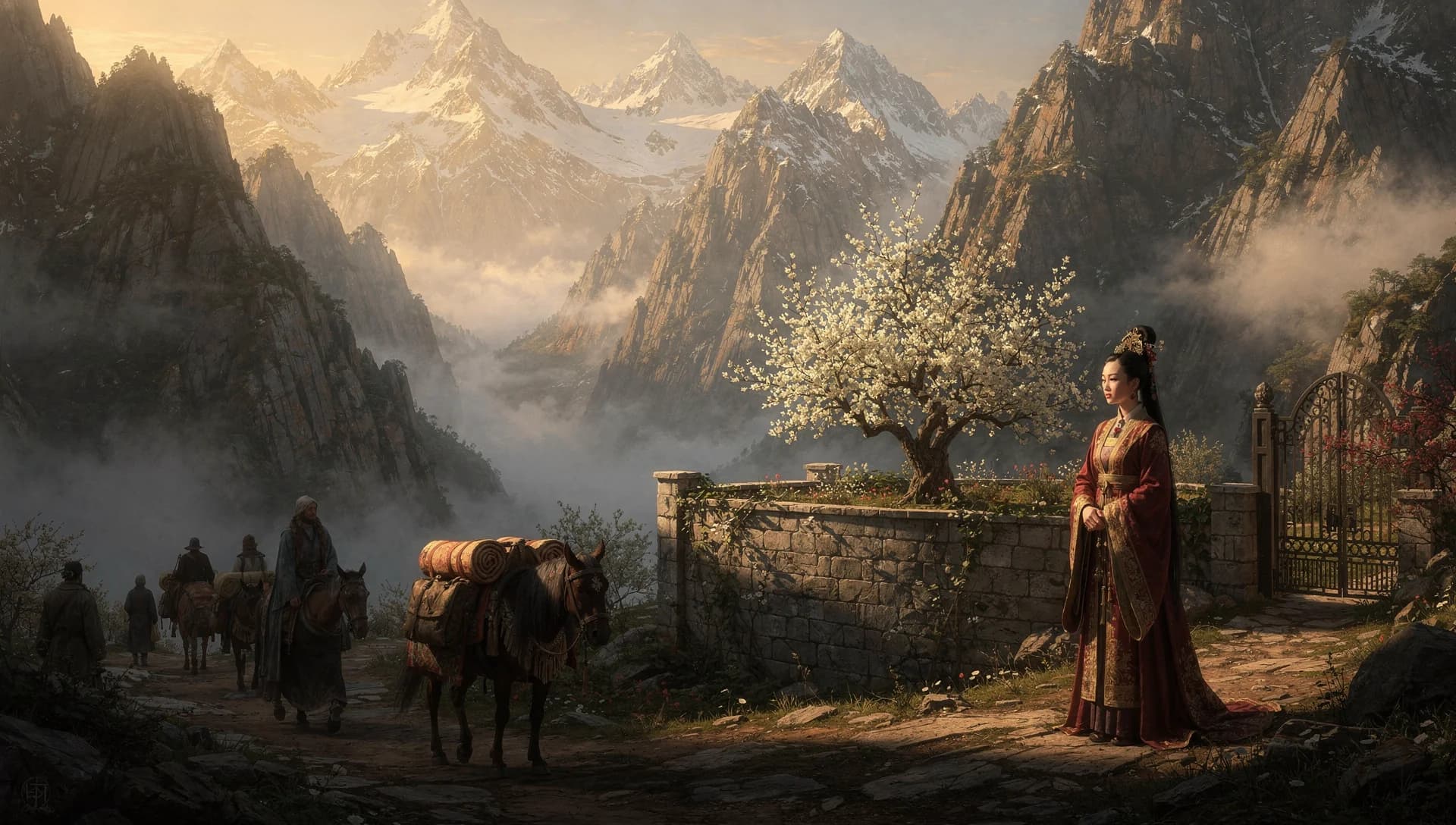
The UB states that Andite immigrants into China brought memories of Eden and Dalamatia, and that "early Chinese legends place the land of the gods in the west." This maps to the Kunlun mountain tradition, a mythical western paradise where immortals dwell, the Queen Mother of the West tends a garden with peaches of immortality, and a sacred tree grows.
UB Citation
Academic Source
Birrell, Chinese Mythology (1993); Shanhaijing (Classic of Mountains and Seas)
Historical Evidence(Moderate evidence)
The Shanhaijing (Classic of Mountains and Seas, compiled 4th-1st century BCE) describes Kunlun as a western paradise with a sacred garden, a tree of immortality, and divine guardians, all structural parallels to Eden. The Queen Mother of the West (Xiwangmu) tends a garden where peaches of immortality grow. The UB provides the mechanism: Andite migrants carried literal memories of Eden (a western garden with a Tree of Life) into China, where they crystallized into the Kunlun tradition.
Deep Dive
In the Shanhaijing, the Classic of Mountains and Seas, compiled in fragmentary form between the fourth and first centuries BCE from older oral and written traditions, Chinese mythological geography places a sacred mountain called Kunlun in the far west. The mountain is the residence of immortals, the location of a divine garden where peaches of immortality grow, and the home of the Queen Mother of the West (Xiwangmu) who tends the garden and dispenses immortality to those who reach it. The Kunlun is described as multi-tiered, ascending in divine levels, with various sacred beings inhabiting its slopes and summit. In the later Daoist tradition, Kunlun became the residence of the highest gods and the destination of the spiritual quest. The Western Paradise of later Chinese Buddhist Pure Land traditions was sometimes conflated with or layered onto the Kunlun motif, producing a complex western paradise tradition that pervades Chinese religious imagination for over two thousand years.
The Urantia Book at 79:7.4 records the historical mechanism behind this mythological tradition. The later waves of Andites brought with them certain of the cultural advances of Mesopotamia. They greatly improved the economic and educational practices of the northern Chinese, and their later descendants contributed much to a subsequent spiritual awakening. The Andite traditions of the beauty of Eden and Dalamatia influenced Chinese traditions; early Chinese legends place the land of the gods in the west. This is a specific historical-mechanism claim. The Andite migrations, occurring during the third millennium BCE and earlier, carried eastward into China the cultural memories of the older Adamic and Dalamatian civilizations. These memories crystallized in Chinese tradition as the Kunlun mythology, the western paradise where the gods dwell.
The structural fit between the Eden tradition and the Kunlun tradition is precise on multiple points. First, the geographic direction: both are located in the west from the perspective of the receiving culture. Eden was located, by the UB account, in the eastern Mediterranean region, which is indeed west of China. The Andite migrations carrying the memory eastward would have preserved the western-direction marker. Second, the garden element: the Kunlun centers on a sacred garden tended by a divine mother figure. The Eden tradition centers on a sacred garden tended by Adam and Eve, with Eve in particular associated with the maternal-creative function. The Queen Mother of the West (Xiwangmu) preserves, in mythologically transformed form, the memory of Eve as the mother-figure of the Edenic civilization. Third, the immortality element: Kunlun produces peaches of immortality. Eden contained the Tree of Life, the fruit of which was associated with extended life-span maintenance for the corporeal staff and Adam-Eve. The structural function is the same, with the Chinese tradition mythologically elaborating the original. Fourth, the multi-tiered ascent: Kunlun is described as multi-leveled, ascending through divine grades. Eden is described in the UB as a complex civilizational center with internal ranking and multiple zones of activity.
Anne Birrell's 1993 monograph Chinese Mythology: An Introduction is the standard contemporary academic survey of the Chinese mythological tradition. Birrell documents the Kunlun mythology as one of the deepest and most pervasive Chinese mythological motifs, with parallels in pre-Han bronze inscriptions, Han funerary art, Six Dynasties poetry, Tang Daoist writings, and continuing through the medieval and modern Chinese imagination. The Shanhaijing itself, despite its compositional complexity, preserves substantial older oral material that scholars trace back to second-millennium BCE Chinese cultural memory. The Mu Tianzi Zhuan (Tale of King Mu of Zhou), describing King Mu's western journey to meet the Queen Mother, is one of the earliest written elaborations of the tradition and reflects the Western Zhou period (c. tenth century BCE) when Chinese contact with western cultural traditions through Central Asian routes was active.
The structural fit with the UB account is precise on the historical mechanism. Andite migrations into China during the third millennium BCE are consistent with the broader population-historical evidence (the genetic and archaeological evidence of west-to-east cultural transmission across Central Asia in the same period). The mythological encoding of an Edenic-Dalamatian memory as a western-paradise tradition is consistent with how oral traditions typically transform historical memory: a real geographic origin gets preserved, a real cultural memory of a sophisticated source civilization gets mythologized into a divine-paradise framework, and the specific figures (Adam and Eve as the original parents, the corporeal staff as the teaching presence, the Tree of Life as the sustenance source) get transformed into divine inhabitants of the paradise.
The strongest counterargument is that the Kunlun tradition is internal to Chinese mythological development and does not require external Andite or Edenic input to explain. This is the standard academic position. The reply is that the structural specifics (western location, sacred garden, mother-figure tending the garden, immortality fruit, multi-tiered ascent, sacred geography) are unusually concentrated in the Kunlun tradition compared to other Chinese mythological elements, and the UB account provides a specific historical mechanism (Andite migration carrying Edenic memory) that explains the cluster.
What the parallel implies is that Chinese mythological tradition preserves, in transformed form, real cultural memory of the Edenic-Dalamatian civilization that the UB describes from another angle. For contemporary readers of Chinese mythology, this offers a way to take the traditions seriously as carrying real historical content rather than dismissing them as primitive imagination. For comparative religion, the Kunlun tradition becomes intelligible as one of the more elaborate Asian preservations of the western-Edenic memory, alongside the Garden of the Hesperides in Greek tradition, the Avalon and Tir na nOg traditions in Celtic, and the various paradise traditions in other cultures. All are partial preservations of the same underlying historical reality.
Key Quotes
“The later waves of Andites brought with them certain of the cultural advances of Mesopotamia; this is especially true of the last waves of migration from the west. They greatly improved the economic and educational practices of the northern Chinese; and while their influence upon the religious culture of the yellow race was short-lived, their later descendants contributed much to a subsequent spiritual awakening. But the Andite traditions of the beauty of Eden and Dalamatia did influence Chinese traditions; early Chinese legends place “the land of the gods” in the west.”
“The similarities between certain of the early Chinese and Mesopotamian methods of time reckoning, astronomy, and governmental administration were due to the commercial relationships between these two remotely situated centers. Chinese merchants traveled the overland routes through Turkestan to Mesopotamia even in the days of the Sumerians.”
“Birrell documents the Kunlun mythology as a deep and pervasive Chinese mythological motif, with the western sacred mountain functioning as the residence of immortals, the location of a sacred garden, and the home of the Queen Mother of the West.”
“The Classic of Mountains and Seas describes Kunlun as a multi-tiered western paradise with a sacred garden, peaches of immortality, and divine guardians, structurally paralleling the Edenic garden tradition through preservation in Chinese mythological vocabulary.”
Cultural Impact
The Kunlun and western-paradise traditions have shaped Chinese cultural imagination for over two millennia. Through the Daoist immortality traditions, the Kunlun became the goal of the spiritual quest, with Daoist alchemists pursuing the elixir of immortality understood as a return to or partaking of the Kunlun source. The Queen Mother of the West (Xiwangmu) developed into one of the most prominent female deities in Chinese popular religion, with her birthday festival continuing as a major celebration in contemporary Daoist communities. The peaches of immortality became a standard motif in Chinese art, appearing in countless paintings, ceramics, and embroideries from the Han dynasty through the modern period. The Pure Land Buddhist tradition, when it entered China in the first millennium CE, was layered onto the existing western-paradise tradition, with Amitabha's Pure Land sometimes conflated with or replacing the Kunlun in popular imagination. Through Chinese influence on Korea, Japan, and Vietnam, the western-paradise motif spread throughout East Asia. Beyond East Asia, the western-paradise tradition has parallels in the Greek Hesperides, the Celtic Avalon and Tir na nOg, the Norse Asgard, the Aztec Tlalocan, and various other paradise traditions across world cultures, with the UB account providing a unifying explanation: all are preservations of the same underlying memory of the Edenic-Dalamatian civilization, transmitted through different cultural channels.
Modern Resonance
Contemporary Chinese popular religion continues to honor the Queen Mother of the West and the Kunlun tradition, with active temples and festivals across the Chinese-speaking world. For Chinese readers reconnecting with their classical heritage after the disruptions of the twentieth century, the UB framework offers external validation that takes the antiquity and historical depth of the indigenous mythological tradition seriously. For Western readers encountering the Kunlun tradition through translations of Chinese classics, the framework offers a way to take the tradition seriously as carrying real historical content rather than dismissing it as exotic mythology. The structural parallel between Eden and Kunlun is one of the cleaner cross-cultural preservations the UB framework makes intelligible: same underlying memory, transmitted through different cultural channels, preserved with different degrees of fidelity in different traditions. For comparative religion, this offers a productive frame for reading the various world-paradise traditions as fragmentary preservations of a shared underlying historical reality rather than as independent cultural inventions or as evidence of universal Jungian archetypes.
Related Mappings
Singlangton, yellow race spiritual leader (~100,000 BC)
= "One Truth" tradition → Tao / the Way
Machiventa Melchizedek, his incarnation remembered in Japan
= Shinto awareness of a divine incarnation at Salem
Soul and spirit, dual inner realities
= Yang and Yin, complementary cosmic forces
Salem monotheism in Chinese form
= Lao-tse's Tao, the One First Cause
Related Articles
Where to next
The free newsletter. The research behind each piece, no spam.