
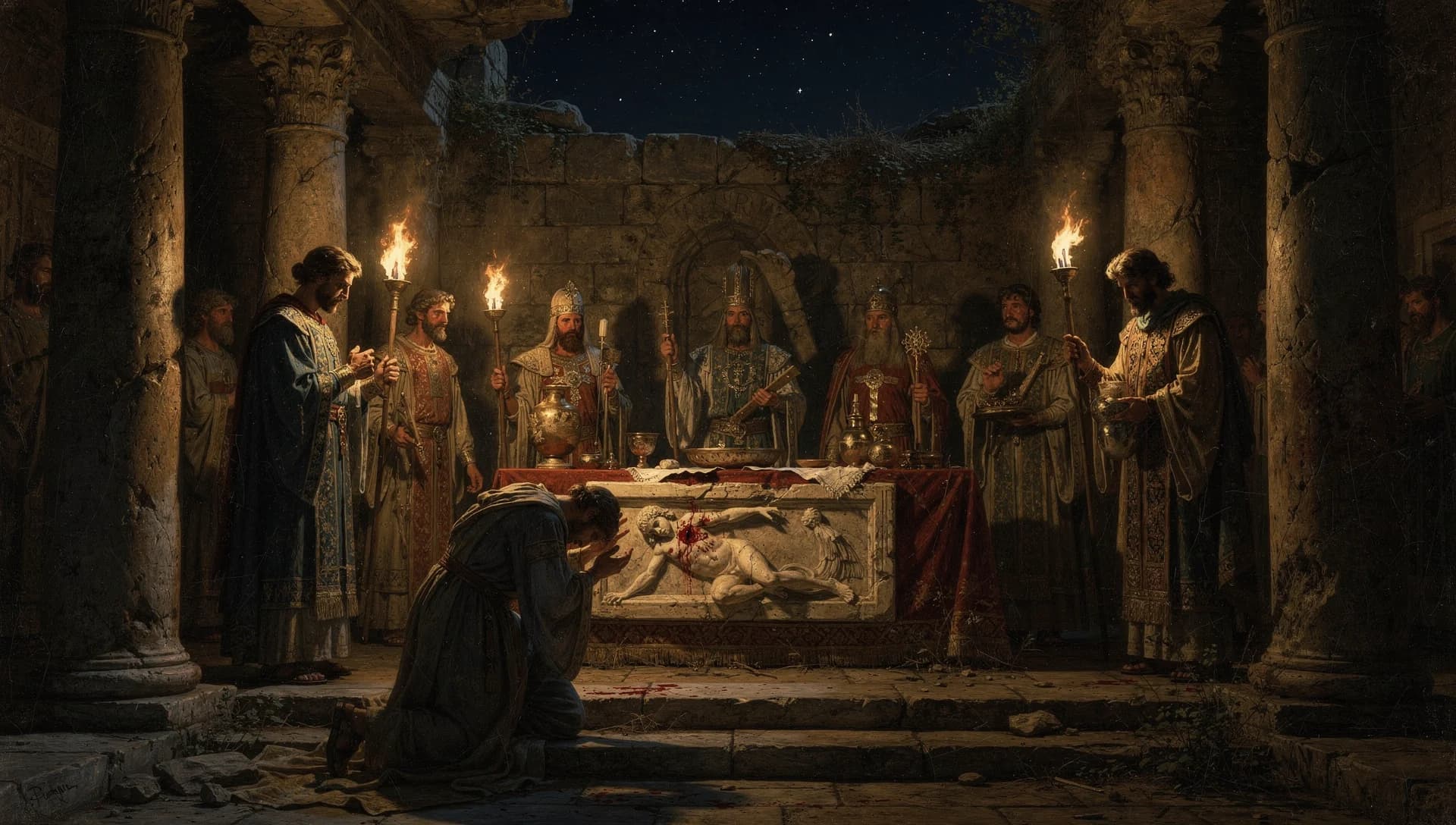
 Mythic
The dying-and-rising god pattern: Osiris, Tammuz, Attis, Adonis, Dionysus
 UB
UBCorrupted Salem teaching in ritual form, expectation of a returning Son
Full Article
Read the deep-dive article on this connection
Corrupted Salem teaching in ritual form, expectation of a returning Son = The dying-and-rising god pattern: Osiris, Tammuz, Attis, Adonis, Dionysus
The Connection
The dying-and-rising god motif appears with remarkable persistence across the ancient Near East and Mediterranean: Osiris in Egypt, Tammuz/Dumuzi in Mesopotamia, Attis in Phrygia, Adonis in Syria, Dionysus in Greece. The UB identifies these consistently as degraded descendants of Salem missionary teaching, in which the original doctrine of salvation by faith in one God was progressively transformed into ritual reenactments of a sacrificed god whose resurrection was celebrated annually. The pattern is not prophecy of Christ, but downstream corruption of the same Salem seed, encountering and intermixing with pre-existing vegetation cults.
UB Citation
UB 98:4.1-6, 98:5.3-4
Academic Source
Frazer, The Golden Bough (1890); Mettinger, The Riddle of Resurrection (2001); Smith, "Dying and Rising Gods" (1987)
Historical Evidence(Strong evidence)
James Frazer's The Golden Bough established the dying-rising god motif as a cross-cultural pattern, though his sweeping treatment was later critiqued by Jonathan Z. Smith. Tryggve Mettinger's The Riddle of Resurrection (2001) re-examined the evidence and concluded that at least Osiris, Dumuzi, and Melqart show the pattern genuinely. The UB explicitly identifies these cults as "corrupted Salem teaching" at 98:4, locating the pattern not in pre-Christian prophecy but in progressive dilution of an originally monotheistic teaching that promised a future bestowal Son.
Deep Dive
Watch the spring rituals at the temple of Cybele on the Palatine Hill in Rome around the year 200 CE. The day is March 22, the festival of Attis. Priests called Galli, in altered states from fasting and frenzied dance, gash their arms and chests with broken pottery shards, scattering blood as votive offering. A pine tree, draped in violets and bound with woolen fillets, is carried in procession to symbolize the dying god. Three days later, on March 25, the Hilaria festival celebrates Attis' resurrection. The cycle has been performed annually for centuries. The crowd participates in the god's death and rebirth as a guarantee of their own immortality.
Walk a few miles east, to the Iseum on the Campus Martius. The cult of Isis and Osiris is performing a similar liturgy. Osiris was murdered by his brother Set, dismembered, and reassembled by Isis, who gave him a posthumous fertility that produced the falcon-god Horus. The annual Khoiak festival, transposed into Roman observance, celebrated the death and resurrection of Osiris with public processions and private mystery initiations. Initiates received the promise of immortality through identification with the resurrected god.
In Phoenicia, the parallel cult of Adonis dramatized the same pattern. In Mesopotamia, Tammuz, the Akkadian Dumuzi, descended into the underworld and returned annually with the spring vegetation. In Greece, the Orphic mysteries of Dionysus reenacted the god's dismemberment by the Titans and his subsequent reassembly. Across the entire ancient Near East and Mediterranean, the dying-and-rising god pattern was so widespread that James Frazer in The Golden Bough (1890) treated it as the central organizing motif of pre-Christian religion.
The standard early-twentieth-century reading was that this pattern represented a kind of pre-Christian preparatio evangelii: the human spirit anticipating, through vegetation cycles and seasonal myths, the eventual coming of the actual divine death and resurrection in Christ. This reading is no longer academically respectable. Jonathan Z. Smith's 1987 article in the Encyclopedia of Religion dismantled most of Frazer's sweeping claims. The category "dying and rising gods" is now treated by most scholars as a post-hoc Christian projection onto disparate pagan materials.
Tryggve Mettinger's 2001 The Riddle of Resurrection reopened the question. Working from the actual primary sources rather than from Frazer's synoptic generalizations, Mettinger concluded that at least Osiris, Dumuzi, and Melqart show genuine death-and-rising motifs in pre-Christian texts. The pattern is not a Christian projection. It is a real pre-Christian phenomenon, though smaller in scope than Frazer thought.
The UB intervention is theologically distinctive. UB 98:4.6 states that "The Phrygian and Egyptian mysteries taught that the divine son (respectively Attis and Osiris) had experienced death and had been resurrected by divine power." The UB does not deny the pattern; it acknowledges the pattern. But the UB locates the pattern not in pre-Christian prophecy of Christ but in downstream corruption of an earlier monotheistic teaching. UB 98:4-5 frames the mystery cults as the late-classical degenerative form of what had originally been the Salem teaching of one God and the promise of a bestowal Son. As that teaching encountered older vegetation and fertility cults, the bestowal-Son element was transposed into the older agricultural-cycle frame, producing the Attis, Osiris, Adonis, and Dumuzi forms.
This reading reverses the conventional twentieth-century narrative. The pattern is not pre-Christian preparation for Christ. It is post-Salem corruption of a teaching that had already pointed toward Christ in its original form. The Salem missionary teaching, transmitted into the Levantine and Anatolian religious environment around 2000 BCE, was that the Universal Father had promised a bestowal Son who would die and rise. As the teaching diffused into cultures with strong vegetation-cult traditions, the dying-rising element was retained and the monotheistic frame was lost. What remained was the seasonally renewed vegetation god rather than the once-for-all bestowal Son.
The strongest counterargument is that the dying-rising pattern is older than the Salem teaching as the UB dates it. Dumuzi worship is attested in Sumerian texts predating the 1973 BCE Melchizedek incarnation. The UB response, traceable through Paper 66 and Paper 74, is that the originating Salem teaching itself drew on still older Dalamatia-era teachings about the Material Son's function and the bestowal expectation. The Sumerian Dumuzi worship, on this reading, descends from pre-Salem teaching of a Material Son figure, with the Salem teaching reinforcing rather than originating the pattern.
The cumulative effect is to relocate the dying-rising god pattern from prefigural pre-Christian prophecy into a longer historical chain of teaching, corruption, and reinforcement that ultimately points to the same destination: the actual bestowal of Michael as Jesus, which the UB treats as the historical fulfillment of what the Salem teaching had always anticipated.
Key Quotes
“The Phrygian and Egyptian mysteries taught that the divine son (respectively Attis and Osiris) had experienced death and had been resurrected by divine power, and further that all who were properly initiated into the mystery, and who reverently celebrated the anniversary of the god's death and resurrection, would thereby become partakers of his divine nature and his immortality.”
“The majority of people in the Greco-Roman world, having lost their primitive family and state religions and being unable or unwilling to grasp the meaning of Greek philosophy, turned their attention to the spectacular and emotional mystery cults from Egypt and the Levant.”
Cultural Impact
The dying-rising god question was one of the great battlegrounds of nineteenth- and twentieth-century religious studies. Frazer's Golden Bough, with its sweeping treatment of the motif, became a foundational text of comparative mythology and influenced literary modernism (Eliot's The Waste Land, Pound's Cantos) and depth psychology (Jung's archetype theory). The popular reading of "Christ as another dying-rising god" became a standard secular dismissal of Christian distinctiveness in the early twentieth century. Jonathan Z. Smith's critical dismantling of Frazer in the 1980s was supposed to settle the matter, but Mettinger's 2001 reassessment showed that the pattern is genuinely there, just smaller and more complicated than Frazer claimed. The mainstream academic position is now stuck between dismissal and acknowledgment, without a clean explanatory framework for what the pattern actually represents. The UB framework offers exactly the explanatory framework the academy lacks. The pattern is real. It is older than Christianity. It is not a Christian projection. But it is also not a pre-Christian prophecy of Christ in any direct sense. It is a downstream corruption of a Salem teaching that had original monotheistic-bestowal content, with the bestowal element preserved as ritual reenactment after the monotheistic frame was lost. This reading dignifies the pre-Christian traditions while preserving the historical distinctiveness of the Michael bestowal.
Modern Resonance
Modern popular religion in the West frequently encounters the "Jesus is just another dying-rising god" argument in social media, in popular books, and in YouTube videos that draw heavily on Frazer-derived comparative mythology. The argument is meant to relativize Christian distinctiveness by showing that the pattern was widespread before Jesus and therefore is just a recurring human myth-pattern rather than a unique historical event. The UB framework offers a more sophisticated response than either uncritical Christian apologetics ("the parallels are coincidental or demonic") or naive comparative religion ("the pattern shows Jesus is a myth"). The pattern is real, the parallels are real, and the historical event of Jesus is real. The reason the parallels exist is that an earlier teaching pointed forward to the actual event, and the earlier teaching's pointers were preserved in degraded form in the cultures the teaching reached. This framing has practical pastoral value. A Christian reader who encounters Frazer-style dismissals of Christian distinctiveness no longer has to choose between dismissing the parallels and dismissing the gospel. The parallels are there because the gospel was always coming. The mystery-cult traditions were partial echoes of what would eventually be revealed in full at the bestowal.
Related Mappings
Salem missionaries, universal thread through all religions
= Melchizedek missionaries as the hidden link between traditions
Ganid's world religion compilation
= First comparative religion study in human history
Seven outstanding human teachers
= Sethard, Moses, Zoroaster, Lao-tse, Buddha, Philo, Paul
Plural historical floods (Dalamatia 162 years after rebellion, Eden sinking, Mesopotamian regional floods)
= Universal flood traditions across ~300 world cultures
Related Articles
Where to next
The free newsletter. The research behind each piece, no spam.