
 Mythic
Greek thinker who engaged directly with Jesus' teaching
 UB
UBRodan of Alexandria, Greek philosopher
Full Article
Read the deep-dive article on this connection
Rodan of Alexandria, Greek philosopher = Greek thinker who engaged directly with Jesus' teaching
The Connection
The UB devotes two full papers (160-161) to Rodan, a Greek philosopher from Alexandria who came to engage with Jesus' teaching. He represents the highest Greek philosophical mind encountering the gospel directly. His discussions with Nathaniel and Thomas demonstrate how Greek rational philosophy could harmonize with the religion of Jesus.
UB Citation
UB 160:1.1, 161:3.4
Academic Source
No known academic parallel; UB-unique character
Historical Evidence(Moderate evidence)
Rodan is presented as a real historical figure in the UB, though no independent historical record survives. His philosophical arguments in Papers 160-161 represent a sophisticated fusion of Greek logic with Jesus' spiritual teachings. He formulated one of the clearest UB arguments for the personality of God, reasoning from the necessity of personal relationship. His role illustrates the UB theme that Greek philosophy was the best intellectual preparation for the gospel.
Deep Dive
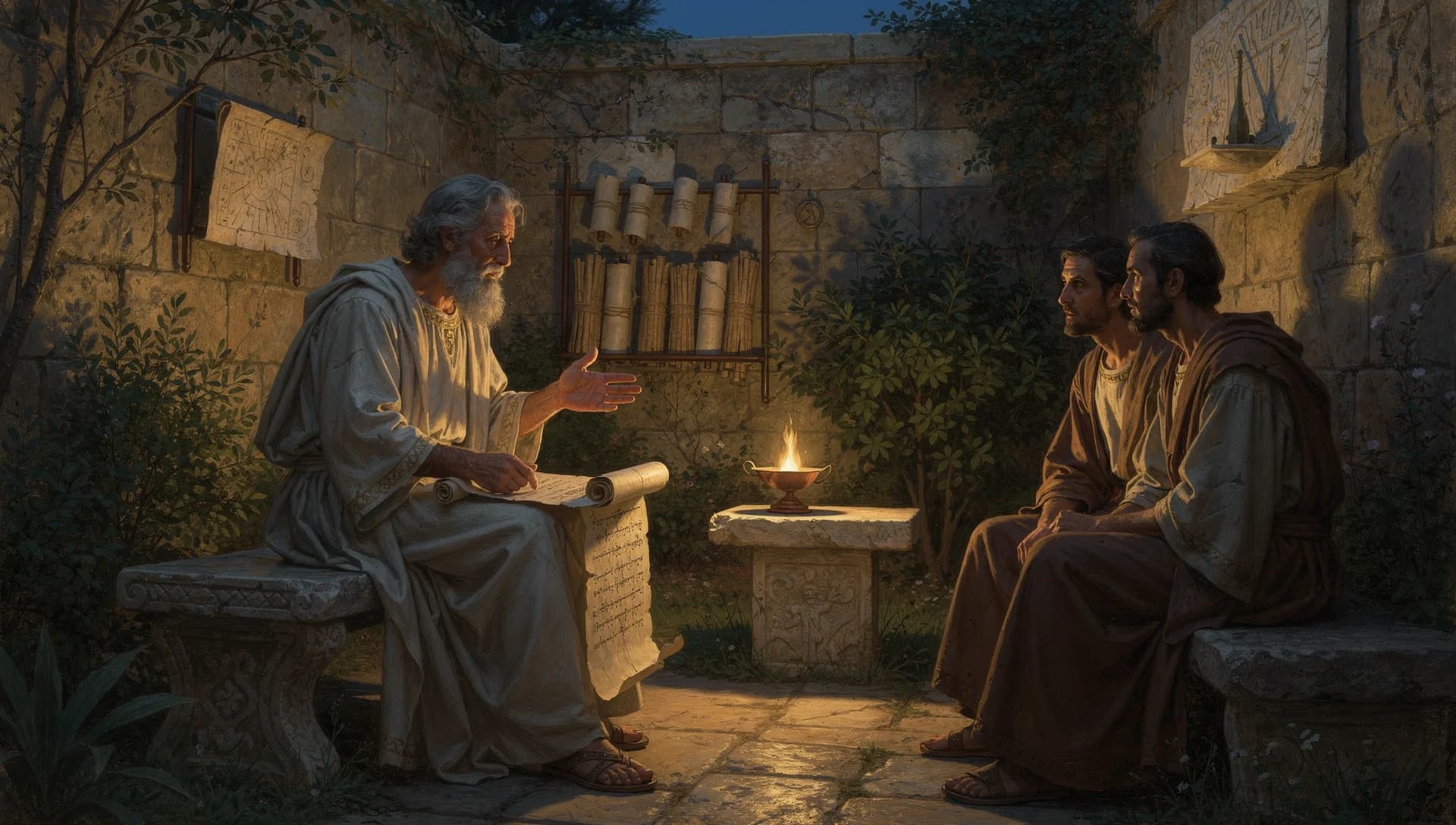
In September of A.D. 29, on the green hills above the lake at Magadan, a Greek philosopher from Alexandria sat down with Nathaniel and Thomas under the open sky and began the most sustained philosophical conversation the gospel narrative records. He had come a long way for it. Alexandria in the late 20s was the intellectual capital of the Mediterranean world, with its great library, its Museion, its philosophical schools running side by side. Rodan had been trained there in the full Greek tradition: Platonic metaphysics, Aristotelian logic, Stoic ethics, the eclectic synthesis that the Hellenistic schools had been refining for three centuries. He had heard the gospel from one of Abner's associates working a mission at Alexandria, and the gospel had taken hold. He wanted to understand. He wanted to harmonize what the Galilean teacher was saying with the categories of philosophy he had spent his life mastering. He came to Magadan specifically to talk it through.
The Urantia Book devotes two full papers, 160 and 161, to the resulting conversations. Paper 160 records Rodan's own philosophical address, ten talks that Nathaniel and Thomas insisted on hearing in full before they would respond. Paper 161 records the question-and-answer that followed, including the famous discussion of the personality of God that became one of the clearest argumentations for divine personality the UB contains. Paper 160:0.1 introduces him: "Nathaniel and Thomas were very busy with their discussions with a certain Greek philosopher from Alexandria named Rodan. This Greek had recently become a disciple of Jesus through the teaching of one of Abner's associates who had conducted a mission at Alexandria. Rodan was now earnestly engaged in the task of harmonizing his philosophy of life with Jesus' new religious teachings."
What Rodan represents in the UB scheme is the highest reach of Greek rational philosophy meeting the gospel directly, in person, while Jesus was still on earth. The Greeks had built, over five centuries, an extraordinary intellectual apparatus for thinking about God, the soul, virtue, and the right life. Plato had argued for the immortality of the soul, the reality of the Forms, and the goodness of the demiurge who fashioned the cosmos. Aristotle had given the West its first systematic logic and a doctrine of the unmoved mover. The Stoics had articulated a universal divine reason (the logos) pervading all things. The Cynics had stripped religion to its ethical core. By the late first century BCE the schools had cross-pollinated thoroughly; an educated Alexandrian like Rodan would have moved fluently across all of them. What he lacked, what no Greek philosophical tradition could give him by itself, was the personal Father, the God who is not just the unmoved mover or the cosmic logos but a personality who can be known in direct relationship.
Paper 161:1.6 records the start of the breakthrough. The argument from the Trinity: if the Father in Paradise enjoys equality of communication with the Eternal Son and the Infinite Spirit, two beings fully equal to himself, then personality (which the Greek philosophical tradition had defined essentially in terms of relational mutuality) must be predicable of the Father. Paper 161:1.10 adds the argument from the source of personality: God must be a personality since he is the Creator of all personality and the destiny of all personality. Paper 161:1.11 records the result: "When Rodan heard these arguments, he said: I am convinced. I will confess God as a person if you will permit me to qualify my confession of such a belief by attaching to the meaning of personality a group of extended values, such as superhuman, transcendent, supreme, infinite, eternal, final, and universal."
That is one of the cleanest moments of philosophical persuasion in the whole narrative. A trained Greek philosopher, faced with rigorous argument from his own logical premises plus the testimony of the apostles' direct experience of Jesus, concedes the personality of God. The concession is not naive; he qualifies it by piling up the transcendent attributes that his philosophical training had taught him to associate with the divine. But he concedes the central point: God is a personality, not merely an impersonal absolute.
Why does this matter for the decoder? Because Rodan represents the meeting point of two streams the UB tracks separately: the post-Adamic human philosophical achievement of the Mediterranean world, and the direct revelation carried in the person of the Creator Son. He is the living demonstration of what the UB elsewhere argues abstractly, that Greek philosophy was the best intellectual preparation for the gospel. The Stoic logos, refined by centuries of speculation, finds its personal referent in Jesus, the Word made flesh. The Platonic Form of the Good, sought through dialectic, finds its personal embodiment in the Father whom Jesus reveals. The Aristotelian unmoved mover, deduced from the necessity of a first cause, finds his personal voice in the gospel.
There is no known academic parallel for Rodan as an individual; the UB stands alone in identifying him by name. Independent historical attestation has not survived. But the figure he represents, the educated Alexandrian convert grappling with the integration of Greek philosophy and gospel, is exactly what we know existed in the first and second centuries from the writings of Justin Martyr, Clement of Alexandria, Origen, and the long Alexandrian Christian-Platonic tradition. Rodan's conversation with Nathaniel and Thomas at Magadan is the prototype, the founding instance, of what would become the dominant intellectual project of the early church: rendering the gospel in the philosophical categories of the surrounding Mediterranean world, while preserving its distinctive personal-relational core.
The strongest counterargument is silence: no other source mentions Rodan, and the UB's account places him in a quite specific historical setting where some independent attestation might be expected. The reply is that the early church's Greek philosophical heritage is real, and the named individuals who carried it across the apostolic generation are mostly lost from the historical record. We know Apollos, who was Alexandrian. We know that Greek-trained converts were already prominent in the apostolic mission. The UB's identification of one specific named figure at the moment of first contact is consistent with the broader pattern that historical scholarship documents, and adds biographical specificity to a generic phenomenon.
What the parallel implies is that the gospel's Greek philosophical rendering was not a later corruption or a Pauline invention. It began in the apostolic generation itself, with Jesus' explicit blessing, in the persons of figures like Rodan whose careful philosophical work made the gospel intelligible to the educated Greek world without falsifying its core. The decoder's task here is to point at the figure who made this possible and to honor the specific philosophical achievement his conversations represent.
Key Quotes
“Nathaniel and Thomas were very busy with their discussions with a certain Greek philosopher from Alexandria named Rodan. This Greek had recently become a disciple of Jesus through the teaching of one of Abner’s associates who had conducted a mission at Alexandria. Rodan was now earnestly engaged in the task of harmonizing his philosophy of life with Jesus’ new religious teachings, and he had come to Magadan hoping that the Master would talk these problems over with him.”
“When Rodan heard these arguments, he said: “I am convinced. I will confess God as a person if you will permit me to qualify my confession of such a belief by attaching to the meaning of personality a group of extended values, such as superhuman, transcendent, supreme, infinite, eternal, final, and universal.””
“Early Monday morning, Rodan began a series of ten addresses to Nathaniel, Thomas, and a group of some two dozen believers who chanced to be at Magadan.”
Cultural Impact
Rodan stands as the named prototype of a tradition that shaped Western Christianity decisively. The Alexandrian Christian-Platonic synthesis, beginning with Clement and Origen in the second and third centuries, ran through Augustine in the fourth and fifth, the medieval scholastics in the eleventh through fourteenth, and the Renaissance humanists into the modern world. Every time a Christian theologian has reached for Greek philosophical categories to articulate the gospel, that work descends from the project Rodan inaugurates in Paper 160. The doctrine of God as personal, infinite, transcendent, immanent, eternal, and the source of all personality has its earliest careful formulation in Rodan's response to the apostolic argument. The Trinitarian theology that became Nicene orthodoxy in 325 owes part of its philosophical apparatus to the kind of work Rodan and his apostolic conversation partners did first. The contemporary global Christian intellectual tradition, in its many denominations and theological schools, is unintelligible apart from this synthesis. Rodan does not get credit by name in any of it, but the UB's identification of him as the historical first instance restores his place in the genealogy of Christian thought.
Modern Resonance
Contemporary readers wrestling with the integration of philosophy and faith, of reason and revelation, find in Rodan a model of how it can be done. He does not surrender his philosophical training to make room for the gospel. He brings the full apparatus of Greek logic to bear on the apostolic claim and finds, on rigorous examination, that the claim holds. The personality of God is not a sentimental concession but the conclusion of a careful argument. For modern readers exhausted by the supposed conflict between religion and reason, Rodan's example is encouraging: the conflict is mostly artificial, the result of bad philosophy on one side or shallow theology on the other. Done well, philosophy supports the gospel rather than undermining it. Done well, the gospel completes philosophy rather than displacing it. The integrative project Rodan inaugurated is exactly the project most needed by the contemporary religious mind, and the UB's preservation of his name makes him an ancestor whose example is available to anyone who wants to attempt the same synthesis today.
Related Mappings
Adamson + Ratta, superhuman couple
= Cronus + Rhea, Titan parents of the Olympians
16 children of Adamson + Ratta
= Olympian Gods: Zeus, Hera, Poseidon, etc.
Caligastia, invisible sky ruler
= Ouranos, Greek sky father (via Hittite Anu transmission)
Salem missionaries' purest European teaching
= Cynics, philosophical school preserving Salem monotheism
Related Articles
Where to next
The free newsletter. The research behind each piece, no spam.