
Three Hundred Cultures, Many Floods: The Universal Deluge Tradition and the Urantia Record
Catastrophic flood narratives appear in nearly every world culture. Mesopotamian Ziusudra and Utnapishtim, Hebrew Noah, Greek Deucalion, Hindu Manu, Chinese Yu the Great, Aztec Tata and Nene, Incan Viracocha. The Urantia Book reads this universal pattern not as one global event but as the composite memory of several distinct catastrophes: the Dalamatia submergence, the sinking of the first Eden, the Mesopotamian regional floods, and the post-glacial coastal drowning.
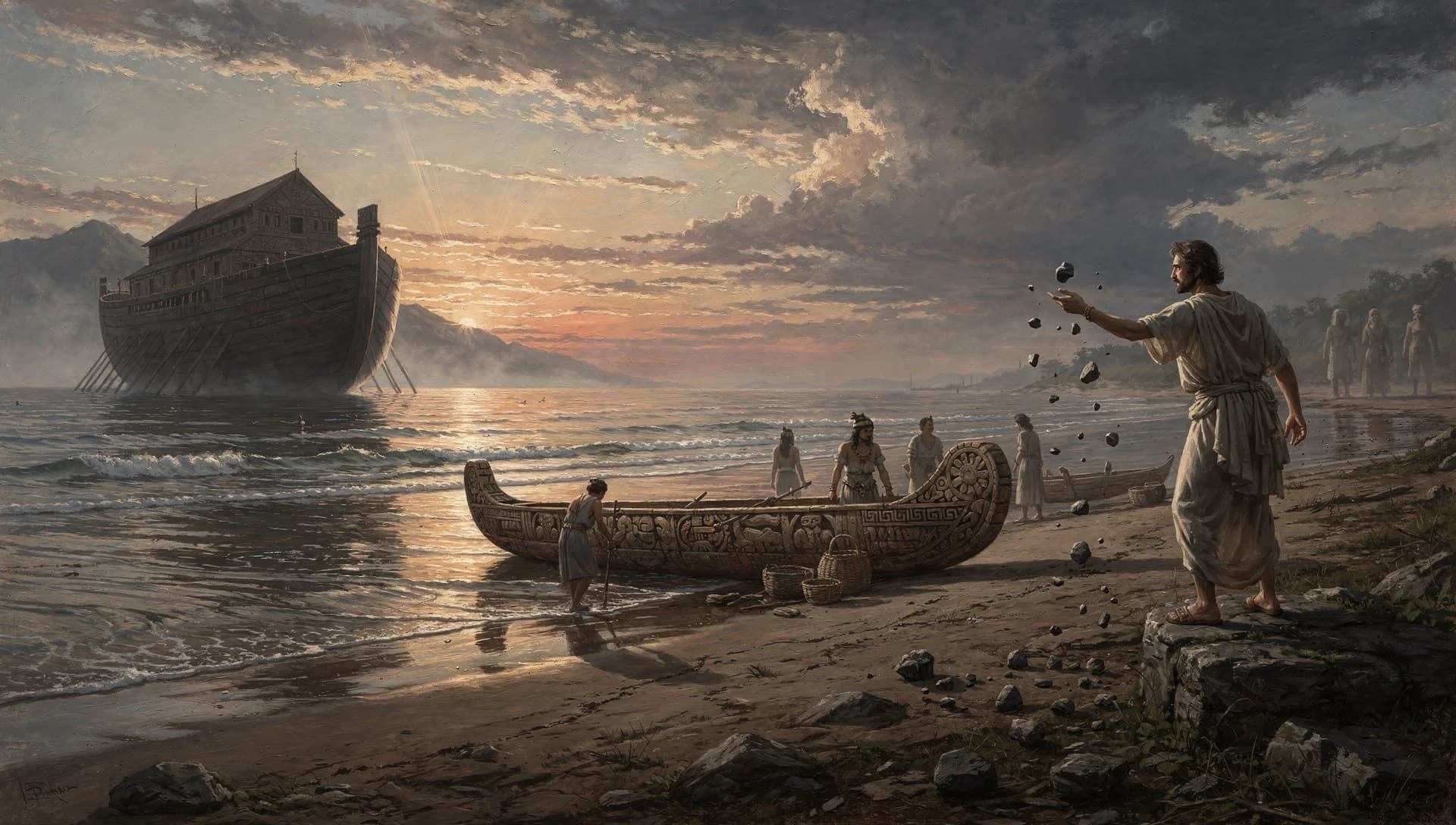
Plural historical floods across Urantia cosmic history = Universal flood traditions across approximately 300 world cultures
This article expands on the decoder mapping. For the side-by-side card and quick reference, see the mapping page.
The Universal Deluge Pattern
Catastrophic flood narratives turn up in essentially every world culture. The shape repeats with striking consistency.
The Mesopotamian tradition preserves Ziusudra (Sumerian), Atrahasis (Akkadian), and Utnapishtim (Akkadian) as pre-flood heroes who survived a divine deluge through prior warning and the building of an ark. The Hebrew tradition preserves Noah as the righteous ark-builder whose family repopulates the post-flood world. The Greek tradition preserves Deucalion and Pyrrha as survivors of Zeus's flood who repopulate humanity by casting stones. The Hindu tradition preserves Manu and the fish-avatar Matsya, who guides the ark through the deluge. The Chinese tradition preserves Yu the Great as the culture-hero who tamed the waters through engineering. The Aztec Five Suns cycle preserves the Fourth Sun flood with survivors Tata and Nene in a hollow cypress. The Incan Viracocha tradition preserves a flood-era destruction of humanity. And many more.
Alan Dundes's The Flood Myth (University of California Press, 1988) catalogued roughly 300 distinct flood traditions from across the continents, establishing the pattern as too widespread for purely local explanation. Yet the mainstream reading of a single global flood also fails to account for the diverse features of the regional traditions.
The Urantia Book identifies the actual historical substrate.
What the Urantia Book Says
The Urantia Book documents multiple distinct catastrophic events across the planet's history. Each contributed memory content to the universal flood tradition.
First, the Dalamatia submergence, around 162 years after the rebellion (about 200,000 BCE):
"One hundred and sixty-two years after the rebellion a tidal wave swept up over Dalamatia, and the planetary headquarters sank beneath the waters of the sea, and this land did not again emerge until almost every vestige of the noble culture of those splendid ages had been obliterated." (67:5.4)
Paper 78 references "still older vestiges of the days of Dalamatia" existing "under the waters of the Persian Gulf" (78:7.7).
Second, the first Eden submergence, roughly 34,000 to 38,000 years ago:
"The peninsula had been overrun by these lower-grade Nodites for almost four thousand years after Adam left the Garden when, in connection with the violent activity of the surrounding volcanoes and the submergence of the Sicilian land bridge to Africa, the eastern floor of the Mediterranean Sea sank, carrying down beneath the waters the whole of the Edenic peninsula. Concomitant with this vast submergence the coast line of the eastern Mediterranean was greatly elevated. And this was the end of the most beautiful natural creation that Urantia has ever harbored." (73:7.1)
Third, the Mesopotamian regional floods of approximately 5000 to 3000 BCE that became the substrate for the Noah narrative. Paper 78 records the historical Noah of Aram, whose local flood became the seed of the biblical narrative:
"But Noah really lived; he was a wine maker of Aram, a river settlement near Erech. He kept a written record of the days of the river's rise from year to year. He brought much ridicule upon himself by going up and down the river valley advocating that all houses be built of wood, boat fashion, and that the family animals be put on board each night as the flood season approached. He would go to the neighboring river settlements every year and warn them that in so many days the floods would come. Finally a year came in which the annual floods were greatly augmented by unusually heavy rainfall so that the sudden rise of the waters wiped out the entire village; only Noah and his immediate family were saved in their houseboat." (78:7.5)
Fourth, the post-glacial coastal drowning that affected essentially all coastal populations during the Holocene sea-level rise of around 120 meters from the Last Glacial Maximum (about 20,000 BCE) to roughly 6000 BCE.
What the Ancient Sources Say
The scholarly comparative treatment of world flood traditions is extensive. Dundes's The Flood Myth (1988) remains the principal synthesis, collecting flood narratives from across continents with introductory essays surveying the major theoretical approaches. William Ryan and Walter Pitman's Noah's Flood: The New Scientific Discoveries About the Event That Changed History (Simon and Schuster, 1998) proposed the Black Sea catastrophic inundation hypothesis as a historical anchor for the Mesopotamian flood tradition, dated to about 5600 BCE through a rapid breakthrough from the Mediterranean into the Black Sea.
Patrick Nunn and Nicholas Reid's 2016 documentation of verified 10,000-year Aboriginal coastal-inundation oral traditions (Australian Geographer 47) demonstrated that long oral preservation of accurate flood memory is empirically possible. Their work supports the broader plausibility of deep-time preservation of multiple ancient catastrophic events.
The principal Mesopotamian flood sources include the Sumerian Eridu Genesis (preserving Ziusudra), the Akkadian Atrahasis Epic (eighteenth to seventeenth century BCE), and Tablet XI of the Epic of Gilgamesh (preserving Utnapishtim). The Hebrew Genesis flood narrative (chapters 6 to 9) is substantially later in compositional history but preserves the same substrate tradition. The Greek Deucalion tradition appears in Apollodorus and Ovid. The Hindu Matsya-Manu tradition appears in the Shatapatha Brahmana and in subsequent Puranic elaborations. The Chinese Yu the Great tradition appears in Sima Qian's Records of the Grand Historian.
Why This Mapping Matters
The universal distribution of flood traditions has been contested across very different interpretive frameworks. The Biblical-literalist reading treats the tradition as memory of a single Noahic global flood. The comparative-folklorist reading treats it as local catastrophic memories generalized through cultural diffusion or independent invention. The Urantia Book offers a middle position: the universal pattern preserves the memory of multiple distinct catastrophic events, each contributing its own content to specific regional traditions.
The Mesopotamian tradition preserves memory of the regional floods that the Urantia Book documents at 78:7, plus inherited memory of the Dalamatia submergence carried forward through Nodite cultural continuity. The Hebrew tradition preserves the Mesopotamian substrate through the Abrahamic migration from Ur to Palestine. The Mesoamerican tradition preserves memory of multiple catastrophes through the red-race migration carrying pre-migration memory into the Americas. The broader pattern of universal flood tradition reflects the multiple-event historical substrate that the Urantia Book documents.
The mapping's significance is this: the universal flood tradition should be read as preserving genuine historical memory of multiple specific catastrophic events distributed across the planet's history, rather than as either a single-flood memory or a fully independent parallel development.
Sources
- The Urantia Book, Paper 67 (The Planetary Rebellion), Paper 73 (The Garden of Eden), Paper 78 (The Violet Race After the Days of Adam). Urantia Foundation, first printing 1955. Cited passages: 67:5.4, 73:7.1, 78:7.1-7.
- Dundes, Alan, editor. The Flood Myth. University of California Press, 1988.
- Ryan, William and Walter Pitman. Noah's Flood: The New Scientific Discoveries About the Event That Changed History. Simon and Schuster, 1998.
- Nunn, Patrick D. and Nicholas J. Reid. "Aboriginal Memories of Inundation of the Australian Coast Dating from More than 7000 Years Ago." Australian Geographer 47, no. 1, 2016.
- George, Andrew. The Epic of Gilgamesh. Penguin Classics, 1999.
- Lambert, W. G. and A. R. Millard. Atra-Hasis: The Babylonian Story of the Flood. Oxford University Press, 1969.
Confidence and Evidence
- Confidence: UB CONFIRMED
- Evidence rating: STRONG
- Basis: The Urantia Book documents multiple specific catastrophic events across UB 67, 73, and 78. The universal distribution of flood traditions is extensively documented in comparative-religion scholarship. The plural-event framework accounts for the cross-cultural distribution pattern more accurately than either single-event or purely coincidental explanations.
Related Decoder Articles
- Three Noahs, One Story
- Mesoamerican Flood Cycles
- Garden of Eden = Atlantis / Dilmun
- Celtic Otherworld = The Submerged First Eden
Byline: Derek Samaras | Urantia Book Network | April 2026
Connecting Articles
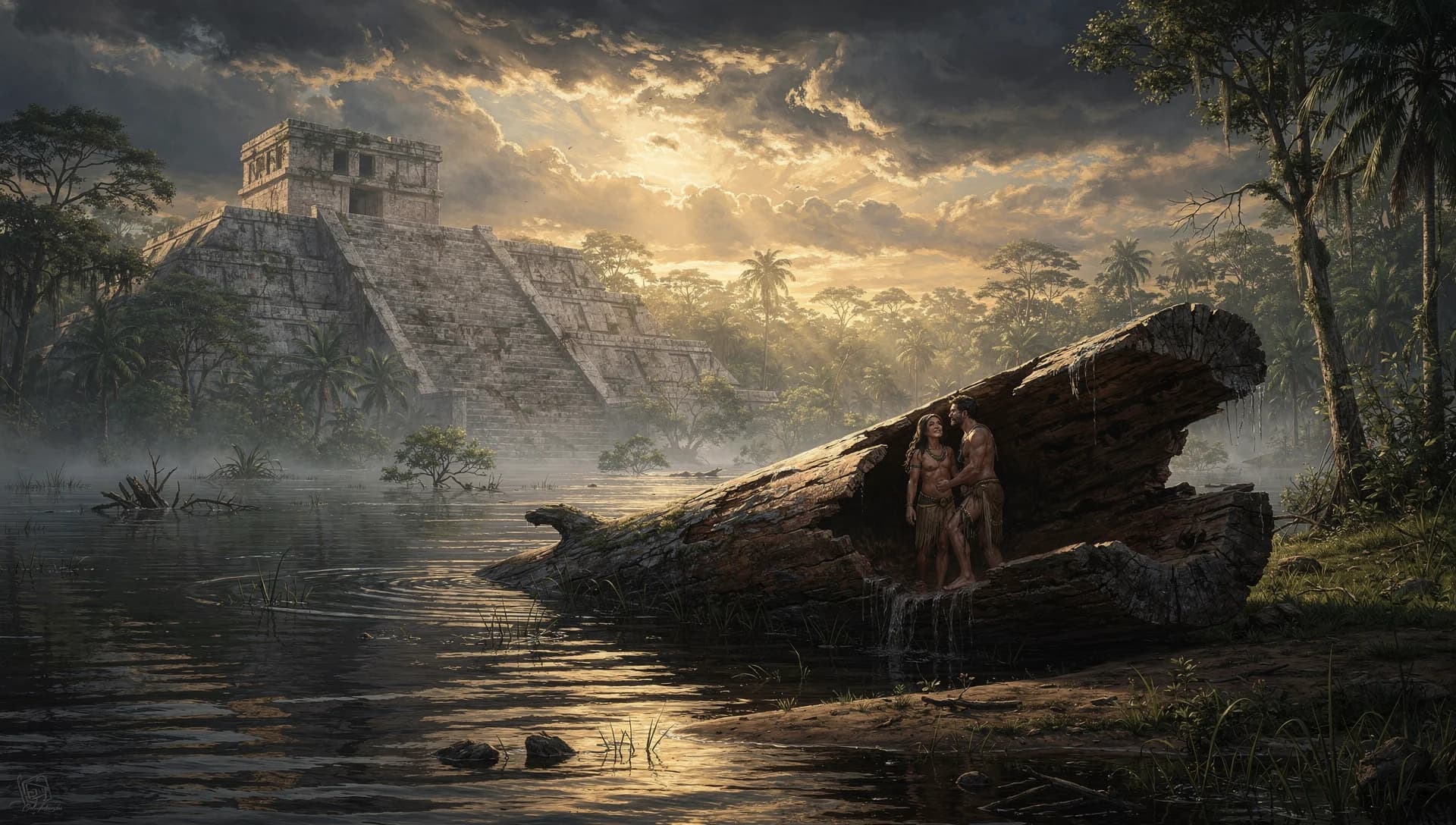
Five Suns and Many Floods: Mesoamerican Flood Cycles and the Urantia Record
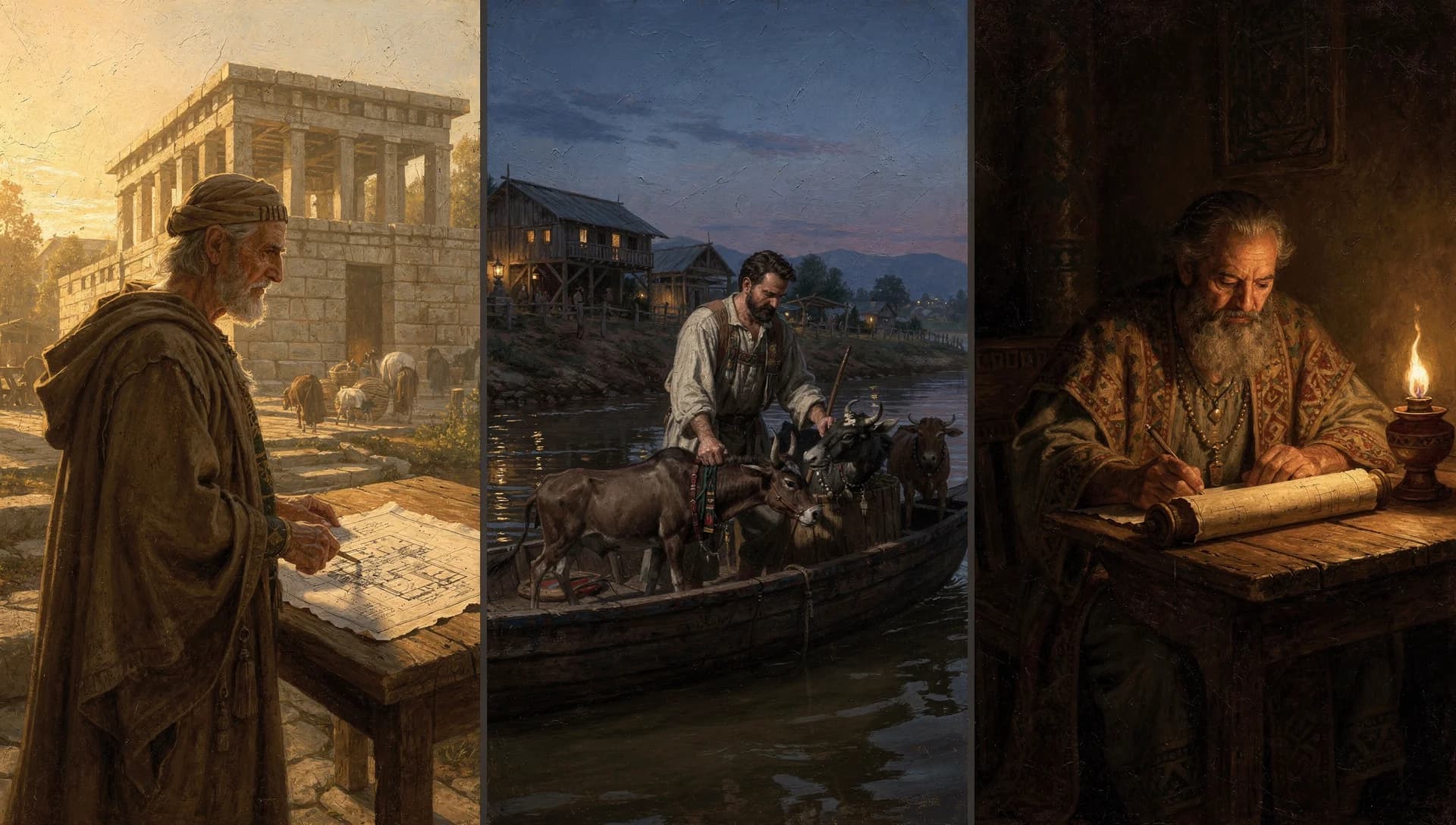
Three Noahs, One Story: The Composite Noah of Genesis
The Longest Memory: Australian Aboriginal Dreamtime and the Primordial Teaching-Ancestors
The Final Adjudication: Ragnarok and the Pending Verdict
The Newsletter
Get the research behind each piece
Free. New Urantia Book explorations, the sources behind the videos, and early looks. No spam, unsubscribe anytime.
Prefer video? Follow on YouTube and Facebook.
Delivered through Substack. You can also read past issues.