
 Mythic
Mithraic sacraments: communion and Sunday worship
 UB
UBMithraic ritual as proto-Christian practice
Full Article
Read the deep-dive article on this connection
Mithraic ritual as proto-Christian practice = Mithraic sacraments: communion and Sunday worship
The Connection
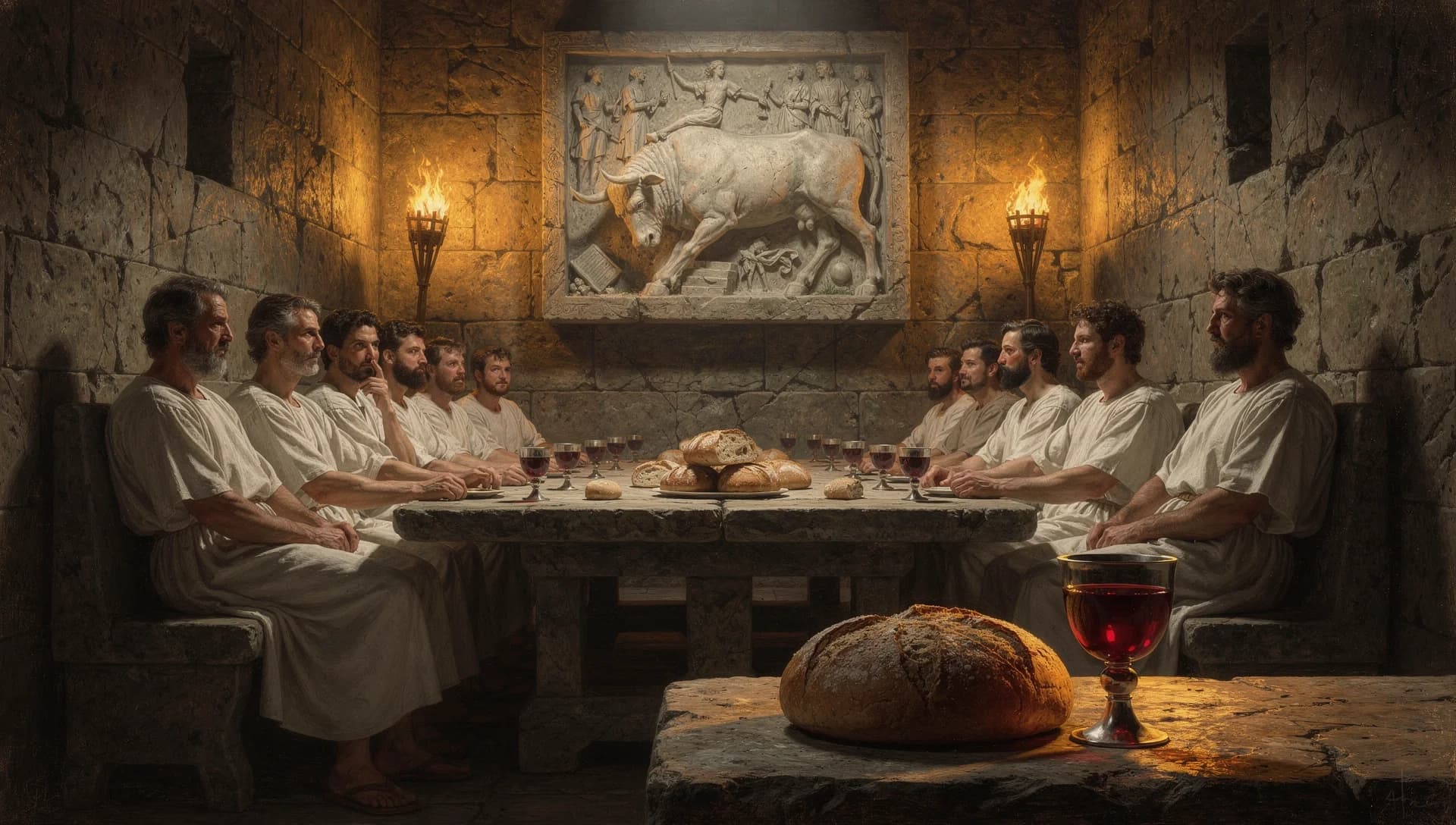
The UB identifies Mithraic sacramental practice as a direct precursor to Christian ritual. Mithraism practiced a sacred meal of bread and wine, designated Sunday as its holy day (the day of the Sun), and organized its worship around initiatory sacraments. These practices were absorbed into Christianity rather than independently invented.
UB Citation
Academic Source
Clauss, The Roman Cult of Mithras (2000); Lease, Mithraism and Christianity (1980)
Historical Evidence(Strong evidence)
The UB draws explicit parallels between Mithraic and Christian ritual. Manfred Clauss documents the Mithraic sacred meal (bread, water, and sometimes wine), Sunday observance, and graded initiatory system. Gary Lease examines the "complex interplay" between Mithraic and Christian practice in the 2nd-4th centuries CE. Justin Martyr (c. 150 CE) himself noted the Mithraic communion parallel and attributed it to demonic imitation, acknowledging the pre-Christian origin of the practice.
Deep Dive
In the Mithraeum at Santa Prisca on the Aventine Hill in Rome, fragments of a Latin inscription preserve a hymn of the cult: he who saved us by shedding the eternal blood. The verse, addressed to Mithras, has been the subject of scholarly debate for nearly a century, with some scholars arguing for direct Christian influence and others arguing for parallel development. The Mithraic sacred meal, attested across the empire in iconographic and inscriptional form, included bread, water, and wine, with the wine sometimes substituted by water in particular initiatory contexts. The meal was understood to confer participation in Mithras's saving act and to ensure the participant's eternal life. Justin Martyr, writing in Rome around 150 CE, addressed the parallel directly in his First Apology: the wicked devils have imitated this in the mysteries of Mithras, commanding the same thing to be done, for that bread and a cup of water are placed with certain incantations in the mystic rites of one who is being initiated, you either know or can learn.
The Urantia Book at 98:5.4 documents the Mithraic ritual structure in unusual detail. The adherents of this cult worshiped in caves and other secret places, chanting hymns, mumbling magic, eating the flesh of the sacrificial animals, and drinking the blood. Three times a day they worshiped, with special weekly ceremonials on the day of the sun-god and with the most elaborate observance of all on the annual festival of Mithras, December twenty-fifth. It was believed that the partaking of the sacrament ensured eternal life, the immediate passing, after death, to the bosom of Mithras, there to tarry in bliss until the judgment day. The structural elements are listed precisely: sacred meal as participation in the saving deity, weekly observance on the day of the sun-god (Sunday), elaborate annual festival on December 25, eternal-life soteriology, post-mortem destination, eschatological judgment.
Each of these elements has a clear Christian parallel. The Christian Eucharist is structurally a sacred meal in which the participant participates in the saving work of Christ. The Christian Sunday is the day of the resurrection, observed weekly. December 25 became the Christian celebration of the nativity in the fourth century. The Christian soteriological framework promises eternal life through participation in Christ, with post-mortem destination dependent on faith. The eschatological judgment is the end-of-the-age framework that pervades the New Testament. The structural overlap is so extensive that some early Christians (Justin Martyr) and many modern scholars (Richard Reitzenstein, Wilhelm Bousset, the History of Religions School) have argued for substantial Mithraic influence on early Christian sacramental practice.
Manfred Clauss's 2000 The Roman Cult of Mithras provides the contemporary academic standard for the cult's sacramental practice. Clauss documents the sacred meal, the bread-and-water (or bread-and-wine) elements, the seven-grade initiatory system (Corax/Raven, Nymphus/Bridegroom, Miles/Soldier, Leo/Lion, Perses/Persian, Heliodromos/Sun-Runner, Pater/Father), and the elaborate ritual calendar. Gary Lease's 1980 article Mithraism and Christianity examined the complex interplay between the two traditions in the second through fourth centuries CE, with each potentially influencing the other through their shared social and geographic contexts.
The structural fit with the UB account is precise on the historical content. The UB does not claim that Christian sacraments were invented by copying Mithraism. The UB claims that the Mithraic sacramental practice was running before and during the formation of Christian sacramental practice, that Christianity formed in a religious environment where the Mithraic structure was the dominant alternative, and that elements of the Mithraic vocabulary were absorbed into the Christian synthesis. Justin Martyr's testimony from 150 CE, attributing the parallel to demonic imitation, is itself acknowledgment that the Mithraic practice predated the Christian and that the parallel was real.
The strongest counterargument is that the parallels are sometimes overstated, and the actual sacramental development of Christianity has substantial roots in Jewish ritual practice (the Passover, the synagogue meal, the qiddush) that do not require Mithraic explanation. This is a fair point. The Christian sacramental practice has multiple roots, including the Jewish liturgical inheritance, the historical institution of the Last Supper by Jesus, and the cultural environment of the Roman Empire in which the practice was elaborated. Mithraic influence is one factor among several, not the sole source.
The UB account is consistent with this multi-source reading. The Christian sacraments are not Mithraic in origin; they are Jewish-historical in their primary institution (the Last Supper) and partially shaped by the surrounding Mediterranean religious environment in their elaboration. The Mithraic parallels are real, but they are partial. The Mithraic eschatological framework, the cosmic-judgment imagery, and the soteriological vocabulary contributed to the Christian synthesis without displacing the Jewish-historical core.
What the parallel implies for contemporary Christian self-understanding is significant. The Eucharist is not a Mithraic borrowing. It is the historical institution of a Jewish-rooted ritual practice elaborated within a religious environment that was running structurally similar Mithraic practices. The Sunday observance is not a Mithraic borrowing. It is the day of the resurrection observed within a calendar that was running structurally similar Mithraic and Sol Invictus observances. The structural similarity reflects the fact that both traditions are partial preservations of the underlying Salem-derived teaching, with Christianity preserving more of the underlying truth and Mithraism preserving more of the cosmic-conflict eschatological framing. For contemporary believers troubled by the parallels, the UB framework offers a way to take the historical facts seriously without requiring abandonment of the sacramental practice.
Key Quotes
“The adherents of this cult worshiped in caves and other secret places, chanting hymns, mumbling magic, eating the flesh of the sacrificial animals, and drinking the blood. Three times a day they worshiped, with special weekly ceremonials on the day of the sun-god and with the most elaborate observance of all on the annual festival of Mithras, December twenty-fifth. It was believed that the partaking of the sacrament ensured eternal life, the immediate passing, after death, to the bosom of Mithras, there to tarry in bliss until the judgment day.”
“In the end the nominal Christian faith dominated the Occident. Greek philosophy supplied the concepts of ethical value; Mithraism, the ritual of worship observance; and Christianity, as such, the technique for the conservation of moral and social values.”
“Clauss documents the Mithraic sacramental practice including the sacred meal of bread and water (or wine), Sunday observance, and the seven-grade initiatory system, with the cult-meal understood to confer participation in the saving deity and eternal life.”
“Justin acknowledges the parallel between Mithraic and Christian eucharistic practice, attributing the Mithraic version to demonic imitation but thereby confirming that the Mithraic practice predated and resembled the Christian.”
Cultural Impact
The Mithraic-Christian sacramental parallel has shaped Western religious history at the deepest level. The structural homology between Mithraic communion and Christian Eucharist, between Mithraic Sunday observance and Christian Sunday observance, between Mithraic initiatory grades and Christian baptismal-confirmational practice, has been a focus of comparative religion since at least Justin Martyr in the second century. Through Mithraism, the Iranian sacramental inheritance entered Western religious imagination and shaped the development of Christian liturgy. The Christian liturgical year (Advent, Christmas, Epiphany, Lent, Easter, Pentecost, Ordinary Time) bears the structural marks of having developed in a religious environment running multiple liturgical alternatives, with the Christian calendar selectively absorbing and transforming pre-existing observances. The seven sacraments of medieval Catholic theology, the seven-grade Mithraic initiation, and the broader sevenfold organization of late antique religious imagination are all participating in the same theological-organizational pattern. Beyond the high tradition, the Mithraic-Christian inheritance has shaped Western popular religious imagination through Christmas, through the cosmic-warrior framing of Christ in late antique and medieval art, and through the sacramental theology of participation that pervades both Catholic and Orthodox Christian self-understanding.
Modern Resonance
The contemporary skeptic who reads about the Mithraic parallels often concludes that Christianity is a fraud. The UB framework offers a more accurate reading. The parallels are real. They do not invalidate Christianity. They show that Christianity formed in a religious environment running multiple partial preservations of the underlying Salem-derived teaching, and that elements of the surrounding religious vocabulary were absorbed into the Christian synthesis. The Christian sacraments are not Mithraic; they are Jewish-historical in their primary institution and partially shaped by the surrounding environment in their elaboration. For contemporary believers troubled by the discovery of the parallels, the framework offers a way to take the historical facts seriously without abandoning the practice. For skeptics inclined to reduce Christianity to recycled mystery cult, the framework offers a more accurate target: criticize the theological synthesis, recognize the real historical bestowal, and acknowledge that the Eucharist is the institution of Jesus Christ rather than a Mithraic borrowing. The Mithraic-Christian relationship becomes intelligible as competing partial preservations of common Salem-derived material, with Christianity ultimately preserving more of the underlying truth.
Related Mappings
Zoroaster, Salem missionary descendant
= Zarathustra, founder of Zoroastrianism
Seven Master Spirits, supreme universe administrators
= Ahura Mazda + seven supreme gods (Amesha Spentas)
Lucifer rebellion, distorted memory of cosmic war
= Zoroastrian dualism (Ahura Mazda vs. Angra Mainyu)
Zoroastrian influence on Jewish theology
= Jewish heaven, hell, devils derived from Zoroastrianism
Related Articles
Where to next
The free newsletter. The research behind each piece, no spam.