
 Mythic
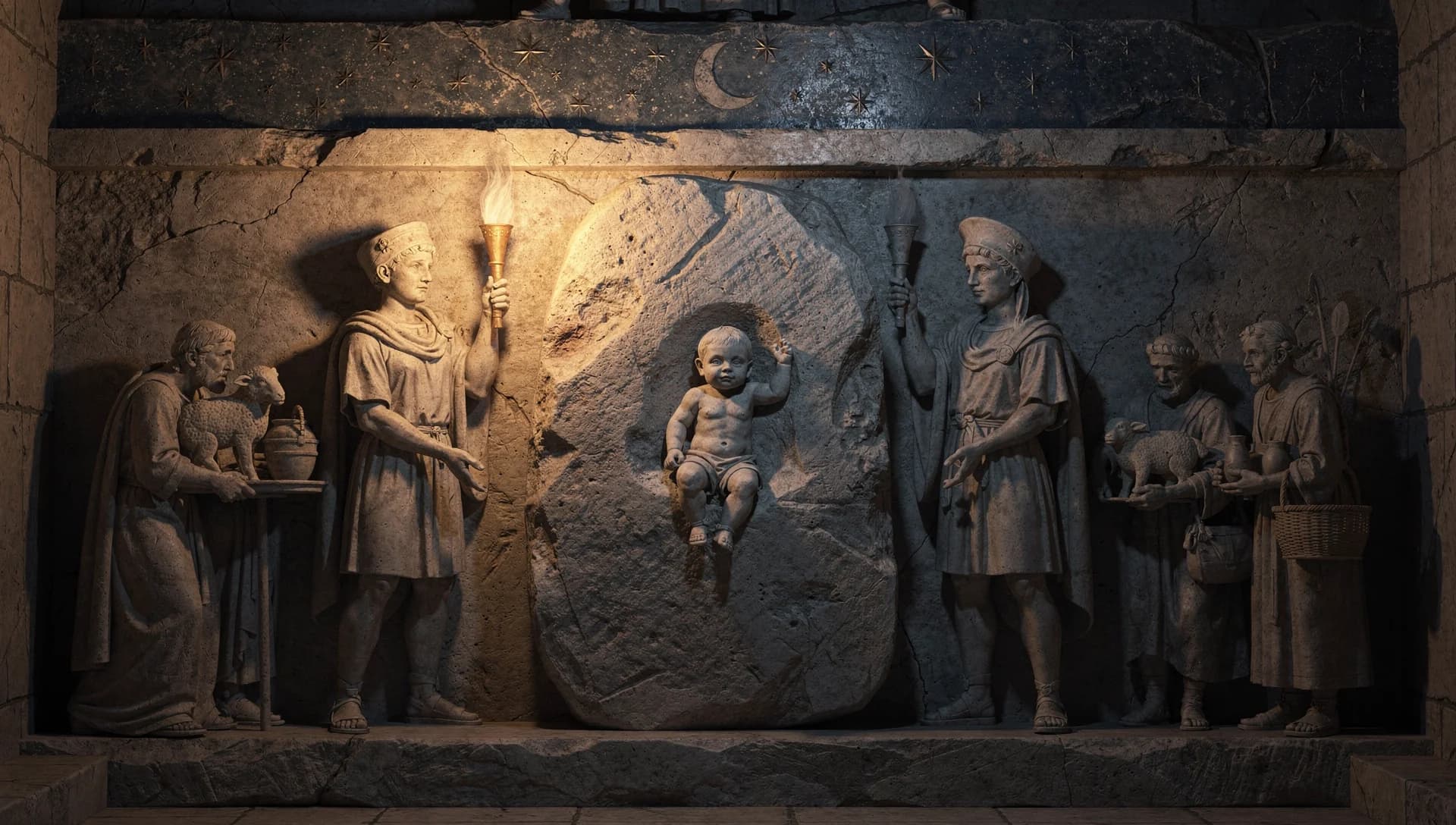
Shepherds and angels at Mithras' birth
 UB
UBMithraic birth legend as nativity source
Full Article
Read the deep-dive article on this connection
Mithraic birth legend as nativity source = Shepherds and angels at Mithras' birth
The Connection
The UB identifies the Mithraic birth legend, complete with attending shepherds and angelic messengers, as a direct source for the Christian nativity narrative. The Gospel nativity accounts drew on existing Mithraic imagery that was already familiar to the Roman audience. The shepherds, the miraculous birth, and the heavenly announcement all had Mithraic precedents.
UB Citation
Academic Source
Nabarz, The Mysteries of Mithras (2005); Ulansey, The Origins of the Mithraic Mysteries (1989)
Historical Evidence(Moderate evidence)
The UB states that the Gospel writers incorporated Mithraic birth imagery into their nativity accounts. Payam Nabarz documents the Mithraic birth legend: Mithras born from rock, witnessed by shepherds, accompanied by supernatural signs. David Ulansey traces the astronomical symbolism embedded in Mithraic iconography. While the direction of influence is debated in scholarship, the structural parallels between Mithraic and Christian birth narratives are well-documented.
Deep Dive
In the small lower-level chamber of the Mithraeum at Dura-Europos, on the Euphrates frontier of the Roman Empire, archaeologists in the 1930s recovered a fresco showing Mithras emerging fully grown from a great rock, his birth attended by the local Persian-styled priests of the cult. The rock-birth, the petra genetrix, was a standard element of Mithraic iconography across the empire, with variants showing shepherds witnessing the birth, animals attending the scene, and supernatural signs accompanying the emergence. The Mithraic nativity preceded the Christian by centuries (Mithraic iconography is well-attested by the early second century CE), and elements of the imagery, particularly the shepherds and the supernatural attendance, have parallels in the Lukan nativity narrative.
The Urantia Book at 98:7.4 places these mystery-cult contributions in the broader account of how the Christian gospel was synthesized from multiple sources during its early formation. The UB notes the Melchizedek teachings as the basic factor in all the religions of Occident and Orient that have arisen in the last four thousand years, with the various mystery cults contributing specific iconographic and narrative elements to what would become the Christian synthesis. The UB does not claim that the Christian nativity is fictional or that the Lukan account is fabricated. The UB claims that the Lukan narrative drew on existing iconographic vocabulary that was already familiar to the Roman audience, in order to present the actual historical bestowal of Christ Michael in terms that the surrounding culture could understand.
This is a more nuanced claim than either the strong skeptical position (Christianity copied Mithras) or the strong Christian apologetic position (the parallels are coincidental). The UB position is that the historical bestowal really happened, the gospel writers drew on available cultural materials to present it, and the Mithraic iconographic elements that surface in the nativity narratives are part of the cultural vocabulary the gospel writers were using. This is structurally analogous to the way any religious narrative is composed: real events are presented through the available cultural categories of the audience.
Payam Nabarz's 2005 The Mysteries of Mithras documents the Mithraic birth legend in detail, with Mithras born from rock, witnessed by shepherds, accompanied by supernatural signs (the dadophoroi or torch-bearers, the cosmic attendants). David Ulansey's 1989 The Origins of the Mithraic Mysteries traces the astronomical symbolism embedded in the iconography, with the rock-birth corresponding to the heliacal rising of the constellation Mithras represents. The shepherds in particular are striking parallels: the Mithraic iconography of shepherds witnessing the birth is unusual in the Greco-Roman religious vocabulary and is one of the more distinctive features of the cult. The Lukan inclusion of shepherds at the Christian nativity (Luke 2:8-20) is similarly distinctive and has been a focus of comparative analysis since the nineteenth century.
The structural fit is real but the parallel is more limited than skeptics often suggest. The shepherds, the supernatural attendance, and the cosmic-significance framing are paralleled. The specific theological framing (Christ as the bestowal Son of God, born of a virgin in fulfillment of prophetic expectation, in a particular historical location at a particular time) is distinctively Christian and is not paralleled in Mithraism. The historical anchoring (a real birth in a real location at a real time) is also distinctively Christian. The Mithras of the cult is a mythological figure; the Jesus of the gospels is a historical figure presented through partially mythological vocabulary.
The strongest counterargument is that the parallels are sometimes overstated by both skeptics and apologists, and the actual scholarly consensus is more cautious about direct iconographic borrowing. This is a fair point. The reply is that even the cautious scholarly consensus acknowledges some iconographic continuity between mystery-cult vocabulary and Christian nativity imagery, and the UB account provides a framework that accommodates the actual evidence: real historical bestowal, narrated through available cultural categories, with the categories themselves being partial preservations of underlying Salem-derived theological vocabulary.
What the parallel implies is significant for the contemporary believer's reading of the gospel nativity narratives. The narratives are not photographic documentation of historical events, nor are they fabricated mythology. They are theologically interpreted accounts of real historical events, presented through the available cultural and iconographic vocabulary of the first-century Roman world. The shepherds may or may not have been historically present; the angelic attendance is theologically meaningful but iconographically familiar; the broader narrative shape is informed by both Hebrew prophetic expectation and Greco-Roman cultural categories. The UB framework offers a way to read the nativity narratives as theologically serious without requiring them to be either fundamentalist literal history or skeptical mythology. The bestowal really happened. The narratives are interpretive presentations of the bestowal in terms the audience could understand.
For the contemporary reader of the gospels, this offers a more honest reading practice than either fundamentalist literalism or skeptical reduction. The narratives are doing real theological work. They are also drawing on the available cultural materials. Both facts are true, and the UB framework allows both to be honored.
Key Quotes
“1. The Melchizedek teachings, which are a basic factor in all the religions of Occident and Orient that have arisen in the last four thousand years.”
“Nabarz documents the Mithraic birth legend with Mithras emerging from rock, witnessed by shepherds, and accompanied by supernatural signs, in iconography well-attested across the Roman Empire by the early second century CE.”
“Ulansey traces the astronomical symbolism embedded in Mithraic iconography, including the rock-birth and the cosmic-attendance scene, as part of a sophisticated cosmological mystery-cult vocabulary.”
Cultural Impact
The pre-Christian iconographic vocabulary that fed into the Christian nativity narratives has shaped Western religious art and literature for two millennia. The shepherds at the manger, the angelic announcement, the cosmic-significance framing, the supernatural attendance at the birth, are all standard elements of Christian nativity iconography that have parallels in earlier mystery-cult traditions. Through the medieval cycle plays, the Renaissance nativity painting tradition (from Giotto through Caravaggio), the Baroque tradition (Rembrandt, Rubens), and the modern Christmas card vocabulary, the iconographic inheritance has been reproduced and elaborated continuously for nearly two thousand years. The Mithraic-influenced shepherds in particular have had long iconographic afterlife: nearly every visual representation of the nativity includes shepherds, even though the Lukan text gives them a relatively brief role in the broader narrative. Beyond Christian art, the dying-and-rising savior framework, the cosmic-significance birth narrative, and the supernatural-attendance imagery have shaped Western literary tradition's depictions of the heroic birth in countless contexts, from Arthurian romance through fantasy literature to contemporary cinema. The hero's journey vocabulary that Joseph Campbell systematized is, in significant part, the inherited mystery-cult vocabulary refracted through millennia of cultural transmission.
Modern Resonance
The discovery that Christian nativity imagery has Mithraic and other mystery-cult precedents has been used by skeptics to argue that Jesus is a recycled myth-figure rather than a historical person. The UB framework offers a more accurate diagnosis. Jesus is a real historical person whose actual bestowal life is documented in Part IV of the UB. The nativity narratives in the gospels are theologically interpreted presentations of his historical birth, drawing on available cultural and iconographic vocabulary to communicate the theological significance to a first-century Roman audience. The presence of mystery-cult iconographic elements in the nativity does not undermine the historical reality of Jesus; it reflects the theological work the gospel writers were doing to present that reality in their cultural context. For contemporary believers troubled by the parallels, the framework offers reassurance: the historical bestowal is real, the narrative dressing is partly cultural inheritance, and both can be true at once. For skeptics inclined to reduce Christianity to mythology-recycling, the framework offers a more accurate target for criticism: criticize the theological synthesis, not the historical bestowal.
Related Mappings
Zoroaster, Salem missionary descendant
= Zarathustra, founder of Zoroastrianism
Seven Master Spirits, supreme universe administrators
= Ahura Mazda + seven supreme gods (Amesha Spentas)
Lucifer rebellion, distorted memory of cosmic war
= Zoroastrian dualism (Ahura Mazda vs. Angra Mainyu)
Zoroastrian influence on Jewish theology
= Jewish heaven, hell, devils derived from Zoroastrianism
Related Articles
Where to next
The free newsletter. The research behind each piece, no spam.