
The Sky Father Who Could Not Be Seen: Caligastia and the Greek Ouranos
Greek cosmogony places Ouranos at the top of the divine hierarchy, the sky-father whose presence is felt but never directly witnessed. The figure arrived in Greece through Anatolian channels, originally as the Hittite Anu. The Urantia Book describes Caligastia in exactly this way: an invisible planetary ruler whose ongoing presence is a fact of cosmic record even after his exile.
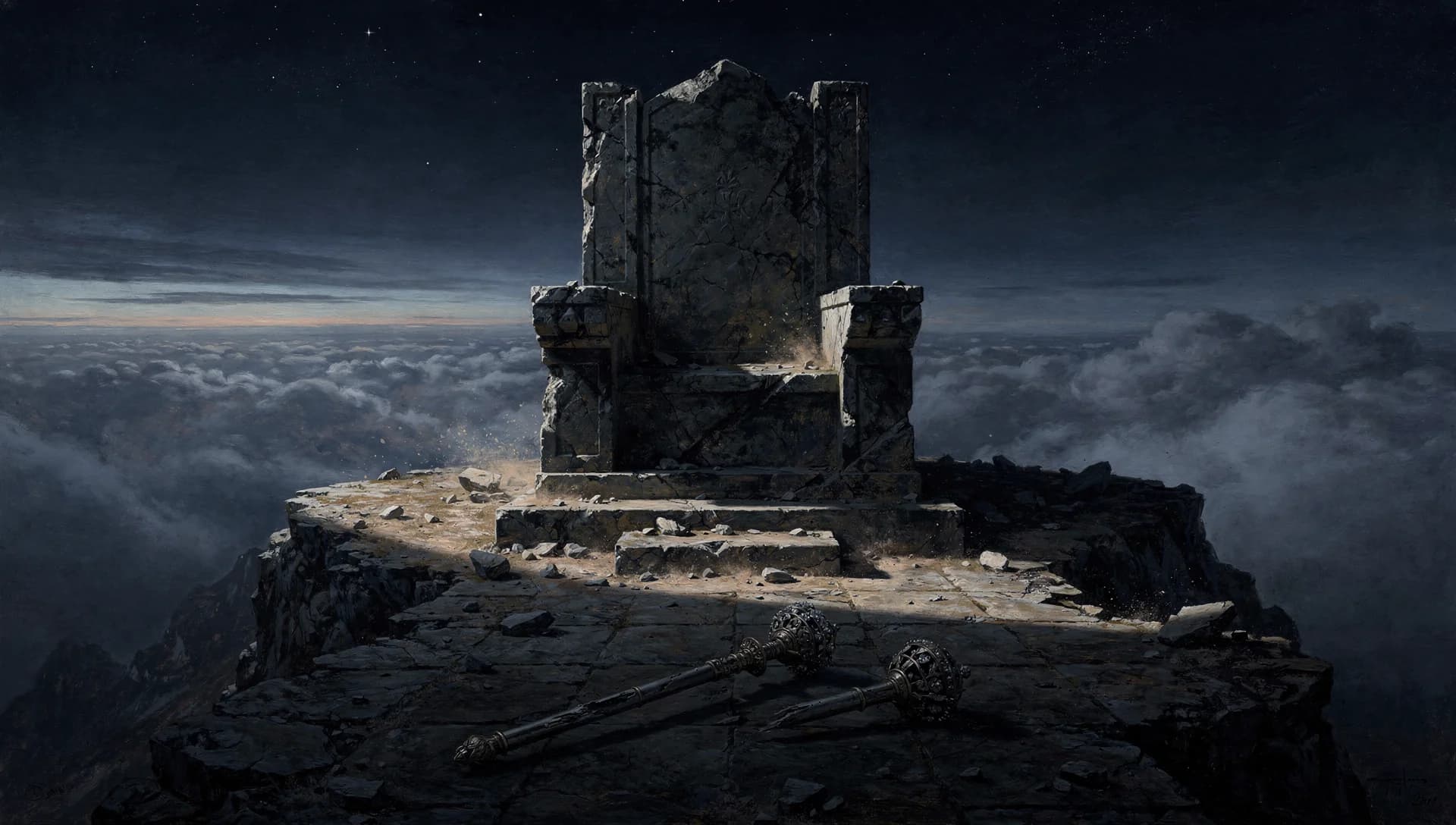
Caligastia, invisible sky ruler = Ouranos, Greek sky father (via Hittite Anu transmission)
This article expands on the decoder mapping. For the side-by-side card and quick reference, see the mapping page.
The Sky Father at the Top of the Hierarchy
The Greek cosmogony begins with sky and earth. Hesiod's Theogony (c. 700 BCE) places Ouranos, the personified sky, at the apex of the primordial order. He is the consort of Gaia. He is the father of the Titans, and through them the grandfather of the Olympians. He is never directly witnessed in Greek ritual practice; there are no major temples to Ouranos, no regular cult, no visible statuary. His role in the mythology is structural rather than devotional. He presides, distantly, and he is displaced early in the divine succession.
This structural remoteness is the first peculiarity. Greek religion otherwise invests enormous imaginative and ritual energy in the visible gods, the ones whose statues stand in the temples. Ouranos is exempt from this pattern. He is there, at the top, and he is never there in any sensible way.
The second peculiarity is the transmission. Walter Burkert's The Orientalizing Revolution (Harvard University Press, 1992) and Martin West's The East Face of Helicon (Oxford University Press, 1997) have documented that the Greek Ouranos is not a native Indo-European figure. He arrives in Greece via Anatolian intermediaries, most directly through the Hittite and Hurrian god Anu, whose Kumarbi Cycle mythology is preserved on tablets from Bogazkoy dated to the thirteenth century BCE. The figure's ultimate antecedent is the Sumerian An, the supreme sky-father, whose Mesopotamian cult described him as an "otiose deity," remote and unseen, present but non-intervening.
The companion article on Caligastia and An makes the structural case that An preserves a memory of Caligastia. If that is correct, the Hittite Anu inherits it, and the Greek Ouranos inherits it further. The figure of the invisible sky ruler at the top of the divine hierarchy, never witnessed but structurally essential, is a single mnemonic package transmitted westward through the Andite migrations, the Hurrian-Hittite literary matrix, and the Anatolian-Aegean cultural contact zone.
The Urantia Book describes the same invisible ruler in direct language.
What the Urantia Book Says
Caligastia arrived on Urantia as a Lanonandek Son, assigned to serve as Planetary Prince. The record is specific about his invisibility to ordinary mortals:
"THE advent of a Lanonandek Son on an average world signifies that will, the ability to choose the path of eternal survival, has developed in the mind of primitive man. But on Urantia the Planetary Prince arrived almost half a million years after the appearance of human will." (UB 66:0.1)
Caligastia's personal incorporation was not physical in the way the corporeal staff's bodies were physical. He and Daligastia were superhuman personalities whose presence on the planet was real but not directly visible to evolutionary mortals. They operated through the corporeal staff and through midway creatures. The Urantia Book provides a specific description:
"Caligastia was a Lanonandek Son, number 9,344 of the secondary order. He was experienced in the administration of the affairs of the local universe in general and, during later ages, with the management of the local system of Satania in particular." (UB 66:1.1)
After the rebellion, Caligastia did not leave the planet. His authority was revoked, but his presence persisted. He remained invisible, and he remained active as a disruptive influence, until the bestowal mission of Michael resolved the situation technically. The Urantia record is explicit that Caligastia's ongoing role as the invisible antagonist persisted from the time of his rebellion through the ensuing hundreds of thousands of years of planetary history, up to and beyond the appearance of Jesus, and that the residual conflict was only formally resolved by the Michael bestowal.
The structure the Urantia Book describes, an invisible supreme ruler on an administrative level above ordinary mortals, who once ruled in titular form, who is now remote and ineffective but still nominally present, is the structure Greek religion preserves as Ouranos.
What the Ancient Source Says
Hesiod's Theogony gives the first extensive Greek treatment of Ouranos. He is described as being engendered by Gaia as her equal partner, the "starry sky" who covered her "on every side" (Theogony 126-128). Their union produced the Titans. Ouranos is said to have imprisoned his children within Gaia until Cronus, with Gaia's help, castrated him with a sickle, ending his reign. After the castration, Ouranos withdraws to the distant upper regions and plays no further active role in the narrative.
The passivity is remarkable. Ouranos is the first supreme ruler in Greek cosmogony, yet he has no temple, no mythological adventures after his displacement, no cult presence, no iconography to speak of. He functions as a structural slot: the highest level of the pre-Olympian hierarchy, occupied by a figure whose defining attribute is that he is not present.
The Hittite parallel was first connected to the Greek narrative by Hans Gustav Güterbock in his study of the Kumarbi Cycle (Kumarbi: Mythen vom churritischen Kronos, Zürich, 1946). The Kumarbi narrative, preserved in thirteenth-century BCE Hittite translations of an older Hurrian original, opens with Anu as the supreme ruler. Anu is displaced by his vizier Kumarbi in a castration scene structurally identical to the Ouranos-Cronus episode in Hesiod. Güterbock and subsequent scholars have documented the transmission from Hurrian to Hittite to Greek as one of the clearest cases of direct mythological inheritance across the eastern Mediterranean.
The Hittite Anu is in turn adapted from the Sumerian An, whose remote and otiose character is catalogued in ORACC (Open Richly Annotated Cuneiform Corpus, University of Pennsylvania): "An seems to have always been regarded as rather remote from human affairs." Paul-Alain Beaulieu's The Pantheon of Uruk During the Neo-Babylonian Period (Brill, 2003) confirms the pattern: the supreme sky-father in Mesopotamian religion is, from the earliest attestations, characterized by a striking absence.
Why This Mapping Matters
The Greek Ouranos is a figure without a cult. He is at the top of the hierarchy and he is nowhere. That is the central oddity of the figure, and the major scholarly treatments from Jane Harrison's Prolegomena to the Study of Greek Religion (Cambridge, 1903) through Walter Burkert's Greek Religion (Harvard, 1985) have consistently noted it. Burkert's summary formulation is that Ouranos is a figure "invoked almost exclusively as an ancestor, never as an object of worship."
This peculiarity is exactly what the mapping from Caligastia predicts. A planetary prince whose rule is titular and whose actual presence is invisible to ordinary mortals, who is displaced from effective authority early in the dynastic sequence but whose structural slot persists in the cosmology, would seed exactly this kind of figure: the absent sky ruler whose name is remembered but whose worship is meaningless.
The transmission chain is well established in the academic literature. Mesopotamian An → Hurrian-Hittite Anu → Greek Ouranos. Each step loses content and preserves structure. The content lost is ritual relevance. The structure preserved is the invisible top of the hierarchy, displaced but never fully absent. The Andite migrations provide the mechanism by which the original memory, however broken, reaches Mesopotamia in the first place. Each subsequent transmission compresses and rearranges.
The mapping does not claim that Hesiod knew about Caligastia. It claims that the structural oddity preserved in the Greek figure is a downstream residue of the structural fact the Urantia Book records: that a planetary ruler who arrived about five hundred thousand years ago, and was displaced about two hundred thousand years ago, persisted as an invisible presence, and that the deep human memory of his displacement and continued existence would leave exactly this kind of fingerprint on subsequent religious cosmology.
Sources
- The Urantia Book, Paper 66 (The Planetary Prince's Staff), Paper 67 (The Planetary Rebellion). Urantia Foundation, first printing 1955. Cited passages: 66:0.1, 66:1.1.
- Hesiod. Theogony. Edition and commentary by M. L. West. Oxford University Press, 1966.
- Burkert, Walter. The Orientalizing Revolution: Near Eastern Influence on Greek Culture in the Early Archaic Age. Harvard University Press, 1992.
- Burkert, Walter. Greek Religion: Archaic and Classical. Harvard University Press, 1985.
- West, Martin L. The East Face of Helicon: West Asiatic Elements in Greek Poetry and Myth. Oxford University Press, 1997.
- Güterbock, Hans Gustav. Kumarbi: Mythen vom churritischen Kronos, aus den hethitischen Fragmenten zusammengestellt, übersetzt und erklärt. Europaverlag, 1946.
- Hoffner, Harry A. Hittite Myths. Second edition, Society of Biblical Literature, 1998.
- Beaulieu, Paul-Alain. The Pantheon of Uruk During the Neo-Babylonian Period. Brill, 2003.
- Harrison, Jane Ellen. Prolegomena to the Study of Greek Religion. Cambridge University Press, 1903.
Confidence and Evidence
- Confidence: INFORMED SPECULATION
- Evidence rating: MODERATE
- Basis: The structural oddity of the Greek Ouranos (supreme ruler without active cult, displaced but still nominally present, invisible by structural definition) matches the Urantia description of Caligastia. The documented transmission chain from Mesopotamian An through Hittite Anu to Greek Ouranos is an established result in Near Eastern and classical scholarship and supplies the mechanism.
Related Decoder Articles
- Caligastia, Planetary Prince = An / Anu, Supreme Sky Father
- Adamson + Ratta = Cronus + Rhea, Titan Parents
- Van, Loyal Corporeal Staff Member = Enki / Ea
By Derek Samaras
Connecting Articles
Caligastia and Anu: The Invisible Sky Ruler Who Could Not Be Seen
The Insider Who Betrayed: Caligastia and the Norse Loki
Not One Devil, Six Rebels: The Theological Confusion of Lucifer, Satan, and Caligastia
Sixty-Seven Children, Twelve Remembered: The Adamsonites and the Olympian Pantheon
The Newsletter
Get the research behind each piece
Free. New Urantia Book explorations, the sources behind the videos, and early looks. No spam, unsubscribe anytime.
Prefer video? Follow on YouTube and Facebook.
Delivered through Substack. You can also read past issues.