
The Forbidden Fruit Redeemed: The Apple, the Andites, and the Long Road to the Basque Cider House
The apple began as the fruit of fear, the icon of Thou shalt not. Follow it from the wild forests of the Tian Shan, along the Andite road, to the Basque cider house, and watch a symbol of prohibition become a fruit of fellowship.
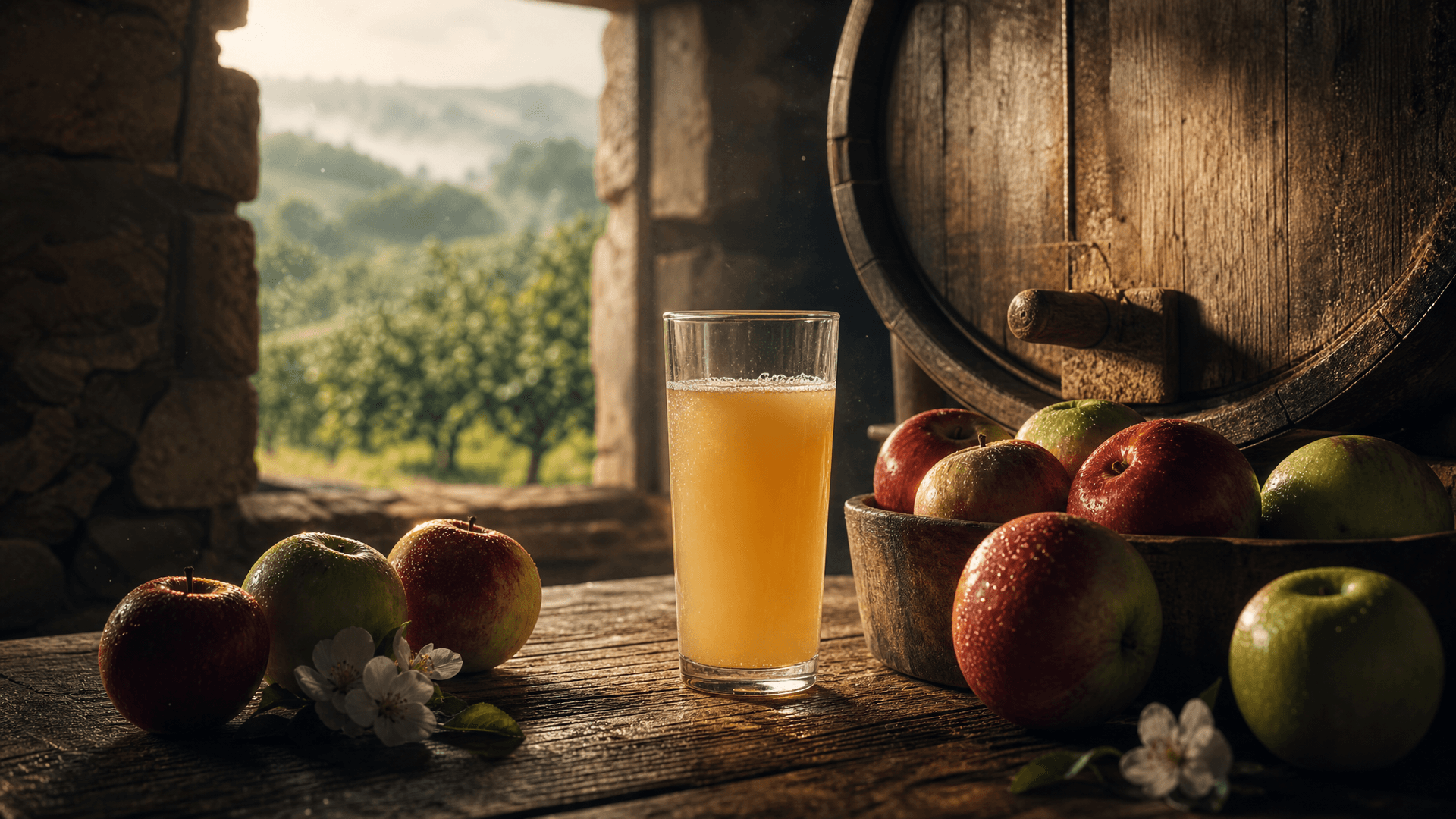
The Forbidden Fruit Redeemed
The Apple, the Andites, and the Long Road to the Basque Cider House
Derek Samaras | Urantia Book Network | June 2026
A Fruit With a Double Life
Pour a glass of natural Basque cider, the cloudy, still, slightly wild kind they pour from a barrel in a stone cider house in the hills behind San Sebastian, and you are holding the end of one of the longest stories on this planet. The apple in that glass has lived a double life. It started as the fruit of fear. It ended as the fruit of fellowship. And the road between those two lives runs straight through the people the Urantia Book praises more highly than any other human stock to walk the earth.
That is what I want to trace with you here. Not a tidy parable, but a real trail you can follow on a map, in a genome, and in the text of the revelation: the apple from the wild mountain forests where it was born, along the migration road of the Andites, down to the Atlantic coast where a remnant of the ancient blue race still presses it into cider to this day.
Look at the apple long enough and a pattern emerges. Let me show you.
Watch the cinematic companion to this article:
Part I: The Apple as Thou Shalt Not
We have to start with something that might surprise you, because it surprised me. The Urantia Book does not romanticize the apple. It demystifies it.
When the revelators describe the deep prehistory of human religion, they describe a long age of fear. Primitive people lived under the dread of bad luck and the terror of chance, and out of that dread they built a vast scaffolding of taboos, things you could not touch, could not say, could not eat. The apple was one of the very first casualties.
"Tree fetishes were a later development, but among some tribes the persistence of nature worship led to belief in charms indwelt by some sort of nature spirit. When plants and fruits became fetishes, they were taboo as food. The apple was among the first to fall into this category; it was never eaten by the Levantine peoples." (88:1.3)
Read that again. The apple was not forbidden because it was special and holy. It was forbidden because it was feared. And the revelators go further, drawing the picture out into something almost cinematic:
"Every primitive tribe had its tree of forbidden fruit, literally the apple but figuratively consisting of a thousand branches hanging heavy with all sorts of taboos. And the forbidden tree always said, 'Thou shalt not.'" (89:2.1)
That is the apple's first life. It is the icon of prohibition. The fruit that fear hung with a warning sign. Long before any sacred story about a garden, the apple was already the thing you were not allowed to have, the branch heavy with "Thou shalt not."
This matters for how we read the famous garden story too. The book of Genesis never names the fruit Eve and Adam are said to have eaten. The apple identification came later in Western tradition, partly through a Latin pun, since malus in Latin means both "evil" and "apple tree," and partly through medieval European art that simply painted it that way. The Urantia Book's account fits this beautifully. The apple was "literally the apple" in the primitive world of taboo, the universal forbidden fruit of a thousand tribes, figuratively a thousand branches of "Thou shalt not." The garden story inherited a symbol that fear had already made.
So the apple begins in shadow. Now watch it move toward the light.
Part II: The Fruit That Made People Feel Like Gods
There is a second thread we have to pick up before we can understand cider, and the revelators hand it to us directly. Fermentation, the turning of fruit and grain into something that alters the mind, also began in fear and awe.
"Plants were first feared and then worshiped because of the intoxicating liquors which were derived therefrom. Primitive man believed that intoxication rendered one divine. There was supposed to be something unusual and sacred about such an experience. Even in modern times alcohol is known as 'spirits.'" (85:2.1)
I love that the text catches the fossil hiding in our own language. We still call hard liquor "spirits," a word that carries the literal ancient belief that what was in the cup was a supernatural presence. The early world did not think a fermented drink was a beverage. It thought it was a doorway. Drunkenness was read as spirit possession, and the plants that produced these effects were venerated, even feared, as something more than plants. Tree worship, the revelators note, is "among the oldest religious groups" (85:2.3).
I want to be honest and careful here, because this is the Urantia Book Network and not a brewery's advertising. The text is not handing us a permission slip. It is showing us where the human relationship with fermentation came from, and it came from a confusion, the mistaken belief that an altered mind was a divinized mind. That is the cautionary note built into this whole story, and I am going to keep it in view. Real divinity does not arrive in a cup. It arrives, as the revelation teaches everywhere, through the indwelling presence of God and through doing the Father's will.
So hold both threads now. The apple is the forbidden fruit of fear. Fermentation is the false doorway of fear. Two shadows. And the people who are about to walk onto the stage are precisely the people the revelation credits with turning shadows into culture.
Part III: The Best Stock to Walk the Earth
Here come the Andites.
If you have read my earlier work on these pages, you know I keep returning to them, because once you understand who they were, you start seeing their footprints everywhere. The Andites were not a naturally evolved race. They were a synthesis, a blending of the violet race of Adam and Eve with the older Nodite peoples and the best of the evolutionary stocks.
"The Andite races were the primary blends of the pure-line violet race and the Nodites plus the evolutionary peoples... the term Andite is used to designate those peoples whose racial inheritance was from one-eighth to one-sixth violet. Modern Urantians, even the northern white races, contain much less than this percentage of the blood of Adam." (78:4.1)
And the revelators do not hold back in describing what this synthesis produced:
"The Andites were the best all-round human stock to appear on Urantia since the days of the pure-line violet peoples. They embraced most of the highest types of the surviving remnants of the Adamite and Nodite races and, later, some of the best strains of the yellow, blue, and green men." (78:4.3)
These were restless, adventurous, brilliant people. The text says they "never stopped until they had circumnavigated the globe and discovered the last remote continent" (78:4.6). They poured out of Mesopotamia in wave after wave, and here is the line that matters most for our apple:
"And to every nation to which they journeyed, they contributed humor, art, adventure, music, and manufacture. They were skillful domesticators of animals and expert agriculturists." (78:5.8)
Expert agriculturists. Skillful domesticators. That is the key turning in this whole essay, so let me slow down on it.
Part IV: Why the Apple Needed the Andites
Here is a fact about apples that most people never learn, and once you learn it, the Andite connection stops being poetic and starts being almost mechanical.
Apples do not breed true from seed.
Plant a seed from the best apple you have ever eaten and you will not get that apple back. You will get something wild, usually small, usually sour, genetically scrambled, nothing like the parent. Apples are what geneticists call extreme heterozygotes, which is a technical way of saying every apple seed is a genetic dice roll. The wonderful varieties we know, the ones worth pressing into cider, cannot reproduce themselves through their own seeds at all.
So how do you get a reliable apple? You cannot do it by chance. You have to do it on purpose. You have to take a living cutting from the tree you want and graft it onto the roots of another tree, joining them so the two grow as one. Every Honeycrisp on earth is a clone, a cutting of a cutting, carried forward by deliberate human hands. The cultivated apple is not a product of nature left alone. It is a product of intention, knowledge, and patience transmitted from one generation to the next. Grafting of fruit trees emerged roughly three thousand years ago, and the first detailed written description comes from Roman agricultural writers.
Now read what the Urantia Book says about the stage of civilization the Adamic and Andite peoples were meant to bring:
"The agricultural stage. This era was brought about by the domestication of plants, and it represents the highest type of material civilization. Both Caligastia and Adam endeavored to teach horticulture and agriculture. Adam and Eve were gardeners, not shepherds, and gardening was an advanced culture in those days. The growing of plants exerts an ennobling influence on all races of mankind." (68:5.9)
Adam and Eve were gardeners, not shepherds. The whole Adamic vocation was deliberate cultivation, the patient art of making plants better on purpose. And the revelators draw out exactly the temperament this kind of work builds in a people:
"Association with animals suggests struggle and force; association with plants instills patience, quiet, and peace. Agriculture and industrialism are the activities of peace." (68:5.11)
Do you see the convergence forming? The one fruit on earth that absolutely cannot exist without deliberate, transmitted, patient human cultivation is the apple. And the people the revelation names as the master agriculturists of the ancient world, the carriers of the gardener's art out of Mesopotamia and across the continents, are the Andites. The apple is, in a real sense, the signature fruit of exactly the kind of intentional horticulture the Adamic mission was sent to plant in the human race.
But it gets better, because we can put the apple and the Andites on the same map.
Part V: The Apple's Homeland Is the Andite Road
Where did the apple come from? Not the garden of legend. The literal, genetic birthplace of the fruit in your glass.
The answer is one of the most beautiful facts in botany. Every cultivated apple on earth descends primarily from a single wild species, Malus sieversii, and that wild apple still grows today in the mountain forests of the Tian Shan, in southeastern Kazakhstan, in the hills around the city of Almaty. The name Almaty itself comes from the local word for apple. Walk into those wild groves and you will find trees bearing fruit nearly indistinguishable from the apples in a modern supermarket, growing with no human help at all, the living ancestors of every orchard in the world. The great botanist Nikolai Vavilov traced the apple to that exact spot a century ago, and modern genome sequencing has confirmed him. The 2010 sequencing of the apple genome identified Malus sieversii of Central Asia as the progenitor of the domesticated apple, and later studies have filled in the picture, showing how the wild Tian Shan apple was carried west and crossed with the European wild crabapple along the way.
And how did it get carried west? Here the science and the revelation start singing in harmony. The researcher Robert Spengler, in his work on the Silk Road origins of our food, makes the case that the apple was not really domesticated in one place by one act. It was domesticated by movement. As people carried apples west out of Central Asia, they broke the genetic isolation of separate wild populations and crossed them, and that human-driven mixing is what produced the large, sweet, reliable fruit we know. The apple, in other words, was made by a migrating people moving along a trans-Eurasian road.
Now lay that over the Urantia Book's map of the Andites. The revelators tell us the Andite culture ran "from Mesopotamia through Sinkiang" (78:5.2), which is to say straight through Turkestan and the Tian Shan region, the apple's homeland, and that the Andites of Turkestan were among the great domesticators and movers of the ancient world. The wild apple's native range and the Andite migration corridor are not near each other. They are the same ground.
I have written before about the strange, persistent evidence along that corridor, the tall, long-skulled, tartan-clad mummies preserved in the dry sands of the Tarim Basin, the sophistication that seems to appear along this road and radiate outward. I will say here what I always say, and what the honest reader has to hold onto: the recent genetic work on those Tarim populations is complicated, and the 2021 study found the earliest of them to be a genetically isolated local people rather than simple migrants from the west. The picture is not settled, and I am not going to pretend it is. What I am pointing to is geography, the simple, checkable fact that the fruit and the people share a homeland and a road. That convergence is suggestive. It is not a proof. I would rather hand you a real question than a fake certainty.
But the road has an end, and the end is the heart of this story.
Part VI: The Blue Man at the End of the Road
Follow the Andites west, all the way west, past Mesopotamia, past Anatolia, across the Mediterranean, to the Atlantic edge of Europe. There the Andites met, and largely absorbed, an older and remarkable people: the blue race.
The blue man was one of the six colored Sangik races, and the revelators clearly held him in deep affection. He spread across the whole European continent and was, in their words, "the most aggressive, adventurous, and exploratory of all the evolutionary peoples of Eurasia" (78:1.8). His descendants are the people archaeology calls the Cro-Magnons. And listen to the specific gifts the text gives him, because they are about to matter:
"The blue men were hunters, fishers, and food gatherers; they were expert boatbuilders. They made stone axes, cut down trees, erected log huts, partly below ground and roofed with hides." (80:3.6)
Expert boatbuilders. Hold that.
The blue men were also, the revelation tells us, a people of unusual integrity. "The blue men were perfectly honest in all their dealings and were wholly free from the sexual vices of the mixed Adamites" (80:3.4). They were artists, hunters, sailors, and builders. And when the Andites came west, the two peoples blended, the gardener's art meeting the boatbuilder's vigor.
Most of the blue race was eventually absorbed and disappeared into the general European population. But not all of it. The revelators tell us exactly where a remnant held on:
"In the north the Andites, through warfare and marriage, obliterated the blue men, but in the south they survived in greater numbers. The Basques and the Berbers represent the survival of two branches of this race, but even these peoples have been thoroughly admixed with the Saharans." (80:9.11)
The Basques. A surviving branch of the ancient blue race, on the Atlantic coast, in the mountains where Spain meets France.
And the Basques, to this day, are one of the most distinctive peoples in Europe. Their language, Euskara, is a true isolate, related to no other living language on earth, a pre-Indo-European survivor that has held on while wave after wave of other tongues washed over the continent. They carry the highest frequency of Rh-negative blood of any population in the world. I want to be careful and fair here, the way I always try to be on these pages. Modern genetics paints the Basques as a genuinely distinct and unusually isolated people, though scholars debate exactly how to read that isolation, and the genetics neither prove the Urantia Book's claim nor were gathered to test it. But the resonance is real and worth sitting with. The revelation said, decades before any of this DNA was sequenced, that the Basques are a surviving branch of an ancient race. And the science independently finds them to be one of the most ancient, isolated, and distinctive populations in Europe. That is a convergence worth noticing.
Now bring the threads together. Because of all the things this surviving branch of the blue race is famous for, two of them are these: boats, and apples.
Part VII: The Cider House
The Basques are sailors. It is in everything about them. They were among the great whalers and cod fishermen of the Atlantic, crossing to Newfoundland and Labrador generations before most of Europe paid the New World any attention. At Red Bay, on the Labrador coast, there is a UNESCO World Heritage site that was a Basque whaling station in the 1500s, and a Basque galleon, the San Juan, that sank there in 1565 and was found again on the sea floor four centuries later. The blue man was an expert boatbuilder. His Basque descendants built ships that crossed an ocean. The revelation wrote the headline; history filled in the story.
And what did those ships carry in their holds? Cider. The historical records of Basque whaling voyages show enormous quantities of cider provisioned for the crews, hundreds of barrels loaded for a single long expedition. The Basque sailor and the Basque apple crossed the Atlantic together.
Because the other thing the Basques have always been is apple people. Their cider tradition, sagardoa, is one of the deepest in Europe, documented in writing for the better part of a thousand years. There are records of Basque apples and cider-making reaching back to the eleventh and twelfth centuries. A medieval Gipuzkoan charter is said to have barred imported cider until the local supply was drunk first. A sixteenth-century visitor called the Basque country "the land of the apple." And the tradition is alive right now, today, in the sagardotegi, the cider house, where every winter people gather around the great barrels, and someone calls out "txotx," and the crowd lines up to catch the bright stream of cider straight from the cask into the glass.
Sit with that image, because it is the resolution of everything we have traced.
The apple began as the forbidden fruit, the icon of "Thou shalt not," the branch hung with fear. Fermentation began as the false doorway, the cup mistaken for a god. Those were the apple's two shadows. And here, at the far western end of the Andite road, in the hands of the surviving children of the blue race that the Andites blended with, the shadows are gone. The forbidden fruit has become the shared cup. The taboo has become the toast. The fruit that fear once hung with a warning sign now hangs in an orchard above a stone cider house where neighbors gather in the dark of winter and pour for one another and laugh.
That is not prohibition. That is communion. The fruit of "Thou shalt not" became the fruit of "come, sit, drink with us." The apple was redeemed.
Part VIII: What the Apple Remembers, and What the Andites Lost
I want to close on the harder, quieter thread that runs underneath all of this, because the apple's story is also the Adamic story, and the Adamic story carries a real loss.
The Andites who carried the gardener's art across the world were the descendants of a mission that did not go as planned. Adam and Eve were sent to biologically and spiritually uplift the human race, and that program was cut short by what the revelation calls the default. I have written about the default at length elsewhere, and I want to be precise about it here, because precision is a form of respect. The default was not the "fall of man." The revelators are emphatic:
"Adam and Eve did fall from their high estate of material sonship down to the lowly status of mortal man. But that was not the fall of man. The human race has been uplifted despite the immediate consequences of the Adamic default." (75:8.1)
The default was never framed as wickedness. The text defines it carefully as a wrong technique chosen in pursuit of a right end, a departure from the divine plan rather than an act of evil intent. Eve, lonely and impatient on a hard, isolated world, reached for a shortcut to a good goal, and Adam, the text tells us plainly, "knew exactly what he was about; he deliberately chose to share the fate of Eve" out of love for his mate (75:5.2). It is one of the most human moments in the whole revelation. It is not a story about villains. It is a story about good people who tried to hurry the plan, and what it cost.
And here is the part that connects to our cider, the part I most want you to carry away. One of the things the full Adamic uplift was meant to establish, and one of the things the default cut short, was the elevation of women.
"The Adamites and Nodites accorded women increased recognition, and those groups which were influenced by the migrating Andites have tended to be influenced by the Edenic teachings regarding women's place in society." (84:5.5)
Adam, the text says simply, "endeavored to teach the races sex equality" (74:7.22). That was part of the gift. Where the Andites carried their influence, the standing of women tended to rise. Where that influence faded or never reached, women's long climb was harder, and the revelators note with unusual frankness that in the Occident "woman has had a difficult climb under the Pauline doctrines which became attached to Christianity" (84:5.6). The uplift of women was meant to be part of the Adamic inheritance, and the default meant it arrived only partially, carried unevenly along the same roads the apple traveled.
So when I lift a glass of that cloudy Basque cider, this is what I taste in it. I taste the long patience of the gardener's art that Adam and Eve were sent to teach. I taste the road of the Andites, who carried that art and so much else out of Mesopotamia and into the world, imperfectly, after a mission that broke. I taste the vigor of the blue man, the honest boatbuilder, whose children still press the fruit on the Atlantic shore. And I taste the quiet reminder that the gifts of that ancient uplift, the orchard, the equality, the peace that the revelators say the growing of plants instills in a people, came to us partial, carried by hands that had to improvise after the plan was cut short. We are drinking what was salvaged. And what was salvaged is genuinely good.
The apple remembers all of it. The fear and the fellowship. The shadow and the redemption. The plan and the default and the long patient work of carrying something beautiful forward anyway.
Pour a glass. Sit with someone you love. And taste the whole long road that brought the forbidden fruit home.
For the deeper history of the people at the center of this story, see The Andite Emergence and The Andite Migrations Out of Mesopotamia. For the agricultural mysteries the Adamic mission seeded into later tradition, see the decoder entry on the Adamic agricultural inheritance and the Eleusinian Mysteries. And for the full, compassionate account of the default and what it cost, see Why the Adamic Mission Defaulted and Cano and Eve's Default: The Real Story.
Connecting Articles

The Andite Migrations Out of Mesopotamia
The Woven World: Carpet, Thread, and the Loom of Eternity

The Three Noahs: A Builder's Son, a Winemaker, and a Story Assembled in Babylon
The Anointed Tree: The Olive, the Oil Press, and the Light of Gethsemane
The Newsletter
Get the research behind each piece
Free. New Urantia Book explorations, the sources behind the videos, and early looks. No spam, unsubscribe anytime.
Prefer video? Follow on YouTube and Facebook.
Delivered through Substack. You can also read past issues.