
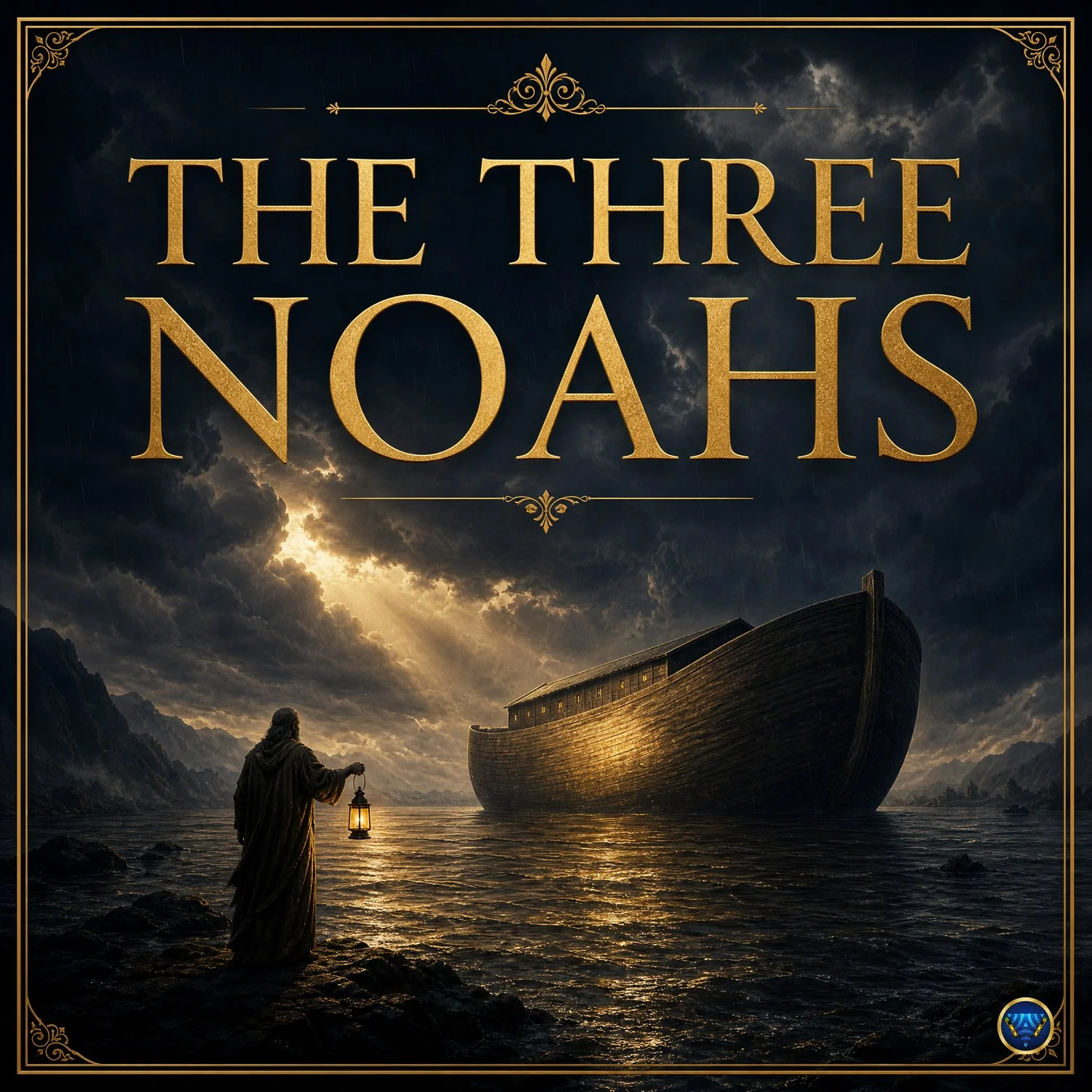
The Three Noahs: A Builder's Son, a Winemaker, and a Story Assembled in Babylon
Almost everyone knows the story of Noah and the ark. The Urantia Book offers something quieter and, in its way, more remarkable: two real men separated by roughly thirty thousand years who carried the same name, and a third figure assembled much later to join them.

The Story Everyone Knows
One righteous man. One great flood. One wooden ark, riding the water while the world drowns, every kind of animal saved by a single family. It is among the most widely told stories on earth, carried in scripture, in art, in the bedtime memory of whole civilizations.
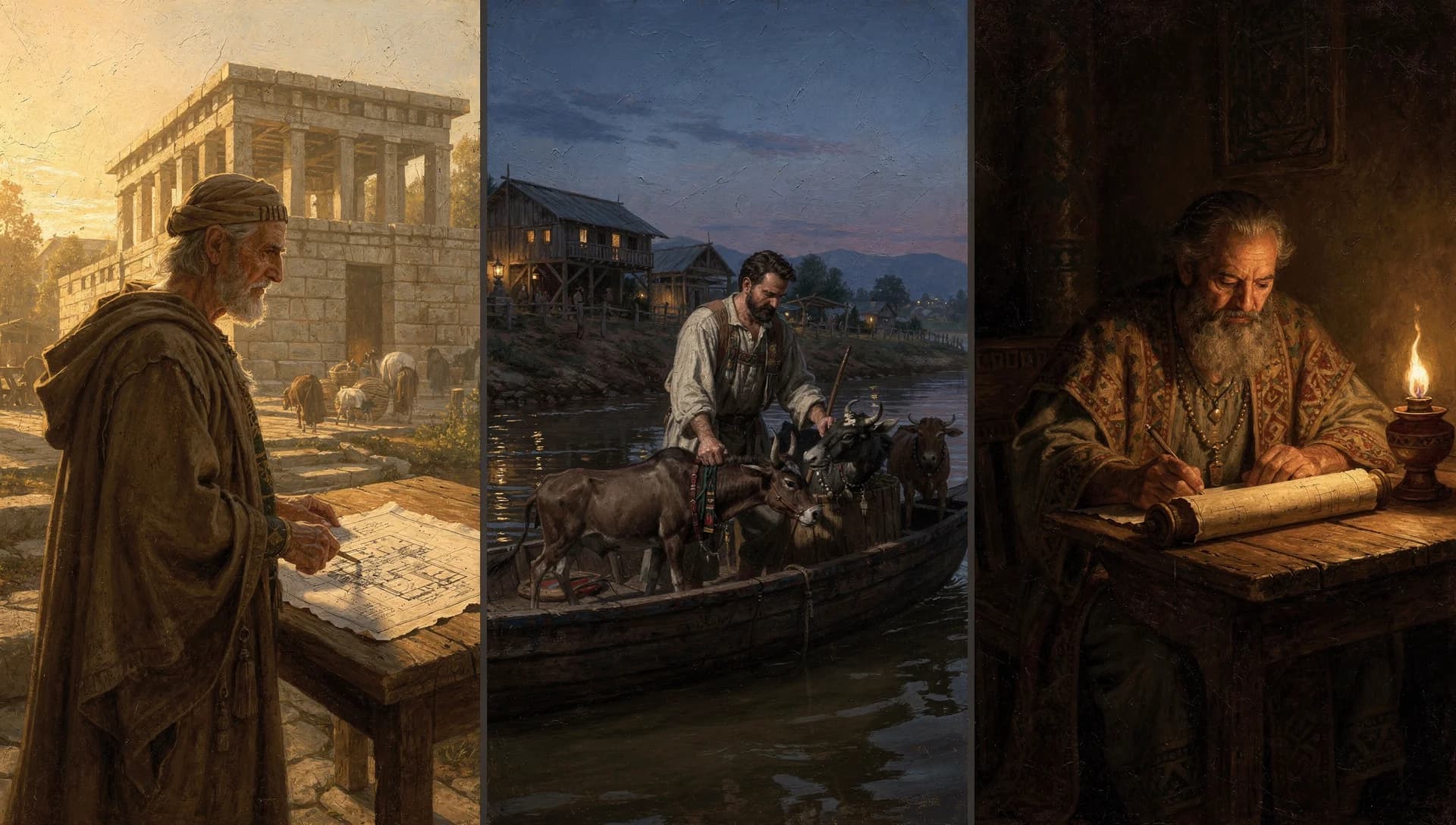
The Urantia Book does not ask us to throw that story away. It asks us to look underneath it, and what it shows there is in some ways more human and more interesting than the legend. Behind the famous account stand three distinct figures. Two of them were real men separated by roughly thirty thousand years (74:0.1, 78:7.2) who happened to carry the same name. The third was assembled long afterward, in exile, by scribes solving a genealogical problem. Three Noahs, braided so tightly over the centuries that they came down to us as one.
Watch the cinematic companion to this article:
The First Noah: The Builder's Son
The earliest Noah in the record never saw a flood at all. He belongs to the story of the first Garden of Eden, and he appears in a single sentence that is easy to read straight past.
To understand him you have to know what the Garden was. A survey committee spent nearly three years choosing its site and settled on a long narrow peninsula, almost an island, reaching westward from the eastern shores of the Mediterranean Sea (73:3.1-2). The work of preparing it was enormous, and the record is specific about where that work began.
"The first task was the building of the brick wall across the neck of the peninsula. This once completed, the real work of landscape beautification and home building could proceed unhindered." (73:4.2)
Someone drew those plans. Someone laid out the wall, the terraces, the irrigation channels, the stone temple at the center. That man is not named in the text, but his son is, and we meet him at the most significant moment in the Garden's history: the arrival of Adam and Eve, which the record places 37,848 years before A.D. 1934 (74:0.1).
"Soon after their awakening, Adam and Eve were escorted to the formal reception on the great mound to the north of the temple. This natural hill had been enlarged and made ready for the installation of the world's new rulers. Here, at noon, the Urantia reception committee welcomed this Son and Daughter of the system of Satania. Amadon was chairman of this committee, which consisted of twelve members embracing a representative of each of the six Sangik races; the acting chief of the midwayers; Annan, a loyal daughter and spokesman for the Nodites; Noah, the son of the architect and builder of the Garden and executive of his deceased father's plans; and the two resident Life Carriers." (74:2.5)
There he is. Noah, son of the architect and builder of the Garden, executive of his deceased father's plans. His father died with the work unfinished, and the son carried it through. When the world's new rulers arrived, he was one of the twelve chosen to stand on that mound and receive them.
This is the detail most retellings of the flood story never touch, and it is worth sitting with. The name Noah is already in the record tens of thousands of years before any ark, attached to a builder's son on a Mediterranean peninsula. Whatever else the later story became, the name itself is far older than the water.
The Second Noah: The Winemaker
Roughly thirty thousand years later (74:0.1, 78:7.2), and a considerable distance east, a second man carried the same name into a very different life.
To understand him, you have to understand his land. The plain of Mesopotamia, watered by the Tigris and the Euphrates, was a cradle of early civilization, and it lived with water the way coastal peoples live with tides. Then the ground itself began to change.
"For thousands of years after the submergence of the first Eden the mountains about the eastern coast of the Mediterranean and those to the northwest and northeast of Mesopotamia continued to rise. This elevation of the highlands was greatly accelerated about 5000 B.C., and this, together with greatly increased snowfall on the northern mountains, caused unprecedented floods each spring throughout the Euphrates valley. These spring floods grew increasingly worse so that eventually the inhabitants of the river regions were driven to the eastern highlands. For almost a thousand years scores of cities were practically deserted because of these extensive deluges." (78:7.2)
For roughly a thousand years the spring waters grew so destructive that a whole region of cities emptied out. A catastrophe on that scale leaves a mark on the memory of every people who survives it. And inside that long season of rising water lived an actual person, described with the detail of a real life rather than a legend.
"But Noah really lived; he was a wine maker of Aram, a river settlement near Erech. He kept a written record of the days of the river's rise from year to year. He brought much ridicule upon himself by going up and down the river valley advocating that all houses be built of wood, boat fashion, and that the family animals be put on board each night as the flood season approached. He would go to the neighboring river settlements every year and warn them that in so many days the floods would come. Finally a year came in which the annual floods were greatly augmented by unusually heavy rainfall so that the sudden rise of the waters wiped out the entire village; only Noah and his immediate family were saved in their houseboat." (78:7.5)
Here is the second Noah: not a mythic patriarch but a tradesman with a notebook. He tracked the river. He read its cycles. He took the unpopular step of telling his neighbors to build for the water and to be ready, and he was mocked for it. When the worst year finally came, his preparation saved his family. The wooden boat is real. The warning is real. The survival of one family is real. What the later legend added was scale.
The Third Noah: Assembled in Babylon
The third Noah was made rather than born, and the record tells us when and why. Nearly five thousand years later (78:7.3), during the Babylonian captivity, Hebrew scholars set out to trace their people's lineage all the way back to the beginning. They ran into a genealogical problem, and they solved it with a storyteller's instinct.
"Almost five thousand years later, as the Hebrew priests in Babylonian captivity sought to trace the Jewish people back to Adam, they found great difficulty in piecing the story together; and it occurred to one of them to abandon the effort, to let the whole world drown in its wickedness at the time of Noah's flood, and thus to be in a better position to trace Abraham right back to one of the three surviving sons of Noah." (78:7.3)
The flood memory of the region came with a landscape attached, and the sacred high place of the northern highlands was drawn in along with it.
"Mount Ararat was the sacred mountain of northern Mesopotamia, and since much of your tradition of these ancient times was acquired in connection with the Babylonian story of the flood, it is not surprising that Mount Ararat and its region were woven into the later Jewish story of Noah and the universal flood." (77:4.12)
A local flood and a local hero became, in this telling, the reset point of all humanity. The wine maker of Aram, the memory of the waters, the mountain, and a name already ancient in the record were merged, given the lifespan of a patriarch, and set at the head of a clean line running back to Adam. It was an act of editing in the service of a genealogy.
What the Record Says About the Waters
This is the line that gives the whole account its clarity, offered calmly and without heat:
"The traditions of a time when water covered the whole of the earth's surface are universal. Many races harbor the story of a world-wide flood some time during past ages. The Biblical story of Noah, the ark, and the flood is an invention of the Hebrew priesthood during the Babylonian captivity. There has never been a universal flood since life was established on Urantia. The only time the surface of the earth was completely covered by water was during those Archeozoic ages before the land had begun to appear." (78:7.4)
The waters that covered the whole earth belong to the deep geologic past, long before there was anyone to remember them. The flood that entered scripture was real, but it was regional, and the man at its center was a careful tradesman of the river country rather than the sole survivor of a drowned planet.
The floods themselves did leave a lasting mark on history. They closed an age.
"These floods completed the disruption of Andite civilization. With the ending of this period of deluge, the second garden was no more." (78:7.6)
Why the Layers Matter
It would be easy to read all this as subtraction, as a story being taken away. It is closer to the opposite. The legend gave us one enormous figure standing alone against a drowning world. The fuller account gives us two men we can actually stand beside.
One of them inherited his father's unfinished plans and finished them, and was standing on the great mound at noon when the world's new rulers arrived. The other watched a river for a lifetime, wrote down what he saw, warned people who laughed at him, and was ready when the water finally came. Both were builders in their way. Only one of them saw his work completed. The other left behind nothing but a warning that went unheeded and a family that lived.
Seen this way, the three Noahs are not a contradiction to be resolved. They are strands that time pressed into one. The builder's son earned his place in the record. The wine maker of Aram earned his by paying attention. The scribes of Babylon, doing their best to connect their nation to its origins, gave the memory the shape it has carried ever since.
The story is still worth telling. It simply has more truth in it than one ark can hold.
This article accompanies the Urantia Book Network video "There Were Three Noahs." The Garden reception is found in Paper 74, section 2; the Garden site and its wall in Paper 73, section 3 and section 4; the flood account in Paper 78, "The Violet Race After the Days of Adam," section 7; and the Mount Ararat tradition in Paper 77, section 4. Every direct quotation from the Urantia Book is verbatim from the cited paragraph, checked against the canonical text; readers are warmly encouraged to read the surrounding passages for themselves.
Derek Samaras | Urantia Book Network | August 2026 | urantiabooknetwork.com
Connecting Articles

The Andite Migrations Out of Mesopotamia

The Forbidden Fruit Redeemed: The Apple, the Andites, and the Long Road to the Basque Cider House

The Submerged Peninsula: A Geophysical and Textual Case for the Levantine Location of the First Eden
Three Noahs, One Story: The Composite Noah of Genesis
The Newsletter
Get the research behind each piece
Free. New Urantia Book explorations, the sources behind the videos, and early looks. No spam, unsubscribe anytime.
Prefer video? Follow on YouTube and Facebook.
Delivered through Substack. You can also read past issues.