
 Mythic
Eleusinian Mysteries: the grain-goddess and the secret of cultivated life
 UB
UBAdamic agricultural inheritance and the grain teaching
Full Article
Read the deep-dive article on this connection
Adamic agricultural inheritance and the grain teaching = Eleusinian Mysteries: the grain-goddess and the secret of cultivated life
The Connection
The UB names the Eleusinian mysteries at 98:2.10 as "a Greek version of the worship of fertility" that grew up within the Olympian pantheon after the Salem missionary influence had been diluted. The mysteries centered on Demeter and Persephone, the grain-mother and her daughter, and on the sacred knowledge of cultivated agriculture as a gift from the gods. The UB records that the Adamites brought advanced agriculture to the ancient world, and that the memory of agriculture as a divinely-given rather than independently-discovered art was preserved at Eleusis in sacramental form.
UB Citation
UB 98:2.10, 76:4 (Adamic agriculture)
Academic Source
Burkert, Ancient Mystery Cults (1987); Kerenyi, Eleusis: Archetypal Image of Mother and Daughter (1967)
Historical Evidence(Strong evidence)
The UB directly names the Eleusinian mysteries as a degraded Salem derivative. Walter Burkert's Ancient Mystery Cults documented Eleusis as the oldest and most prestigious of the Greek mysteries, centered on the disclosure of a single sheaf of grain as the culminating revelation. Carl Kerenyi traced the Demeter-Persephone mythology to pre-Hellenic agricultural religion. The combination of grain-as-gift theology and sacramental initiation matches the UB pattern of "Salem teaching corrupted into ritual mystery" with unusual clarity.
Deep Dive
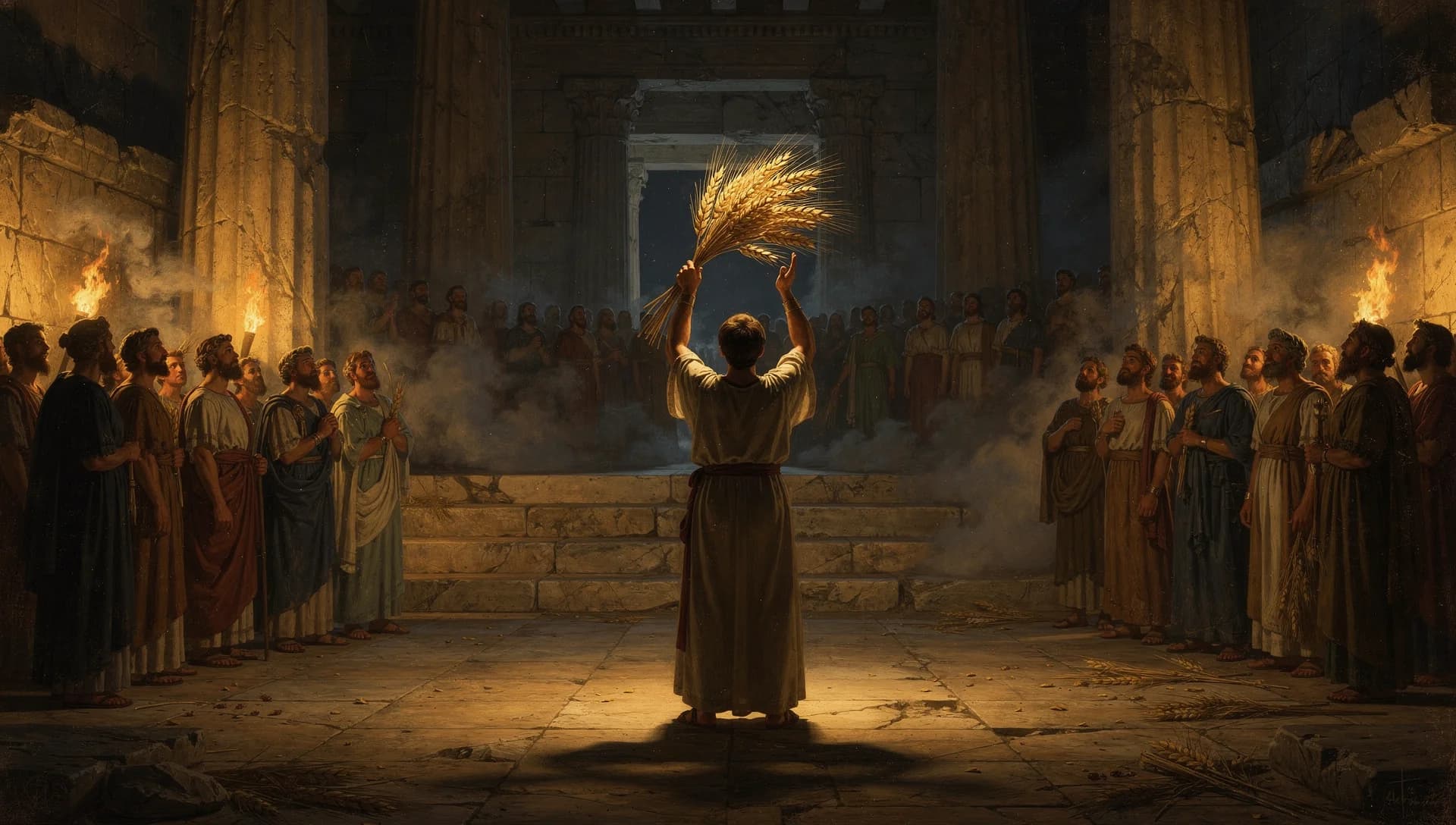
For nearly two thousand years, from the late Bronze Age until the closing decree of Theodosius in 392 CE, the most prestigious religious initiation in the Greek world took place at Eleusis, a small town fourteen miles west of Athens. Initiates walked the Sacred Way from the Athenian Eleusinion at the foot of the Acropolis to the Telesterion at Eleusis, fasting, drinking the kykeon (a barley-and-mint-and-pennyroyal preparation), and entering the great hypostyle hall where, in the climactic moment of the rite, the hierophant displayed something to them. What was displayed has been the subject of two thousand years of scholarly speculation: a sheaf of grain, according to one ancient tradition (Hippolytus); a vision of Demeter and Persephone reunited, according to another; a more direct experience of the divine in agricultural form, according to others. The initiates were sworn to secrecy. They kept it. The mystery is not a literary mystery to be decoded; it is a real ancient ritual whose central content was successfully hidden by the participants themselves.
The Urantia Book at 98:2.10 names the Eleusinian mysteries as a Greek version of the worship of fertility that grew up within the Olympian pantheon after the Salem missionary influence had been diluted. The placement is structurally significant. Paper 98 is tracking how Salem-derived teaching survived in attenuated form within Greek philosophical religion until the common-people demand for personal salvation drove the rise of the mystery cults. Eleusis is named alongside Dionysian nature worship and the Orphic brotherhood as one of the three principal mystery streams of classical Greece. The judgment is mixed: the mysteries preserved real religious depth that the philosophical religion lacked, but the price was a regression into ritualism that obscured the underlying simple Salem teaching of salvation by faith.
Walter Burkert's 1987 monograph Ancient Mystery Cults made the case that Eleusis was the oldest and most prestigious of the Greek mysteries, with origins reaching back to the Mycenaean period. Carl Kerenyi's 1967 study Eleusis traced the Demeter-Persephone mythology to pre-Hellenic agricultural religion. Both scholars agree on the structural core of the rite: the Mother grieves, the Daughter descends to the underworld and returns, the grain is the symbol of the cycle, the initiate participates in the cycle and is promised something beyond the death of the body. Pindar wrote that blessed is he who has seen these things before going beneath the earth, for he knows the end of life and he knows its god-given beginning. Cicero, who was himself an initiate, said in De Legibus that Eleusis taught him not only how to live with joy but how to die with hope.
The structural match with the UB account is precise on three points. First, the agricultural element. The UB records that Adam and Eve, the planetary uplifters, brought advanced agriculture to the ancient world, including the cultivation of grains. The teaching of agriculture as a gift from the gods, rather than as a human invention, is a real historical memory of a real Adamic intervention that preserved cultivated crops through the late Pleistocene transition. The Eleusinian centrality of grain as the sacramental focus, the disclosure of the sheaf as the culminating revelation, fits the UB account of Adamic agriculture as a gift to humanity, not an autonomous evolutionary development. Second, the mother-daughter divine pair. Eve and her female descendants in the Adamic line played a real teaching role in the early Mediterranean basin, and the memory of a divine mother and daughter pair in the agricultural tradition fits this. Third, the soteriological element. The Eleusinian initiate is promised something beyond bodily death, a personal continuation, an enrichment of the post-mortem state. This is the Salem teaching of personal survival in fragmentary ritual form.
The strongest counterargument is that Eleusis is a homegrown Greek cult with continuous Mycenaean and pre-Mycenaean roots, and no Salem mediation is needed to explain it. The reply is that the structural specifics, particularly the personal-survival theology and the grain-as-divine-gift framework, are not generic agricultural religion. They appear in concentrated form in the Mediterranean basin precisely where Salem missionary activity had been densest. The UB account does not say Eleusis was Salem invented; it says Eleusis was an Adamic-agricultural-tradition cult that preserved, in degraded ritual form, real elements of Salem missionary teaching that had been transmitted into Greek religion over the preceding centuries.
What the parallel implies is that the Eleusinian secret, whatever it was at the level of ritual content, was carrying real freight. The initiates were not deluded. They were participating in a fragmentary preservation of real teaching about real divine intervention in human agricultural and spiritual history. The closing of Eleusis by Theodosius marked the end of one of the longest-running fragmentary preservations of Salem-derived teaching in the ancient world. The UB account places this loss in its proper context: Eleusis preserved enough of the underlying Salem framework to be worth preserving, and the corruption was great enough that its replacement by Christianity was not a tragedy.
Key Quotes
“The Eleusinian mysteries grew up within the Olympian pantheon, a Greek version of the worship of fertility; Dionysus nature worship flourished; the best of the cults was the Orphic brotherhood, whose moral preachments and promises of salvation made a great appeal to many.”
“Burkert documents Eleusis as the oldest and most prestigious of the Greek mysteries, with the climactic ritual centering on the disclosure of a sheaf of grain and the personal soteriological promise of a blessed afterlife to those properly initiated.”
“Kerenyi reconstructs the Eleusinian mythology around the Demeter-Persephone mother-and-daughter pair, with the grain cycle and the descent-and-return of the daughter forming the structural core of the rite.”
Cultural Impact
The Eleusinian mysteries shaped Western intellectual and religious history far beyond their classical heyday. Cicero, Aristides, and Plutarch all wrote in praise of the rite as the spiritual high point of their lives, and through them the testimony entered the Christian Latin tradition that would compare and contrast pagan with Christian mystery. The grain-as-sacramental-substance pattern fed directly into the Christian Eucharistic framework: the Last Supper's bread, blessed and shared, occupies the structural slot the Eleusinian sheaf had occupied for a thousand years before. The mother-and-daughter soteriological pair is one of the deepest substrates of Western religious imagination, surfacing in the Marian-Magdalene devotional pair of medieval Christianity, in the Jungian archetype of the Demeter-Kore, and in the second-wave feminist recovery of goddess-centered spirituality. Beyond the Christian channel, Eleusis fed into the early modern occult revival, with the Hermetic and Rosicrucian traditions claiming Eleusinian inheritance, and into the twentieth-century academic study of religion through Frazer, Harrison, and the Cambridge Ritualists. Carl Ruck, R. Gordon Wasson, and Albert Hofmann's 1978 The Road to Eleusis proposed that the kykeon contained ergot-derived psychoactive compounds, opening a still-controversial conversation about psychedelic religion in the ancient world that has had significant cultural influence.
Modern Resonance
The Eleusinian mysteries occupy a particular place in contemporary spiritual seeking. Romantic poets like Keats found in Eleusis a model of religion of the imagination. Jungian depth psychology found in the Demeter-Persephone myth a primary archetype of feminine descent and return. The ecospiritual movement finds in Eleusis a model of agricultural-cosmic religion that does not require a sky-god. The psychedelic-spirituality movement finds in the Ruck-Wasson-Hofmann ergotic kykeon hypothesis a precedent for sacred plant use. Each of these readings preserves a fragment of what the actual mystery may have carried, and each is partial. The UB framework offers a more comprehensive reading: Eleusis was preserving, in degraded ritual form, real Adamic-agricultural teaching combined with real Salem-derived survival theology. The mystery is not infinitely deep. It is finitely and specifically deep, anchored to historical events that the UB makes available for the contemporary reader. The Demeter-Persephone myth becomes, in this frame, the cultural memory of the Adamic intervention in human agriculture combined with the Salem teaching of post-mortem survival, transmitted to us in the form a Greek peasant farmer could understand and re-perform annually.
Related Mappings
Salem teaching corrupted into dying/rising god cult
= Cybele and Attis, mother-son mystery religion
Day of Attis' death, pre-Christian sacred calendar
= "Black Friday," the original day of mourning before Easter
Pre-Christian mother-goddess cult in Rome
= Mother of God temple on the site of St. Peter's Basilica
Paul's composite Christianity
= Jewish morality + Greek philosophy + mystery cult ritual
Related Articles
Where to next
The free newsletter. The research behind each piece, no spam.