
The Anointed Tree: The Olive, the Oil Press, and the Light of Gethsemane
One tree has been crushed for its light since the dawn of civilization. It gave the world its sign for peace, its very word for the Messiah, and the silent stage for the Master's last free hours. Follow the olive from the first oil press to the garden whose name means press of oils.
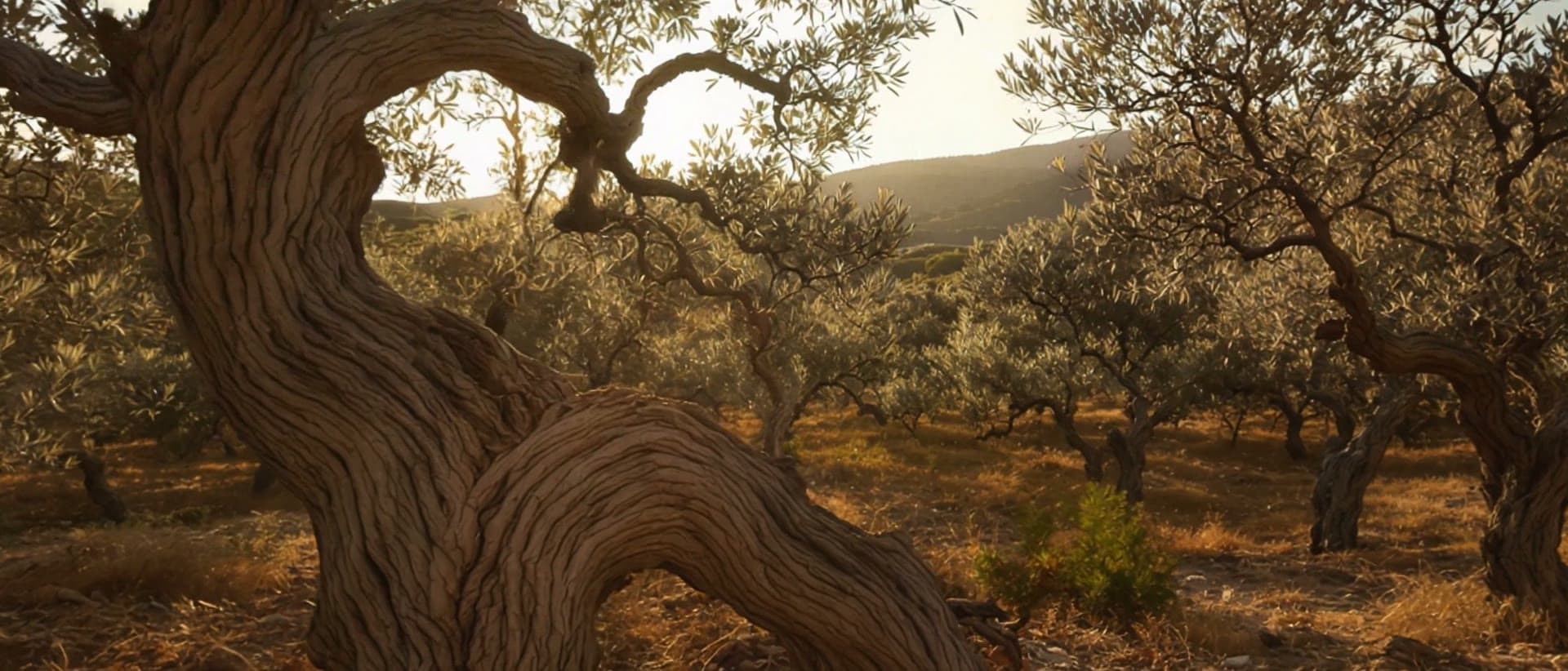
The Anointed Tree
The Olive, the Oil Press, and the Light of Gethsemane
Derek Samaras | Urantia Book Network | June 2026
A Stone in the Moonlight
There is a sentence in the Urantia Book that I have never been able to read quickly. It is short, plain, and almost unbearable once you understand where it stands in the story. On the last free night of his life, after the supper, after the final prayer with his friends, after the agony among the trees, Jesus walked a little way down the slope and waited.
"Jesus sat down, alone, on the olive press, where he awaited the coming of the betrayer, and he was seen at this time only by John Mark and an innumerable host of celestial observers." (183:0.5)
Sit with the geography of that for a moment. The garden was called Gethsemane. The seat was an olive press. The man was the one his followers called the Christ, which means the anointed one, the one touched with oil. And in a few minutes the torches would come up the hill, and he would be taken and crushed by the events of the next day as surely as any olive is crushed under stone. Every word in that scene is an olive word. The whole long history of one tree had been quietly converging on that stone for thousands of years.
That is the trail I want to walk with you here. Not a sermon, but a real history you can follow in the soil, in the language, in archaeology, and in the text of the revelation: the olive, from the wild groves where it was first gathered, through the press that gave the ancient world its light, up the mountain that bears its name, into the orchards of Bethany where a dead man was called back to life, and finally to that stone in the moonlight. The olive is one of the oldest friends the human race has. By the end I think you will see that it is also one of the deepest symbols the revelation ever let stand without explaining, because it did not need explaining. It only needed to be noticed.
Let me show you.
Watch the cinematic companion to this article:
Part I: The Oldest Friend
Start with the tree itself, because almost everything people believe about where the olive came from is half legend.
The wild ancestor of every cultivated olive is the oleaster, a tough, often spiny shrub of the Mediterranean scrublands that bears small, bitter, oil-poor fruit. Somewhere in the eastern Mediterranean, in or near the Levant, human beings turned that wild shrub into the orchard tree we know. The scholarly consensus, built from both archaeology and genetics, places the primary domestication of the olive in that eastern corner of the sea roughly six thousand years ago, with the dominant cultivated lineages most likely originating along the country that is now the border between northwestern Syria and southeastern Turkey. From there cultivation spread west and south in waves, carried by the Bronze Age trading peoples, then by Phoenician and Greek colonists, and finally industrialized by Rome across nearly the whole basin.
The oldest physical evidence of people actually making olive oil is astonishing, and it sits underwater. Off the Carmel coast south of Haifa, at a submerged Neolithic site called Kfar Samir, archaeologists have recovered thousands of crushed olive stones with the pulp still clinging to them, heaped in pits as the waste of oil extraction. These deposits date to roughly seven and a half thousand years ago. The stones are wild in shape, which tells us something beautiful: people were gathering and pressing wild olives for their oil for centuries before they ever planted an orchard. The friendship came first. The cultivation followed.
Now, there is a story you may have heard, and it is worth handling honestly, because it is the kind of thing that gets repeated until it sounds like fact. A museum in Tunisia, the Zaitounah olive museum, is the source of a claim that circulated through a 2004 news report and has lived online ever since: that the olive was brought into Palestine from Armenia around 4000 BC. It is a lovely, tidy origin story, and I understand why it spread. But the careful evidence does not support it. The archaeology of olive oil is densest in the Levant itself, not imported into it. The genetics point to eastern Mediterranean wild stock, not the Armenian highlands. And the olive is a creature of warm, dry Mediterranean winters; it simply cannot survive the hard continental cold of the Armenian plateau, which is why olives are not native there and are only now being trialed commercially. What is true, and worth crediting warmly, is that Armenia holds a genuinely ancient agricultural distinction of its own. The oldest known winery on earth, the Areni-1 cave, sits in Armenia and dates to almost exactly that 4000 BC horizon. Armenia's deep gift to the world was the vine, not the olive. The two stories simply got braided together somewhere in the retelling.
Here is where the revelation quietly enters. The Urantia Book has very little to say about the olive by name, but it has a great deal to say about the kind of work the olive represents, and it ranks that work near the summit of what lifts a world. When the revelators describe the stages by which a civilization climbs, they place the deliberate cultivation of plants at the top.
"The agricultural stage. This era was brought about by the domestication of plants, and it represents the highest type of material civilization. Both Caligastia and Adam endeavored to teach horticulture and agriculture. Adam and Eve were gardeners, not shepherds, and gardening was an advanced culture in those days. The growing of plants exerts an ennobling influence on all races of mankind." (68:5.9)
And they go further, describing the very temperament that patient cultivation builds into a people.
"Association with animals suggests struggle and force; association with plants instills patience, quiet, and peace. Agriculture and industrialism are the activities of peace." (68:5.11)
Read those two passages with the olive in mind and they take on a particular weight. No tree on earth demands more patience than the olive. It can take a decade to begin bearing well, and a generation to mature, and then it can outlive thirty generations of the families who tend it. To plant an olive is to plant for your grandchildren and theirs. It is the purest expression of exactly the patient, peace-instilling, forward-looking cultivation that the revelation says ennobles a race. The revelators tell us that tilling the soil is so fundamental that it appears everywhere life advances: "Agriculture is universal on all atmospheric worlds; tilling the soil is the one pursuit that is common to the advancing races of all such planets" (49:4.5). The olive is this principle made into wood and oil. It is the tree of the long view.
There is a deeper thread here, and the Urantia Book lets us follow it. Adam and Eve were the parents of what the revelators call the violet race, a people brought to a young world to uplift and to cultivate it. "This is the origin of the violet race on the inhabited worlds" (51:3.3). Their home, the second garden in Mesopotamia, became "the cradle of civilization for almost thirty thousand years," and from it their descendants, blended over the ages with the older Nodite and Sangik peoples into the stock the revelation calls the Andites, carried the gardener's art out to the ends of the earth (78:0.1).
The revelators describe these Andites in terms that matter for our tree. Restless and brilliant, they were above all cultivators.
"They were skillful domesticators of animals and expert agriculturists... And so the culture of Mesopotamia quietly spread out over Europe, India, China, northern Africa, and the Pacific Islands." (78:5.8)
One band of them sailed early to the heart of olive country. "About 12,000 B.C. a brilliant tribe of Andites migrated to Crete," skilled mariners who "carried on as herders and agriculturists" (80:7.2). Crete, of all places, is one of the great homelands of the olive, where a gnarled tree at the village of Vouves has been bearing fruit for the better part of two thousand years and perhaps far longer.
So when we ask where the patient art of cultivation truly came from, the revelation does not hand us a single museum legend about an Armenian olive. It hands us a people: the children of the violet race, and the Andite agriculturists who carried the gardener's vocation across the world. It is the same impulse that the apple followed along its own long road, traced in the companion to this piece, The Forbidden Fruit Redeemed. The olive is one more fruit of that ancient and patient art.
Part II: The Press
To understand the rest of the story, you have to understand how oil is actually wrung from a fruit that is small, hard, and bitter. The answer is the whole point. You crush it.
The ancient process had two stages, and they were kept separate on purpose. First the olives were crushed, gently, to break open the flesh and free the oil without shattering the bitter pit. In the simplest villages this was done by treading or beating the fruit in a stone basin. By Roman times it was done with a mill, a great rolling stone or pair of stones turning in a basin, pulping the fruit while sparing the stones. Then came the pressing. The crushed paste was packed into stacked woven mats, which acted as filters, and the stack was squeezed under enormous, sustained force. The oldest mechanism was the beam press, where one end of a massive wooden beam was anchored in a stone wall and the other end was driven down by hanging stone weights, bearing the whole load onto the mats. Later came the screw press, which applied even greater and finer pressure. In every system the principle never changed. Olives yield their treasure only under the weight of stone.
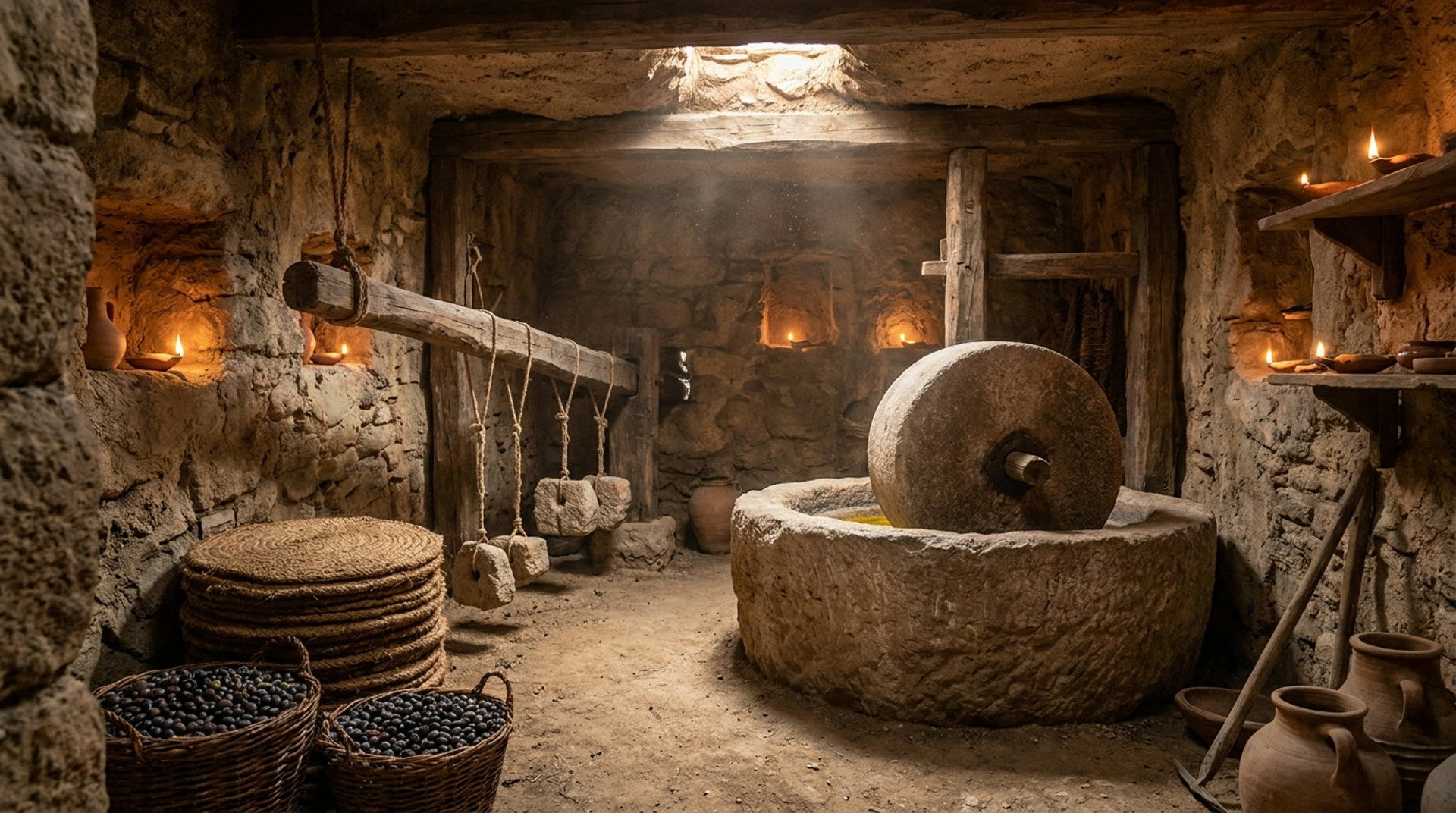
There is a darker echo of that stone in the Master's own teaching. To show how gravely heaven regards any harm done to the defenseless, he reached for this very image.
"But whosoever causes one of these little ones to stumble, it would be better for him if a millstone were hanged about his neck and he were cast into the sea." (158:8.1)
The same heavy stone that pressed the olive into light became, on his lips, the measure of how fiercely God guards the small and the helpless. One stone, named twice: once to make light, and once to weigh the cost of cruelty.
The finest oil came from the first, lightest crushing, the clear oil that flowed before any hard pressing was applied. In Hebrew this was shemen katit, beaten oil, and it carried a sacred reservation. The book of Exodus commands that pure beaten olive oil, and only that, be used to keep the lamp of the sanctuary burning. The purest oil of the first pressing fed the holy light. The coarser oil of later pressings went to the everyday work of the world, to soap and fuel and ordinary lamps. The fruit was crushed, and out of the crushing came light.
Hold that image, because the place names of the Master's last night were built from it. The garden where Jesus prayed and was betrayed was called Gethsemane. That name is not decorative. It comes from the Hebrew and Aramaic gat shemanim, which means, simply and exactly, oil press. The Urantia Book situates the spot precisely.
"They lived for the most part in tents, which they pitched in a shaded park, or garden, known in that day as Gethsemane. This park was situated on the western slope of the Mount of Olives not far from the brook Kidron." (142:8.4)
A press of oils, on the slope of the Mount of Olives, surrounded by the groves that fed it. Archaeology agrees with the name; an excavation at the site in the twentieth century identified the remains of an olive oil production facility from the period. So when the Urantia Book tells us that Jesus walked down "toward the olive press near the entrance to Gethsemane Park" (183:0.3), it is not using a metaphor. It is describing a working installation, a real stone press standing in a real garden, the place where for generations the local harvest had been crushed into oil and light. That press is about to become the most important seat in the history of this world.
Part III: The Anointed One
Before we climb the mountain, follow the oil itself, because the oil is where the olive touches the very name of the faith.
In ancient Israel, olive oil was not merely food and fuel. It was the medium of consecration. To set a person apart for a sacred office, you poured oil on their head. Prophets were anointed, priests were anointed, and above all kings were anointed. When the prophet Samuel chose Saul, and later David, he poured a flask of olive oil over them, and that act, not a crown, made them king. The Hebrew word for one so consecrated is mashiach, which means the anointed one. When the Hebrew scriptures were translated into Greek, mashiach became christos, from the Greek verb meaning to rub with oil. And christos is the word we carry into English as Christ.
This is worth saying slowly, because it is easy to miss how literal it is. Christ is not a surname. It is a translation of a Hebrew word whose physical, concrete meaning is a person anointed with olive oil. The whole towering structure of a faith rests, at the level of language, on the pressed fruit of one tree. The Urantia Book uses the title with that meaning intact.
"Suffice it to say that it is built around the person of Jesus of Nazareth, the humanly incarnate Michael Son of Nebadon, known to Urantia as the Christ, the anointed one." (98:7.2)
The anointed one. The oil-touched one. And the oil that the word remembers is olive oil.
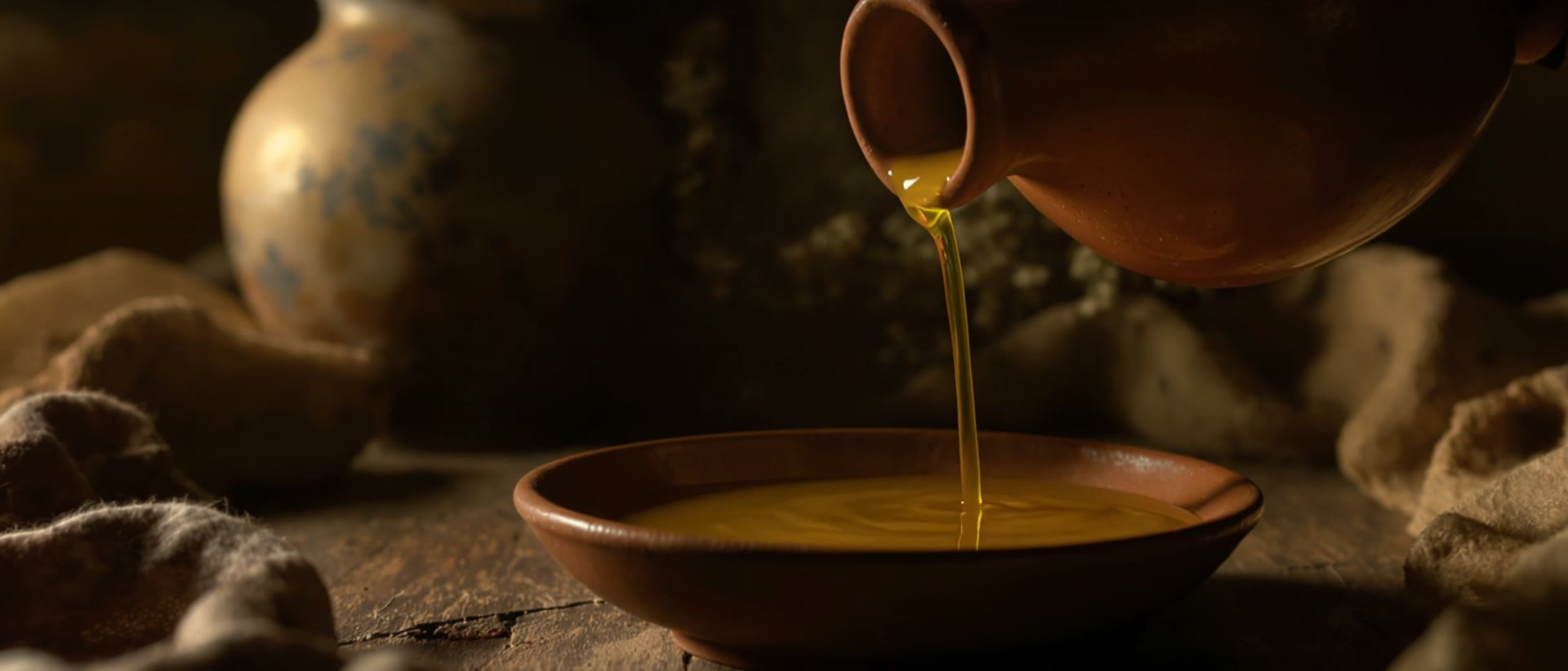
The olive's gift of oil runs quietly all through the human chapters of the Master's life, in the small domestic details the revelators take care to preserve. In the carpenter's home at Nazareth, the evening light itself came from this tree.
"During the winter, at the evening meal the table would be lighted by a small, flat clay lamp, which was filled with olive oil." (122:6.3)
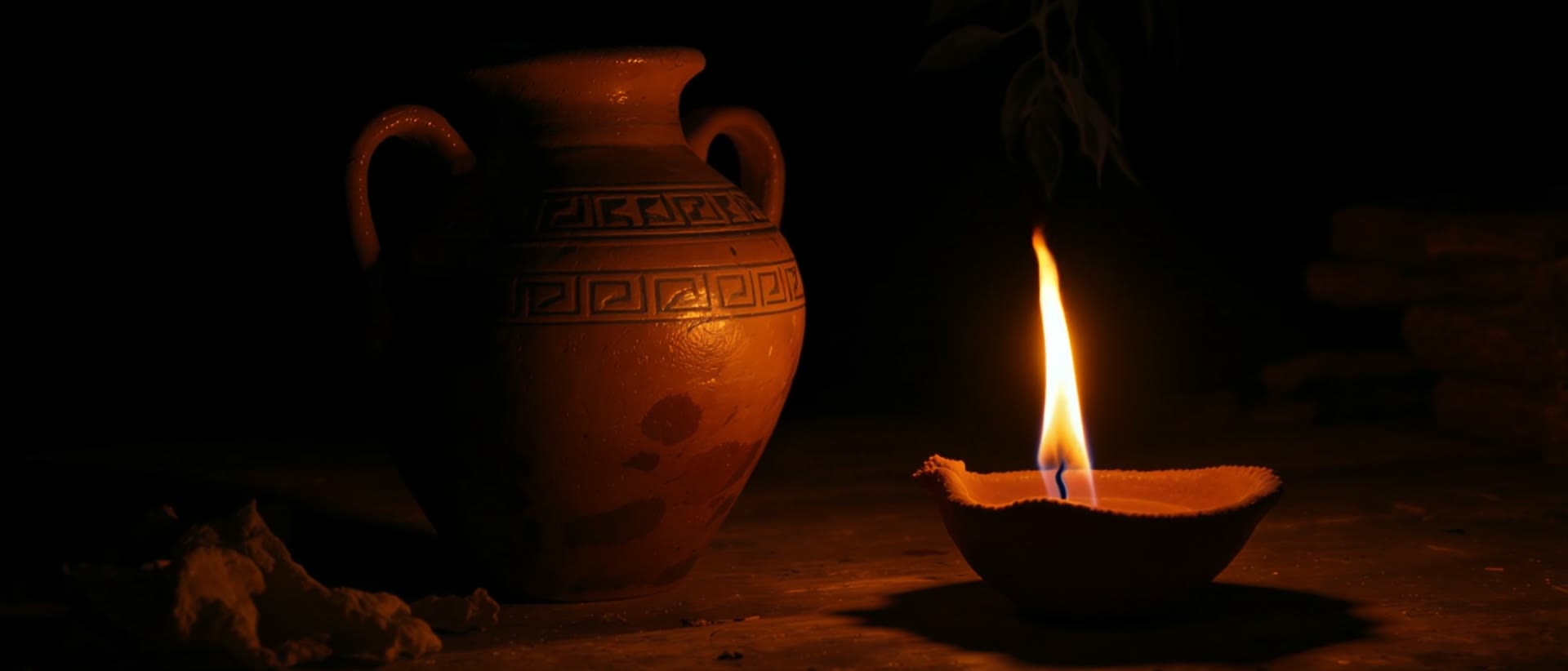
The boy who would be called the anointed one grew up doing his evening reading by the light of pressed olives. The oil was medicine, too. When the followers of John debated the custom of anointing the sick with oil for healing, it was a settled practice of the time (150:0.2). It was the substance of hospitality and honor; when a grateful woman anointed Jesus at the house of Simon the Pharisee, he gently contrasted her devotion with his host's neglect, saying, "My head with oil you neglected to anoint, but she has anointed my feet with precious lotions" (147:5.4). To anoint a guest's head with oil was simple courtesy. To pour it out in tears was love.
And the oil reached even into his first public proclamation. When Jesus stood up in the synagogue and read the words that announced his mission, the passage he chose from the prophet Isaiah was steeped in this same imagery.
"The spirit of the Lord God is upon me, for the Lord has anointed me; he has sent me to bring good news to the meek, to bind up the brokenhearted, to proclaim liberty to the captives, and to set the spiritual prisoners free; to proclaim the year of God's favor and the day of our God's reckoning; to comfort all mourners, to give them beauty for ashes, the oil of joy in the place of mourning, a song of praise instead of the spirit of sorrow, that they may be called trees of righteousness, the planting of the Lord, wherewith he may be glorified." (126:4.2)
The Lord has anointed me. The oil of joy in the place of mourning. That they may be called trees of righteousness, the planting of the Lord. The anointed one opened his ministry with the language of oil and trees, and closed it on a press, in a grove, on a mountain of olives. The symbol was there from the first sermon to the last night.
Part IV: The Mountain of Olives
The stage for so much of the gospel story is a single ridge, and it is named for this one tree. The Mount of Olives is a limestone ridge that rises east of Jerusalem's Old City, across the deep ravine of the Kidron Valley, its summits standing more than eight hundred meters high, looking down over the Temple from the opposite side. In antiquity its slopes were covered in olive groves, and the groves gave the hill its name, in Hebrew and in Greek alike, the mount of olives.
The Urantia Book makes that ridge one of the great recurring places of Jesus' life, and it begins early. As a boy of nearly thirteen, making his first pilgrimage to Jerusalem, Jesus came over the crest of this very hill and saw the Holy City for the first time.
"About halfway up to Jerusalem, Jesus gained his first view of the Mount of Olives (the region to be so much a part of his subsequent life), and Joseph pointed out to him that the Holy City lay just beyond this ridge, and the lad's heart beat fast with joyous anticipation of soon beholding the city and house of his heavenly Father." (124:6.8)
The region to be so much a part of his subsequent life. The revelators knew, writing it, how completely true that parenthesis would become. And they record that the same spot held both his first joy and his deepest grief.
"At no time in his life did Jesus ever experience such a purely human thrill as that which at this time so completely enthralled him as he stood there on this April afternoon on the Mount of Olives, drinking in his first view of Jerusalem. And in after years, on this same spot he stood and wept over the city which was about to reject another prophet, the last and the greatest of her heavenly teachers." (124:6.10)
He would return to that ridge again and again. He wept there as a boy on a later visit, grieving over a people he loved (125:4.2). He wept there as a man, at the height of the triumphal entry, when the crowds were singing and he alone could see what was coming.
"Jesus was lighthearted and cheerful as they moved along until he came to the brow of Olivet, where the city and the temple towers came into full view; there the Master stopped the procession, and a great silence came upon all as they beheld him weeping. Looking down upon the vast multitude coming forth from the city to greet him, the Master, with much emotion and with tearful voice, said: 'O Jerusalem, if you had only known, even you, at least in this your day, the things which belong to your peace, and which you could so freely have had!'" (172:3.10)
The things which belong to your peace. He spoke those words on the mountain of the tree of peace. And it was this same ridge, with its Gethsemane camp, that became the headquarters of his final ministry. The revelators tell us the olive groves of Gethsemane were where the apostolic company camped, and that the Sabbaths were spent just over the hill with friends at Bethany (142:8.4). For the last week of his life, the Mount of Olives was home base. He taught on it, he prayed on it, he wept on it, and from it, in the end, he departed.
Part V: The Orchards of Bethany
On the far slope of that same ridge, the eastern side facing the wilderness and the Jericho road, lay the village of Bethany. To this day the place carries the memory in its Arabic name, al-Eizariya, which means the place of Lazarus. And here the olive is woven directly into the most stunning event of the Master's public ministry, because the family at the center of it were olive growers.
"Lazarus and his sisters were the children of a well-to-do and honorable Jew, one who had been the leading resident of the little village of Bethany... They had inherited extensive vineyards and olive orchards in this vicinity, and that they were wealthy was further attested by the fact that they could afford a private burial tomb on their own premises." (168:0.4)
Lazarus, Martha, and Mary, the three Jesus loved as his own family, lived among olive trees. Their wealth, their standing, their very tomb, all rested on the orchards of Bethany. And it was here, in this grove-girdled village, that Jesus stood before a sealed tomb four days after his friend had died and spoke the words that the olive tree itself seems built to illustrate.
"I am the resurrection and the life; he who believes in me, though he dies, yet shall he live. In truth, whosoever lives and believes in me shall never really die." (168:0.7)
Then he called into the tomb.
"And when he had prayed, he cried with a loud voice, 'Lazarus, come forth!'" (168:2.2)
I want you to feel why the setting matters. Of all the trees that could surround that resurrection, it was the olive, and the olive is the one tree on earth that most stubbornly refuses to stay dead. Cut an olive to the ground, burn its trunk, leave it for dead, and it sends up new shoots from the living root and rises again. The ancient world knew this and made the olive a symbol of life that cannot be ended. The Greeks told how, when the Persians burned the sacred olive on the Acropolis of Athens, a fresh green shoot sprang from the charred stump the very next day, and they read it as a sign that the city itself would rise again. The olive is the tree of resurrection. And in an orchard of resurrection trees, the Master gave the world its clearest demonstration that death is not the end. The setting was not an accident. On this world, the revelators tell us, the raising of Lazarus stood as the greatest single work of his earthly ministry, and they staged it among the trees that rise from their own graves.
Part VI: The Crushing
Now we come back to the press, and to the hardest, most luminous turn in the whole story.
On the last night, after the supper, Jesus led his friends back to the Gethsemane camp on the olive slope, and there, among the trees, the crushing began in earnest. He went a little apart with three of them and prayed, and the revelators do not hide what it cost him.
"And when he had fallen down on his face, he prayed: 'My Father, I came into this world to do your will, and so have I. I know that the hour has come to lay down this life in the flesh, and I do not shrink therefrom, but I would know that it is your will that I drink this cup.'" (182:3.1)
He prayed it three times, and the weight of it pressed the strength out of him.
"While no mortal can presume to understand the thoughts and feelings of the incarnate Son of God at such a time as this, we know that he endured great anguish and suffered untold sorrow, for the perspiration rolled off his face in great drops." (182:3.7)
And in the depth of that crushing, heaven did not leave him to face it alone. As he rose from the second prayer, the revelators record a moment of pure tenderness in the dark garden.
"...a mighty angel came down by his side and, speaking to him, touched him and strengthened him." (182:3.2)
This was not a rescue. The angel did not come to take the cup away, but to make the man able to drink it. What the messenger carried was not escape, but resolve.
"Among other words spoken to him by the mighty angel was the message that the Father desired his Son to finish his earth bestowal by passing through the creature experience of death just as all mortal creatures must experience material dissolution in passing from the existence of time into the progression of eternity." (182:3.6)
Heaven did not spare him the press. It sent strength to endure it.
Read that with the press in view. In a garden whose name means oil press, surrounded by trees whose fruit yields its oil only under crushing weight, the anointed one was himself being pressed, and what was wrung out of him was not bitterness but surrender.
"Father, you see my sleeping apostles; have mercy upon them. The spirit is indeed willing, but the flesh is weak. And now, O Father, if this cup may not pass, then would I drink it. Not my will, but yours, be done." (182:3.4)
Not my will, but yours, be done. That is the first oil of the first pressing. That is the pure, clear thing that flows out before the hard weight even fully descends. And then, his prayer finished and his human will made one with the divine, he walked down to the press and sat on it to wait.
"Failing to disperse his followers, the Master left them and walked down toward the olive press near the entrance to Gethsemane Park... Jesus sat down, alone, on the olive press, where he awaited the coming of the betrayer." (183:0.3, 183:0.5)
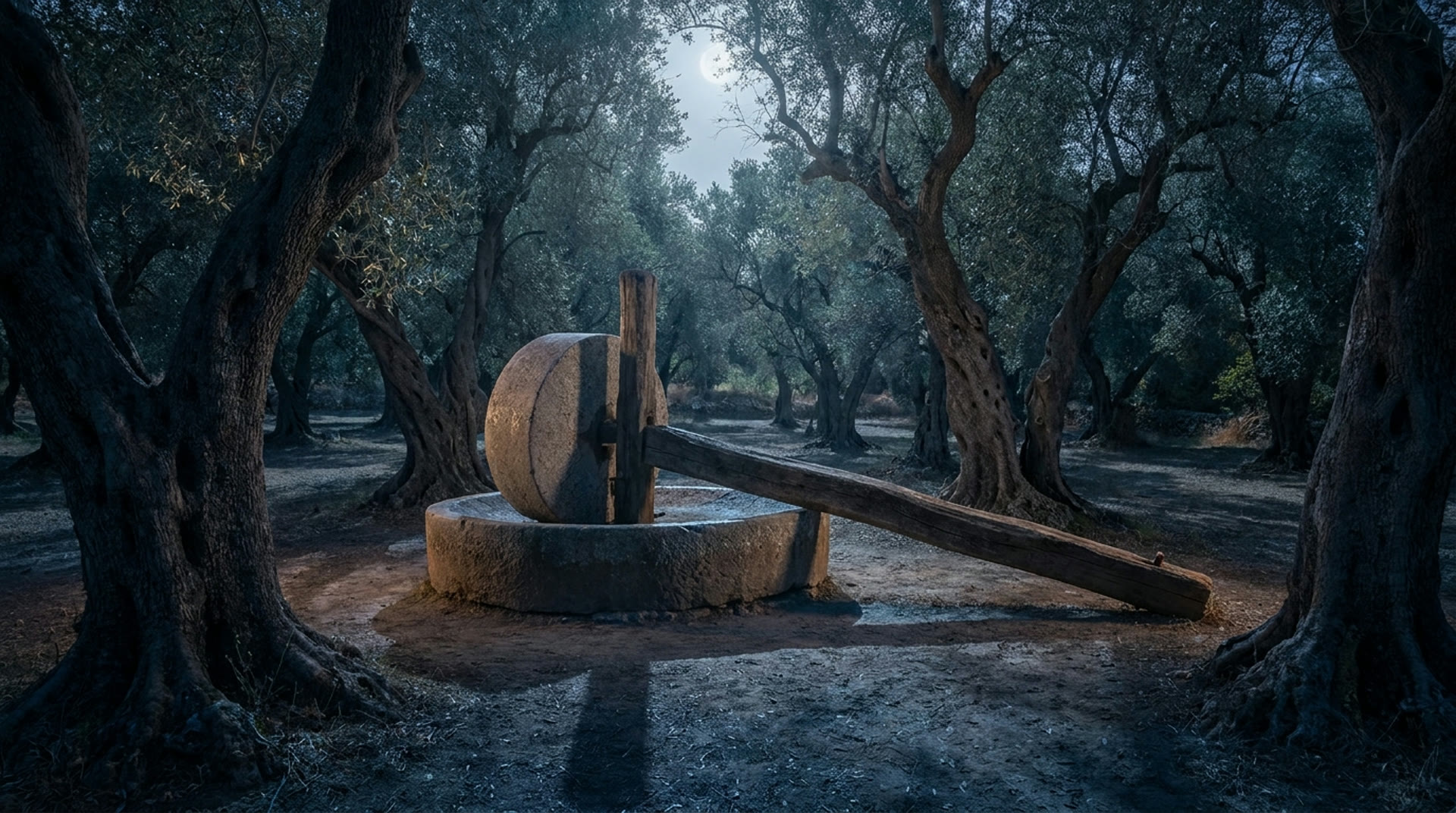
The torches came up the hill. His friends rushed down "to near the olive press where the Master was sitting in moonlit solitude" (183:3.2). The betrayer came forward. And after he was taken, the apostles gathered back at that same stone to argue what to do, in a scene the revelators title, with quiet exactness, "Discussion at the Olive Press." There, Simon Zelotes "stood up on the stone wall of the olive press" and pleaded for a rescue by the sword (183:4.2), and there the wiser counsel of nonresistance prevailed, exactly as the Master had taught.
Step back and see the whole shape of it. The tree that has been crushed for its light since the dawn of civilization. The press that turns crushing into oil. The garden named for that press. The mountain named for that tree. The man called the anointed one, the oil-touched one, who taught that the growing of plants instills patience and peace, who lit his childhood by olive oil, who opened his ministry with the oil of joy and trees of righteousness, who wept for peace on the mount of olives, who raised the dead among the resurrection trees, and who, on his last free night, sat down alone on the olive press and let himself be pressed, so that out of the crushing might come the clearest light this world has ever received. The olive did not just witness the story. The olive was telling it the whole time.
Part VII: The Dove, the Branch, and the Living Trees
When the crushing was over and the resurrection accomplished, the olive carried the Master home, too. After his forty days of appearances, the revelators bring him back to the same ridge to take his leave.
"When he had spoken, he beckoned for them to come with him, and he led them out on the Mount of Olives, where he bade them farewell preparatory to departing from Urantia. This was a solemn journey to Olivet." (193:3.3)
From the western slope, "about two thirds the way up the mountain," where they "could look out over Jerusalem and down upon Gethsemane" (193:5.1), he said his last farewell and departed. He came over this mountain as a boy with his heart beating fast. He left from it as the risen Son with the world's commission in his words. The tree of peace stood at both ends of his life.
And peace is the olive's most universal meaning, older than Athens, older than Rome, woven into the very flood story that opens the human record. When the waters receded, the dove sent out from the ark returned with a freshly plucked olive leaf, and that leaf became, for the whole Western world, the sign that the storm was over and the peace between heaven and earth restored. The Greeks made the olive Athena's gift to her city, judged more precious than the sea-god's spring, and crowned their Olympic victors with wreaths of wild olive. The branch of the olive still encircles the world on the emblem of the United Nations, still rests in the talon of national seals as the sign of a people that prefers peace to war. No other tree has ever carried so much of humanity's longing for peace, and it is fitting beyond words that the one who wept for peace on the mount of olives, and who was called the Prince of Peace, should have spent his last hours and his parting moment among these trees.
There is one more thread, and it is the kind of true detail that gives me chills. Pilgrims today are shown ancient, gnarled olive trees in the Garden of Gethsemane and told these are the very trees that watched Jesus pray. The honest science is more careful, and somehow more beautiful. A study coordinated by Italy's National Research Council radiocarbon-dated the standing trunks of the oldest Gethsemane olives and found the wood to date to roughly the twelfth century, not the first. But here is the wonder. The same study found that the trees all share an identical genetic fingerprint, meaning they are clones, grown from a single common parent, and the researchers stressed that an olive's root system can be far older than its visible trunk, because the tree renews itself again and again from the same living root. The wood you can see is medieval. The root beneath it may reach back across the centuries. We cannot prove these are the trees of that night. But they may very well be the living children of those trees, risen again and again from the same undying root, exactly as the olive always does, exactly as the resurrection they witnessed promised. The garden is still keeping the symbol alive, whether or not anyone planned it.
Part VIII: The Olive Shade of Destiny
I want to close with the strangest and most hopeful olive passage in the whole revelation, one that lifts the tree off the historical map entirely and sets it at the end of the human story.
When the Urantia Book describes what becomes of the races of a world that completes the long Adamic uplift, it tells us that the peoples gradually blend into one. And it gives that finished, unified, peaceful humanity a color.
"By the end of the Adamic dispensation on a normal planet the races are practically blended, so that it can be truly proclaimed that 'God has made of one blood all the nations,' and that his Son 'has made of one color all peoples.' The color of such an amalgamated race is somewhat of an olive shade of the violet hue, the racial 'white' of the spheres." (52:3.7)
An olive shade. The destiny color of a perfected world, the skin tone of a humanity that has finished its long climb out of fear and division into unity and peace, is described by the revelators as an olive shade. The tree of peace gives its name even to the color of a settled world. From the first wild olives gathered on a Neolithic shore, to the gardener vocation that ennobles a race, to the press that turns crushing into light, to the mountain and the orchards and the stone in the moonlight, the olive has run like a green thread through the whole story, and at the far end of that thread is the color of a world made whole.
The olive remains, today, exactly what it has always been: the patient, peaceful, near-immortal tree of the long view. There are something on the order of a billion cultivated olive trees alive in the world now, the great majority of them still rooted in the Mediterranean basin where the friendship began, and the oil they give still anchors the healthiest traditional diet on earth. Some of those trees have been alive, by careful estimate, for the better part of two thousand years, and a few perhaps far longer, quietly outlasting empires, rising again from their own roots whenever they are cut down. They are still the tree of resurrection. They are still the tree of peace. They are still the tree whose crushing gives light.
So the next time you see olive oil poured, or a branch of olive offered as a sign of peace, or a gnarled old tree standing in a dry hillside that has seen a hundred human lifetimes come and go, remember the stone in the moonlight. Remember that the anointed one sat down, alone, on an olive press, and let himself be pressed, and that out of that crushing came the clearest light this world has ever known. The olive was there for all of it. It is, in the deepest sense the revelation allows, the anointed tree.
Note on citations: every passage placed in quotation marks above and attributed to the Urantia Book was verified word for word against the canonical text at the cited Paper:Section.Paragraph reference. Two related passages that carry a dash in the original, at 168:2.7 and at 125:4.2, are referred to here by description rather than direct quotation, in keeping with house style.
Note on sources: the historical and scientific background draws on current scholarship, including Besnard, Terral and Cornille, "On the origins and domestication of the olive" (Annals of Botany, 2018); Langgut and Garfinkel, "The history of olive cultivation in the southern Levant" (Frontiers in Plant Science, 2023); Bernabei, "The age of the olive trees in the Garden of Gethsemane" (Journal of Archaeological Science, 2015); and the International Olive Council. The popular claim that the olive was carried to Palestine from Armenia around 4000 BC traces to a single 2004 museum statement and is not supported by the archaeological or genetic record; Armenia's genuine deep-time agricultural distinction, the Areni-1 winery, belongs to the vine rather than the olive.
For the companion to this story, see the deep history of the Adamic gardener mission in The Forbidden Fruit Redeemed, and the account of the Master's final hours in the Urantia Book's Papers 182 and 183.

Connecting Articles
The Forbidden Fruit Redeemed: The Apple, the Andites, and the Long Road to the Basque Cider House

The Quiet Government: What Paper 114 Says to a Movement That Feels Like It Failed

The Woven World: Carpet, Thread, and the Loom of Eternity

The Three Noahs: A Builder's Son, a Winemaker, and a Story Assembled in Babylon
The Newsletter
Get the research behind each piece
Free. New Urantia Book explorations, the sources behind the videos, and early looks. No spam, unsubscribe anytime.
Prefer video? Follow on YouTube and Facebook.
Delivered through Substack. You can also read past issues.