
The First Crack: Continental Drift and the Date of 750 Million Years
In 1955, American geology called continental drift a fairy tale. The Urantia Book not only endorsed drift; it dated the first breakup of the continents to 750 million years ago. Modern reconstructions of the supercontinent Rodinia now place its first breakup at almost exactly that date.
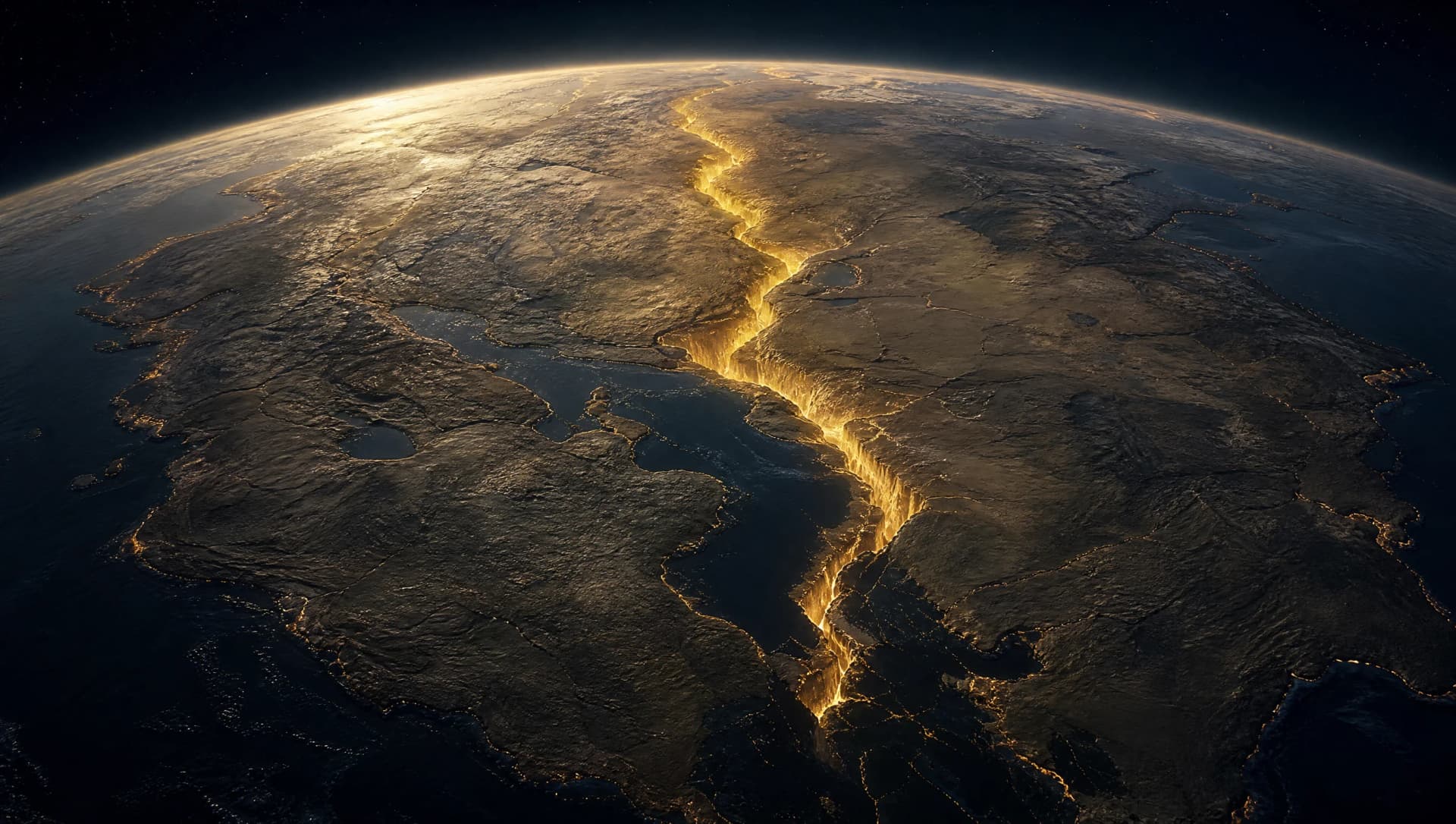
A Fairy Tale, According to Stanford
In 1912, the German meteorologist Alfred Wegener proposed that the continents had once been joined and had since drifted apart. Anglo-American geology did not merely decline the idea; it buried it. At a landmark 1926 symposium of the American Association of Petroleum Geologists, the hypothesis was debated and, in the words of historians, generally denounced. Rollin Chamberlin of the University of Chicago wrote that Wegener's hypothesis "is of the footloose type" and complained that taking it seriously would force geologists to forget seventy years of learning and start over. As late as 1944, Stanford's Bailey Willis published a paper in the American Journal of Science whose verdict was in its title: continental drift, he concluded, is a fairy tale.
The historian of science Naomi Oreskes, who wrote the standard account of this episode, documents that from 1930 to 1955 drift's few American defenders were dismissed as cranks, and that geologists with private sympathies found it professionally wise to keep quiet. Vindication came only in the 1960s: seafloor spreading proposed by Harry Hess in 1962, the magnetic stripe prediction of Vine and Matthews in Nature in September 1963, and the full plate tectonic synthesis by 1968, after which the field converted almost overnight.
Hold that chronology firmly, because the Urantia Book was published in 1955, at the bottom of drift's reputation, with its geological papers reportedly completed in the mid-1930s, when endorsing drift in America was an act of professional self-harm. The record did not hedge. It wove continental drift through four consecutive papers of Earth history as settled fact, describing the drift's beginning, its pauses, its resumption, and its consequences for mountains, seas, and life.
At a Glance
| Key figure | The record | Modern science |
|---|---|---|
| Continental drift | Woven through Papers 57-60 as fact | Called "a fairy tale" in 1944; vindicated by plate tectonics in the 1960s |
| First breakup date | 750 million years ago (57:8.23) | Rodinia's first breakup: about 750 to 720 million years ago (Li 2008; Merdith 2021) |
| What the era believed | No breakup at all; Wegener's own frame was Pangaea, about 200 million years | |
| Circumpacific belt | "more than twenty-five thousand miles long" (60:3.11) | Ring of Fire: about 25,000 miles |
| Drift today | Ended 75 million years ago (60:3.12) | Still moving, centimeters per year by GPS. A logged miss |
The Date Nobody Had
Endorsing drift early is notable. What the record did next is the remarkable part. It put a date on the first breakup:
"750,000,000 years ago the first breaks in the continental land mass began as the great north-and-south cracking, which later admitted the ocean waters and prepared the way for the westward drift of the continents of North and South America, including Greenland. The long east-and-west cleavage separated Africa from Europe and severed the land masses of Australia, the Pacific Islands, and Antarctica from the Asiatic continent." (57:8.23)
And it tied the consequences of that cracking to the stage-setting for life:
"700,000,000 years ago Urantia was approaching the ripening of conditions suitable for the support of life. The continental land drift continued; increasingly the ocean penetrated the land as long fingerlike seas providing those shallow waters and sheltered bays which are so suitable as a habitat for marine life." (57:8.24)
Understand what a 750 million year figure meant in the 1930s: nothing. It corresponded to nothing in anyone's science. Wegener himself framed drift around the breakup of Pangaea roughly 200 million years ago. No radiometric date for any continental breakup existed, and mainstream geology denied there had ever been a breakup to date. A reader in 1955 could only file the number away.
Then geology caught up twice. First it accepted drift. Then, decades later, it discovered that Pangaea was not the first supercontinent. Reconstructing deep time from zircons, paleomagnetism, and orogenic belts, geologists assembled the story of Rodinia, a supercontinent that formed over a billion years ago and then broke apart in the late Proterozoic.
The benchmark synthesis of Rodinia's history, Li and colleagues' 2008 review in Precambrian Research, places widespread continental rifting between 825 and 740 million years ago, with major pulses near 825, 780, and 750 million years, and dates the first true breakup, along the western margin of Laurentia, the ancestral core of North America, as possibly as early as 750 million years ago. Newer full-plate models, such as Merdith and colleagues' 2021 reconstruction spanning the last billion years, tie the breakup of Rodinia's core to a global plate reorganization about 720 million years ago. Standard reference summaries give the breakup window as roughly 750 to 633 million years ago.
The record's number sits at the leading edge of the measured window, attached to the correct kind of event, a first cracking of a unified landmass that admitted the ocean and set continents adrift, including the margin of ancestral North America. And one active line of research in modern geoscience argues something the record's sequence implies: that this breakup flooded the world with shallow seas and nutrient flux, and in doing so helped stage the later emergence of complex marine life.
The Ring of Fire, Measured in Miles

The record follows the drift to its consequences. Describing the era when the westward-moving mass met resistance, it writes:
"80,000,000 years ago great disturbances occurred in the earth's crust. The western advance of the continental drift was coming to a standstill, and the enormous energy of the sluggish momentum of the hinter continental mass upcrumpled the Pacific shore line of both North and South America and initiated profound repercussional changes along the Pacific shores of Asia. This circumpacific land elevation, which culminated in present-day mountain ranges, is more than twenty-five thousand miles long..." (60:3.11)
A belt of crustal violence and mountain building wrapping the entire Pacific rim, more than twenty five thousand miles long. Modern geology calls it the Ring of Fire and conventionally gives its length as about 25,000 miles. The mechanism has been reframed, subduction rather than the momentum of drifting continents, but the object itself, a circumpacific belt of uplift and disturbance ringing the ocean and running through the Americas and Asia alike, is drawn accurately and at the correct scale.
The Ledger
Now the differences, stated as plainly as the convergences.
First, the record tells a single-breakup story: one continental mass cracks at 750 million years and its pieces drift, with pauses, to their present positions. Modern geology tells a cyclic story. Continents have assembled and dispersed repeatedly: the supercontinent Nuna around two billion years ago, Rodinia's assembly and breakup, a contested Ediacaran grouping called Pannotia, and finally Pangaea, which assembled around 300 million years ago and broke up around 200 million years ago. The Atlantic that today separates the Americas from Africa and Europe opened in that last cycle, not the first. The record's narrative compresses what geology now reads as at least two full cycles into one continuous drift.
Second, the record declares the drift finished:
"75,000,000 years ago marks the end of the continental drift. From Alaska to Cape Horn the long Pacific coast mountain ranges were completed, but there were as yet few peaks." (60:3.12)
GPS geodesy measures the continents drifting today, at rates of centimeters per year. On this point the record carries the assumptions of its era, and its own disclaimer applies:
"...within a few short years many of our statements regarding the physical sciences will stand in need of revision in consequence of additional scientific developments and new discoveries." (101:4.2)
Third, the record's paragraph has Australia and Antarctica severing from Asia, where modern reconstructions detach them from other partners. The geometry of deep-time paleogeography is genuinely hard, and reconstructions have themselves been redrawn repeatedly; we simply note that the record's directions do not map onto current models detail for detail.
What Remains
Strip away everything era-bound, and two facts stand. In the decades when drift was a fairy tale in American lecture halls, the record built its entire Earth history on drifting continents. And it attached to the first breakup a date, 750 million years, that had no source in the science of its day and now lands on the opening of the measured Rodinia rifting window. Whatever a reader concludes about the book, that number was not borrowed from the geology of the 1930s. There was nothing to borrow.
Keep Reading
Sudden Animals follows the story into the seas those fingerlike gulfs created, where the record's date for the dawn of complex life meets the modern Cambrian timeline. The Record and the Science holds the original five astronomy convergences. And for the record's account of what those sheltered bays were for, Paper 58 tells the life establishment story in its own words.
Connecting Articles

Sudden Animals: The Cambrian Explosion and the Record's Date for the Dawn of Life

The Submerged Peninsula: A Geophysical and Textual Case for the Levantine Location of the First Eden

The Adjudication of Urantia: What Happens When the Lucifer Era Ends

Cano and Eve's Default: The Real Story
The Newsletter
Get the research behind each piece
Free. New Urantia Book explorations, the sources behind the videos, and early looks. No spam, unsubscribe anytime.
Prefer video? Follow on YouTube and Facebook.
Delivered through Substack. You can also read past issues.