
The Discourse on Science: The Night Jesus Out-Thought Athens
In the world capital of philosophy, a Greek scholar lectured Jesus on science for three hours. Then Jesus answered, and gave a view of matter and spirit that reads like it was written centuries too early.
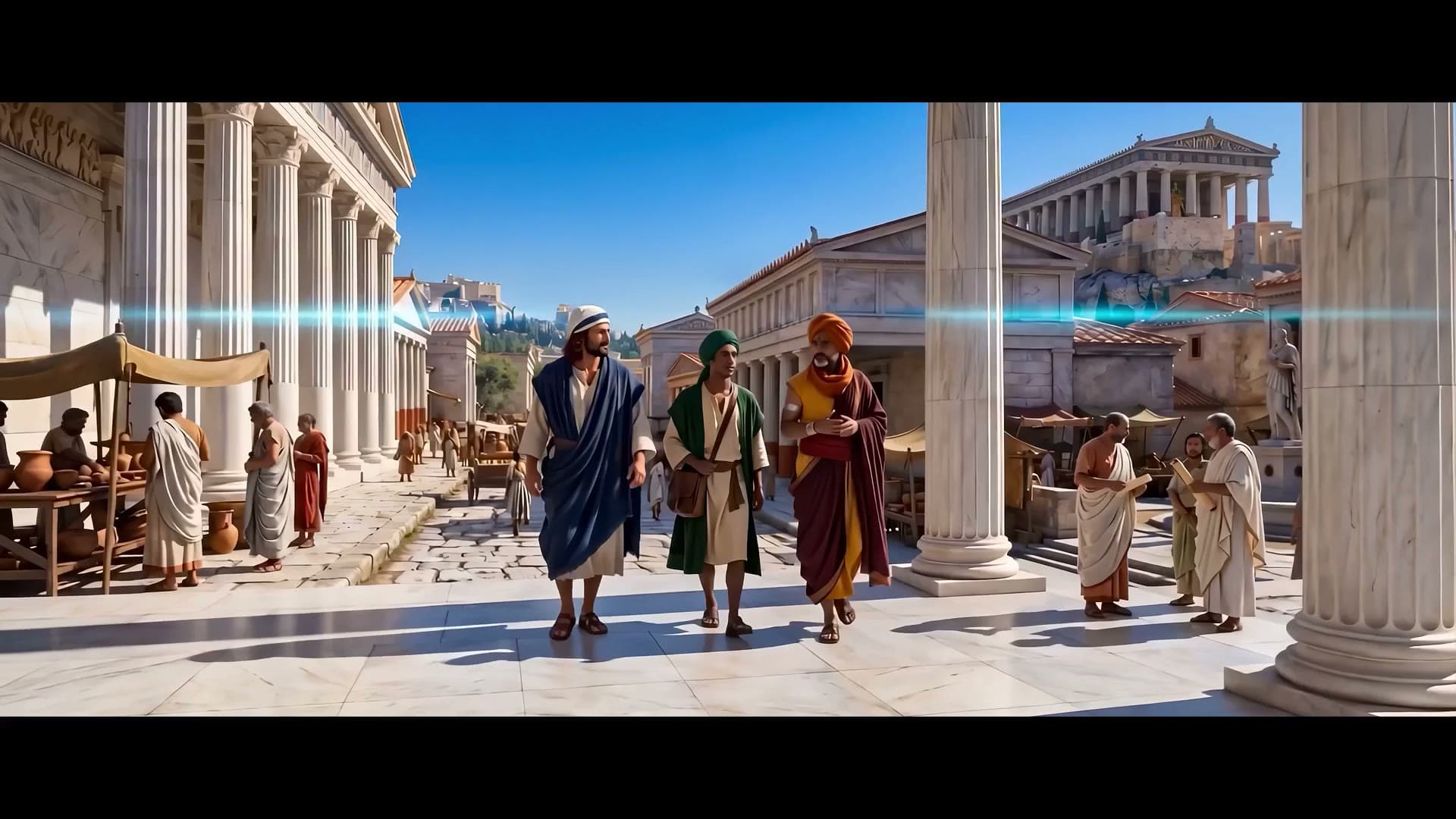
The Discourse on Science: The Night Jesus Out-Thought Athens
Derek Samaras | Urantia Book Network | August 2026
There is a cinematic version of this. Watch the scroll film: The Discourse on Science, and the full film is below.
On his world tour, traveling as tutor to a young Indian student named Ganid, Jesus came to Athens, the old center of Greek science and learning. One evening at their inn, a Greek philosopher lectured on science for nearly three hours. When the scholar finally finished, Jesus answered him, and the answer has aged remarkably well.
Measurement has a ceiling
Jesus began by naming the exact boundary where science stops.
"Scientists may some day measure the energy, or force manifestations, of gravitation, light, and electricity, but these same scientists can never (scientifically) tell you what these universe phenomena are." (133:5.4)
You can measure how a thing behaves without ever reaching what it is. From there he drew the map that keeps science and religion from stepping on each other.
"Science deals with physical-energy activities; religion deals with eternal values. True philosophy grows out of the wisdom which does its best to correlate these quantitative and qualitative observations." (133:5.4)
Sound math, and yet not true
Then, in the city of pure reason, Jesus gently showed the limits of pure arithmetic with a farmer's example.
"Arithmetic says that, if one man could shear a sheep in ten minutes, ten men could shear it in one minute. That is sound mathematics, but it is not true, for the ten men could not so do it; they would get in one another's way so badly that the work would be greatly delayed." (133:5.5)
The numbers are correct and the conclusion is false, because life is not only quantity. Real things interfere, cooperate, and complicate in ways a clean equation never predicts.
One universe, not two
Where a lesser mind would have pitted matter against spirit, Jesus united them.
"Matter and spirit and the state intervening between them are three interrelated and interassociated levels of the true unity of the real universe." (133:5.9)
And he closed the circle with a line that turns the whole cold subject warm.
"The real universe is friendly to every child of the eternal God." (133:5.8)
His hope for the future was not that one side would win, but that both would grow humble enough to meet.
"When both science and religion become less dogmatic and more tolerant of criticism, philosophy will then begin to achieve unity in the intelligent comprehension of the universe." (133:5.7)
The verdict of a Greek
The philosopher who came to lecture left having listened. His parting words are the quiet triumph of the whole evening.
"At last my eyes have beheld a Jew who thinks something besides racial superiority and talks something besides religion." (133:5.11)
That is what happened at Athens. Not a debate won, but a wider world shown, where the study of matter and the love of God are two honest roads up the same mountain.
Quotes drawn from the cited paragraphs; readers are encouraged to verify against the canonical text.
Connecting Articles



The Newsletter
Get the research behind each piece
Free. New Urantia Book explorations, the sources behind the videos, and early looks. No spam, unsubscribe anytime.
Prefer video? Follow on YouTube and Facebook.
Delivered through Substack. You can also read past issues.