
Mercy and Justice, Part Two: The Man at the Dock
Jesus saw a man mistreating his wife in public. He stopped it without a raised voice, reached the man with a single question and a smile, and then taught something the ancient world rarely heard about marriage.

Mercy and Justice, Part Two: The Man at the Dock
Derek Samaras | Urantia Book Network | August 2026
There is a cinematic version of this. Watch the scroll film: Mercy and Justice, Part Two, and the full film is below.
Part one drew the line between mercy and justice on a country road. Part two shows the same principle in the hardest place to apply it, and the same wide dignity extended to the person almost everyone else in that world overlooked.
Force was not the tool
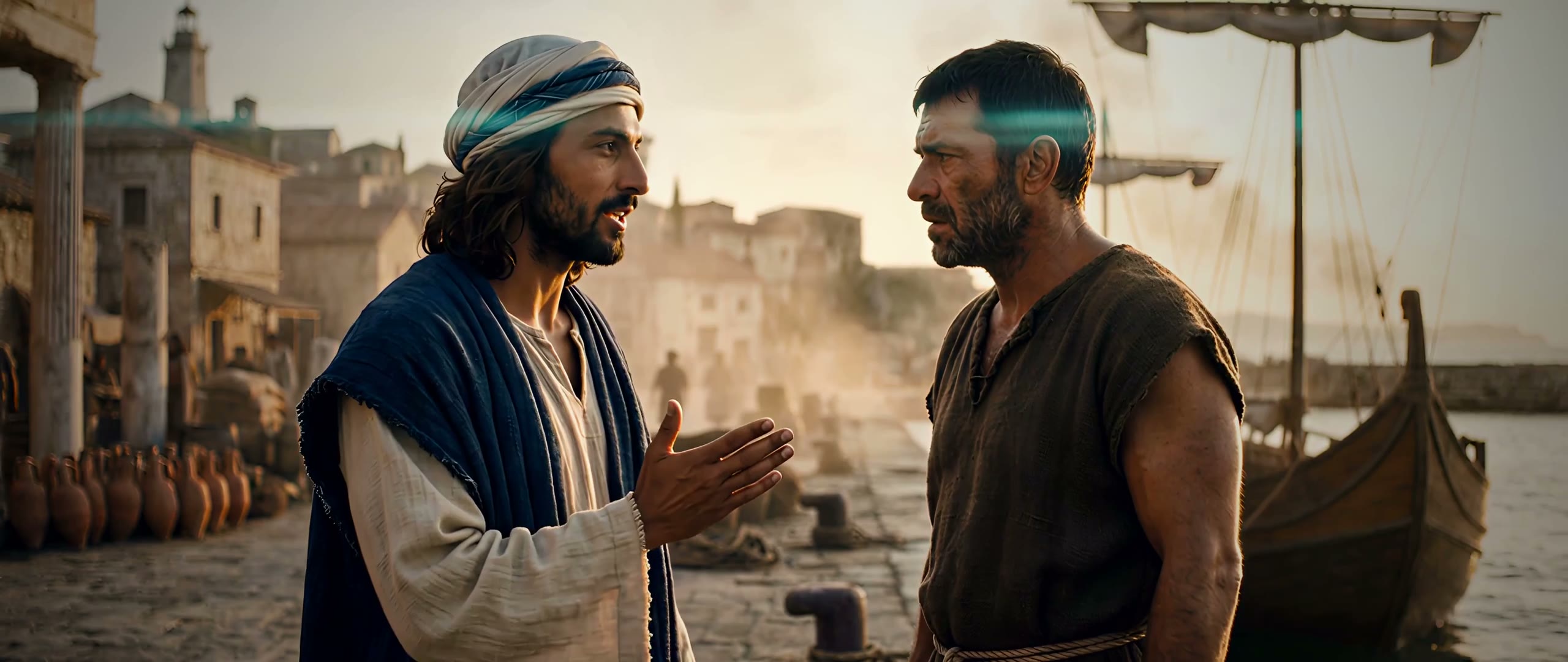
At the ship landing in Tarentum, the travelers watched a man mistreating his wife in full public view. Jesus did what he always did, he stepped in for the person under attack. But not with his fists. He came up behind the angry husband, touched his shoulder, and asked a disarming question.
"My friend, may I speak with you in private for a moment?" (133:2.1)
Then, instead of accusing, he assumed the best. He told the man he could see in his face the love of justice, and that surely a man like him would have rushed to a stranger's rescue if he had found him attacked by robbers on the road. He asked, simply, what had happened. And what turned the man was not the argument.
"My wife has done no great wrong; she is a good woman, but she irritates me by the manner in which she picks on me in public, and I lose my temper." (133:2.1)
The record is careful to say that it was the kindly look and the sympathetic smile at the end of Jesus's words, more than the words themselves, that reached the man's heart. He admitted his lack of self-control and renewed a pledge he had made years before.
The teaching he left behind
Then, in saying goodbye, Jesus gave him the lesson, and it was radical for its time. A husband's power is not a possession. It is a trust that only the wife can grant.
"My brother, always remember that man has no rightful authority over woman unless the woman has willingly and voluntarily given him such authority." (133:2.2)
He tied a man's whole spiritual stature to how he treats the people in his own house.
"The loving care and consideration which a man is willing to bestow upon his wife and their children are the measure of that man's attainment of the higher levels of creative and spiritual self-consciousness." (133:2.2)
And he lifted the marriage itself up into something cosmic.
"Do you not know that men and women are partners with God in that they co-operate to create beings who grow up to possess themselves of the potential of immortal souls?" (133:2.2)
As the travelers boarded the boat, they looked back on the couple standing in a silent, teary embrace. One quiet conversation at a dock had done what no amount of force could have done.
Quotes drawn from the cited paragraphs; readers are encouraged to verify against the canonical text. Back to Part One.
Connecting Articles

The Newsletter
Get the research behind each piece
Free. New Urantia Book explorations, the sources behind the videos, and early looks. No spam, unsubscribe anytime.
Prefer video? Follow on YouTube and Facebook.
Delivered through Substack. You can also read past issues.