
Civilization Delivered in Ten Portions: The Dalamatia Councils and the Sumerian ME
Sumerian religion held that civilization was a package of divine decrees called ME, organized into discrete domains and held by Enki at Eridu. The Urantia Book describes a council of one hundred organized into ten specialist boards, each governing one domain of civilized life, at Dalamatia. The organizational chart is unusually similar.
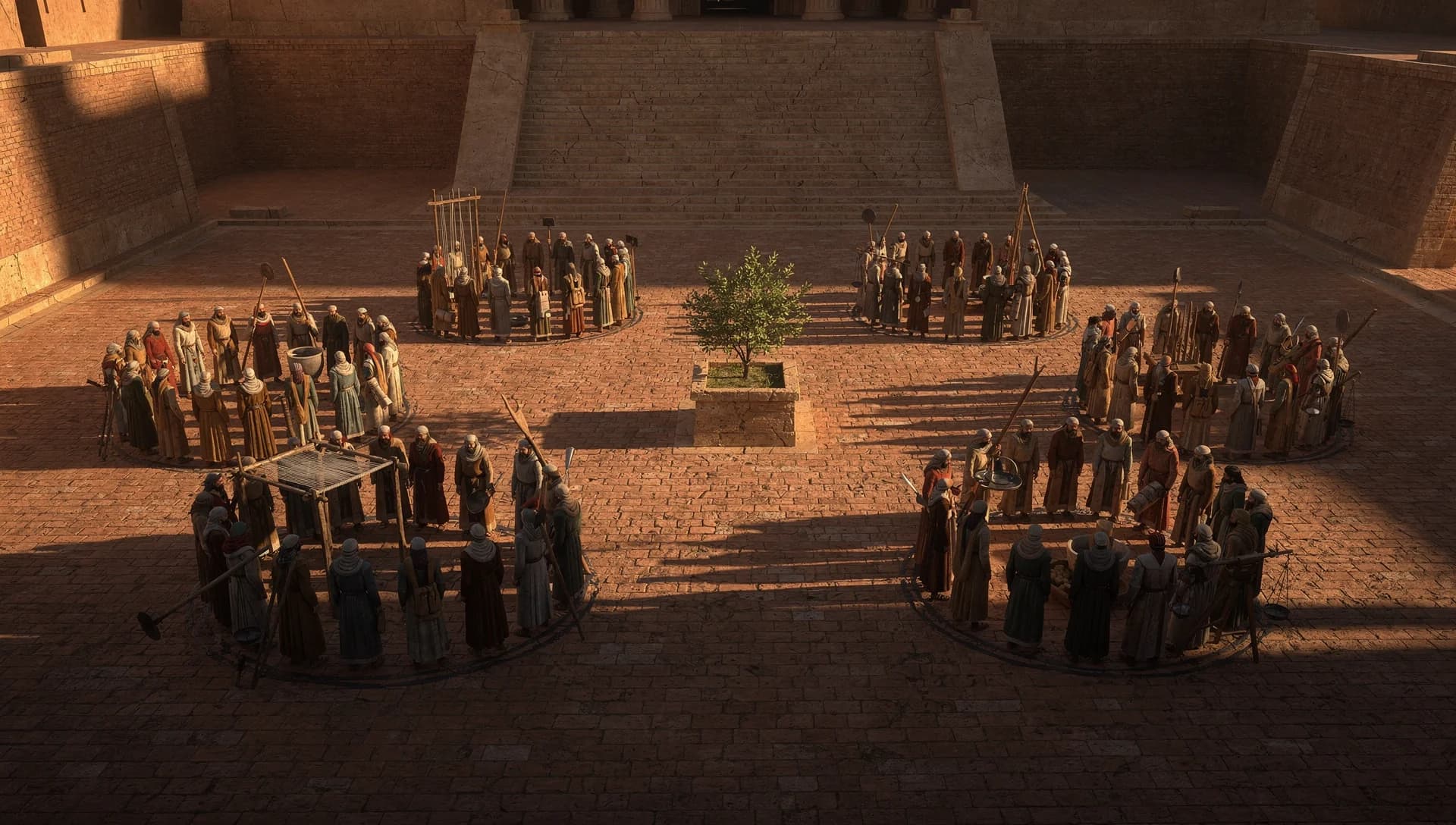
Dalamatia Ten Councils, civilization delivered as organized knowledge = The Sumerian ME, divine decrees / arts of civilization
This article expands on the decoder mapping. For the side-by-side card and quick reference, see the mapping page.
Civilization as a Bureaucracy
Sumerian religion has a specific answer to the question of where civilization came from. It came as a package of divine decrees called ME, each one the charter of a particular craft or social institution. The list is long. The institutions covered are detailed: kingship, priesthood, the scribal art, weaving, metallurgy, medicine, music, the legal system, trade. Each institution has a ME. The ME are held by the gods, particularly by Enki at Eridu, and they are delivered to humanity through discrete transactions.
Samuel Noah Kramer's formulation in The Sumerians (University of Chicago, 1963) is the one most often cited: the ME represent "the fundamental, unalterable, comprehensive assortment of powers and duties, norms and standards, rules and regulations relating to civilized life." That is, the Sumerians thought of civilization not as something that evolved but as something that was delivered, in organized form, by superhuman beings, and then distributed downward into human practice.
The Urantia Book describes an event that matches the structural claim.
What the Urantia Book Says
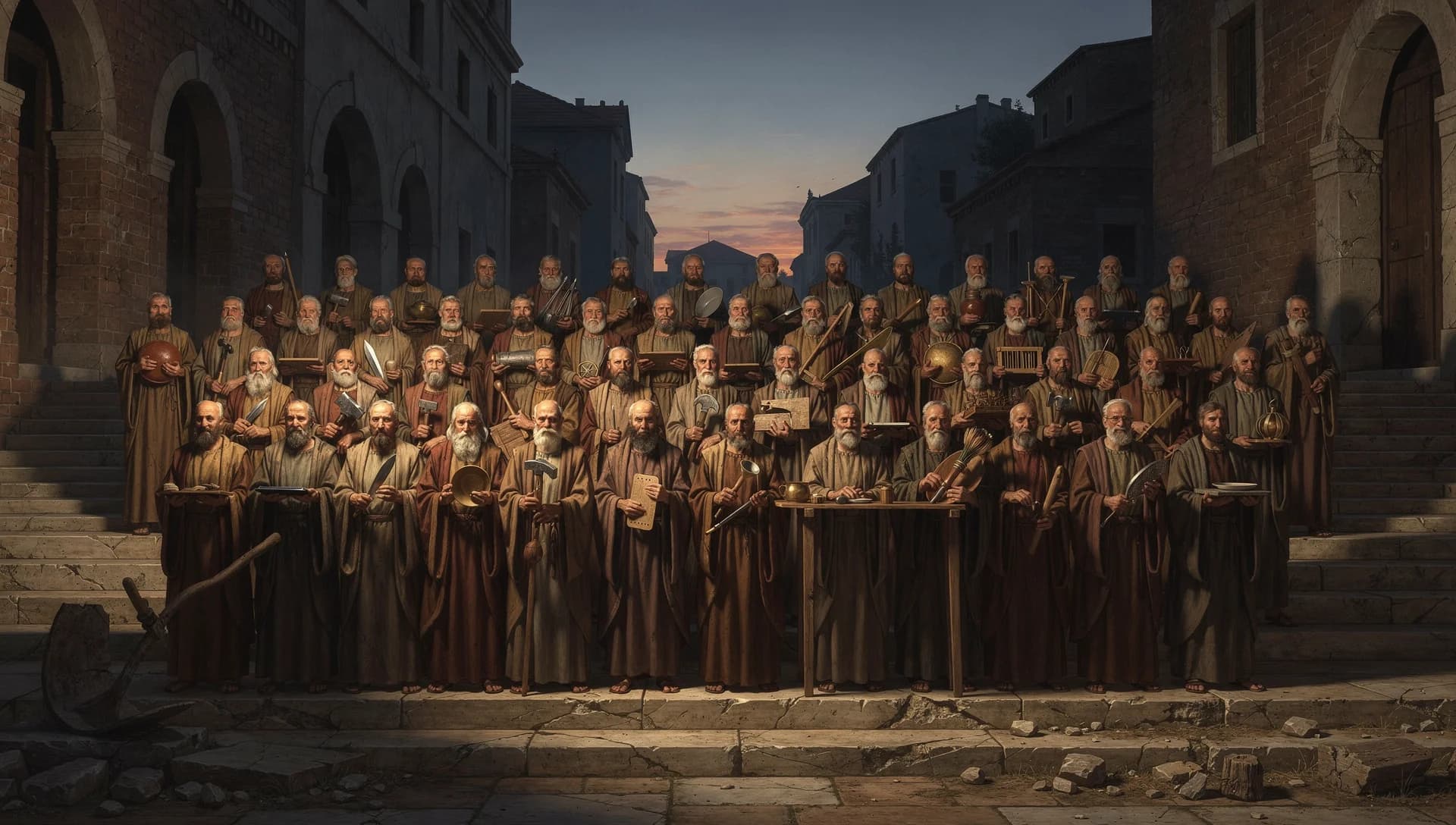
The one hundred members of Caligastia's corporeal staff were not deployed as a single undifferentiated body. They were organized into ten specialist councils, each of ten members, and each council was charged with a specific domain of civilized life. The record gives the organizational chart in full:
"The one hundred were organized for service in ten autonomous councils of ten members each. When two or more of these ten councils met in joint session, such liaison gatherings were presided over by Daligastia. These ten groups were constituted as follows:" (UB 66:5.1)
The list that follows is unusually concrete for a scriptural text. The first council governs food and material welfare, led by Ang; it teaches well-digging, spring control, irrigation, and weaving (66:5.2). The second governs animal domestication under Bon, and it is this council that trained the fandors as passenger birds (66:5.4, 66:5.6). The third governs the conquest of predatory animals. The fourth governs education and the arts of writing, and the record notes:
"The blue man was partial to alphabet writing and made the greatest progress along such lines. The red man preferred pictorial writing, while the yellow races drifted into the use of symbols for words and ideas, much like those they now employ. But the alphabet and much more was subsequently lost to the world during the confusion attendant upon rebellion." (UB 66:5.10)
The fifth is the commission on industry and trade, led by Nod:
"5. The commission on industry and trade. This council was employed in fostering industry within the tribes and in promoting trade between the various peace groups. Its leader was Nod. Every form of primitive manufacture was encouraged by this corps. They contributed directly to the elevation of standards of living by providing many new commodities to attract the fancy of primitive men. They greatly expanded the trade in the improved salt produced by the council on science and art." (UB 66:5.11)
The sixth is the college of revealed religion, under Hap. The seventh is the guardians of health and life, under Lut. The eighth is the planetary council on art and science, under Mek. The ninth governs advanced tribal relations and human government. The tenth is the supreme court of appeal:
"The supreme court of tribal co-ordination and racial co-operation. This supreme council was directed by Van and was the court of appeals for all of the other nine special commissions charged with the supervision of human affairs. This council was one of wide function, being intrusted with all matters of earthly concern which were not specifically assigned to the other groups." (UB 66:5.31)
The concept is explicit: civilization delivered as an organized curriculum across ten specialist domains, with a supreme appeals council coordinating them, located at a single center, administered by a corporeal staff of superhuman beings over a period of about three hundred thousand years.
What the Ancient Source Says
The Sumerian ME appear in multiple literary compositions. The principal source is the myth Inanna and Enki: The Transfer of the Arts of Civilization from Eridu to Uruk (ETCSL 1.3.1), edited by Gertrud Farber-Flügge in Der Mythos "Inanna und Enki" unter besonderer Berücksichtigung der Liste der me (Studia Pohl 10, Biblical Institute Press, 1973). The composition lists over one hundred specific ME by name. The list overlaps substantially with the domains governed by the Dalamatia councils: kingship and civil authority, priesthood and religion, the crafts, music and instruments, writing, the legal arts, metallurgy, and many more.
The narrative framing of the myth is that Inanna travels from Uruk to Eridu, is entertained by Enki, gets him drunk on beer, and departs with the ME in her boat. Enki sobers up, realizes what he has done, and sends his sukkal Isimud to retrieve them. Inanna successfully escapes and delivers the ME to Uruk, where they become the charter of human civilization. The myth is at once a cosmic charter (civilization is delivered from the gods) and a civic charter (Uruk, not Eridu, is now the rightful seat of the arts of civilization).
Kramer's translation in Sumerian Mythology (University of Pennsylvania, 1944) remains the standard English version. Dalley's Myths from Mesopotamia (Oxford, 2000) provides the Akkadian parallels. The concept of the ME as discrete, enumerable, transferable units of divine civilization is stable across the literary tradition from the third millennium to the first.
Why This Mapping Matters
Most ancient civilizations told origin stories about the arts they practiced. These stories usually attribute individual crafts to individual gods: Hephaestus the smith, Hermes the trickster who invented music, Prometheus the fire-bringer. What is unusual about the Sumerian tradition is that it organizes all of the arts into a single enumerable list, treats the list as a finite and transferable inventory, and attributes the list as a whole to a specific location (Eridu, Enki's city) from which it was distributed to other centers.
The Urantia Book's account of the Dalamatia councils has exactly this structure. A finite enumerable list (ten councils, one hundred members). A single central location (Dalamatia). A central administrator (the corporeal staff, coordinated by the supreme court under Van). A distribution mechanism (teachers sent out to the primitive tribes). A specific historical trauma that interrupted the program (the rebellion).
The Inanna-Enki myth's narrative of ME transferred from Eridu to Uruk may encode a further memory: the rebellion splitting the staff's civilizational knowledge between factions, with part of it continuing under Van and Amadon in the highland retreat and part of it reemerging later under the Nodite lineage at Uruk. The myth is not a historical report. It is a mnemonic structure whose shape matches the shape of the real event.
The match extends to specific names. The commission on industry and trade at Dalamatia was led by Nod. Nod later defected into rebellion. The Nodites traced their lineage to him. In the Sumerian memory, Nod becomes Enlil, and the transfer of the ME is accompanied by rivalry between Enki (loyal wisdom) and Enlil (ruling authority), which matches the loyalty split in the Urantia record.
Sources
- The Urantia Book, Paper 66 (The Planetary Prince's Staff). Urantia Foundation, first printing 1955. Cited passages: 66:5.1, 66:5.2, 66:5.4, 66:5.6, 66:5.10, 66:5.11, 66:5.13, 66:5.17, 66:5.23, 66:5.31.
- Farber-Flügge, Gertrud. Der Mythos "Inanna und Enki" unter besonderer Berücksichtigung der Liste der me. Studia Pohl 10, Biblical Institute Press, 1973.
- Kramer, Samuel Noah. Sumerian Mythology. American Philosophical Society / University of Pennsylvania, 1944; revised edition, Harper, 1961.
- Kramer, Samuel Noah. The Sumerians: Their History, Culture, and Character. University of Chicago Press, 1963.
- ETCSL (Electronic Text Corpus of Sumerian Literature), Oxford. Text 1.3.1, Inanna and Enki.
- Dalley, Stephanie, ed. Myths from Mesopotamia: Creation, the Flood, Gilgamesh, and Others. Revised edition, Oxford University Press, 2000.
- ORACC (Open Richly Annotated Cuneiform Corpus), University of Pennsylvania. ME article.
Confidence and Evidence
- Confidence: INFORMED SPECULATION
- Evidence rating: MODERATE
- Basis: The organizational structure (enumerable list of civilizational domains, central administrative location, superhuman stewardship, distribution mechanism) matches between the Dalamatia councils and the Sumerian ME. The presence of Nod/Enlil and Van/Enki in both traditions, at the same relative positions in the hierarchy, strengthens the mapping.
Related Decoder Articles
- The Corporeal Staff of One Hundred = Anunnaki
- Van, Loyal Corporeal Staff Member = Enki / Ea
- Nod, Rebel Faction Leader = Enlil, Lord of the Wind
By Derek Samaras
Connecting Articles
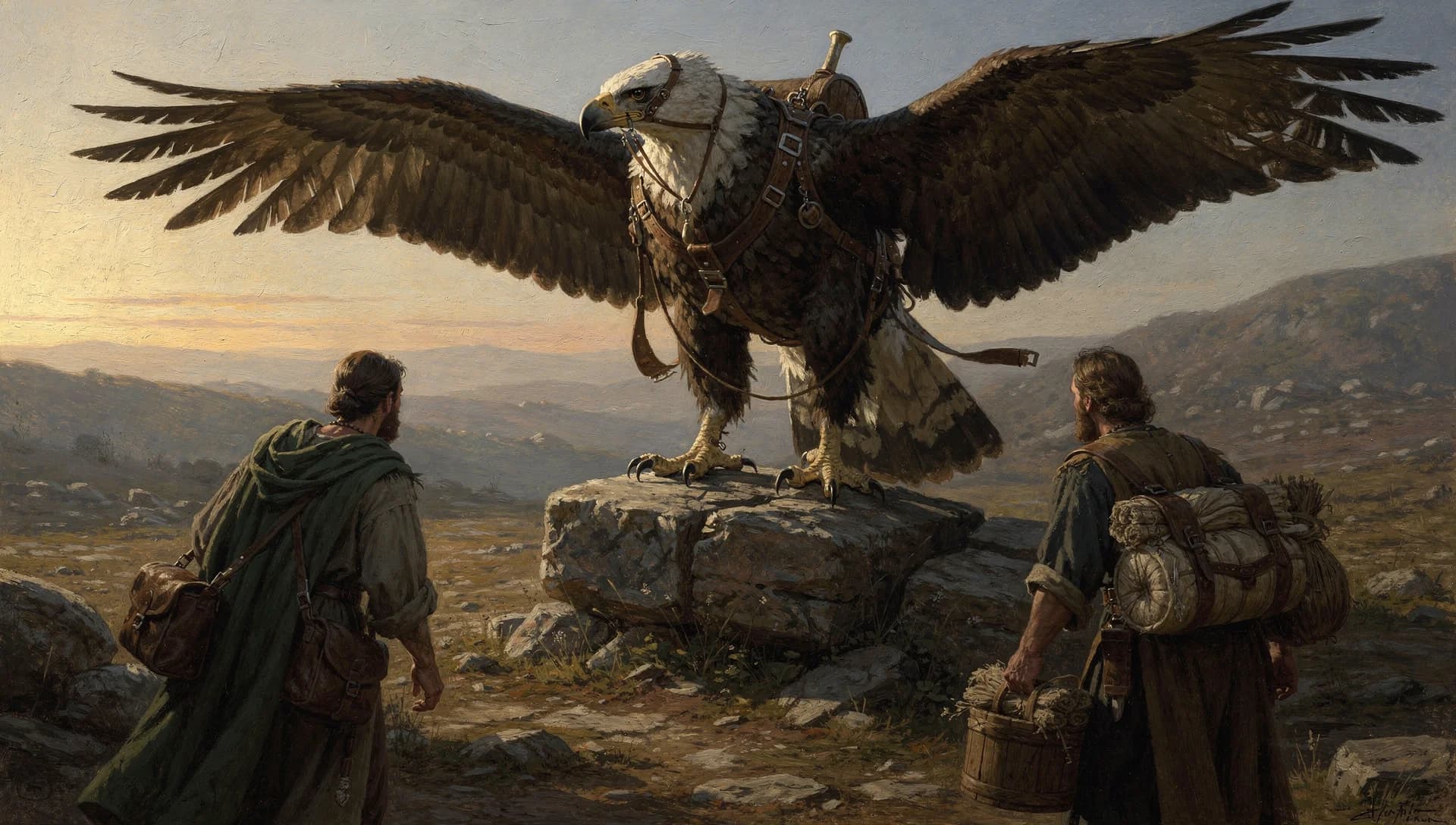
The Bird That Carried the Bull: Fandors and the Mesopotamian Anzu
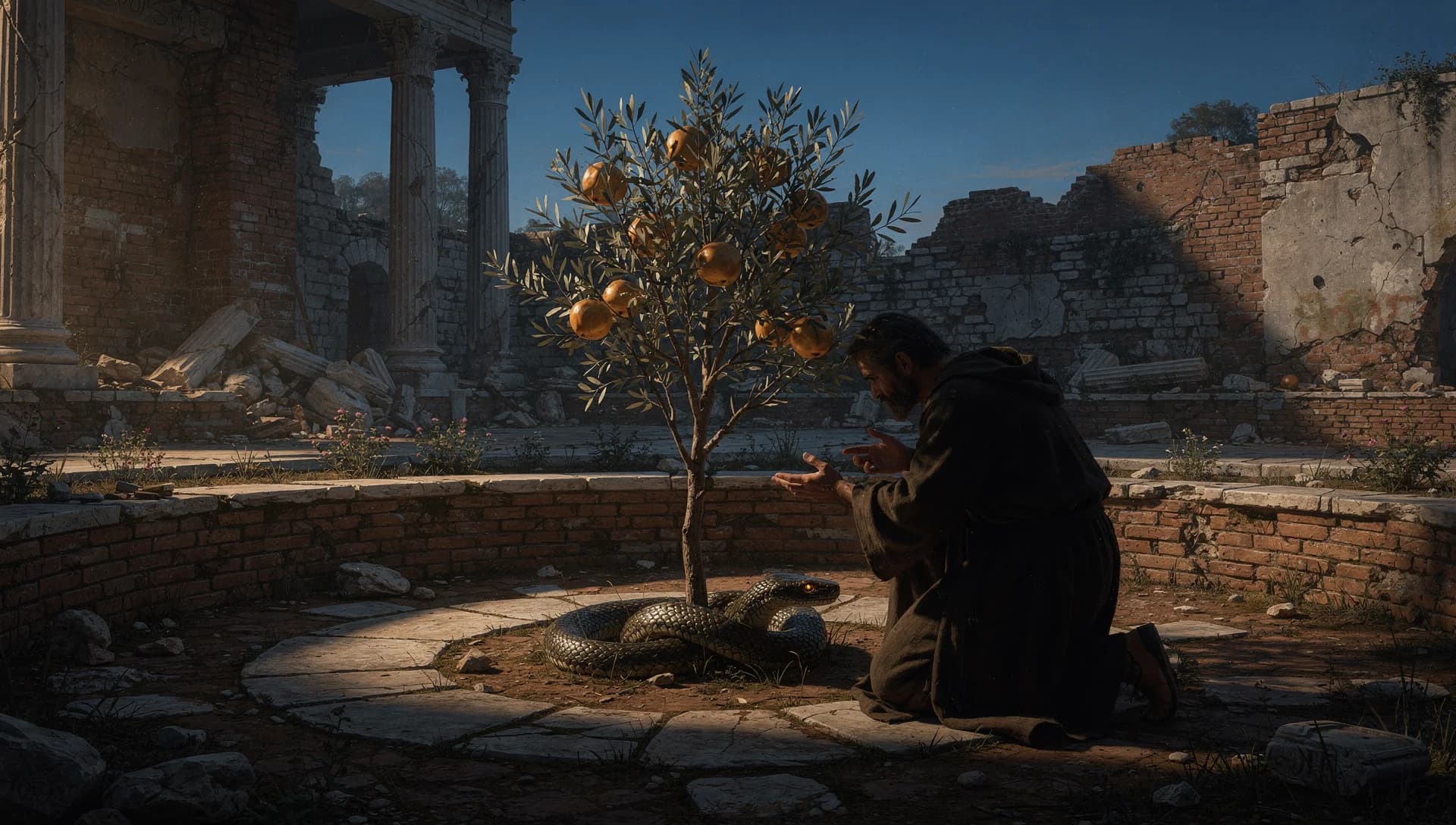
A Tree Delivered to a Garden: The Tree of Life and the Sumerian Huluppu
The Corporeal Staff and the Anunnaki: When Mainstream Etymology Already Says the Answer
Nod and Enlil: The Rebel Who Became the Storm-God
The Newsletter
Get the research behind each piece
Free. New Urantia Book explorations, the sources behind the videos, and early looks. No spam, unsubscribe anytime.
Prefer video? Follow on YouTube and Facebook.
Delivered through Substack. You can also read past issues.