
Fragments of Revelation: John's Patmos Vision and What the Text Preserves
The Book of Revelation has been read across two millennia as either a direct divine communication or as a compilation of apocalyptic symbolism. The Urantia Book takes a middle position: John's Patmos vision was a genuine revelatory experience, but the surviving text is, in the Urantia Book's precise phrase, 'greatly abridged and distorted.'
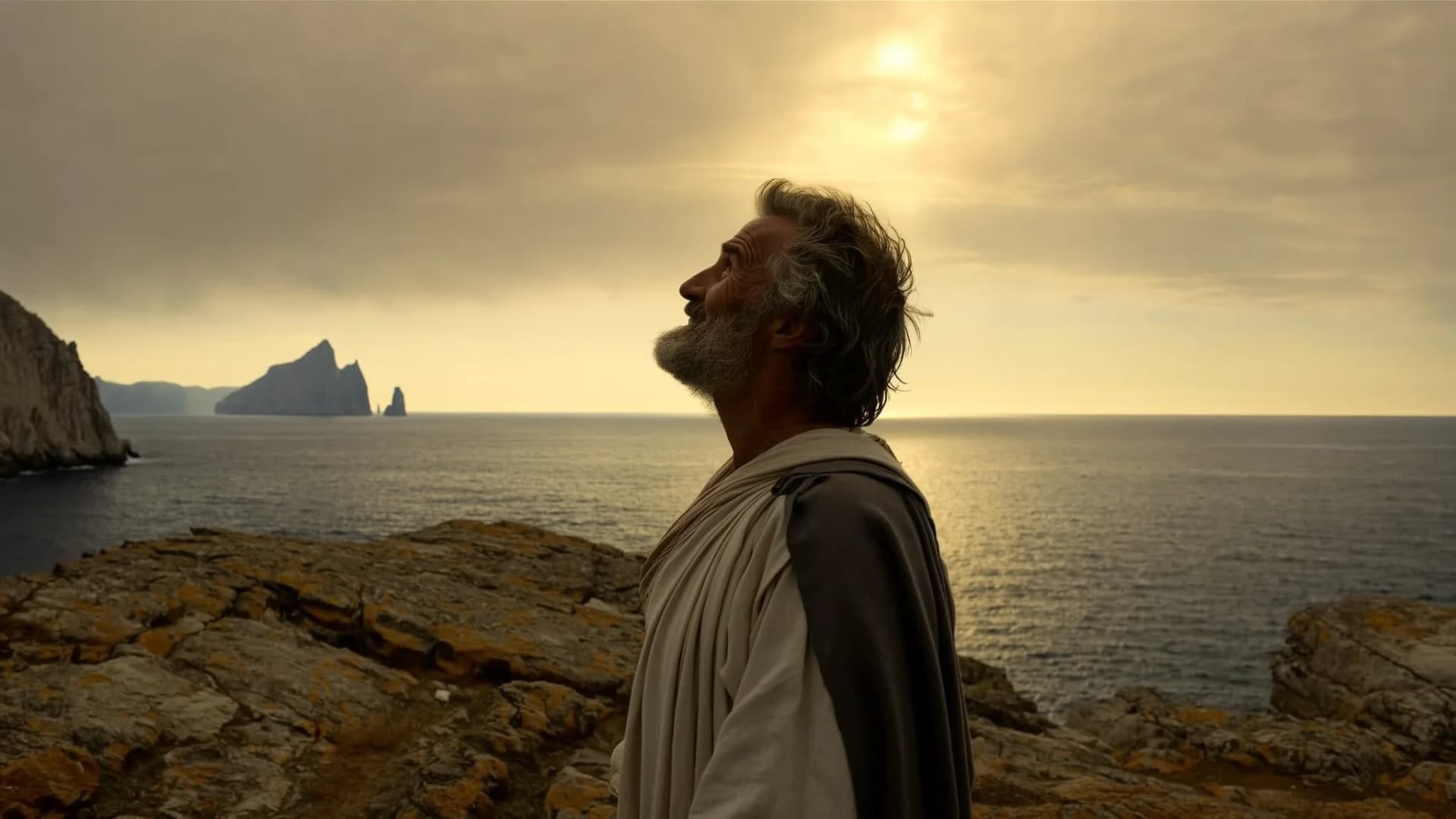
John's Revelation, fragments of genuine revelation = Book of Revelation, "greatly abridged and distorted"
This article expands on the decoder mapping. For the side-by-side card and quick reference, see the mapping page.
The Reception History Problem
The Book of Revelation is the single most interpretively contested text in the Christian canon. Premillennialists, postmillennialists, amillennialists, preterists, futurists, historicists, and idealists have each produced elaborate systematic readings that agree on almost nothing. The text has been read as a direct prediction of specific end-time events, as a coded political critique of the Roman Empire, as a mystical-symbolic guide to spiritual progress, and as an unreliable post-canonical appendix that almost failed to make the canon in the first place.
The Urantia Book's treatment of Revelation is precise and limited. The text is not a wholesale rejection, nor a wholesale endorsement, but a specific claim about its character: genuine revelatory content exists within it, but the surviving text preserves that content in substantially corrupted form.
What the Urantia Book Says
The principal Urantia statement on Revelation is compact:
"When in temporary exile on Patmos, John wrote the Book of Revelation, which you now have in greatly abridged and distorted form. This Book of Revelation contains the surviving fragments of a great revelation, large portions of which were lost, other portions of which were removed, subsequent to John's writing. It is preserved in only fragmentary and adulterated form." (UB 139:4.14)
Three claims are embedded in this passage. First, John did receive genuine revelatory visions at Patmos. Second, these visions contained real revelatory content ("glimpses of glory"). Third, the current Book of Revelation preserves this content only after substantial abridgment and distortion.
The Urantia Book's broader treatment of John the apostle places him in the inner circle of Jesus' followers and treats his career with respect. John was one of the three apostles closest to Jesus throughout the ministry. His eventual exile to Patmos (conventionally dated to the reign of Domitian, c. 81-96 CE) is consistent with the historical pattern of Roman imperial persecution of early Christian leaders.
The distortion mechanism is not elaborated in Paper 139. Based on the broader Urantia treatment of textual transmission, three plausible distortion vectors apply:
First, the abridgment inherent to any visionary experience's translation into written language. Visions contain more content than words can capture. Any verbal record of a visionary experience compresses and simplifies.
Second, John's own interpretive framework. The visions came to a first-century Jewish-Christian mind shaped by apocalyptic literary conventions (1 Enoch, 4 Ezra, Daniel, the Dead Sea Scrolls apocalyptic material). His interpretive categories would have compressed the revelatory content into those available frameworks.
Third, the editorial transmission history. The Book of Revelation as it survived into the canon had passed through multiple copying, editorial, and interpretive hands before reaching its canonical form. Each stage introduced modifications; cumulatively these produced the "distortion" the Urantia Book names.
What the Ancient Source Says
The Book of Revelation's textual and canonical history is unusually well-documented compared to other New Testament books. The text entered canonical status later than most of the New Testament, with significant eastern Christian opposition to its inclusion persisting into the fourth century. Cyril of Jerusalem's fourth-century catechetical lectures and the Peshitta (Syriac Christian canon) both exclude Revelation. The book was eventually accepted as canonical, but the doubtful reception reflected genuine early questions about its origin and transmission.
The composition and compositional history of Revelation is extensively studied. David E. Aune's three-volume Revelation (Word Biblical Commentary, 1997-1998) provides the comprehensive modern treatment. Craig R. Koester's Revelation (Anchor Yale Bible, Yale University Press, 2014) is the standard recent reference. Elaine Pagels's Revelations: Visions, Prophecy, and Politics in the Book of Revelation (Viking, 2012) treats the historical reception.
The specific textual evidence for the abridgment/distortion claim includes: the multiple textual recensions attested in the manuscript tradition (the Sinaiticus and Alexandrinus witnesses preserve significantly different readings from the majority text in several places), the apparently composite structure of the text (several scholars have argued for multiple underlying source documents), and the substantial interpretive difficulty even trained exegetes have with the text's internal logic.
The apocalyptic genre background is the critical context. Revelation participates in a Jewish apocalyptic literary tradition that extends from Daniel (second century BCE) through 1 Enoch, 4 Ezra, 2 Baruch, and the Dead Sea Scrolls apocalyptic material into the first and second centuries CE. John J. Collins's The Apocalyptic Imagination (Eerdmans, 2016) treats the genre comprehensively. Revelation's imagery (the seven seals, the four horsemen, the beast, the new Jerusalem) draws substantially on this inherited symbolic vocabulary. The genre conventions would have constrained how a visionary experience could be translated into written apocalyptic text.
The scholarly question of whether Revelation preserves genuine visionary experience or is a literary-theological construction is ongoing. Most modern scholarship treats the text as a literary-theological product drawing on inherited apocalyptic conventions rather than a direct transcript of a visionary event. The Urantia Book occupies a middle position: genuine visionary experience lies behind the text, but the text itself is not a direct transcript of that experience.
Why This Mapping Matters
The interpretive tradition's treatment of Revelation has had substantial theological consequences. The book's imagery shapes Christian eschatology, the understanding of divine judgment, the expectation of the second coming, and the broader apocalyptic imagination of Western religious history. Reading Revelation as either a direct divine transcript or as a purely literary construction produces different theological conclusions.
The Urantia Book's middle position offers specific interpretive guidance. The text should be read as containing genuine revelatory content, but the content should be read through the lens of its documented transmission history. Specific passages may preserve direct visionary glimpses; other passages reflect editorial interpolation, later theological concerns, or compositional compression. The text requires discernment rather than flat acceptance or flat rejection.
Several specific passages in Revelation align strongly with Urantia-confirmed content. Revelation 20's binding of the dragon for a thousand years corresponds to the Urantia account of Lucifer's internment pending Uversa adjudication (treated in the companion Lucifer-Binding decoder article). Revelation 12's war in heaven preserves a memory of the Lucifer rebellion. The seven messengers and the seven churches preserve structural patterns the Urantia Book recognizes in local universe administration.
Other passages are more compromised. The specific chronology of the tribulation, the detailed numerology, and the precise identification of the beast, the harlot, and other figures are not supported by the Urantia account and should be read as interpretive compression rather than specific prediction.
The mapping's significance is that it authorizes a specific interpretive posture toward Revelation: genuine revelatory content within a substantially modified text. The book is neither to be flatly accepted as prediction nor flatly rejected as human construction. It is to be read with discernment, alongside other sources, with awareness that the original visionary content has been substantially abridged and distorted in the surviving text.
Sources
- The Urantia Book, Paper 139 (The Twelve Apostles). Urantia Foundation, first printing 1955. Cited passage: 139:4.14.
- Aune, David E. Revelation. 3 volumes, Word Biblical Commentary, Word Books, 1997-1998.
- Koester, Craig R. Revelation: A New Translation with Introduction and Commentary. Anchor Yale Bible, Yale University Press, 2014.
- Pagels, Elaine. Revelations: Visions, Prophecy, and Politics in the Book of Revelation. Viking, 2012.
- Collins, John J. The Apocalyptic Imagination: An Introduction to Jewish Apocalyptic Literature. Third edition, Eerdmans, 2016.
- Yarbro Collins, Adela. The Apocalypse (Revelation). Michael Glazier, 1979.
- Beale, G. K. The Book of Revelation: A Commentary on the Greek Text. New International Greek Testament Commentary, Eerdmans, 1999.
Confidence and Evidence
- Confidence: UB CONFIRMED
- Evidence rating: MODERATE
- Basis: The Urantia Book states the abridgment/distortion claim directly in Paper 139:4.14. The textual history of Revelation is unusually complex and well-documented, including multiple recensions and late canonical acceptance. The genuine visionary experience at Patmos is historically plausible given the documented pattern of Roman imperial persecution of early Christian leaders. The specific interpretive middle position (genuine content, distorted transmission) is consistent with the broader Urantia treatment of textual transmission across the biblical canon.
Related Decoder Articles
- Lucifer Binding = Loki Binding Beneath the Earth
- Hebrew Scribal Revision During Babylonian Captivity
- Michael's Final Adjudication = Ragnarok
By Derek Samaras
Connecting Articles
The Bound Rebel: Lucifer Interned and Loki in the Cave

The Longest Memory: Australian Aboriginal Dreamtime and the Primordial Teaching-Ancestors
The Final Adjudication: Ragnarok and the Pending Verdict
We Come From One: African First-Family Traditions and the Sangik Origin
The Newsletter
Get the research behind each piece
Free. New Urantia Book explorations, the sources behind the videos, and early looks. No spam, unsubscribe anytime.
Prefer video? Follow on YouTube and Facebook.
Delivered through Substack. You can also read past issues.