
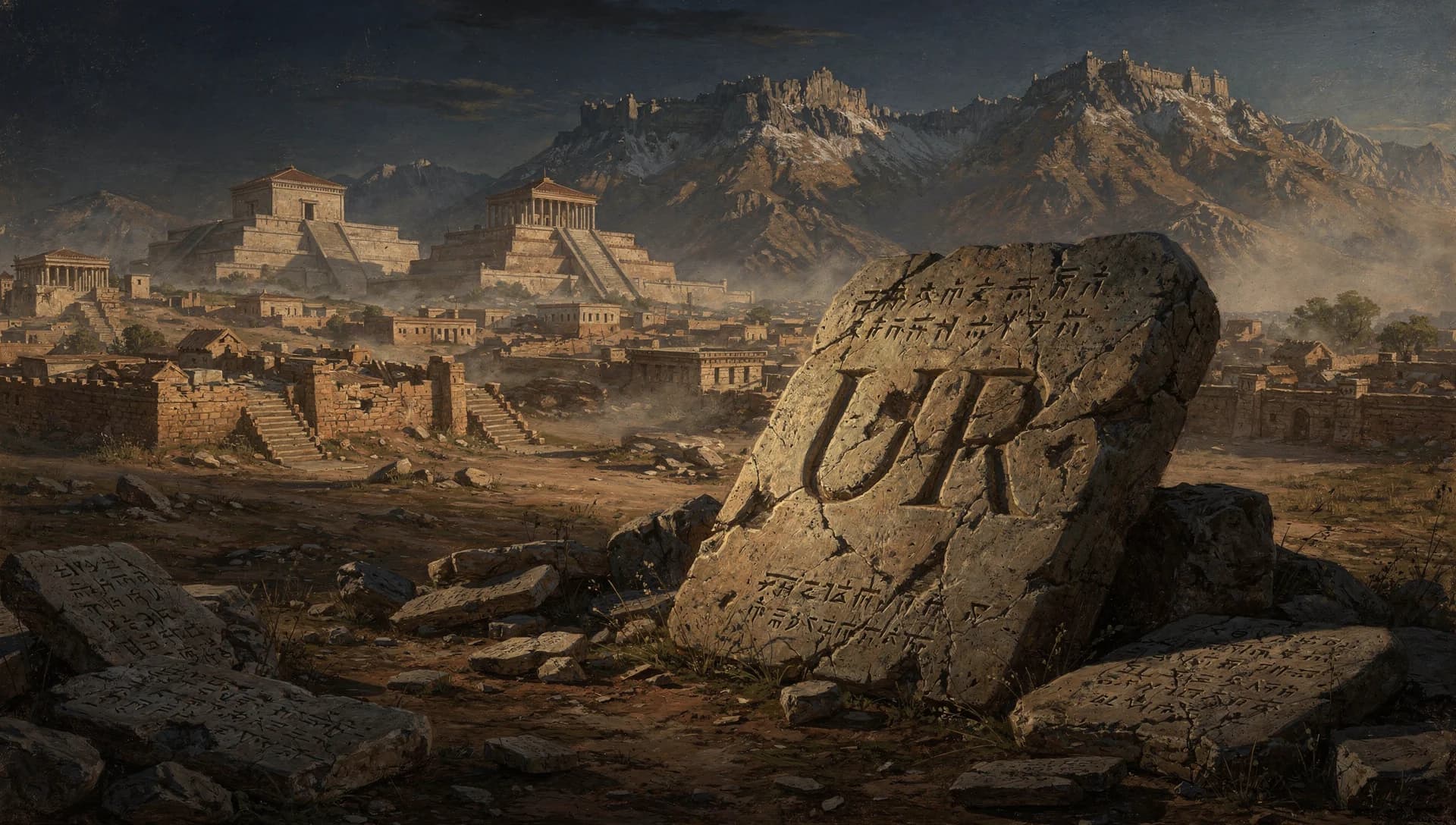
 Mythic
Ur, Uruk, Urartu, Armenia, Iran, Iraq, Ararat, Aram, Eridu
 UB
UBThe UR root, oldest identifiable root in human language
Full Article
Read the deep-dive article on this connection
The UR root, oldest identifiable root in human language = Ur, Uruk, Urartu, Armenia, Iran, Iraq, Ararat, Aram, Eridu
The Connection
The UR root clusters geographically around Mesopotamia and the Armenian highlands, exactly where the UB places Dalamatia, the first Garden, the second Garden, and Van's highland headquarters. This is the cradle region of civilization in both mainstream scholarship and the UB.
UB Citation
UB 66-78 (regional history)
Academic Source
Kramer, The Sumerians (1963); Mallory, In Search of the Indo-Europeans (1989)
Historical Evidence(Moderate evidence)
The UR root is well-attested across Mesopotamian and Near Eastern place names as meaning "city/dwelling/foundation." The geographic cluster (Ur, Uruk, Urmia, Urartu, Urfa, Urusalim) forms a coherent pattern around the Fertile Crescent and Armenian highlands. Urartu/Van connection: the Urartian capital Tushpa was near modern Van. "Biainili, possibly pronounced Vanele, became Van in Old Armenian."
Deep Dive
Pull out a map of the ancient Near East and mark every place-name beginning with UR. The cluster is striking. In southern Mesopotamia, you have Ur (Abraham's home city), Uruk (the city of Gilgamesh), and Eridu (the oldest city in Sumerian tradition, with a UR-element in its archaic spelling). In the highlands to the north, you have Urmia (the great lake of northwestern Iran) and Urartu (the iron-age kingdom centered on Lake Van). In the western Anatolian-Levantine corridor, you have Urfa (modern Sanliurfa, near Gobekli Tepe) and Urusalim (the Amarna-letters spelling of Jerusalem). The cluster forms a coherent geographic ring around the northern Fertile Crescent and the Armenian highlands.
The mainstream linguistic position is that UR functioned as a place-element meaning "city" or "foundation" or "dwelling place" in Sumerian and pre-Sumerian Mesopotamian usage. The element survived across multiple linguistic transitions because it was deeply rooted in the geographical-administrative vocabulary of the region. As Akkadian replaced Sumerian, then Aramaic replaced Akkadian, then Arabic replaced Aramaic, the UR-prefixed place-names persisted because they were already established toponyms.
The UB framework treats this geographic cluster as the linguistic fossil of the deep civilizational substrate the UB describes. The cluster ring covers exactly the region the UB identifies as the cradle of human civilization: Dalamatia in the Persian Gulf (south of the cluster), the first Eden in the eastern Mediterranean (west), Van's highland headquarters in the Kopet Dag region (east-center), the second Eden in Mesopotamia (south-center), and Salem in the Levant (west). The cluster is the geographic shadow of the original civilizational footprint.
Samuel Noah Kramer's The Sumerians (1963) and J.P. Mallory's In Search of the Indo-Europeans (1989) document the clustering of these UR-prefixed names without proposing the specific UB-framework explanation. Both treat the cluster as evidence of a deep substrate that predates the major historical language families. The Pennsylvania Sumerian Dictionary establishes UR as a real Sumerian morpheme with consistent place-naming usage. What the UB framework adds is the specific historical claim that the substrate is the linguistic descent of the Dalamatia-era administrative language.
A fascinating sub-pattern within the UR cluster is the Urartu / Lake Van connection. Urartu was the Iron Age kingdom (roughly 9th-6th centuries BCE) that ruled the Armenian highlands from a capital at Tushpa near modern Van. The kingdom's native name was Biainili, which Armenian historical linguistics traces as the source of the modern toponym Van: "Biainili, possibly pronounced Vanele or Vanili, became Van in Old Armenian." The UB places Van's actual highland headquarters not at Lake Van in Turkey but in the Kopet Dag region east of the southern Caspian, roughly 1000 km to the east. The Lake Van location is, in the UB framing, a case of name preservation: the Van character's name attached to a lake far west of his actual headquarters because his name was carried by migrating populations and eventually settled on a new geographic referent.
Paul Zimansky's Ecology and Empire: The Structure of the Urartian State (1985) documents the linguistic transition from Biainili to Van in detail. The transition is well-established within Armenian historical linguistics. What the UB framework adds is the specific historical reason for the Biainili form to have arisen: the local population, descendants of mixed Andite and indigenous stocks, preserved the memory of the loyal staff member named Van whose teaching had reached the Armenian highlands during the post-rebellion era.
The strongest counterargument is that the UR-cluster could be explained without any UB-framework appeal. Mainstream linguistics treats the cluster as evidence of a deep pre-Indo-European, pre-Semitic substrate language that left UR-prefixed toponyms across the region. The UB framework agrees that the substrate exists; it just identifies the substrate more specifically as the Dalamatia-era administrative language. Whether one accepts this specific identification depends on whether one accepts the broader UB historical framework.
What the geographic cluster does, regardless of one's position on the UB framework, is provide a consistent dataset for testing competing hypotheses about pre-historical Near Eastern linguistic geography. The cluster is real. The morpheme is real. The persistence across multiple language families is real. Whether the underlying explanation is "deep pre-Indo-European substrate" or "Dalamatia administrative language," the surface phenomena are well-attested and provide a foundation for further investigation.
Key Quotes
“And all this explains how the Sumerians appeared so suddenly and mysteriously on the stage of action in Mesopotamia. Investigators will never be able to trace out and follow these tribes back to the beginning of the Sumerians, who had their origin two hundred thousand years ago after the submergence of Dalamatia.”
“The descendants of Adamson, clustered about the shores of the lake of Van, were willing listeners to the Hittite teachers of the Salem cult.”
Cultural Impact
The UR-cluster has been studied by Assyriologists and historical linguists for over a century without yielding a definitive account of its origin. The mainstream consensus is that the cluster reflects a pre-Sumerian substrate language whose specific identity has been lost. This is roughly equivalent to the consensus on the Etruscan language: it existed, it influenced later languages, but its specific linguistic affiliations are obscure. The UB framework provides one specific hypothesis about the substrate's identity. The hypothesis is unfalsifiable in any direct sense (we cannot recover the Dalamatia administrative language to test the proposed connection), but it does match the geographic and chronological pattern of the cluster better than alternatives like "random pre-Sumerian substrate." For Urantia readers, the cluster provides a tangible geographic anchor for the UB historical framework. Standing in the ruins of Ur, Uruk, or Urartu, one can connect the visible archaeological remains to the specific historical narrative the UB tells. The cluster is not abstract; it is the visible toponymic shadow of a deep historical substrate that the UB frames as the original Dalamatia-era civilizational stratum. For comparative linguistics, the cluster offers a useful test case for substrate-language hypotheses generally. If the UB framework is correct, the substrate should leave specific signatures (geographic clustering, semantic consistency, persistence across multiple language families) that can be tested against parallel cases like Etruscan, Basque, and pre-Indo-European Anatolian.
Modern Resonance
In the past two decades, archaeology in the Anatolian and Armenian highlands has produced extraordinary new evidence about the deep prehistory of the region. Gobekli Tepe, near modern Sanliurfa (an UR-prefixed name), has pushed the date of monumental religious construction back to at least 9500 BCE, four thousand years older than the previously accepted dates for organized monumental religion. Karahan Tepe and similar sites in the same region are extending the picture further. The UB framework would predict exactly this kind of discovery: the region should yield evidence of pre-civilizational religious organization predating the conventional Mesopotamian sequence. The actual archaeological discoveries match this prediction in broad outline, even though they do not directly attest to UB-specific entities like Dalamatia or the Prince's temple. For contemporary readers interested in the deep prehistory of human religion, the UR-cluster provides one of the most concrete connections between the UB framework and the visible archaeological record. The names persist in modern geography. The sites contain real archaeological remains. The chronology aligns broadly with the UB-framework dates for early civilizational activity. What is missing is direct attestation of the UB-specific entities, which the UB itself acknowledges is not available because the relevant sites are submerged or destroyed.
Related Mappings
Related Articles
Where to next
The free newsletter. The research behind each piece, no spam.