
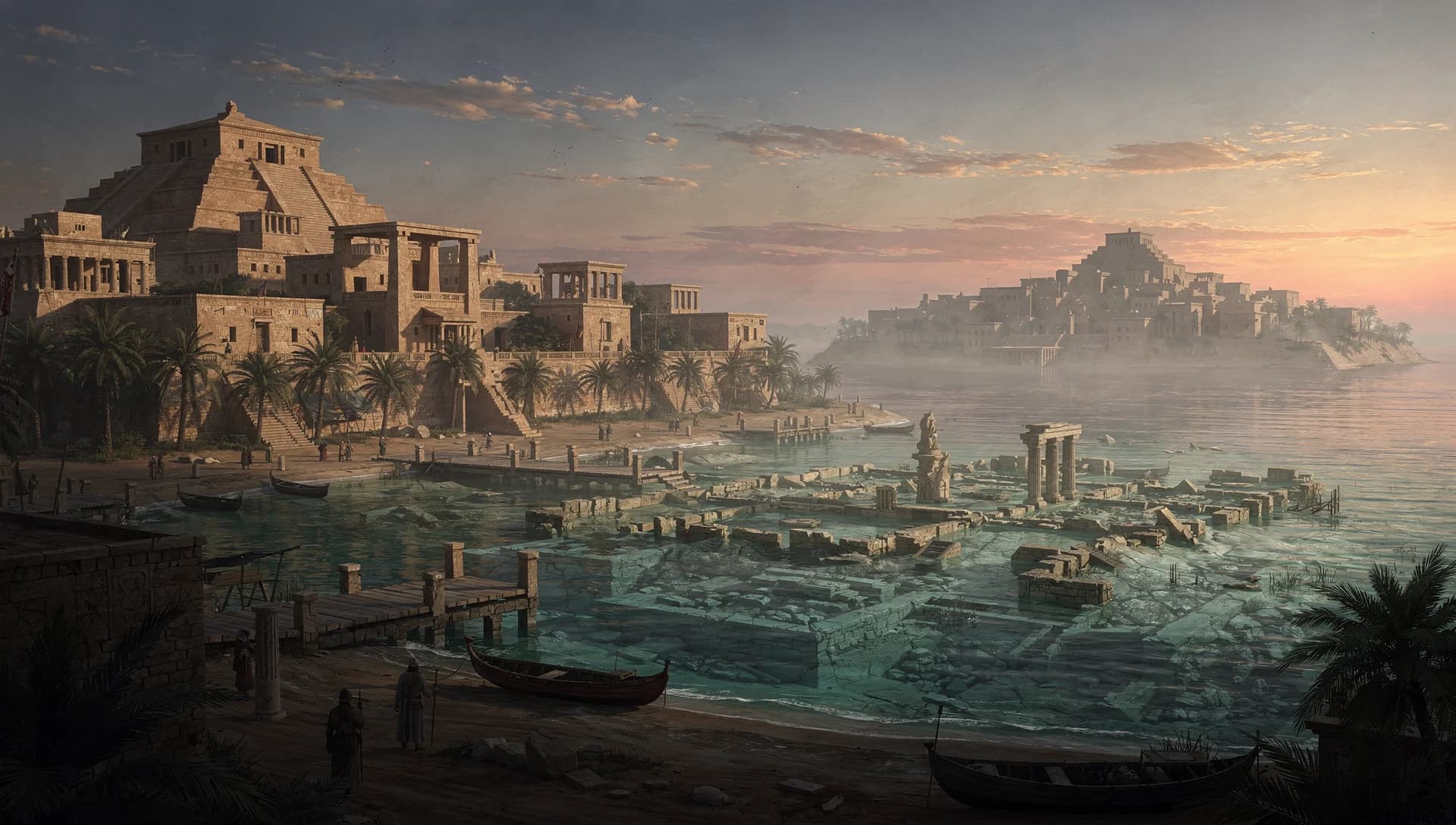
 Mythic
Dilmun (Bahrain) vs. Dilmun (Nodite HQ)
 UB
UBTwo Dilmuns, name migration
Full Article
Read the deep-dive article on this connection
Two Dilmuns, name migration = Dilmun (Bahrain) vs. Dilmun (Nodite HQ)
The Connection
Archaeology identifies Dilmun as a Bronze Age civilization on Bahrain (~3000-1600 BCE). But the UB identifies an EARLIER Dilmun: the Nodite city founded "north and east" of Dalamatia after the Prince's city sank (~200,000 years ago). The Sumerians "confused both the first and second Nodite cities with Dalamatia and called all three Dilmun" (77:4.8). Three cities, 200,000 years apart, one name.
UB Citation
UB 77:3.1, 77:4.7-8
Academic Source
Crawford (1998), Dilmun and its Gulf Neighbours; Potts (1990), The Arabian Gulf in Antiquity
Historical Evidence(Moderate evidence)
The Sumerian descriptions of Dilmun as a paradise "where the Gods first blessed mankind" far exceed the archaeological remains on Bahrain. The UB resolves this by identifying the Sumerian paradise memory as referring to the FIRST Dilmun (the Nodite capital) and Dalamatia, not the later Bronze Age settlement. The Egyptians called it "Dilmat." The name survived 200,000 years of transmission.
Deep Dive
In 1880, the British archaeologist Henry Rawlinson identified Bahrain as the location of Dilmun, the paradise-land mentioned in Sumerian and Akkadian texts. The identification was based on a number of converging lines of evidence: the Sumerian descriptions placed Dilmun beyond the Persian Gulf, the trade tablets at Ur recorded Dilmun as a source of copper, dates, and pearls (all goods associated with the Bahrain region), and the geography matched the texts' descriptions reasonably well. Subsequent archaeology, particularly the Danish expeditions of the 1950s and 1960s under Geoffrey Bibby and Peter Glob, excavated extensive Bronze Age sites on Bahrain that confirmed the trading-emporium identification.
The puzzle that emerged from this work is the gap between the Sumerian descriptions and the Bahrain archaeology. The Sumerian texts describe Dilmun as a paradise: the place where the gods first blessed mankind, where the waters are sweet, where there is no sickness or death, where the lion does not kill and the wolf does not snatch the lamb. The Bahrain archaeology shows a respectable Bronze Age trading post with temples, irrigation, and elite tombs, but nothing that matches the cosmological-paradisal language of the texts.
Harriet Crawford's Dilmun and its Gulf Neighbours (1998) and Daniel Potts' The Arabian Gulf in Antiquity (1990) summarize the mainstream scholarly response: the Sumerian Dilmun-paradise language is treated as religious-poetic exaggeration, with Bahrain as the historical kernel that received the imaginative overlay. This is a coherent reading. It is also a reading that treats a fairly substantial body of paradise-language as poetic projection rather than historical memory.
The UB framework offers a different resolution. UB 77:4.7-8 states that the Sumerian texts confused three distinct cities under the single name Dilmun: the original Dalamatia (the Prince's headquarters, submerged after the rebellion), the first Nodite city founded "north and east" of Dalamatia after the submergence (UB 77:3.1), and the later Adamic-Sumerian settlement that became the Bronze Age Bahrain. UB 77:4.8 is explicit: "the later Adamized Sumerians confused both the first and second Nodite cities with Dalamatia and called all three Dilmun."
The UB framing dissolves the puzzle. The paradise-language refers to the original Dalamatia and the first Dilmun (the Nodite capital), both of which were genuinely extraordinary places by the standards of their time: the former having been the actual Planetary Prince headquarters with its tree of life and superhuman corporeal staff, the latter having been the post-rebellion seat of advanced Nodite culture. The Bronze Age Bahrain settlement preserves only the name of these earlier sites, having absorbed the cultural memory of paradise-language while being itself a much later and lesser establishment.
The Egyptian preservation of the name as Dilmat is documented in Egyptian-Mesopotamian trade and diplomatic correspondence. The Egyptians referred to the same paradise-region under the variant name, indicating that the cultural memory was shared across the Egyptian-Mesopotamian boundary.
The strongest counterargument to the UB framing is that the underwater archaeology of the Persian Gulf has not (yet) confirmed the existence of submerged settlements at the locations the UB indicates. The Persian Gulf is a relatively shallow body of water that was largely dry land during the Last Glacial Maximum and gradually flooded as sea levels rose during the Holocene. The hypothesis that earlier civilizational settlements were submerged by this flooding is not implausible. Recent underwater survey work in the Gulf has identified what appear to be drowned coastlines and possibly drowned settlement sites, though direct attestation of UB-specific entities like Dalamatia remains absent.
Jeffrey Rose, an archaeologist working on the Gulf basin, has proposed in a 2010 article in Current Anthropology that the pre-flooding Gulf basin may have hosted significant Paleolithic populations whose remains are now submerged. This is not a UB-framework argument; Rose works within mainstream archaeological methods. But it does establish the geological plausibility of submerged pre-historical settlement in the Gulf region, which is the necessary precondition for the UB account.
What the Dilmun case illustrates is the general pattern of UB-framework engagement with archaeology: the UB makes specific historical claims that are mostly not directly verifiable by current methods, but that are consistent with patterns in the data that mainstream archaeology has not fully accounted for. The Sumerian paradise-language exceeds what Bahrain can support. The geological history of the Gulf permits earlier settlement. The cultural memory of an earlier Dilmun is preserved in both Sumerian and Egyptian records. These elements fit the UB framework even if they do not directly prove it.
Key Quotes
“After the submergence of Dalamatia the Nodites moved north and east, presently founding the new city of Dilmun as their racial and cultural headquarters.”
“The Egyptians called this city of ancient glory Dilmat, while the later Adamized Sumerians confused both the first and second Nodite cities with Dalamatia and called all three Dilmun. And already have archaeologists found these ancient Sumerian clay tablets which tell of this earthly paradise "where the Gods first blessed mankind with the example of civilized and cultured life."”
Cultural Impact
The Dilmun question has been a recurring puzzle in Assyriology since the late nineteenth century. The mainstream resolution (Bahrain as historical kernel with poetic overlay) is academically respectable but leaves significant explanatory work undone. Why did the Sumerians invest such elaborate paradise-language in a place that Bahrain could not have actually been? Why does the Egyptian record preserve the same name and the same paradise-associations? The UB framework provides a unified account. The paradise-language refers to genuine pre-historical sites that the Sumerians and Egyptians remembered through long oral and textual transmission. The Bronze Age Bahrain settlement absorbed the name and some of the associations because it was the latest in a chain of three sites called Dilmun. The accumulated paradise-language belongs to the deeper layers of the chain, not to the surface Bronze Age site. For Sumerologists, this framework offers a hypothesis to test against the textual evidence. Do the Sumerian Dilmun-paradise texts show internal stratification consistent with multiple original referents being conflated? The textual evidence is fragmentary, but the question is at least investigable. For Urantia readers, the Dilmun case illustrates the general UB pattern of treating ancient paradise-traditions as historical memory rather than poetic projection.
Modern Resonance
Bahrain today is a modern Gulf state with a complicated geopolitical position. The Bronze Age Dilmun sites are now within tourist and heritage frameworks. Visiting them, one encounters small museums and modest archaeological displays that explain Dilmun as a Bronze Age trading emporium. The deeper paradise-association is rarely highlighted because it would require addressing the gap between the textual descriptions and the archaeological remains. For Urantia readers, the UB framework offers a richer way to engage with the Bahrain heritage. The Bronze Age sites are real and important, but they preserve the name of much older sites that are now submerged in the Persian Gulf. The visit to Bahrain becomes a pilgrimage to a name rather than to a place: the name itself carries 200,000 years of cultural memory, even though the physical referents of the original name have been lost. The broader lesson is about how cultural memory persists through chains of name-attachment. When we encounter ancient names that resist conventional etymology, when we find paradise-language attached to specific geographic referents, when we see name-migration across millennia, we are encountering the linguistic-cultural archive of human experience with deep history. The UB framework treats this archive seriously rather than dismissively, and the Dilmun case is one of the cleaner illustrations of that approach.
Related Mappings
UR-AN-TIA, the planet's name
= "Land of An (the Prince)"
DALA-MA-TIA, headquarters city
= "Land/Place of Daligastia"
The UR root, oldest identifiable root in human language
= Ur, Uruk, Urartu, Armenia, Iran, Iraq, Ararat, Aram, Eridu
Van's highland headquarters
= Lake Van (Turkey), name preservation, NOT the HQ location
Related Articles
Where to next
The free newsletter. The research behind each piece, no spam.